Tag Archives: Mary

Mary Gardens

Andrea Oliva Florenda, a professor at St. John’s University in Queens, New York, offered a day of reflection on Mary Gardens, December 1 at Bishop Molloy Retreat Center, Jamaica, New York. Professor Florenda teaches in the department of theology and religious studies at St. John’s, specializing in Marian theology. She’s also the designer and curator of the Marian Garden at the university.

Mary Gardens, dedicated to Mary, the Mother of Jesus, appeared in Europe following the Black Death, a pandemic that caused millions of deaths in that part of the world in the 14th century. The gardens, usually found in monasteries and religious shrines, brought hope to people walking “in the shadow of death.”

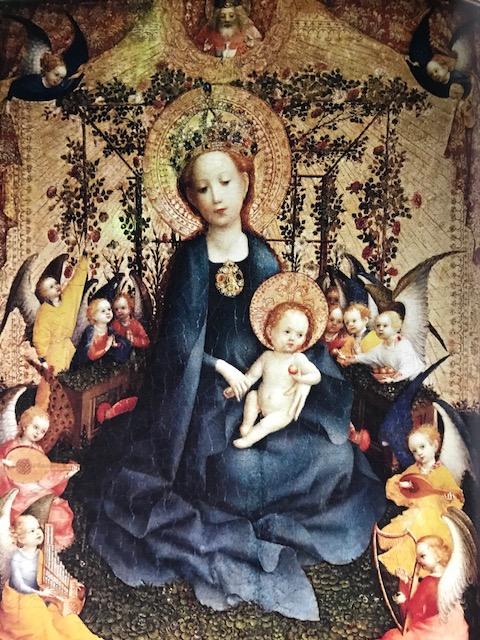
God placed Adam and Eve in a garden, Christian tradition says. (Genesis 2, 8-28) Rising from the dead, Jesus proclaimed eternal life in a garden. (John 20,11-18) For early and medieval Christians, Mary appeared as a garden enclosed, flowers, plants and trees surrounded her, “our life, our sweetness and our hope.” The Mary Garden, which became a favorite inspiration for medieval and renaissance artists, brought the promise of life to the “poor banished children of Eve.”

Does the Mary Garden have a role today in a world facing climate change and environmental degradation? Professor Florenda thinks it does. Besides the mysteries of faith, it teaches reverence for creation, for the soil, for plants that feed us and bring healing, for flowers that nourish our sense of beauty.

Certainly science and technology have a large part to play in the current environmental movement, but Professor Florenda notes the number of young people, from various religious tradition drawn to her Mary Garden at St. John’s, where the mysteries of seed and soil unfold, where pharmacy students study medicinal herbs and seasonal vegetables feed the poor.

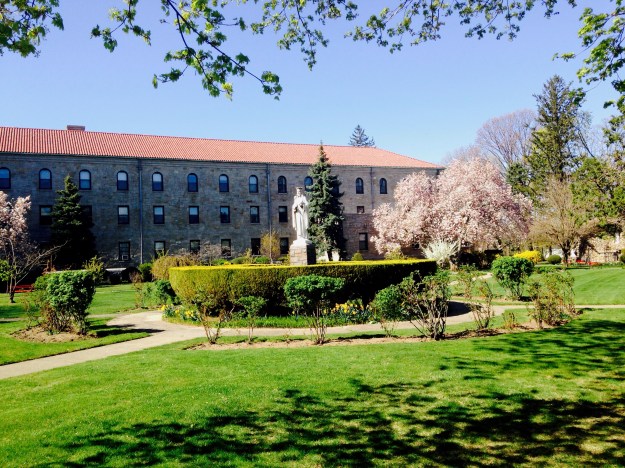
The day of reflection on Mary Gardens ended at the grotto honoring Mary in the garden of Immaculate Conception Monastery in Jamaica. There, Professor Florenda spoke about the meaning of the grotto, its structure and the plants and trees surrounding it.

“There is a language in each flower,
that opens to the eye,
A voiceless but a magic power.
A prayer in earth’s blossoms lie.” Anonymous
Morning Thoughts: Over Easy

by Howard Hain

.

A run-of-the-mill bakery.

A hand truck full of eggs.

A handful of women from Latin America.

Neither load is fragile.

A woman’s strength may appear as a delicate shell, and if poorly handled she too may break.

But strength is not a matter of not breaking.

It’s a matter of showing up, chipped, broken, sometimes even shattered.

It’s a matter of overcoming.

Of producing.

Of providing.

Of letting go.

One buttered roll at a time.

Preparing the day “café con leche” by “café con leche”.

The eggs slowly disappear.

The ladies change names.

Mary, the Mother of God, remains.

———

“Holy Mother, pierce me through, in my heart each wound renew, of my Savior crucified.”

———

It’s a matter of believing. Of dreaming. Of seeing what can’t be seen. Of loving who can’t be loved.

It’s a matter of hope that never ends, of hope that sustains the very faith from which it came.

It’s a matter of saying “yes” to each and every hour—for someone must be present to serve God’s promise of daily bread.

———

She who stands closest to the foot of the cross most resembles the man being crucified. She must embody Compassion, she still hears His breath, expanding and contracting deep within. Suffering is not be feared. Being without the source of all consolation and peace is just too terrifying.

The “fear of the Lord” keeps us within the grasp of Jesus’ hand.

It “is the beginning of wisdom.” Mary is there to begin. She remains till the end.

Wisdom begets Wisdom.

And she most often looks like a little unpresuming lady working behind a busy breakfast counter.

She is a lady nonetheless.

She is the mother of all I hope for.

———

“Pray for us, O holy Mother of God; that we may be made worthy of the promises of Christ.”

———

.

.

Martha, Martha

29d6ce6c782d7314a69950e1a560b871

We read St. Luke’s account of Jesus’ visit to Bethany for the Feast of St. Martha. It’s part of Jesus’ journey from Galilee to Jerusalem (Luke 10,38-42), a journey Luke describes,  not by miles, but by the people Jesus meets.

Jesus is a prophet speaking God’s word as he goes. Some reject him outright on his way to Jerusalem.  Jesus enters the house of Martha and Mary as a prophet speaking God’s word. Unfortunately Martha, busy about many things, misses his word and Jesus rebukes her. Mary hears his word and is praised. Good as she is, Martha’s carrying too many of the “cares of this life” when Jesus visits.

That’s what Luke wants us to learn from this gospel- the cares of this life can get in the way of hearing God’s word. But we all know there’s more to Martha than what Luke tells us here. Other New Testament sources praise this good woman.  John’s gospel, for example, says that  Jesus was a long time friend of Lazarus and his sisters in Bethany.

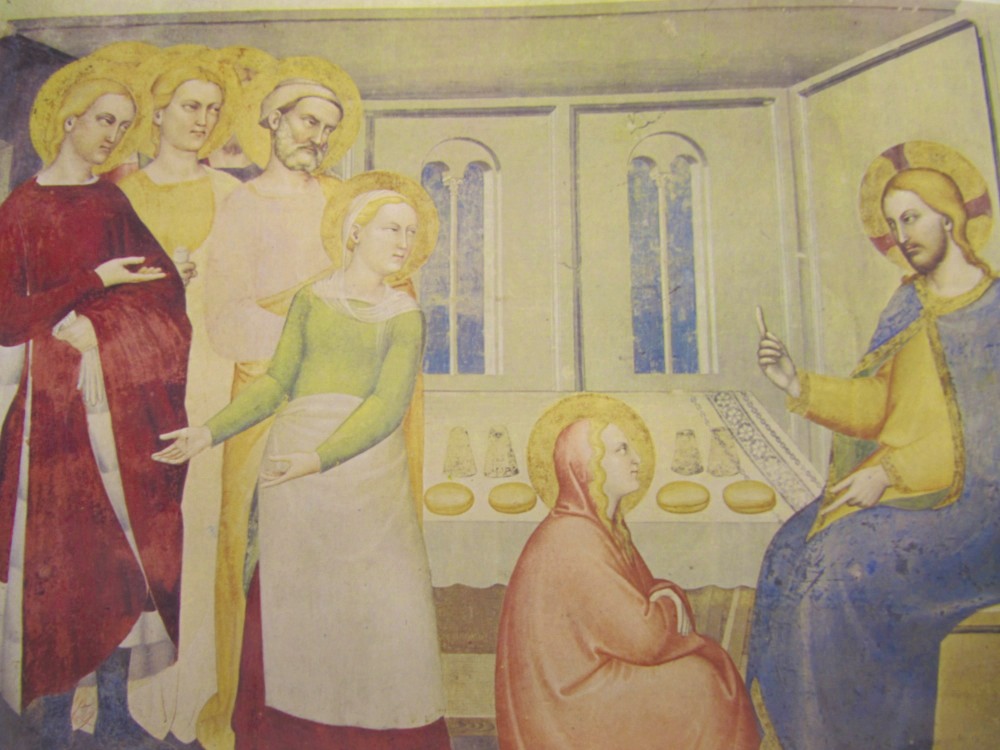
I keep two other sources in mind when I read Luke’s story.  One is a painting (above) by the 13th century Tuscan artist, Giovanni di Milano, showing Jesus with Martha and Mary at Bethany.

The artist imagines a supper at Bethany. The table’s set for four people– that would be Jesus, Lazarus, Mary and Martha. But look at the others coming in the door. Obviously, they’re Jesus’ disciples, led by Peter. One disciple gestures towards Peter, as if saying, “He told us to come.”

Poor Martha in her apron holds up her hands in frustration, “What are we going to do?”
There will be no miracle. The miracle is Martha’s hospitality. Thanks to her,  more than four are going to be fed. We need artists like di Milano to flesh out what the gospels say.

The other source I like is St. Augustine who obviously has a soft spot for Martha and the work she does. Both Martha and Mary had the same holy desire, Augustine says: “ They stayed close to our Lord and both served him harmoniously when he was among them.”

Martha served him as the “Word made flesh,” who was hungry and thirsty, tired and in need of human care and support. She longs to share what Mary enjoys, his presence, his wisdom and his gifts. And she will find her desires fulfilled.

“You, Martha, if I may say so, will find your service blessed and your work rewarded with peace. Now you are much occupied in nourishing the body, admittedly a holy one. But when you come to the heavenly homeland you will find no traveller to welcome, no one hungry to feed or thirsty to give drink, no one to visit or quarreling to reconcile, no one dead to bury.”

“No, there will be none of these tasks there. What you will find there is what Mary chose. There we shall not feed others, we ourselves shall be fed. What Mary chose in this life will be realized there in full. She was gathering only fragments from that rich banquet, the Word of God. Do you wish to know what we will have there? The Lord himself tells us when he says of his servants, Amen, I say to you, he will make them recline and passing he will serve them.”

Want to see Bethany, home of Martha, Mary and Lazarus. Take a look here.

Morning Thoughts: Home Sick

.

I wonder. Did God ever catch a cold?

Did Mary look at Him while He slept, watching carefully His chest rise and fall?

Did Joseph pace around their small home, looking upward, his right hand touching his brow?

I wonder. Did they wince in sync when Jesus coughed from the bottom of His soul?

Was there a day, a single hour, from the moment Jesus was conceived that Joseph and Mary weren’t concerned?

Concerning all this there’s not much to wonder.

Jesus is human.

Of course He experienced “cold” in all its forms.

Of course Joseph and Mary felt they’d rather die than see their child in pain.

And Jesus is divine.

Of course He was homesick.

Of course He longed to return.

Between Mary’s womb and heaven the desert is awfully dry.

He climbed up high, seeking out mountain views.

He returned to the sea, seeking out salt air.

He stopped to hang out with the little ones, seeking out angels.

Jesus is just like you and me.

Only He allows Himself to be loved.

And that led Him to love to the utter extreme.

All flowed from and toward a family reunion.

His pain, His grief, His hope, His love were perfectly ordered.

Even when He coughed or sneezed or tossed and turned, Jesus did so while in the company of a promise.

And He’s extremely contagious.

Joseph and Mary became homesick too.

There’s only one place they could want to be.

With their only child.

Clinging to Him, to their God with all their might.


.

—Howard Hain

.

Morning Thoughts: Such Small Spaces


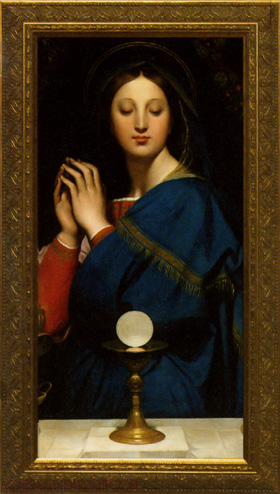
ingres-madonna-of-the-host

Jean Auguste Dominique Ingres, “Virgin Adoring the Host” ca. 1850s

.

Lord God, how is it You fit in such small spaces?

The Creator of all, the Maker of all things, He who knows every hair on every head—how is it Lord You fit in such small spaces?

The Light of Light, the King of Kings—the Heaven, the Earth, and all their Glory—how is it Lord You fit in such small spaces?

How is it Father that You fit in a cradle?

How is it Lamb of God that You fit in a host?

How is it Author of Life that You fit in a word?

How is it my Lord and my God You fit in such small spaces?


.

—Howard Hain

.

Morning Thoughts: Mary’s Mother


durer

Albrecht Durer, “Virgin and Child with Saint Anne”, ca. 1519 (The Met)


Christmas is a time for grandmothers.

They bake and cook and decorate. Their homes become mini North Poles, diplomatic outposts of Santa’s Castle.

At its core, Christmas is of course all about Jesus. All about Jesus, Mary, and Joseph. All about the Holy Family.

The Holy Family is an extended family though. And it doesn’t stop at grandmothers and grandfathers, aunts and uncles, or even cousins and distant cousins.

Just ask Saints Joachim and Anne, Zechariah and Elizabeth, or John the Baptist—not to mention all the unknown relatives whom the child Jesus surely encountered throughout His Galilean days. Ask any one of them about the far-reaching ripple effects of family grace.

Those touched by Jesus have a tendency to appear bigger than life.

Look at Santa Claus.

Most of us are aware that he is really Saint Nick.

But do we stop to wonder who Mrs. Claus really is?

I think she’s Saint Anne.

After all, Mrs. Claus is seen as everyone’s grandmother, especially when it comes to holiday cheer. But when it comes to truly celebrating the birth of Jesus, it is through Saint Anne that we approach the gates of Christ’s Nativity.

Mary’s Mother holds a special key. She is first among grandmas, first among those who pinch chubby cheeks, who pass along one more extra sugary treat.

———

Saint Anne help us. Speak to us. Show us how to be grand parents to all those around us, especially the little ones. Stir up the spirit of Advent. Bake away the holiday blues. Cook up a dish of Christmas love that only your hearth can serve.

———

Come one, come all, to the home of Saint Anne. Come with me to Grandma’s house for a holiday visit. Taste and see. Enter her kitchen, where the hot chocolate can always fit a little more whipped cream, where you hear the constant refrain: “eat…eat…eat…”

At Grandma’s your plate is never empty.

Her table is continually set.

She always sees Jesus as having just been born.

She is always wrapping Him up tightly in swaddling clothes.

It is simply grand.

To Grandma, Jesus is always an innocent child.

And she can’t help but see Him deep within both you and me.


.

—Howard Hain

.

http://www.metmuseum.org/art/collection/search/436244

.

Morning Thoughts: Full of Grace


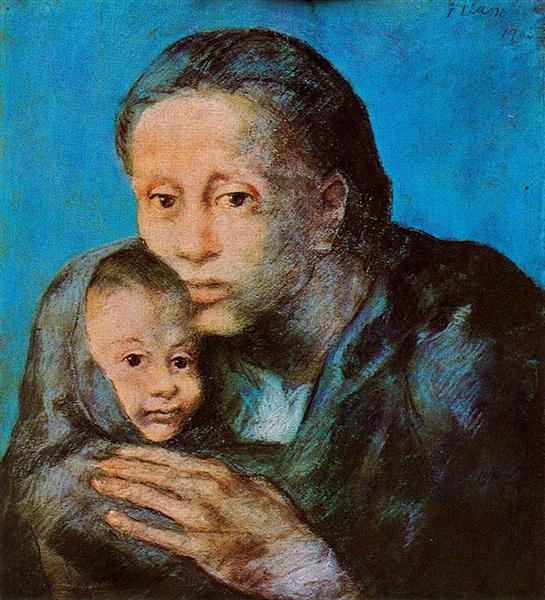
picasso-mother-and-son-with-handkerchief-1903

Pablo Picasso, “Mother and Son with Handkerchief”, 1903


.

If there was a man named Silence, what would he say?

If there was a man named Trust, what would be his worry?

If there was a man named Hope, what would he miss?

———

If there was a man named Love, what would his mother’s name be but Mary?

———

Yesterday I met a mother who just buried her son. Just the two of us on a city sidewalk. The cars, the buses, the children leaving school, even the woman close by and working in her garden…they all kept moving.

———

If there was a man named Hug, what else would he do?


.

—Howard Hain

.

The Rosary

St. Bernard, in a homily for today’s Feast of the Holy Rosary, says that God is by nature incomprehensible, inaccessible, invisible, unthinkable, but wished “to be understood, to be seen and thought of.” And so the Word became flesh of the virgin Mary.

The Rosary is a prayer inviting us into the mystery of Christ.through Mary, his mother, who gave him birth and treasured his memory in her heart. Human as we are, she introduces us to Jesus Christ, Son of God and Son of Mary.

“He lay in a manger and rested on a virgin’s breast, preached on a mountain, and spent the night in prayer. He hung on a cross, grew pale in death, and roamed free among the dead and ruled over those in hell. He rose again on the third day, and showed the apostles the wounds of the nails, the signs of victory; and finally in their presence he ascended to the sanctuary of heaven.

How can we not contemplate this story in truth, piety and holiness? Whatever of all this I consider, it is God I am considering; in all this he is my God. I have said it is wise to meditate on these truths, and I have thought it right to recall the abundant sweetness, given by the fruits of this priestly root; and Mary, drawing abundantly from heaven, has caused this sweetness to overflow for us.”

Friday Thoughts: Young Mother Sewing

Mary Cassatt Young Mother Sewing 1900 Met

Mary Cassatt, “Young Mother Sewing”, 1900 (The Met)


.

A living faith works. It is always active, especially when we are docile to the Spirit.

When we walk by faith we see, we hear, we speak what God intends, especially when we are blind to the cares and anxieties of the world.

Small children are wonderfully active, superbly passive, and at times they seem completely blind, fantastically blind. They are alive. They see. They hear. They speak. They watch. They feel.

Mother Church calls all of us home, even when she is silent. She is always at work. She watches us even when her eyes are busy with the business of the day.

She sews. We just need to obey. To trust. To allow ourselves the freedom to lay across her lap.

In the short description upon the little museum card hanging beneath the painting shown above, God has planted great instruction. The work is by American impressionist Mary Cassatt.

According to the card, about the year 1890 “Cassatt redirected her art toward women caring for children and children alone—themes that reflected her affection for her nieces and nephews and the prevailing cultural interest in child rearing.” And then, after informing us that for this particular painting Cassatt “enlisted two unrelated models to enact the roles of mother and child”, the card completes its little catechesis by blessing us with a precious little anecdote and quote:

Louisine Havemeyer, who purchased it in 1901, remarked on its truthfulness: “Look at that little child that has just thrown herself against her mother’s knee, regardless of the result and oblivious to the fact that she could disturb ‘her mamma.’ And she is quite right, she does not disturb her mother. Mamma simply draws back a bit and continues to sew.”

God are we blessed. So blessed to have such a mother. All of us. Maybe give her a call today. Better yet, perhaps even stop by. She’d love that. She’d love to see your face. You’re always on her mind and in her heart. She lives in the closest church you can find, any building that truly houses her Son.

If she seems a little occupied with the “cooking and cleaning”, with all “the business of life”, don’t let that stop you or cut your visit short. No, throw yourself against your “mother’s knee regardless of the result and oblivious to the fact” that you could disturb your “mamma.”

 It most certainly does not.

“Mamma simply draws back a bit and continues to sew.”

.


.

—Howard Hain

.

http://www.metmuseum.org/art/collection/search/10425

.

Friday Thoughts: Flight Into Egypt

Flight Into Egypt Henry Ossawa Tanner American 1923 Met

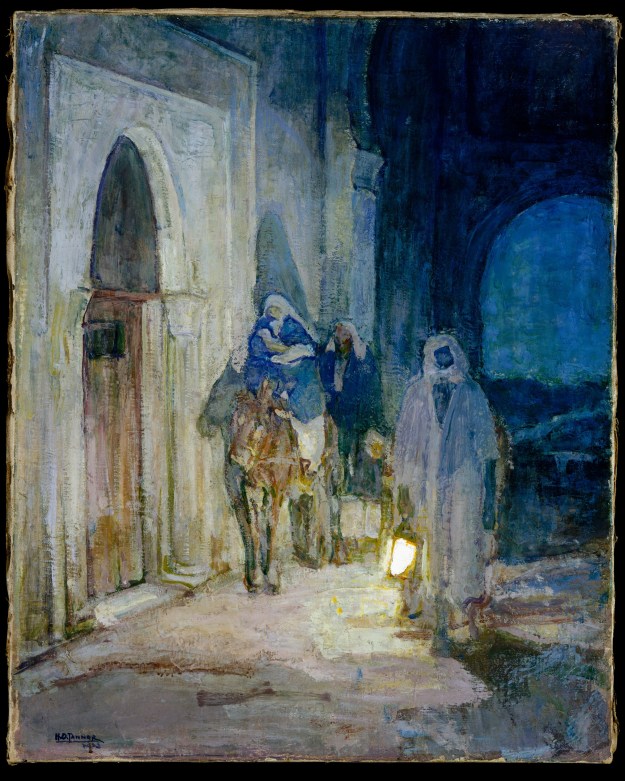
Henry Ossawa Tanner, “Flight into Egypt”, (1923) (Metropolitan Museum of Art)


.

A young lady and a good man. A tiny precious child. A tired donkey. An angel of God leading them by the lantern in his right hand.

You are one of them. You travel by night. Your party is small. But you are not alone.

The streets are empty. At least as far as you can see. Strange lands this side of the Red Sea.

Jesus is with you. He sleeps in your arms. He takes your family name. He rides upon your back. You walk a few feet ahead of Him to ensure the right and safe path.

You too are Jesus. Born a few days before. Completely wrapped up. Yet totally exposed.

Beyond the frame an onlooker more than watches. He paints the picture. He steadies the easel. He knows exactly where the finished work will hang.

.


.

—Howard Hain

 .

http://www.metmuseum.org/art/collection/search/16947

..