Tag Archives: love

A Man Named John

by Howard Hain

A Man Named John

There is a man named John. He was born and raised to be good. He believes that if he is a good person when he dies he will enter heaven. So while here on earth he prepares for death. The result is John lives a simple life. His home is simple. His occupation is not one many would find out of the ordinary. Yet John spends much of his time quietly bettering himself. In short, John is a good man.

It has been a long process. And John knows that his time is coming to an end. He also knows well that the end of his life is not in his own hands. He tells himself again and again “all one can do is prepare.” And prepare is what John has done since birth: He spent his youth lassoing his passions, his middle years harnessing his ego and pride, and his later years in private reflection upon the afterlife—an afterlife in which he hopes and prays he will be permitted to share. But it is his recent days that have been the most difficult. He battles to stop himself from thinking that he has been good and is one of the few who deserves to enter paradise. So each morning, before he rises and meets the day, John prays in bed. He prays in these final days, the days that matter most, for humility. He asks God for nothing but to remain within His glorious will.

Morning after morning John continues to pray. With each day he senses that his preparation is coming closer to an end. He feels his body slipping away and his spirit being freed. He senses he is on the verge of being born into salvation.

One morning as John is praying in bed the door is thrust open. A man and a woman walk into the room. The woman immediately applies a large metal clamp to John’s head. She holds John in place while the man begins to rip John’s body apart. Piece by piece, limb by limb, the man cuts away. The man and woman chat about their weekends as if John were never alive. Piece by piece John is pulled apart. Oblivious to John’s screams, indifferent to his fear, ignorant of his pain, in denial of his life, the man continues to tear away, as if John never breathed nor was ever born—as if dismantling an unwanted couch that won’t fit through the door.

Now what if I told you that John was never born, never lived, never prepared for the afterlife, never ripped into pieces and pulled from his bed. What if I told you that instead of being born John was conceived, instead of living he developed, instead of preparing for the afterlife he prepared for this life? What if I told you that instead of being ripped into pieces and pulled from his bed he was ripped into pieces and torn from the womb?


Howard Hain is a contemplative layman, husband, and father. He blogs at http://www.howardhain.com
Posture of Prayer

by Howard Hain
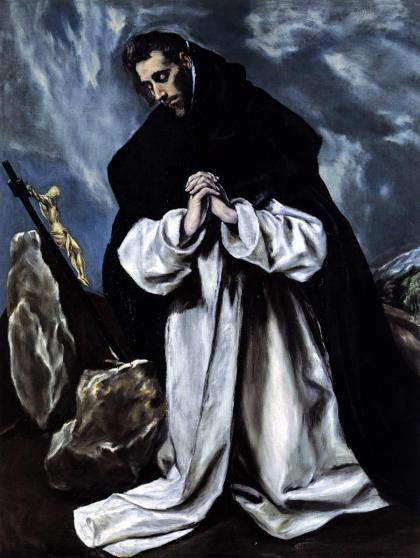
el_greco_st_dominic_in_prayer-1595

El Greco, “St. Dominic Praying”, c. 1588

Sometimes just showing up is all we can do.

To put ourselves in position to pray and worship—at least physically, even if we just cannot seem to get there spiritually—is an act of prayer and worship in itself. And quite often, it is the best we have to offer.

By confessing our aridity through physical obedience alone, we approach God’s altar with humility, for we come to God in our “nothingness”.

The bowing of head, the placement of knees, and the closing of eyes return us to the dark warmth of the womb. It is no coincidence that the posture of prayer and the fetal position bear great semblance.

It is in the womb that we are closest to God, furthest from the corruption of the world, and possess the least of what our “flesh” considers of value—our “brilliant” ideas, our “magnificent” plans, our “heroic” acts—our self-aggrandizement.

It is in the womb that we find ourselves in complete dependence. We receive all we need without knowing, without speaking, without cost.

In that sense, being in the womb is much the same as being in the world—for in the world we are still completely dependent—it is just that without the obvious reminder of the umbilical cord, we so easily forget our total and complete dependence on God, our Creator, our Sustainer, and our Ultimate End.

Hence we find ourselves “knowing,” “telling,” and “paying a price.” When in reality, the only thing that we can somewhat even come close to taking credit for is being physically present to receive His Word, His Wisdom, and His Will. All of which come free of charge, His Son having already paid the price.

———

“Lord, let me place my knees to the earth. Let me feel the foot of the cross against the caps of my knees. Let me close my eyes and bow my head. Let my brow lay upon your bloodied feet. Let me humbly raise my eyes to gaze upon your battered body. Oh my Lord and my God, let your blood and water rain down upon me.”

Amen.


Howard Hain is a contemplative layman, husband, and father. He blogs at http://www.howardhain.com

Follow Howard on Twitter @HowardDHain

twitter.com/HowardDHain

If you enjoyed this post, please consider “liking” it, adding a comment, becoming an email subscriber, or passing it along via the social-media links below. Your support is greatly appreciated. Step by step. All for God’s glory.

I’m Pro-Art

by Howard Hain
DT1554

Paul Cézanne, “Bathers”, 1874-75, (The Met)

I’m Pro Art

In other words:

I’m Pro Truth

In other words:

I’m Pro Beauty

In other words:

I’m Pro Love

In other words:

I’m Pro Creation

In other words:

I’m Pro Life

(Oops, how’d that happen…funny how logic can lead you to such “un-expecting” places.)

(Words do seem to matter—or at least carry some weight—maybe even 7 pounds 8 ounces worth.)

(Before you panic, give it a little, teeny-weeny, infant-sized bit of thought…)

Conclusion:

ProArt (pro-creates) ProLife

ProLife (pre-conceives) ProArt

ProArt (equ=als) ProLife


Howard Hain is a contemplative layman, husband, and father. He blogs at http://www.howardhain.com

Follow Howard on Twitter @HowardDHain

twitter.com/HowardDHain

If you enjoyed this post, please consider “liking” it, adding a comment, becoming an email subscriber, or passing it along via the social-media links below. Your support is greatly appreciated. Step by step. All for God’s glory.


Web Link: The Metropolitan Museum of Art. Paul Cézanne, “Bathers”, 1874–75

Walking Into Heaven

by Howard Hain
Rembrandt_-_The_Philosopher_in_Meditation

Rembrandt, “Philosopher in Meditation”, 1632, (Musée du Louvre)


Dream big.

Think small.

Step by step.

Real growth is incremental.

Reaching toward a glory beyond our reckoning.


Sure and Steady

by Howard Hain
jusepe-josc3a9-de-ribera-tightrope-walkers-1634

Jusepe (Jose) de Ribera, “Tightrope Walkers”, 1634


The brighter the light the more we squint.

The closer we get the less we see.

And if we stare we go blind.

Now what?

You have to trust.

In what?

Not in yourselves.

In total darkness the answer is clear.

All other ways disappear.

Close your eyes.

Shutter your ears.

Forget the past.

Ignore what is below.

Chin slightly elevated.

Now walk.

No need to go too slow.

Sure and steady.

Heart on the goal.

And if we slip?

Don’t worry.

I made the rope.

I hold it tight.

My Son is “the way and the truth and the life”.

In Him you never fall.

In Him you know.

In Him you live.

He walks before you.

You may not see Him but He is there.

Follow close behind.

It is a tight walk.

That’s why I gave Him a pole.

I gave you one too.

And because it can get very dark.

I made them easy to identify.

They are made of thick dead wood.

Your hands know their splinters and knots.

Hold tight.

Say thank You.

Kiss in the dark what you cannot see.

For that old piece of wood.

Will get you across the gorge.

Where on the other side.

It will be planted.

Grafted into the Tree of Life.


Howard Hain is a contemplative layman, husband, and father. He blogs at http://www.howardhain.com

Follow Howard on Twitter @HowardDHain

twitter.com/HowardDHain

If you enjoyed this post, please consider “liking” it, adding a comment, becoming an email subscriber, or passing it along via the social-media links below. Your support is greatly appreciated. Step by step. All for God’s glory.

Clean Enough To Care

by Howard Hain
DP801172.jpg

John Downman, “Child Holding a Doll”, 1780 (The Met)


What if someone handed you a child?

A small child.

A tiny child.

An infant.

A few hours…a few minutes old.

What if you were the only one that the child could be handed to?

Only you.

No one else around to help.

Would you receive that child into your arms?

There’s no sterilized room, no sanitary precautions, no sink, not even a bar of soap—just plain old you, a bunch of imperfect circumstances, and a poor tiny child that needs to be embraced.

You know what you would do.

Even if your hands were filthy, completely covered in soot and mud, you know what you would do.

You’d quickly rub your hands against your pants or shirt and wipe away the obvious dirt.

Then you’d hold out your hands.

Wouldn’t you?

Yes. You would.

We all would.

That’s what makes us human.

That’s what makes us children of God.

We’d do what we could with what we have to help an innocent child.

We know that “cleanliness” in such cases really doesn’t matter. For even if the circumstances were “perfect” we’d still have that uneasy feeling. That feeling that we’re not worthy to hold such innocence, to be entrusted with such treasure.

It’s a holy hesitancy that only true humility can bear.

Yet, it’s the necessity to help, the clear need for our assistance—the abundantly clear reality that we’re the only “hands” on deck—that drives us to overcome such holy and righteous fear—a fear that reveals just how poor we really are, much poorer in fact than even the helpless child we are about to embrace.

It is preciously this beautiful fear of God that propels us to love boldly—to boldly reach out beyond ourselves, to boldly become part of God’s mystical body, to become His very arms and hands—to embody Divine Love Itself—that perfect love of the eternal Father for each and every child ever created.

For it is the Father’s love that creates us, and sustains us, and longs to flow through us.

We just sometimes need extreme circumstances—ridiculously obvious situations—in order to tap the needed courage to let it to flow beyond our own borders and into those around us.

You are in such a situation. Right now.

We all are.

This very moment.

No matter where you are or what you’re doing.

Such a situation is at hand.

A child, a new born—cold, hungry, and without a home—desperately needs to be held.

Quick then, wipe your dirty hands, make due with what you’ve got—believe the Word of God, it’s good enough—now hold out your hands.

You’re clean enough to care.


Howard Hain is a contemplative layman, husband, and father. He blogs at http://www.howardhain.com
Follow Howard on Twitter @HowardDHain

twitter.com/HowardDHain

If you enjoyed this post, please consider “liking” it, adding a comment, becoming an email subscriber, or passing it along via the social-media links below. Your support is greatly appreciated. Step by step. All for God’s glory.


Web Link: The Metropolitan Museum of Art. John Downman, “Child Holding a Doll”, 1780

Bozza Imperfetta (imperfect sketch)

by Howard Hain


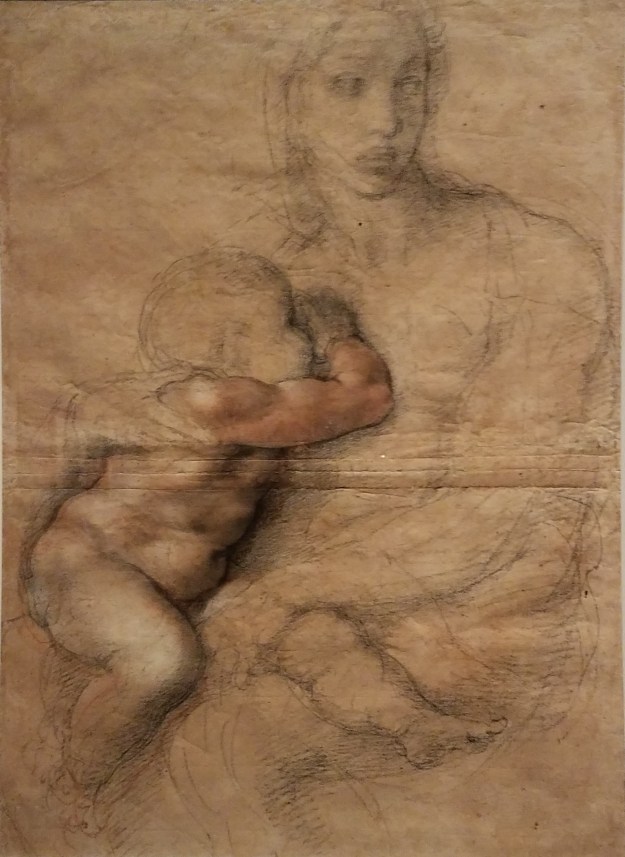
20171121_104929

Michelangelo Buonarroti (Italian, Caprese 1475–1564 Rome). “Unfinished cartoon for a Madonna and Child.” 1525–30. Drawing, black and red chalk, white gouache, brush and brown wash. Casa Buonarroti, Florence


I know almost nothing.

What I do know leads me up the ladder of not understanding.

To my perch upon the Cross.

Within the heart of my child Jesus.


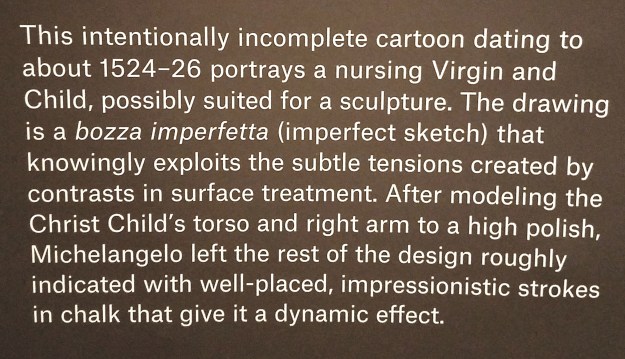
20171121_110016

Museum Wall Card for Work Above, from: Michelangelo: Divine Draftsman and Designer, on view at The Met Fifth Avenue from November 13, 2017 through February 12, 2018.

Walled Garden

by Howard Hain
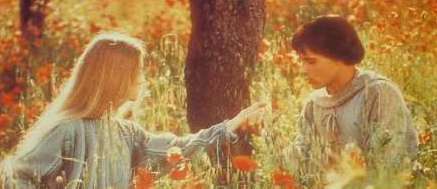
francis-and-clare-from-the-movie-brother-sun-sister-moon-franco-zeffirelli

Saint Francis and Saint Clare from the movie “Brother Sun, Sister Moon”, (Franco Zeffirelli) (1972)


A garden enclosed, my sister, my bride,
a garden enclosed, a fountain sealed!

—Song of Songs 4:12


From memory it is not easy to recall. I do have a clear image, but if it is accurate that remains to be seen. Here we go.

It was downhill. A sloping path. As I approached the stone church, a few people wandered around out front. There was somewhat of a courtyard, well not a courtyard, more like a little wall hugging into existence a welcoming space. This wall was about bench height, made also of stone, and extended outward from the building. It created what I would normally call an out-front patio space, but in Italian terms, perhaps it would be called a terrazza, or maybe even be considered a piazza, or perhaps most accurately, a piazzetta. Then again, maybe it is just a patio to Italians too.

Well, sitting on this low wall was a friar. And running around the open area was a small brown dog with a shaggy little beige beard.

I entered the church. It was small, almost cave like. A curved ceiling. Dark. Old. There was the cross, a crucifix. Not the actual one that spoke to Saint Francis—no, that one was moved up into the Basilica of Saint Clare located in the central part of the still small but no-longer medieval town of Assisi.

The reproduction spoke to me.

I’m an early companion of Francis.


I remained in the chapel for a while. I’m not sure if I was praying or not. I’m pretty sure I got on my knees. But from that day’s perspective, prayer was not known to me. So from that perspective, I wasn’t praying. But from today’s perspective, I most certainly was. For I was there. I was in Italy, in Assisi, in the Church of San Damiano. I was there intentionally. I was lost but I was found. I was looking, and I was obeying. Obeying what I didn’t know. I had no idea why, but I wanted to be there. And I felt something. It was heavy, literally. I remember feeling bent over. I remember thinking about all the prayer that must have taken place in that small space over the past thousand years. I remember thinking that all that collective belief must have an effect. It did. It does. It will. I was certain that I felt it. It bowed me down. It bent me over. And I remember liking it.

Faith is common.

I was a pilgrim and didn’t know it.


I don’t remember much about the convent itself. I do remember walking from room to room, the communal rooms where Saint Clare and her companions, her biological mother and two sisters among them, ate and prayed and cared for their sick. I remember the small warm inner garden, with it’s old well. And the spot marked as the place where Clare liked best to sit. I’ve always loved internal courtyards. The thought of being outdoors and yet enclosed. Architecturally, it best represents the beauty of true solitude. Open. Yet safe. Free. Yet sheltered. Alone. Yet surrounded by those who believe the same.

In that sense, solitude—when it’s truly interior, truly spiritual—is like love: you can never get enough of it, and once you have it, once you truly live within it, you’re never again alone.

Solitude is love. And love is never solitary.


Therefore the Lord himself shall give you a sign. Behold a virgin shall conceive, and bear a son, and his name shall be called Emmanuel.

—Isaiah 7:14


Howard Hain is a contemplative layman, husband, and father. He blogs at http://www.howardhain.com
Follow Howard on Twitter @HowardDHain

twitter.com/HowardDHain

If you enjoyed this post, please consider “liking” it, adding a comment, becoming an email subscriber (drop-down menu at top of page), or passing it along via the social-media links below. Your support is greatly appreciated. Step by step. All for God’s glory.

Arriving in Hope

by Howard Hain


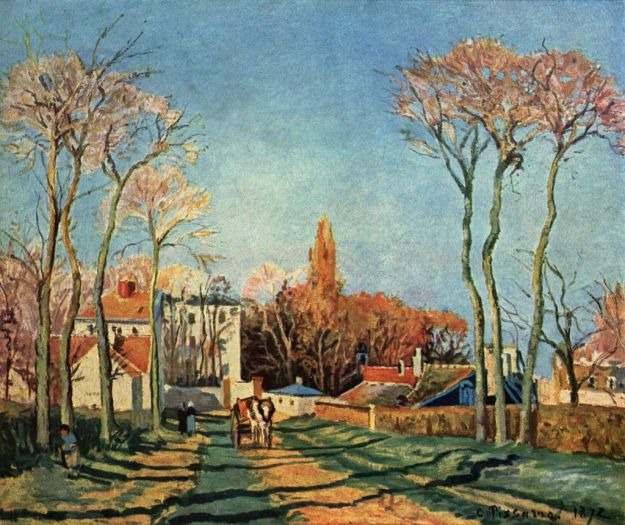
camille-pissarro-entree-du-village-de-voisins-1872.jpg

Camille Pissarro, “Entrée du village de Voisins”, 1872 (Musée d’Orsay)


Waiting and waiting, for exactly what I’m not sure.

The sun to rise.

The day to end.

The water to boil.

Mass to begin.

The cock to crow.

Christ to return.

———

A new day is here.

———

Father, thank You.

Jesus, I love You.

Holy Spirit, have Your way.


Howard Hain is a contemplative layman, husband, and father. He blogs at http://www.howardhain.com
Follow Howard on Twitter @HowardDHain

twitter.com/HowardDHain

If you enjoyed this post, please consider “liking” it, adding a comment, becoming an email subscriber, or passing it along via the social-media links below. Your support is greatly appreciated. Step by step. All for God’s glory.

Where I Want To Be

by Howard Hain


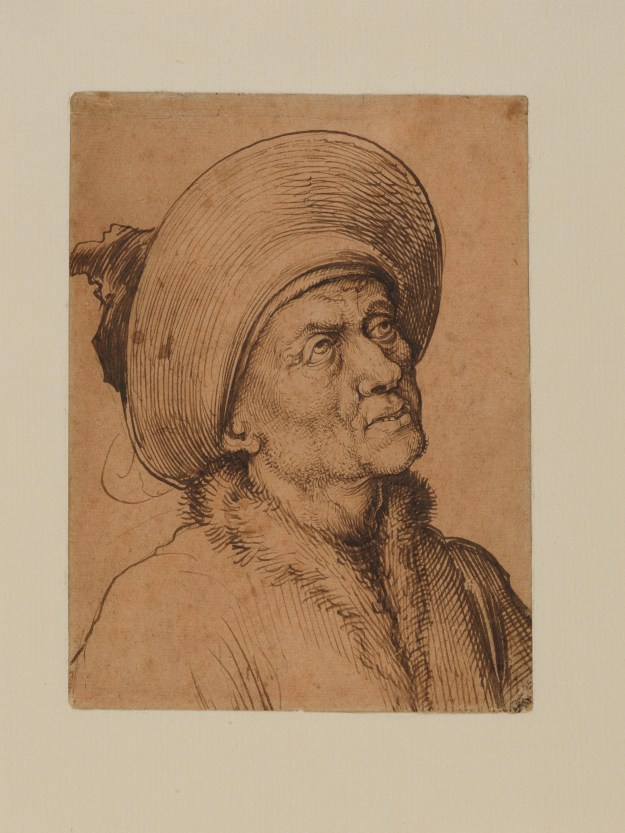
Martin Schongauer Bust of a Man in a Hat Gazing Upward ca 1480-90 The Met

Martin Schongauer, “Bust of a Man in a Hat Gazing Upward”, ca. 1480-90 (The Met)


J.M.J.


There’s only one place I want to be.

On the Cross with my good Christ.

Strange. Odd. Uncomfortable to admit.

The Cross is where I want to be.

The Cross is where I feel free.


The thought of being lifted up high.

The chance to be in pain.

With Him Whom I still don’t know.

To want it to never stop.

To not understand a single thing.

To be burned alive.

I can only call it love.


Yes. So be it. It’s Your command.


The Cross is where I want to be.

The Cross is where I am free.

The Cross is where I encounter love.


Yes, Lord Jesus.

Let me hang with You.

If only for a while.

My sins and those of all the world.

Added to the funeral pile.


Howard Hain is a contemplative layman, husband, and father. He blogs at http://www.howardhain.com
Follow Howard on Twitter @HowardDHain

twitter.com/HowardDHain

If you enjoyed this post, please consider “liking” it, adding a comment, becoming an email subscriber, or passing it along via the social-media links below. Your support is greatly appreciated. Step by step. All for God’s glory.


Web Link: The Metropolitan Museum of Art. Martin Schongauer, “Bust of a Man in a Hat Gazing Upward”, ca. 1480-90