The ear that hears, the eye that sees—the Lord has made them both.
—Proverbs 20:12
———
It is the simple times. It is when we are doing life one dirty dish, one utility bill, one ordinary errand at a time that deepened faith creates an awe-filled stir.
For much is said of the bells and whistles of supernatural faith—but what is most supernatural is the presence of “all”, of “everything”, of “heaven and earth” in each dirty dish, each electric bill, each trip to the dollar store. What is most supernatural is the acknowledged presence of God in day-to-day life.
The deeper our trust, the more complete our surrender, the less “exciting” the external signs need to be. Or to express it differently: The least “exciting” times become so overwhelmingly profound that bells and whistles are hardly noticed.
We are told that we need an ear that hears and an eye that sees.
But what is it to have them?
Is it being still within God’s presence while the sponge soaks, the envelope seals, the cash register line slowly shortens?
The skeptic may see such a man as confined by complacency, dangerously satisfied, or simply numb. The skeptic may even call such a man “blind”.
That is certainly one way to look at it.
There is another:
Or is it that the mighty awe of a salvaged life has finally taken hold?
———
Turning to the disciples in private he said, “Blessed are the eyes that see what you see. For I say to you, many prophets and kings desired to see what you see, but did not see it, and to hear what you hear, but did not hear it.”
The Easter season ends with the Feast of Pentecost and we’re into ordinary time in the church year. Unlike other feasts, Pentecost has no octave; ordinary time is its octave. Most of the church year is ordinary time; most of life is ordinary too, but the Spirit is there just the same.
“Their message goes out to all the earth.” We read the Acts of the Apostles during the Easter season as Jesus’ apostles, led by Peter and Paul, ventured on their way from Jerusalem to Asia Minor and to Rome, empowered by strong winds and tongues of fire, Yes, the Spirit can bring us to the ends of the earth, but the Spirit is also there in the few steps we take every day, though we’re hardly aware.
We tend to minimize ordinary life. Just ordinary, nothing’s happening, we say. Yet, day by day in ordinary time the Risen Lord offers his peace and shows us his wounds. Every day he breathes the Spirit on us. No day goes by without the Spirit’s quiet blessing.
If you grew up in the Tri-State Region, commonly known as the greater New York City area, you know the sound of “1010 WINS”, the radio station that reaches millions living in New York, New Jersey, and Connecticut, especially those sitting in traffic.
“Traffic and Transit on the Ones”
Every ten minutes, “on the ones” as they say, comes the coveted traffic report, including mass transit (train and subway) updates, and of course all the action one needs to know about the “bridges and tunnels”.
What a nightmare commuting can be.
Stop and Go.
“YOU GIVE US 22 MINUTES, WE’LL GIVE YOU THE WORLD”
That’s what we hear, while sitting in our cars, or as we get prepared to sit in our cars—or perhaps board buses, trains and/or subway cars.
Twenty-two minutes, that’s all they need, and we’ve got it all: breaking international news, politics, weather, sports, culture, and of course, traffic and transit “on the ones”.
Of course those twenty-two minutes give us everything we need, except relief. Thanks to them we are now very well-informed people sitting in traffic, as opposed to complete and utter ignoramuses actively stuck behind Greyhounds.
“Top and Bottom of the Hour. The Beginning and the End.”
There’s another great news agency constancy at work in the Tri-State Area. Its broadcast begins at the top and the bottom of the hour. But there’s only one message. The news is always good. And it always leaves one relieved.
New York, New Jersey, and Connecticut are filled with parishes. Most established by the immigrants of their time. And today they march on:
The Liturgy—The Great Prayer of God’s Church—won’t be stopped.
Day in, day out.
It is always the hour.
“YOU GIVE IT 22 MINUTES, IT’LL GIVE YOU MORE THAN THE WORLD”
(The beginning of the Eucharistic Prayer, The Order of Mass)
.
The next right thing.
Sometimes it is just that simple.
In fact, it is always that simple.
But to silly people like us, simple is not good enough.
It’s not complex enough.
Not sophisticated enough.
Not civilized enough.
Not cultured enough.
Not smart enough.
“Simple” lacks “nuance” and “subtlety”.
“Simple” contains nothing of the triune god of highly-refined society: arrogance, ambition, and ambiguity.
“Simple” is simply not good enough for you and me.
But it is for God.
He is simply great.
He is “right and just.”
Let’s simply be like Him.
Believe the next right thing.
Hope the next right thing.
Love the next right thing.
For the next right “thing” is God Himself.
For God is Good.
And He is Love.
Let us love then.
One step at a time.
One breath at a time.
One charitable conception, thought, and decision at a time.
Let us be like God.
Let us be amazingly simple.
Let us be simply amazing.
— “It is right and just.”
.
It is truly right and just, our duty and our salvation, always and everywhere to give you thanks, Lord, holy Father, almighty and eternal God, through Christ our Lord.
(Common Preface I, Eucharistic Prayer, The Order of Mass)
Whenever I can, I invite visitors to our monastery in Jamaica, Long Island, to take the subway to downtown Manhattan for a ride on the Staten Island Ferry and then visit Battery Park, the Museum of the American Indian, and some of the old churches and shrines among the city’s famous skyline. I try to tell the story of our country and the Catholic church in America by walking through those places. It’s a good opportunity to talk about the care we need to give creation as we look at the waters of the harbor, the question of immigration as we visit Castle Clinton in the Battery, and the church as we visit the area’s churches. Looking at the past helps you to understand the present.
Our walk usually ends at St. Peter’s church, the oldest Catholic church in New York City, on the corner of Church and Barclay Streets, a block away from the World Trade Center. The church was dedicated November 4, 1786, three years after British troops evacuated the city at the end of the Revolutionary War and it’s been there as an active parish every since.
Previously, New York City was under Dutch and British rule for almost 150 years. During that time the city was strongly anti-Catholic, with laws calling for any Catholic priest who came there to be jailed. Catholic worship was forbidden; there were no Catholic churches.
Even after the Revolutionary War, despite their support for the American cause, Catholics were looked down upon in New York City. There were only a few hundred in a population of almost 20,000. Being a Catholic didn’t get you far in New York in those days.
So how did that church get built? Well, there were some foreign diplomats from France and Spain and Portugal in the city then. New York was the nation’s capital at that time. (1785-1790)
There were a couple of well-to-do Catholic businessmen, but most of the Catholics that formed St. Peter’s were poor Irish and German immigrants and French refugees and slaves from the recent revolution in Haiti.
Not a good mix of people to form a parish, you might think. This new congregation, besides facing the anti-Catholic attitude of New Yorkers, was poor and getting poorer as new Catholic immigrants poured into New York from Europe. Its priests weren’t the best either. They seemed to be always squabbling among themselves. There were some scandals among them. The laypeople were also divided among themselves. There were factions that wanted to run the parish their way or no way. There wasn’t a bishop in the country at the time to straighten things out.
So what kept it going? The other day we celebrated the Feast for the Dedication of the Church of St. John Lateran in Rome. The liturgy for that feast offers some wonderful insights into what a church and a parish should be. “My house is a house of prayer,” Jesus says. This church is not a social hall; it’s a place where we meet God and God meets us. It’s a place where we are welcomed on our way through life by a living water that restores us and helps us grow. ( Ezekiel 47.1-12) It’s is a place where we remember our mission in this world: we’re builders of the City of God, living stones that together form the temple of God. ( 1 Corinthians 3, 9-17) It’s is a place of communion, where we commune with God and God with us.
The readings for the feast say a church is a place of welcome. It’s where the lost sheep find their way home. It’s where people like Zacchaeus, the tax collector mentioned in St. Luke’s gospel, find new hope for their lives. It’s is a place of sacraments, where infants are blessed, where marriages begin, where we put our dead in the hands of God who promises eternal life.
What keeps a church and a parish going is its spiritual life, its life of prayer, its life of ministry.
Whenever I go to St. Peter’s Church on Barley Street I point out two markers at its entrance. One says that St. Elizabeth Seton, the first native born American saint, was received into the Catholic Church here in 1806. She had been a member of a prominent Anglican church just down the street, Trinity Church, but came to St. Peter’s drawn by her faith in the Mass and the Blessed Sacrament. Socially, it was step down for her. Spiritually, she found a home here in this struggling, messy parish of poor immigrants.
The other marker recalls Pierre Toussaint, a Haitian slave who was also a member of this church in colonial times. He became a famous New York hair-dresser and was welcomed into the homes of elite members of New York society for over 50 years. For 50 years he came to Mass every morning at St. Peter’s. He’s buried in the crypt at St. Patrick’s Cathedral and in being proposed for canonization today.
The church is not a place of brick and stone. It’s a place for people, holy people, to meet God and one another. They make the church.
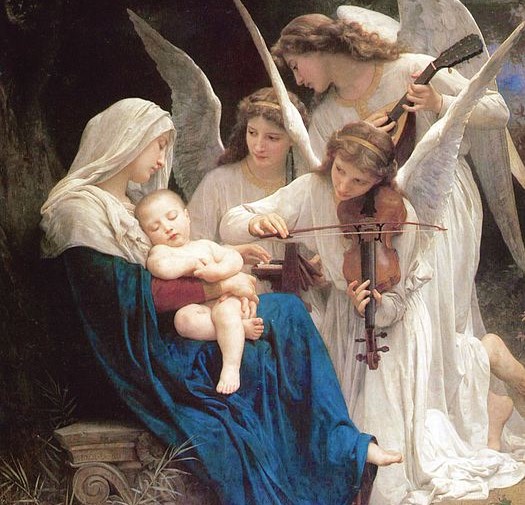
William-Adolphe Bouguereau, “Song of the Angels”, 1881 (detail)
…like newborn infants, long for pure spiritual milk
so that through it you may grow into salvation…
—1 Peter 2:2
.
A woman’s worth is measured by the love she bears for the Child Jesus residing within the person nearest to her.
She is priceless who beholds Jesus in each and every child—who sees all humanity as a child.
For the Mother of God holds each and every human being as if each and every one of us is the Son of God.
May we all see that woman in our life.
And may we all encourage every woman we encounter to nurture this divine gift—a gift held within the immaculate core of each and every instance of Mary’s Immaculate Heart:
The dignity of being God’s beloved daughter.
———
Just yesterday morning, I saw such a woman in the bakery. She told me of her own mother’s recent death. She spoke so lovingly, so faithfully. Her face was aglow. I felt such joy, such happiness, such hope in the promise of eternal life.
She handed me a prayer card from the funeral parlor. And there atop the rear side of the card—on the corresponding back chamber of the image of Jesus’ Most Sacred Heart gracing the front—I saw the face of a small delicate woman. A ninety-two-year-old beautiful little girl.
A recent photograph, I was told. And yet, it was ageless:
Holy Simplicity.
The Wisdom of God.
The “uneducated” schooled in the school of the divine.
———
She told me how blessed she was to be able to see her mother before she passed away. She traveled from New Jersey out to California to be with her. She said there was so much love, the presence of family, so much peace. The grace of a peaceful death. But then my friend showed a moment of remorse. She was not there at the exact moment of her mother’s death. She was already on a plane heading back to New Jersey when her dear mother departed for our one shared eternal home.
I thought of the Cross. The shape written in the sky. The plane speeding across a blue sea of crisp unpolluted air, leaving in its wake a white horizontal beam—while her mother’s soul ascends up toward heaven, slicing through her daughter’s path and adding to the celestial landscape—the vertical post of Christ’s Sacred Sign.
Life and death. Birth and rebirth. Time and eternity. The crisscrossing of two worlds, one temporary and fleeting, the other permanent and eternal.
The Kingdom is at hand, it begins right here, it resides within you and me—and if we have any doubt, all we need to do is stare a little more at Jesus stretched out upon the Cross—where we also find His beautiful, faithful mother standing by His blessed feet.
Faith and hope. Love and more love.
My friend’s remorse was short and fleeting. Together we raised our eyes back up toward Christ.
We let the Christ in each of us seek once more the face of the Father.
More peace and joy than even before. It seemed as if we’d both begin to sing. We hugged instead. A full chorus in heaven accompanied us.
.
…I have stilled my soul…
Like a weaned child on its mother’s lap, so is my soul within me.
A violent squall came up and waves were breaking over the boat, so that it was already filling up. Jesus was in the stern, asleep on a cushion. They woke him and said to him, “Teacher, do you not care that we are perishing?” He woke up, rebuked the wind, and said to the sea, “Quiet! Be still!” The wind ceased and there was great calm. Then he asked them, “Why are you terrified? Do you not yet have faith?”
—Mark 4:37-40 .
.
Lord,
Teach me to be kind
Show me how to be gentle
May I always bring peace to each and every situation
May I never do harm
Let me always be merciful
Let me never judge and never condemn
I need you to teach me, to show me, to encourage me to be more like You
With Your help it is possible.
———
I believe in You, Father
I trust in You, Jesus
You, Holy Spirit, I know are always loving me
Please let there be peace
Please let all the world be still
Please let all children hope and dream and know that You are God
The God of Kindness, of Gentleness, of Peace, of Mercy, of Forgiveness…
The God of Absolute and Perfect Love
The God who will never forsake us, whose promises are certain and real…
God, You are Love.
———
Let Your presence calm the waters
For the waves rock and the boat fills
And Noah has already come ashore
You, Lord Jesus, pray upon the mountain, You walk on water, You rest within the storm…
You still all
You question our faith
You tell us to simply ask
You promise that we shall receive more.
.
And the apostles said to the Lord, “Increase our faith!”
Paul Cezanne, “Bathers” (Les Grandes Baigneuses), 1895-1905
.
“Rejoice always. Pray without ceasing. In all circumstances give thanks, for this is the will of God for you in Christ Jesus.”
—1 Thessalonians 5:17
.
Come with me. I love to go. I so love to go. The Mass in its abundant overflow.
.
“For God so loved the world, that he gave his only begotten Son…” (John 3:16)
.
Come with me. It doesn’t matter what language you speak, nor what color skin your flesh happens to wear. Come. Be one with the Lord.
Pray the great prayer of the Church. Pray with sinners like me. Pray with all God’s Angels and Saints.
Pray the Mass. O, how God loves for us to share, to participate in Christ’s salvation of the world!
Living sacrifices. Gifts of bread and wine.
Come. Come. He is so very real. So much love. His Liturgy kisses each individual brow.
Begin your day by adjusting your ear…
“If today you hear his voice, harden not your hearts.” (Psalm 95)
Pray the Mass. Live it at home. Hour by hour. Minute by minute. Work through the Mass as you work through your day—knowing that the Holy Sacrifice of the Mass is being celebrated at every moment throughout the entire world.
———
.
“The Lord be with you. And with your spirit.”
.
Antiphon to Antiphon. Introductory to Concluding Rites. Let the Mass order your day.
The Sign of the Cross upon opening your eyes.
“Kyrie, eleison…”, as you rise from bed.
A morning shower beneath God’s infinite reign of mercy: “Wash me, O Lord, from my iniquity and cleanse me from my sin.”
Read. Confess. Sing. Proclaim.
Wash the dishes. Run to the store.
Always praise. Yes, always praise: “Glory to God in the highest, and on earth peace to people of good will.”
Head to work. Attend a meeting. Go for a run.
“Alleluia, alleluia”: The Gospel Acclamation.
It’s almost high noon. Enjoy the Sun. The light of God’s face. Hear the Holy Spirit’s instruction and inspiration for the day. Hold up your wounds, pray in union with God’s Crucified Child…
Offer the Universal Prayer while waiting for the bus…
Intercede for the entire world: the salvation of souls, the conversion of sinners, a unified church, the remembered and forgotten souls in purgatorial fire…
…for the sick, the persecuted, the poor, the imprisoned, the hungry, the thirsty…for every single soul for whom God wills us to pray…
For all the intentions of Jesus’ Most Sacred Heart.
———
“I believe in one God…”
Time for lunch.
Prepare the table. Acknowledge God’s goodness. Accept His gifts:
“By the mystery of this water and wine may we come to share in the divinity of Christ…”
Live. Breathe. Be free and at ease.
Let the Eucharistic Prayer flow into the core of your being:
“Lift up your hearts. We lift them up to the Lord…”
“…Holy, Holy, Holy Lord God of hosts…”
Watch as angels ascend and descend…your gifts borne “by the hands of God’s holy Angel to His altar on high…”
A priest at this very moment lifts the hands of Christ:
“Through him, and with him, and in him…”
———
Afternoon arrives:
“Behold the Lamb of God.”
Ask Jesus to come into your soul. Properly position yourself at the foot of the table:
“Lord, I am not worthy…but only say the word and my soul shall be healed.”
Jesus thirsts to enter. Learn to open wide. Beg God on bended knee. Beg Him for the grace to generously give and graciously receive:
“The Body of Christ.
The Blood of Christ.”
“Amen.
Amen.”
———
Sitting in traffic. Waiting on a call. Wanting to get home.
“Period of silence or song of praise.”
Rest beneath the external chaos, enter the internal peace of the Kingdom that resides deep within. Remember that Jesus—Body, Blood, Soul, Divinity—continues to transform your entire being.
Stop and go. Almost home. Evening approaches.
The prayers the priest says quietly at the altar—pray them too—ceaselessly in the silence of your consecrated heart.
“Lord Jesus Christ…free me by this, your most holy Body and Blood…
…keep me always faithful…never let me be parted from you.”
Park the car. Say hello to a man who’s homeless. Briefly visit a confused elderly neighbor. Prepare to sit peacefully around your kitchen table. Practice patience. Hug and kiss the kids. Allow the joy of Christ to radiate outward from the eternal spring within.
At the close of supper, give great thanks, and call to mind an after-communion prayer:
“What has passed our lips as food, O Lord, may we possess in purity of heart, that what has been given to us in time may be our healing for eternity.”
———
Now circle around and approach the end of this blessed day much like the way you began—for somewhere out there—Mass is just about to begin:
“The Lord be with you. And with your spirit.”
Brush your teeth. Prepare to sleep the sleep of a most blessed mystical death. Ask Mother Mary to help you dress for the flight.
“May almighty God bless you, the Father, and the Son, and the Holy Spirit. Amen.”
———
Kiss your wife goodnight.
Turn off the lamp.
Close your eyes in God’s perfect peace. The Mass at your right hand. Its liturgical rhythm steadily beating within your sacred heart.
Darkness descends.
“Go forth, the Mass is ended.”
The best is yet to come.
Faith. Hope. Love.
Eternal Life.
And as always: “Thanks be to God.”
.
“For God so loved the world, that he gave his only begotten Son…”
—John 3:16
—Howard Hain
.
.
(Note: All italicized quotations are from The Order of Mass, unless otherwise indicated.)


 The Victor's Place