Mark’s gospel today tells the gruesome story of the death of John the Baptist, which prefigures the death of Jesus. King Herod ordered his death, prompted by Herodias. Human sinfulness is on display in this court banquet, which the artist (above) describes very well. The women smugly presenting John’s head. The man pointing his finger at Herod and Herod denying it all. John’ eyes are still open, his mouth still speaks.
Venerable Bede says that John’s death is like Jesus’ death because they both embraced the same values. If John stayed silent about Herod’s conduct, he may have gained a few peaceful years of life, but he was more concerned with what God thought than what powerful people on earth thought.
“His persecutor had demanded not that he should deny Christ, but only that he should keep silent about the truth. Nevertheless, he died for Christ. Does Christ not say: I am the truth?
“He preached the freedom of heavenly peace, yet was thrown into irons by ungodly men; he was locked away in the darkness of prison, though he came bearing witness to the Light of life.
“But heaven notices– not the span of our lives, but how we live them, speaking the truth.” (Bede, Homily)
Wonderful line: It doesn’t matter how many years we live, but how we live them, “speaking the truth.”
For John that meant dying for the truth. What does it mean for us? It may not mean getting our heads chopped off, but we should expect some scars from the daily battle for God’s truth. ” May we fight hard for the confession of what you teach.” (Opening prayer)
The gospel readings at Mass after the Feast of the Epiphany are connected to that great feast.
The Magi represent the nations, the Gentiles, seeking Jesus as their Savior. In our reading for Monday Jesus after his baptism by John goes into Galilee. Matthew’s gospel calls it “The Galilee of the Gentiles.” Jesus brings light “to a people who sit in darkness.” (Matthew 4,12-17,24-25) In Galilee Jesus fulfills the promise made to the Magi.
He repeats the words John used to define his ministry: “Repent, for the kingdom of God is at hand.” Yet, while John speaks to the Jewish world, (Saturday, John 3,22-3); Jesus calls a Gentile world as well to turn to God, for the kingdom of God at hand.
Humanly speaking, it wasn’t a good time for such a mission. It’s “after John was arrested,” a dangerous time. Galilee, when Jesus began his mission, was ruled by Herod Antipas, who imprisoned John and then beheaded him. (Matthew 4, 12-25)
It probably wasn’t a good time either for the Magi to come to Bethlehem, in the days of Herod the Great. But God’s time is not our time; God’s ways are not our ways. We can miss the opportunities of grace when we think of time in too human a way.
Accounts of the miracle of the loaves and the crossing of the Sea of Galilee from Mark’s gospel are read on Tuesday and Wednesday of this week. Commentators note that in Mark’s gospel the Sea of Galilee is a stormy path Jesus takes to reach the Gentile world of his day. The other side of the lake, the western side, was predominantly a Gentile area. They are given the same Bread he provides for the children of Israel.
It’s to “all of Galilee” that Jesus goes and consequently “his reputation traveled the length of Syria. They carried to him all those afflicted with various diseases and racked with pain: the possessed, the lunatics, the paralyzed. He cured them all.” (Matthew 4, 23-25)
Jesus brings good news to both Jew and Gentiles in Galilee, the”Galilee of the Gentiles.”
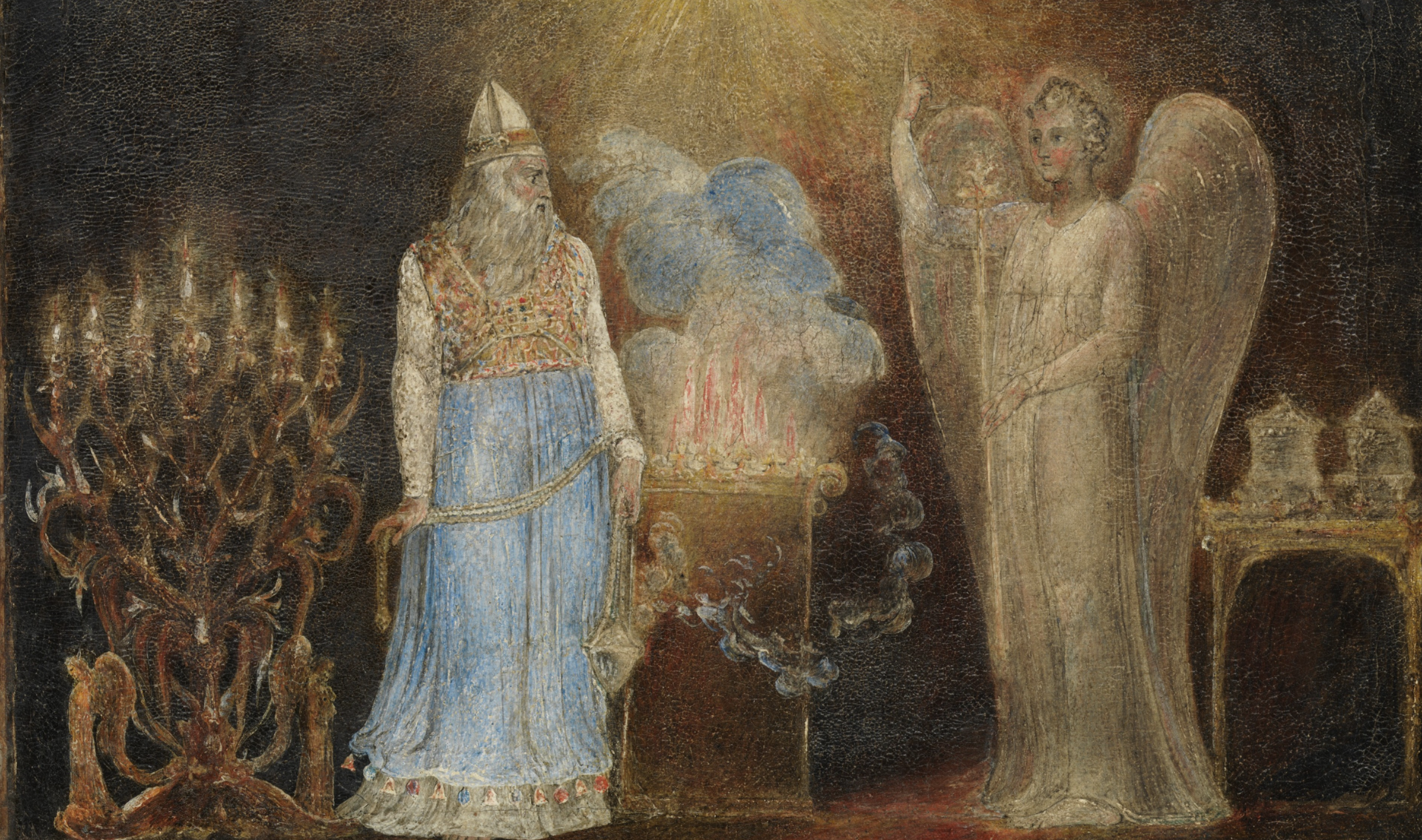
The priest Zachariah goes into the temple bearing incense to worship the Lord , “In the days of King Herod”, our Advent readings says today. An angel appears next to the altar of incense and says to him. “Your prayer has been heard,..Your wife will bear you a son.”
Surely, the old priest was no longer praying for a son. Childbearing was over for his wife and himself. The promise of new life was long gone; there’s no hope for a child.
But the angel promises a child “great in the eyes of the Lord” to be called John, who will more than fulfill their hopes, turning “many of the children of Israel to their God.”
The old priest doubts and is punished with silence. He won’t speak until after the child is born. Then he speaks again, as he announces to those at his birth that “his name is John.”
You lose your voice when you lose hope in God’s promises. You get it back when you believe. When John is born, Zechariah sings a song of praise at God’s unexpected gift.
The Communion Prayer for today’s Mass says: “As we give thanks, almighty God, for these gifts you have bestowed, graciously arouse in us, we pray, the desire for those yet to come.”
Never doubt the gifts God wants to give, Zechariah tells us. Doubt silences us. God’s gifts give us a voice.
O Root of Jesse’s stem, sign of God’s love for all his people: come to save us without delay!
Jesus said to the crowds: “To what shall I compare this generation? It is like children who sit in marketplaces and call to one another, ‘We played the flute for you, but you did not dance, we sang a dirge but you did not mourn.’ For John came neither eating nor drinking, and they said, ‘He is possessed by a demon.’ The Son of Man came eating and drinking and they said, ‘Look, he is a glutton and a drunkard, a friend of tax collectors and sinners.’ But wisdom is vindicated by her works.” (Matthew 11:16-19)
Jesus and John the Baptist seem so unlike each other in today’s gospel. They are related, as our readings next week tell us. Son of Zachariah and Elizabeth, John is six months older than Jesus, Luke reckons in his gospel. We wonder how close they were as children growing up.
John is the first to begin a ministry, in the fierce wilderness of the Jordan Valley where he preaches and baptizes pilgrims on their way to Jerusalem. John baptized Jesus in the Jordan River as he begins his ministry in Galilee in the towns along the Sea of Galilee.
Then, they seem to part ways. Even as they do, John offers Jesus two of his own disciples, Peter and Andrew. Their only contact afterwards, however, seems to be through messengers.
Both preach a message of repentance, “Repent, for the kingdom of God is at hand.” (Matthew 3.2; 4,17). Both call for people to change, but Jesus’ message contains a surprising mercy not found in John’s preaching:
“When John speaks of the One who is to come, he is thinking of an executor of divine judgment, not so much of him through whom God’s mercy and love are made visible. He expects the kingdom of God to arrive in a storm of violence, in the immediate future, with the Messiah’s first appearance… From what we know of his preaching, he seems transfixed by the vision of the judgment and finds nothing to say about the salvation the Messiah will bring.” ( Rudolf Schnackenberg Christian Existence in the New Testament, Volume 1, University of Notre Dame 1968, p 39)
“The ax is ready to cut down the tree that bears no fruit,” John says. Repentance dominates his message. I think of him as a drill sergeant readying troops for the coming battle.
Jesus urges repentance too, but with a tenderness and compassion not found in John. “Go tell John what you hear and see…” he says to messengers John sends. The blind see, the lame walk, the deaf hear, the dumb speak, the dead are raised.
Jesus reveals God’s mercy, not only through his many miracles, but also in his teaching. Think of the stories of the prodigal son, the lost sheep, the thief on the Cross– signs of God’s mercy, God’s patient mercy.
You must take a desert road, John says in his preaching. You must take up your cross and follow me, Jesus says, but again, the way’s not hard–his yoke is easy, his burden light.
Jesus doesn’t dismiss John. There’s none born of woman greater that he, Jesus says. John has integrity, he’s not swayed by what other people think or say, not swayed by public opinion or the fear of failure, or sickness, or deprivation, or death. He’s not swayed by winds good or bad. His face is turned to God, his ears hear God’s word, his voice speaks what he hears.
November 30th is the Feast of St. Andrew. On the lakeshore in Galilee Jesus called him and his brother Simon Peter to follow him. We only know a few details about Andrew. What are they?
He’s a fisherman, of course. Andrew is a Greek name. Why would a Jew have a Greek name? The area around the Sea of Galilee was then multi-cultural, and Andrew’s family were originally from Bethsaida, a trading town in the upper part of the Sea of Galilee with a substantial Greek population. Would that explain why they may have spoken some Greek? Afterwards they located in Capernaum, another trading town close by.
Could that explain why later in John’s gospel, Andrew and Philip bring some Greek pilgrims to Jesus before his death in Jerusalem. Jesus rejoices, seeing them as signs that his passion and glorification will draw all nations to him. One sees why the Greek church has Andrew as its chief patron: he introduced them to Jesus.
Bethsaida, on the northern shore of the Seas of Galilee, has been recently excavated.
Bethsaida: Winegrowers house
Bethsaida: Ruins
Bethsaida: Ruins
Andrew seems to have an interest in religious questions. He’s described as a disciple of John the Baptist, who points Jesus out to him. Jesus then invites Andrew and another disciple to stay for a day with him. “Come and see.” Afterwards, Andrew “found his brother Simon and said to him ‘We have found the Messiah.’” (John 1,35-41)
I notice too that Andrew bring the little boy with the bread and fish to the attention of Jesus.
The Greek Church sees Andrew as the first of the apostles because he’s the first to follow Jesus; then he calls his brother. Western and eastern Christian churches together celebrate his feast on November 30th.
The letter to the Romans, the first reading for his feast in the Roman Catholic liturgy, stresses there is no distinction between Jew and Greek, and praises messengers who bring God’s word to others. Tradition says Andrews brought the gospel to the Greeks, and also claims that Andrew was crucified on the beach at Patras in Greece. Besides Greece, Andrew’s also the patron of Russia and Scotland.
We ask you, O Lord, that, just as the blessed Apostle Andrew was for your Church a preacher and pastor, so he may be for us a constant intercessor before you.
Troparion (Tone 4) (Greek Orthodox)
Andrew, first-called of the Apostles and brother of the foremost disciple, entreat the Master of all to grant peace to the world and to our souls great mercy. Kontakion (Tone 2)
Let us praise Andrew, the herald of God, the namesake of courage, the first-called of the Savior’s disciples and the brother of Peter. As he once called to his brother, he now cries out to us:
“Come, for we have found the One whom the world desires!”
Finally, from John Chrysostom in our Office of Reaadings today, we learn how to read the scriptures:
After Andrew had stayed with Jesus and had learned much from him, he did not keep this treasure to himself, but hastened to share it with his brother. Notice what Andrew said to him: We have found the Messiah, that is to say, the Christ. Notice how his words reveal what he has learned in so short a time. They show the power of the master who has convinced them of this truth. They reveal the zeal and concern of men preoccupied with this question from the very beginning. Andrew’s words reveal a soul waiting with the utmost longing for the coming of the Messiah, looking forward to his appearing from heaven, rejoicing when he does appear, and hastening to announce so great an event to others. To support one another in the things of the spirit is the true sign of good will between brothers, of loving kinship and sincere affection.
Notice, too, how, even from the beginning, Peter is docile and receptive in spirit. He hastens to Jesus without delay. He brought him to Jesus, says the evangelist. But Peter must not be condemned for his readiness to accept Andrew’s word without much weighing of it. It is probable that his brother had given him, and many others, a careful account of the event; the evangelists, in the interest of brevity, regularly summarise a lengthy narrative. Saint John does not say that Peter believed immediately, but that he brought him to Jesus. Andrew was to hand him over to Jesus, to learn everything for himself. There was also another disciple present, and he hastened with them for the same purpose.
When John the Baptist said: This is the Lamb, and he baptizes in the Spirit, he left the deeper understanding of these things to be received from Christ. All the more so would Andrew act in the same way, since he did not think himself able to give a complete explanation. He brought his brother to the very source of light, and Peter was so joyful and eager that he would not delay even for a moment.
June 24, three months after the angel announces to Mary that Elizabeth is six months pregnant (March 25) John the Baptist is born.
From his birth John the Baptist was destined by God, not to follow Zachariah his father as a priest in the temple, but to go into the desert to welcome the Messiah, Jesus Christ. John is the last of the Jewish prophets, the first to recognize Jesus. His birth and death are celebrated in our church calendar.
It may have changed, but there’s an interesting Sunday walk in Rome I’d recommend. Go out the city gate at the Porta di San Sebastiano and walk south along one of the oldest roads in the world, the Via Appia, to the catacombs and church of San Sebastiano. Outside the city gates, you’re in what the ancient Romans called the “limes,” the limits, the world beyond the city, a different world altogether.
To the ancient Romans the “limes” was the end of civilized, reasonable life. No place to live, they thought. Get where you’re going as soon as you can. “Speed limit” comes from the word. Go beyond the limit and you can lose your life.
Few people today are usually on that road, deserted fields all around. The only sound you can hear is the sound of your own breathing and your footsteps.
The last line of St. Luke’s gospel for today’s feast says of John:
“The child grew and become strong in spirit, and he was in the desert until the day of his manifestation to Israel.”
How did John become strong in a desert? Centuries before, God told Abraham to go into a land he would show him. He led Jews from Egypt into the desert, and with no map or provisions, to a world unknown. They were in the hands of God, their strength.
Most of us stay within our limits; we don’t go to live in physical deserts. Yet, try as we may, we face them anyway in things we didn’t expect, like sickness or death or separation or divorce or the loss of a job or lost friends or lost places we know and love. The desert’s never far from any of us.
The Via Appia brings you to the catacombs, the great underground tunnels where early Christians buried their dead. They buried them there, I think, not to hide them, but because this place was an image of a new unknown world. The “limes,” marked the end of this life and foreshadowed a new life. The dead no longer belonged in the city; they were going to a new city.
Life holds its doubts, fears, uncertainty. But we don’t face limits alone. In the “limes” God alone has you in his hands. God gives you strength and brings you where you’re meant to be. God is there. God is there.
Like other ancient church feasts, the Nativity of John the Baptist, June 24, is tied to cosmology. Three months after the angel announces to Mary that Elizabeth is six months pregnant (March 25) John the Baptist is born.John’s birth coincides with the summer solstice. He begins to decrease to make way for the one who will increase. Jesus will be born December 25. The Feast of the Nativity of John the Baptist is celebrated by all the ancient Christian churches. The Orthodox Church celebrates it June 24.
Birth of John the Baptist. Orthodox Church of America.
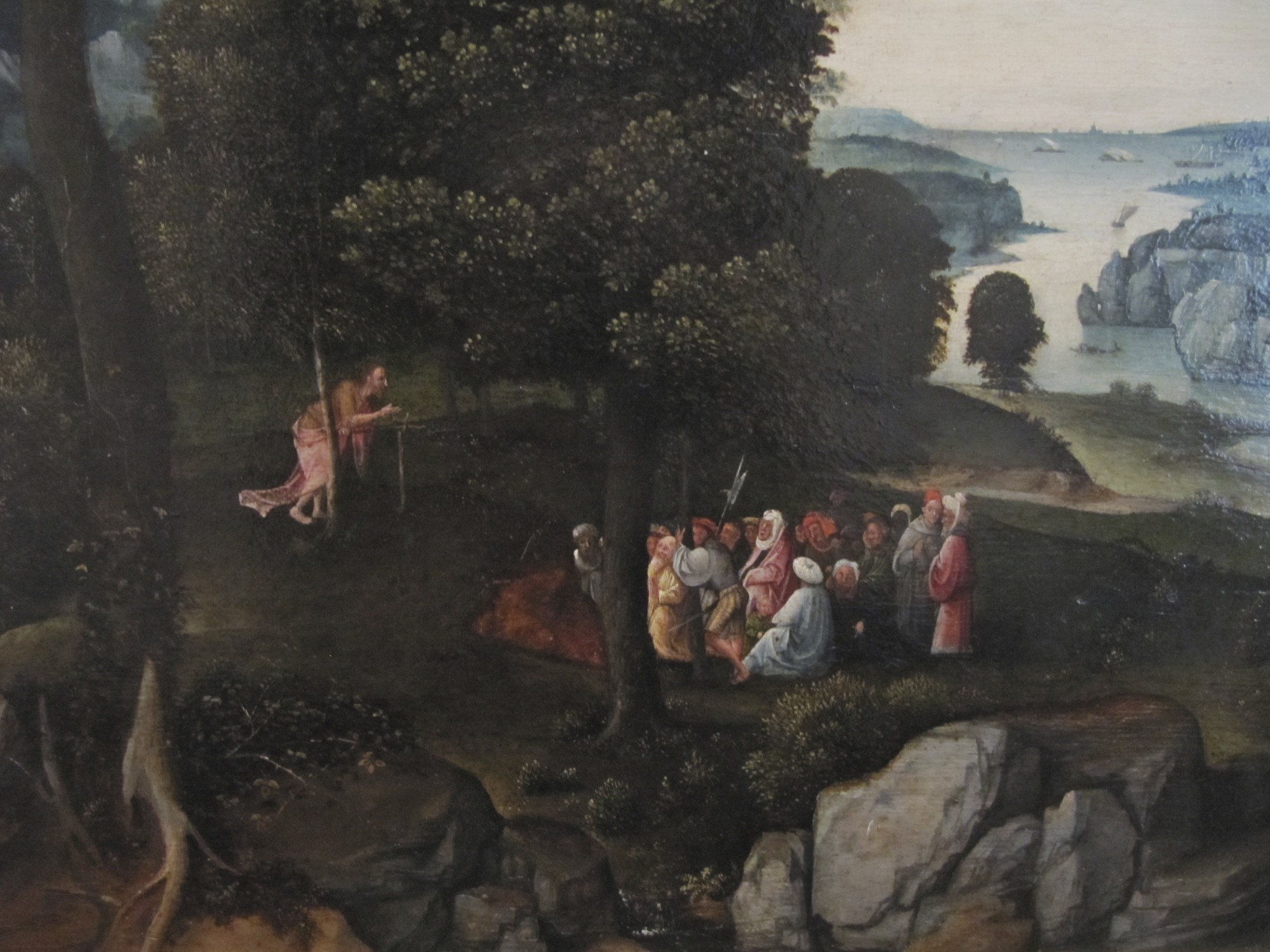
The artist who painted John the Baptist preaching near the Jordan river obviously had no idea what Palestine and the place of John’s ministry looked like, but he gets the story right anyway, I think.
The people listening to John are surrounded by an over-powering wilderness. They’re on their way to Jerusalem, but will they ever get there? There are no well marked trails in sight, no civilized world close by for food and lodging. Only a man preaching to them.
Our readings today from the Old and New Testament point out Elijah and John the Baptist as guides God sent to care for his people, the vine he planted. There were guides then and there will always be guides.
John sent those who listened to him in the wilderness on their way. He baptized them with water and pointed out the path. His words were food for their spirits and brought joy to their hearts. He gave them hope. They’ll find their way.
You can’t listen to the story of the Prophet Jeremiah, our first reading these days, without thinking about the passion of Jesus. In fact, readings from the Book of Jeremiah are common readings for Holy Week. We see Jesus in Jeremiah.
God tells Jeremiah to “hold nothing back,” but speak the truth to those in power and the false prophets of the day, no matter how unpopular it is. Jesus did the same.
Like Jeremiah, Jesus was innocent, but was framed by the powerful as guilty. They questioned his authority, but he would not deny his mission.
Only a few voices seem to stand up for Jeremiah and only a few stood up for Jesus. Neither had many faithful followers at their time of trial. Yet both were carried along by God’s power and their names vindicated.
Jeremiah, like Jesus and John the Baptist who suffered a lonely death at the hands of Herod Antipas belonged to a brave company.
Some would have us see our faith as a ticket to success, an inoculation against failure or suffering. Believe and nothing bad will happen to you. Yet, as you look at Jesus, the prophets and the saints, you see a more realistic profile of faith. We’re promised victory, yes, but only by accepting the mystery of the cross.
Keep an eye on Jeremiah and John. Keep an eye on the passion of Jesus. Follow them.
John the Baptist is a voice that passes away, according to St. Augustine: “John is the voice, but the Lord is the Word who was in the beginning. John is the voice that lasts for a time; from the beginning Christ is the Word who lives for ever.”
John’s “voice” passes away. He no longer baptizes at the Jordan River. He cedes to the Word, and so should we. Our voice passes away; something of ourselves has to go– some of the things we hold dear, the friends who surround us, the institutions that have upheld us. Our way must give way to God’s way.
We think so little of this.
Listen again to Augustine: “What does prepare the way mean, if not be humble in your thoughts? We should take our lesson from John the Baptist. He is thought to be the Christ; he declares he is not what they think. He does not take advantage of their mistake to further his own glory.
“If he had said, “I am the Christ,” you can imagine how readily he would have been believed, since they believed he was the Christ even before he spoke. But he did not say it; he acknowledged what he was. He pointed out clearly who he was; he humbled himself.
“He saw where his salvation lay. He understood that he was a lamp, and his fear was that it might be blown out by the wind of pride.”





 The Victor's Place
