Tag Archives: Jesus

Morning Thoughts: Saint Francis for 4-year-olds (and you and me)


saint-francis-coloring-page

“Saint Francis of Assisi”, coloring book page, colored by a “4-year-old”


(My wife teaches 4-year-olds in a Catholic elementary school. The school’s patron saint is Saint Francis. They call this week “Saint Francis Week” and hold various events throughout the week to celebrate the feast of this great saint (Oct. 4th). My wife and her co-teacher were looking for a short, simple biography that would be appropriate for their 4-year-old students. They didn’t find anything that seemed to be the right fit. So here’s what I jotted down for their pre-K-4 class. The kids really seemed to enjoy it. Maybe you will too. Let us “become like little children”.)


.

Saint Francis, a Knight for God

———

There once was a young man. He lived in a land called Italy. He lived a very long time ago. He lived over 800 hundred years ago!

He lived with his family in a small city named Assisi.

The young man was quite silly. He loved to dream and he loved to sing and he loved to dance. He loved to play with his friends all day long.

The young man’s name was Francis.

His father wanted Francis to be more serious. His father wanted Francis to be just like him. He wanted him to sell expensive fabric to people who were very rich. Fabric is what you use to make pretty things like curtains, tablecloths, and clothes.

Francis’ father wanted him to work in the family shop. But Francis was not very interested in that kind of work. Francis wanted to be a great knight!

And one day Francis went off to do just that.

Francis went off to become a knight. He began to travel to another city where he would fight with a sword and a shield. Francis thought that he would become a great hero.

But on his way Francis got very sick. He had to return to his home. His mother took care of him. And while Francis was getting better he began to dream of different adventures.

He began to spend a lot of time walking around the woods and looking at the flowers and at the trees. He began to watch closely all the animals, especially the birds that flew high up into the sky. Francis began to think a lot about God!

Francis began to dream about heaven. He began to wonder about love. He saw that there was another kind of knight!

Francis decided that he would be a knight for God.

Francis wanted Jesus to be his king and for Mary to be his queen.

Francis no longer wanted to use a sword or a shield. No, Francis wanted to teach all the world how to love. Francis wanted to sing and dance and show everyone how be more like Jesus.

He began to live very simply. He had very few things. His only clothing was an old brown robe. He lived almost like a little animal in the forest. Francis was very free. Francis was filled with joy. He was very happy.

And soon many other young men came to join him. They too wanted to be knights for God. They all lived together. They called each other brother. They shared all they had. They were kind to each other. They loved God together.

And one day, even a young lady wanted to join. She brought other ladies and they started a home of their own. They called each other sister. That young lady’s name was Clare.

A new type of family was beginning to grow. A family who lives very much like Jesus. We call them Franciscans.

We now call that young man, Saint Francis. We now call that young lady, Saint Clare.

Saint Francis and Saint Clare are now in heaven with Jesus and Mary and all the holy angels and saints. They live in perfect peace with God the Father and the Holy Spirit. They see us right now. They pray for us too.

Hey, who knows, maybe one day a few of you boys and girls may become knights and ladies of God, like our patron saints, Saint Francis and Saint Clare!


..

—Howard Hain

.

Friday Thoughts: Pure Extra Virgin

by Howard Hain
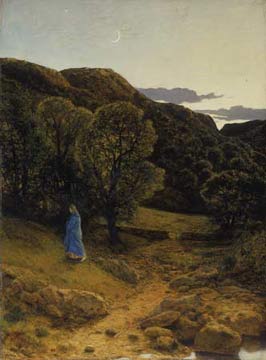
william-dyce-the-garden-of-gethsemane-1860

William Dyce, “The Garden of Gethsemane”, 1860*


To your eyes a thousand years are like yesterday, come and gone, no more than a watch in the night.

—Psalm 90:4


.One good olive.

There are so many factors.

The altitude. The light. The soil. The temperature. The rainfall. The wind. The dew point and humidity. The age of the tree.

Then there are those factors that we can control: pruning, watering, fertilizing, fanning, netting, and wrapping chilly trees with burlap or fleece.

And of course there are those other factors, those that fall somewhere in-between, between our control and our complete lack thereof: most of these relate to the sneaky work of numerous little thieves—animals, birds, insects, and perhaps even fellow farmers or other hungry travelers who just happen to pass by.

But when all is said and done—when all the factors are poured into the olive equation, mixed-up well, and left to unify or settle out—the fruit that’s produced by the world’s most nostalgic, symbolic, and romantic of trees means very little (at least in digestive terms) if it’s simply left to shrivel up and fall to the ground.

———

Picking an olive is perhaps the highest part of the art.

———

When to do so? And toward what end?

If too early, great potential is squandered.

If too late, great taste is lost.

If indecisive, we might as well let nature enjoy it for the time being—for one way or another—God’s process will eventually return it to the earth.

———

And yet, we’re still not done, for even if the olive is picked at just the right time, from just the right tree—the one that has grown in all the right circumstances—when it comes to the culmination of olive production, all is moot if the precious fruit of the womb is never squeezed.

For no matter how good the olive, without applied pressure, there’s nothing left to be labeled “pure extra virgin”.


.But when the fullness of time had come, God sent his Son, born of a women…

—Galatians 4:4


* Gethsemane is the name of a garden on the Mount of Olives in Jerusalem. It appears in the Greek of the Gospel of Matthew and the Gospel of Mark as Γεθσημανή (Gethsēmanē). The name is derived from the Aramaic ܓܕܣܡܢ (Gaḏ-Šmānê), meaning “oil press”.


(Dec/23/2016)


Thoughts Upon The Cross: Doxa. Doxa. Doxa.

by Howard Hain

.

And we have seen his glory,

the glory of an only Son coming from the Father,

filled with enduring love.

—John 1:14


.

The power of God.

A tiny leaf caught between two worlds

Suspended by invisible threads

Dancing to the still small voice.

Deeper and deeper

Into the person

The Son of Man

Who is God.

Glory.

And Might.

Power.

And Majesty.

Fully Alive.

Beautifully Human.

Walking Wisdom.

The Lightness of Fullness.

The Heaviness of Simplicity.

Doxa. Doxa. Doxa.

Honor.

Adoration.

And Praise.

Doxa. Doxa. Doxa.

Beyond praise.

The Power of One.

He Is.

We’re not.

He stands.

We fall down.

He dies.

We live.

Doxa to the Father.

Doxa to the Son.

Doxa to the Holy Spirit.

Doxa. Doxa. Doxa.

Between two worlds.

Is a man.

Who says “I AM”.

A tiny leaf suspended.

He is Lord.

He is God.

Invisible threads.

He Is.

And so now are we.

Dancing.

Still.

Small.

Voice.

The Word.

The Depth.

Beyond the signs.

To the Person Himself.

The Person of Jesus.

Deeper.

And deeper.

Into His flesh.

Into His Glory.

Doxa is Thy Name.

Dwelling among us.

Abiding within us.

Still small leaves caught between two worlds.

Suspended by invisible threads.

Dancing to the breath of God.

From deep to deep.

Depth to depth.

It never ends.

Doxa. Doxa. Doxa.

Doxa in the highest.


.

(May 6, 2017)

Friday: 5th Week of Len

Today’s Readings

https://player.vimeo.com/video/212159869

IMG_0210

Follow the Passion story here: www.passionofchrist.us

The Most Common Occurrence

by Howard Hain


Christ lives in the Eucharistic Prayer.

He listens carefully.

The Father listens too.

We listen with Them.

The Holy Spirit speaks.

He speaks a great silence.

He listens to the listeners.

We collectively hear.

God.

Three Persons.

His Entire People.

All Creation.

The Sound of One Breathing.

The Sound of Life.

Communion.

Amen.


(Jan/4/18)

Still Life with Nativity

by Howard Hain


Can’t keep it neat

Bunched-up cloth

Shifting sand

An avalanche of gifts

Those toward the outside move the most

The trough is fixed in place

The world turns, the Cross stands still” *

Manger, manger, what happened to you?

Sprouted roots

Began life as a tree

…..A table

……….A sawhorse

……………A wagon wheel

Dusty bumpy road

Excitement of a coming feast

Not quite yet

To and fro

Which place is home?

Bethlehem, Nazareth, Jerusalem

The land of Cana

A wedding toast

Now a wooden throne

Plenty of wine to go around

The world turns, the Cross stands still” *

Manger, manger, what happened to you?

Sprouted roots

Began life as a tree


* this line is a loose paraphrase of the Carthusian motto: “Stat Crux Dum Volvitur Orbis” (The Cross Stands Firm, While The World Turns)

Wise as Doves

by Howard Hain

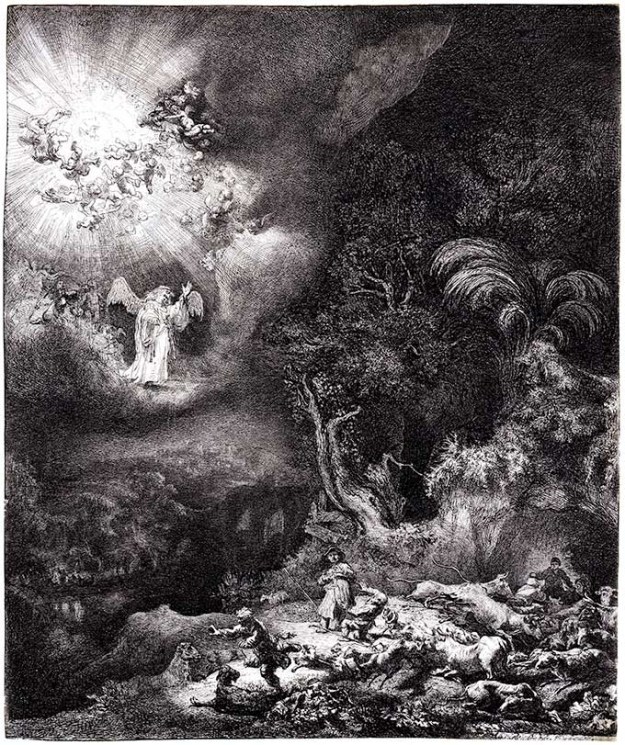
rembrandt-angel-appearing-to-the-shepherds-1634

Rembrandt, “The Angel Appearing to the Shepherds”, 1634


Now there were shepherds in that region living in the fields and keeping the night watch over their flock. The angel of the Lord appeared to them and the glory of the Lord shone around them, and they were struck with great fear.

—Luke 2:8-9


Perhaps the scariest thing to those of us who cling tightly to the things of the world is to accept the job that the Lord assigns us.

Oh, how so many of us are so quick to long for greater adventure!

Yet, when it comes to those humble, little shepherds to whom the angel of the Lord appeared, we are perhaps even quicker to long to be one of them—sitting quietly upon a gentle hillside, effortlessly tending to a passive flock, while the always-full moon provides a soft, ever-so-appropriate illumination from above.

But we are liars. For there’s nothing less romantic in each one of our daily lives, or more mundane. We simply have to be honest, or at least consistent. It all depends on how we look at it. If we see the shepherds in such a delicate light then we also need to see ourselves in the same. For before the angel appears, the shepherds were hardly posing for picturesque landscapes. Perhaps it is for this very reason—their realness, their authenticity, their holy simplicity—that the Lord chose them to be present when He revealed His glory.

It is exciting. We have a wonderful choice, then. Either our “boring” lives make us just the kind of people to whom God prefers to reveal Himself, or our lives are a lot more “exciting” than we ever imagined. Either way, what is vital to making such a decision is true sincerity and genuine gratitude. We need to thank God for who He has made us, for where He has placed us, and for what type of task He has assigned us.

A faithful, humble heart dreams and believes and sees great things among the most ordinary circumstances. Just look at the young virgin and the upright carpenter to whom the shepherds “went in haste” to find in a stable, adoring a child born within the company of the “lowest” of men.

If we spend our time dreaming of being someone else, living somewhere else, and doing something else, we miss the opportunity of being exactly who God intends us to be—and when that happens—we are always in the wrong place, at the wrong time, and most tragically, doing that which matters very little.

For to be the first on the scene, the first to “lay hold”, the first to adore the New Born King, is as good as it gets—even for those whose “normal existence” isn’t standing around all alone—day after day in the scorching sun or biting cold, while picking fleas from matted-down fleece or scaring off hungry wolves.


The angel said to them, “Do not be afraid; for behold, I proclaim to you good news of great joy that will be for all the people…”

So they went in haste and found Mary and Joseph, and the infant lying in the manger. When they saw this, they made known the message that had been told them about this child. All who heard it were amazed by what had been told them by the shepherds.

Then the shepherds returned, glorifying and praising God for all they had heard and seen, just as it had been told to them.”

—Luke, Chapter 2:10,16-18,20


Home Sick

by Howard Hain

I wonder. Did God ever catch a cold?

Did Mary look at Him while He slept, watching carefully His chest rise and fall?

Did Joseph pace around their small home, looking upward, his right hand touching his brow?

I wonder. Did they wince in sync when Jesus coughed from the bottom of His soul?

Was there a day, a single hour, from the moment Jesus was conceived that Joseph and Mary weren’t concerned?

Concerning all this there’s not much to wonder.

Jesus is human.

Of course He experienced “cold” in all its forms.

Of course Joseph and Mary felt they’d rather die than see their child in pain.

And Jesus is divine.

Of course He was homesick.

Of course He longed to return.

Between Mary’s womb and heaven the desert is awfully dry.

He climbed up high, seeking out mountain views.

He returned to the sea, seeking out salt air.

He stopped to hang out with the little ones, seeking out angels.

Jesus is just like you and me.

Only He allows Himself to be loved.

And that led Him to love to the utter extreme.

All flowed from and toward a family reunion.

His pain, His grief, His hope, His love were perfectly ordered.

Even when He coughed or sneezed or tossed and turned, Jesus did so while in the company of a promise.

And He’s extremely contagious.

Joseph and Mary became homesick too.

There’s only one place they could want to be.

With their only child.

Clinging to Him, to their God with all their might.


Communion with Saints

by Howard Hain


A man named Paul lives in my home.

He’s an excellent house guest.

He never imposes.

He’s never and always alone.

My daughter and I talk of him often.

He brings wisdom to our kitchen table.

I’m not exactly sure when he moved in.

But it wasn’t so long ago.

Before and with him there are others.

Theresa, Francis, Bruno, John…just to name a few.

But Paul for some reason never seems to leave.

The others, they kind of come and go.

Paul on the other hand always hangs around.

But then again, I could say the same about the rest.

Is it cliché to say it’s a mystery?


Little Drummer Boys and Girls

by Howard Hain

Yesterday I witnessed a “dress” rehearsal for a live nativity. The cast was made up of first and second graders, and the audience was mostly composed of residents of a retirement home for religious sisters, Franciscans. It was spectacular.

Last week I was at Radio City Music Hall to watch the Rockettes in their “Christmas Spectacular”. It was quite a production.

Sitting in the dark this morning I cannot help but contrast the two.

I also cannot help but relate to the seven-year old who played the part of The Little Drummer Boy.

As that child walked so slowly toward the foot of the altar, where the rehearsal was being staged, I saw my vocation in an entirely different light.

The children were all singing their hearts out, and many of the eighty and ninety year-old sisters were mouthing the words. The boy with the drum didn’t utter a sound. He just kept walking, slowly, extremely slowly toward the altar, every once in a while ever so slightly pretending to tap two tiny sticks upon a toy drum. He was beautifully awkward.

There was no greater spectacle on earth at that very moment. Shall I dare to say, no greater event that heaven or earth has ever known?

For a child was born. We were all being born.

———

Come they told me, pa rum pum pum pum
A new born King to see, pa rum pum pum pum
Our finest gifts we bring, pa rum pum pum pum
To lay before the King, pa rum pum pum pum,
rum pum pum pum, rum pum pum pum,

So to honor Him, pa rum pum pum pum,
When we come.

Little Baby, pa rum pum pum pum
I am a poor boy too, pa rum pum pum pum
I have no gift to bring, pa rum pum pum pum
That’s fit to give the King, pa rum pum pum pum,
rum pum pum pum, rum pum pum pum,

Shall I play for you, pa rum pum pum pum,
On my drum?

Mary nodded, pa rum pum pum pum
The ox and lamb kept time, pa rum pum pum pum
I played my drum for Him, pa rum pum pum pum
I played my best for Him, pa rum pum pum pum,
rum pum pum pum, rum pum pum pum,

Then He smiled at me, pa rum pum pum pum
Me and my drum.*


Little Drummer Boy was composed by Katherine K. Davis, Henry Onorati and Harry Simeone in 1958.


Howard Hain is a contemplative layman, husband, and father. He blogs at http://www.howardhain.com