Tag Archives: Jesus

Morning Thoughts: Up and Away

by Howard Hain

.

“In the same way, everyone of you who does not renounce all his possessions cannot be my disciple.”

—Luke 14:33


.

Butterflies fly.

They sail beautifully and somewhat clumsily at the same time.

It’s as if even their own weight is almost too much to carry.

Hard to imagine them bringing anything else along for the ride.

Paper-thin wings—watercolored and air-dried—the rain keeps them tucked away, hidden, out of sight.

Even little drops of morning dew keep them from flight.

But the hour will come.

Just wait and see.

Still. Quiet. Like an upright leaf.

They position their wings just right.

The sun to burn away all unwanted drops.

———

Have you dew-covered wings?

Does the dew of life weigh you down?

Do you want what’s unwanted to be burned away?

Have you tried pointing your wings toward the sun?

Or do you really not want to float above?


.

“You, my brothers and sisters, were called to be free.”

—Galatians 5:13


.

.

Friday Thoughts: Just The Facts

by Howard Hain

.

All human beings are creations of God.

God loves all His creation.

He wills the best for each and every part of it.

His will is the best.

You are one of His creations.

So is the person you hate.

So is the person you dislike tremendously.

So is the person who annoys you to death.

God loves us all.

God offers us forgiveness for being so unkind to His other creations.

He loves us so much He gives us the freedom to choose the wrong path.

He loves us so much He sent His Only Begotten Son to show us the right way.

Jesus loves us so much He sent the Holy Spirit to strengthen and accompany us.

God smiles.

All three persons smile.

They are One God.

God’s love is all powerful and infinitely kind.

God’s gift of freedom is a gift He intends for us to use.

God desires for us to choose to become like Him.


.

.

Morning Thoughts: Over Easy

by Howard Hain

.

A run-of-the-mill bakery.

A hand truck full of eggs.

A handful of women from Latin America.

Neither load is fragile.

A woman’s strength may appear as a delicate shell, and if poorly handled she too may break.

But strength is not a matter of not breaking.

It’s a matter of showing up, chipped, broken, sometimes even shattered.

It’s a matter of overcoming.

Of producing.

Of providing.

Of letting go.

One buttered roll at a time.

Preparing the day “café con leche” by “café con leche”.

The eggs slowly disappear.

The ladies change names.

Mary, the Mother of God, remains.

———

“Holy Mother, pierce me through, in my heart each wound renew, of my Savior crucified.”

———

It’s a matter of believing. Of dreaming. Of seeing what can’t be seen. Of loving who can’t be loved.

It’s a matter of hope that never ends, of hope that sustains the very faith from which it came.

It’s a matter of saying “yes” to each and every hour—for someone must be present to serve God’s promise of daily bread.

———

She who stands closest to the foot of the cross most resembles the man being crucified. She must embody Compassion, she still hears His breath, expanding and contracting deep within. Suffering is not be feared. Being without the source of all consolation and peace is just too terrifying.

The “fear of the Lord” keeps us within the grasp of Jesus’ hand.

It “is the beginning of wisdom.” Mary is there to begin. She remains till the end.

Wisdom begets Wisdom.

And she most often looks like a little unpresuming lady working behind a busy breakfast counter.

She is a lady nonetheless.

She is the mother of all I hope for.

———

“Pray for us, O holy Mother of God; that we may be made worthy of the promises of Christ.”

———

.

.

Friday Thoughts: Uneasy Mercy

by Howard Hain

.

Behold, this child is destined for the fall and rise of many in Israel, and to be a sign that will be contradicted…

—Luke 2:34


.

When we are truly merciful, or at least sincerely try to be merciful—to see others and their deeds through the eyes of the Ever-Loving Eternal Father—there often is an unholy fear that takes place. This fear is not the fear of God. This fear is not from God.

No, the fear of God—the good and righteous “fear of the Lord”—a gift of the Holy Spirit—is not the fear to which I am referring. Let us make that perfectly clear. Absolutely not. That fear—the good and righteous “fear of the Lord”—is a great grace and is actually what prompts us to be merciful toward others in the first place.

The fear that I am referencing is superficial, like all fear other than the only fear we should ever have, “the fear of the Lord.” Whether this superficial fear comes from the world, from our own weak flesh, or from Satan, is not very important. For what we need to know and always remember is that this superficial fear is not of or from God.

It is the fear of being accused. Accused of condoning. For when we see others with true mercy we no longer merely look at their acts, no matter how sinful they may be. No, we see first and foremost a person. More so, we see a child. A child who is frightened. A child who is running a high fever. And no one with any heart at all, even if it be a calloused and somewhat hardened heart, wants to punish a frightened or feverish child.

No, no matter our maternal or paternal instinct, or lack thereof, the truly human instinct is to hug. To help. To hold. To heal. To alleviate the fear and burning pain.

But without God’s grace we too often, almost always in terms of statistical significance, do not see a child.

We only see a person who has harmed our world, our society, our way of life, our order, our peace.

We only see a person who—no matter how indirectly his or her actions might affect us—has harmed us and our families personally, and we along with the rest of the mob want justice.

A conflict takes place.

God’s perspective versus the world’s. A frightened and sick child versus a criminal who must be punished. Mercy versus justice.

But the conflict isn’t real. God not only loves justice too, God is Justice. And he sent His Only Begotten Son as expiation for the great injustice of mankind. Our kind. Our sin.

For God to only see the need for punishment is for God to deny His Only Begotten Son. That is not going to happen.

So the next time you feel the desire to be merciful—the need to be merciful—even toward the most “obvious” and “blatant” sinner do not give into the temptation. The temptation to fear. The fear that you are in some way condoning the sinful action because you are refusing to demand immediate and absolute punishment, a punishment that “fits the crime.”

No, say the Lord’s Prayer.

You are on God’s side. God is being merciful through you. And no matter how intimidated you may feel, be “firm and steadfast” in God’s love and mercy.

For you too love justice. You too love Jesus. And Jesus is Justice.

Jesus is Living and Breathing Justice.

And it is through this very person, The Person of Jesus, that “mercy and truth have met each other: justice and peace have kissed.” (Psalm 85:11)

Praise be to God.


.

.
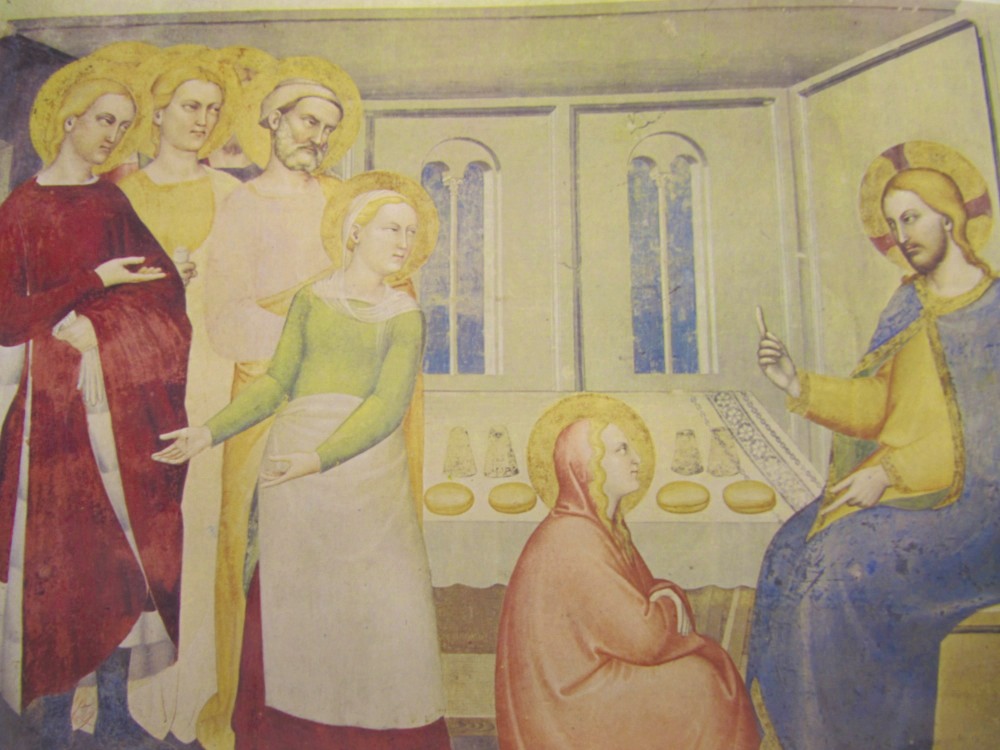
Martha, Martha

29d6ce6c782d7314a69950e1a560b871

We read St. Luke’s account of Jesus’ visit to Bethany for the Feast of St. Martha. It’s part of Jesus’ journey from Galilee to Jerusalem (Luke 10,38-42), a journey Luke describes,  not by miles, but by the people Jesus meets.

Jesus is a prophet speaking God’s word as he goes. Some reject him outright on his way to Jerusalem.  Jesus enters the house of Martha and Mary as a prophet speaking God’s word. Unfortunately Martha, busy about many things, misses his word and Jesus rebukes her. Mary hears his word and is praised. Good as she is, Martha’s carrying too many of the “cares of this life” when Jesus visits.

That’s what Luke wants us to learn from this gospel- the cares of this life can get in the way of hearing God’s word. But we all know there’s more to Martha than what Luke tells us here. Other New Testament sources praise this good woman.  John’s gospel, for example, says that  Jesus was a long time friend of Lazarus and his sisters in Bethany.

I keep two other sources in mind when I read Luke’s story.  One is a painting (above) by the 13th century Tuscan artist, Giovanni di Milano, showing Jesus with Martha and Mary at Bethany.

The artist imagines a supper at Bethany. The table’s set for four people– that would be Jesus, Lazarus, Mary and Martha. But look at the others coming in the door. Obviously, they’re Jesus’ disciples, led by Peter. One disciple gestures towards Peter, as if saying, “He told us to come.”

Poor Martha in her apron holds up her hands in frustration, “What are we going to do?”
There will be no miracle. The miracle is Martha’s hospitality. Thanks to her,  more than four are going to be fed. We need artists like di Milano to flesh out what the gospels say.

The other source I like is St. Augustine who obviously has a soft spot for Martha and the work she does. Both Martha and Mary had the same holy desire, Augustine says: “ They stayed close to our Lord and both served him harmoniously when he was among them.”

Martha served him as the “Word made flesh,” who was hungry and thirsty, tired and in need of human care and support. She longs to share what Mary enjoys, his presence, his wisdom and his gifts. And she will find her desires fulfilled.

“You, Martha, if I may say so, will find your service blessed and your work rewarded with peace. Now you are much occupied in nourishing the body, admittedly a holy one. But when you come to the heavenly homeland you will find no traveller to welcome, no one hungry to feed or thirsty to give drink, no one to visit or quarreling to reconcile, no one dead to bury.”

“No, there will be none of these tasks there. What you will find there is what Mary chose. There we shall not feed others, we ourselves shall be fed. What Mary chose in this life will be realized there in full. She was gathering only fragments from that rich banquet, the Word of God. Do you wish to know what we will have there? The Lord himself tells us when he says of his servants, Amen, I say to you, he will make them recline and passing he will serve them.”

Want to see Bethany, home of Martha, Mary and Lazarus. Take a look here.

Morning Thoughts: One Good Influence

by Howard Hain

.

Teach us to number our days, that we may gain a heart of wisdom.

—Psalm 90:12


.

Sometimes I feel I have no identity at all. I am at each new successive moment the current culmination of the influences upon me.

I don’t know if this statement is true or not, or if it has any truth attached to it at all—or if perhaps it is merely some kind of “existential” temptation. But just in case there is something to it—something worth paying attention to—I should probably then also ask this very real and relevant question:

What influences are upon me?

If I don’t begin my list with “THE WORD”, then something is certainly not right.

Something is clearly out of order.

“Lord…order our days in your peace…” (Eucharistic Prayer I)

———

It is worth noting that ‘days’ takes the plural form, as does ‘words’.

And let us remember that that is not what God sent.

God sent His Son. Not words.

“And the Word became flesh…”

Jesus is truly singular. So much so He is the only universal.

———

So as we receive our daily correction, and as we get ourselves back in order, let us spend time sincerely reading Sacred Scripture, and let us also remember to never mistake the words for The Word: The Living Breathing Presence of Jesus Christ. The Person. The Man. God Made Man. The Only True Being. Ultimate Reality. Ultimate Unity. Ultimate Oneness. The Guy Next Door.

For Jesus is alive.

He lives “before the foundation of the world”. He lives a few thousand years ago. He lives tomorrow. And yes, He lives today—much closer in fact to each and everyone of us—and in much less “extraordinary” circumstances than we too often are told to think.

Let us be influenced.


.

With the Lord a day is like a thousand years, and a thousand years are like a day.

—2 Peter 3:8


.

.

Friday Thoughts: Out Of This World

by Howard Hain


Vncent van Gogh 1887 Sunflowers Met Museum

Vincent van Gogh, “Sunflowers”, 1887, The Met


If only we lived our lives in sanity.

In ability.

In equality.

In justice.

In security.

In compatibility.

In fidelity.

In experience.

In sensitivity.

In vulnerability.

In stability.

In decency.

In fertility.

In gratitude.

In sincerity.

In humanely.

In the world.

In the Word.

In Christ.

In Love.


.

“[Holy Father]…I do not ask that you take them out of the world but that you keep them from the evil one.”

—from the “High Priestly Prayer” of Jesus
(Prayer for the Disciples)
The Gospel According to John, Chapter 17 (verse 15)

.

http://www.usccb.org/bible/john/17

http://www.metmuseum.org/art/collection/search/436524

.

Morning Thoughts: Prayer

by Howard Hain

.

I sat toward the back. Near the cooler. At the third table of three.

Looking through the line of bakery customers, I see out the storefront window, across the somewhat crowded street—that seems to be undergoing never-ending construction—a woman waking by. She passes before the window of the corner convenience store. She crosses herself. I don’t know why. But I believe.

I don’t understand.

But I trust.

I don’t desire. I don’t will. I don’t want.

I respond with faith.

She is good. She is like you—trying her best. She is like me—she could do better.

God loves her. God loves you. God loves me. Nonetheless.

The desire to love is love.

The will to union is union.

The Freedom of Christ is a Cuban pastry with three holes.

I eat away.

I taste and see.

My food is to do the will of Him who sent me.

Faith. Hope. Charity.

All else is a small pile of crumbs—gently laid to rest—the edge of the bakery table—on the well-worn tile floor.


.

“There is nothing more gracious than to think well of our neighbor.”

—Saint Therese of Lisieux


.

.

Friday Thoughts: Simple Awe

Picasso, The Blind Man's Meal, 1903

Picasso, “The Blind Man’s Meal”, (1903)

.

The ear that hears, the eye that seesthe Lord has made them both.

—Proverbs 20:12

———

It is the simple times. It is when we are doing life one dirty dish, one utility bill, one ordinary errand at a time that deepened faith creates an awe-filled stir.

For much is said of the bells and whistles of supernatural faith—but what is most supernatural is the presence of “all”, of “everything”, of “heaven and earth” in each dirty dish, each electric bill, each trip to the dollar store. What is most supernatural is the acknowledged presence of God in day-to-day life.

The deeper our trust, the more complete our surrender, the less “exciting” the external signs need to be. Or to express it differently: The least “exciting” times become so overwhelmingly profound that bells and whistles are hardly noticed.

We are told that we need an ear that hears and an eye that sees.

But what is it to have them?

Is it being still within God’s presence while the sponge soaks, the envelope seals, the cash register line slowly shortens?

The skeptic may see such a man as confined by complacency, dangerously satisfied, or simply numb. The skeptic may even call such a man “blind”.

That is certainly one way to look at it.

There is another:

Or is it that the mighty awe of a salvaged life has finally taken hold?

———

Turning to the disciples in private he said, “Blessed are the eyes that see what you see. For I say to you, many prophets and kings desired to see what you see, but did not see it, and to hear what you hear, but did not hear it.”

—Luke 10:23-24

.

.

—Howard Hain

.

Friday Thoughts: School of Athens

by Howard Hain
Raphael School of Athens Vatican Museum

Raphael, “School of Athens”, 1509-11, Vatican Museums, Raphael’s Rooms, Room of the Segnatura


.

I see you there

Somewhere near the back

Hiding

Thinking no one can see

A priest

A prophet

A king to be

———

Socrates?

A profile

Like the head on a coin

Another good man

Snubbed for what he knows

Can’t see your face

Not fully

Say the least

Though perhaps

We too would die

A drop of hemlock

Is hard to swallow

———

Like that fine-feathered friend

All philosophers are

Little birds

Not too fat to fly

Aerial feeders

Circumventing the globe

Following truth

Wherever it go

———

Plato?

Yes

Now you

We see for sure

After all

Like a son

You and Socrates

Your father figure

Setting up shop

Hanging out

A common shingle

Hard to distinguish

In fact

The fiction

Son from Pop

One generation

Stumbles upon truth

The next

All about father’s business

Selling sovereignty

The sovereignty of Good

Not by peddling answers

By asking simple questions

———

Aristotle?

Yes

He made the frame

The third person

The younger brother of sorts

In some sense

Stealing the show

A third amigo

A sort of philosophic trinity

Aristotle the great

Teaching emperors to be

A bright bronze star

Mentioned last

Never least

A meta-physician

Looking not to the past

He expanded business

Once Plato left the scene

Pointing the way

He thought it should go

Down to earth

Keep it real

Hover low

Eyes on substance

On the truth below

———

Quite a team

These three musketeers

Sharp whiskers

Well-trained tongues

Doubled-edged swords

Wielded about

In universal hands

Yet many others

Names we might know

The great wall of knowledge

An army

To remain

The great unknown

———

Truth

Beauty

The noble pursuit

Lady Wisdom

Her many lovers

And each takes her as his own

A cloud of witnesses

Testifying one truth

The Communion of Saints

Under a different kind of roof

———

Look at that structure

Who built the arch?

It overrides

Every branch of the tree

If colored

It’d be a rainbow

Yes

That once great sign

Now brought so low

Meant so much

Primary color

Fragmented light

Quite a choice

Magic marker

Cross the sky

God’s endless love of life

A sacrament

One might say

A sign

As natural as natural can be

The offspring of union

A pledge

A covenant

A promise

The kind that brings new life

Adam

Then Eve

Woman created

From the lonely side of man

To lovers

Of such wisdom

Truth is clear

The rainbow redeemed

It will once more

Point to the sun

After yet another storm

The fullness of noon

Its rightful place

Where nothing disordered

Continues to loom

———

Welcome home

Child of wonder

Come on in

The water’s warm

Jump high

Up over the frame

Roman columns

Marble floor

Robes in many shades

Your heart

Away from home

Bring nothing more

Leave your sandals

At the door

A burning bush

Holy ground

Children at play

A clubhouse of truth

Safe and sound

Slides and swings

Monkey bars

Hang on tight

Hold on loose

No possessions

Got to share

Acts

Appreciation

Sons of liberty

Daughters of revolution

The mulberry tree

What’s that?

Your degree?

Of such things

We just don’t care

———

Poetry

Completely still

Motion

In dialogue

Statues

Alive

Silent features

Arch

And texture

Every detail

All one view

Did you hear?

Have you seen?

The latest

No not the news

What’s truly new

Not the fleeting

Nor the slice

Not cutting edge

What’s new is old

All under the sun

Originality

Yesterday

Genesis just begun

Just a few rules

Keep perspective

A frame

If you will

A type of kind

Boundless

Creativity

Yes

But not for sale

Bring what’s prized

Not the least

Only one item

The book of life

———

God became man

Truly human

Not veneer

Truth among us

Not to abolish

Bring to fullness

Humanistic pursuit

The glory of God

Made manifest

In man’s pursuit

Of God Himself

———

Jesus

In disguise

The philosopher’s cloak

Reaching upward

To shake His own hand

At the right side

God the Father


Raphael School of Athens 1509-1511.jpg

Raphael, “School of Athens”, 1509-11, Vatican Museums, Raphael’s Rooms, Room of the Segnatura

.

http://www.museivaticani.va/content/museivaticani/en/collezioni/musei/stanze-di-raffaello/stanza-della-segnatura/scuola-di-atene.html