Tag Archives: Jesus Christ

Novena to St. Ann

Throughout the Catholic world novenas honoring St. Ann begin July 17.

You won’t find the names of Ann and Joachim in the bible, but they’re mentioned in one of the apocryphal books, the Protoevangelium of James, written shortly after our New Testament writings.

Interest in Jesus’ family came about because of claims that he was “Son of David,” the Messiah  expected to come from David’s line. Against those who said Jesus was only a carpenter from Nazareth, the infancy narratives in Matthew and Luke assert that  Jesus is the Messiah, descended from David.

The Protoevangelium of James also sees Joachim and Ann  in David’s line, and therefore Mary was too. It says they lived in Jerusalem. Did they accompany Mary to Nazareth after her marriage to Joseph? If so,  Jesus had grandparents taking care of him for a time.

If that’s true, it means Ann and Joachim gave Jesus something more besides proof of his bloodline.  Along with Mary and Joseph, they brought him up. As a young child he learned from them, the simplest and the most sublime things. Knowledge came to him, as it comes to us–through the senses, through mothers and fathers, grandmothers and grandfathers.

St. Ann is often pictured with her daughter Mary holding a small book in her hands. Written on the book in the statue here in this church are the words, “If today you hear God’s voice, harden not your heart,” a verse from the psalms.

Other statues of her have different words in the book. “I,2,3,4; A,B,C,D.” The basics of life. Or notice Giotto’s picture of the presentation of Mary in the temple. (above) Ann pushes her little daughter into the temple. Just like pushing kids to church today?

Parents and grandparents play a powerful role in the lives of their children and grandchildren. They teach kids their abc’s and the  sublime mysteries of faith. Maybe that’s why so many of them make this novena.  They know that’s true.

Daily Readings, Daily Bread

Reading the scriptures daily and on Sundays in the lectionary and the Liturgy of the Hours is one of the great reforms begun by the Catholic Church after the Second Vatican Council. It’s an effort to seek renewal through the Word of God, yet after 60 or so years we’re still getting used to it. Not too many individuals or parishes or other groups in the Catholic Church focus on it, in my view.

Early Christianity saw the scriptures as daily bread. Today we may think the scriptures old and and not up to offering wisdom to our age. More than ever, we have to trust if we search for “the face of God” in scripture we will find it there.

“If today you hear his voice, harden not your hearts.” The daily scriptures are daily bread, but they may not be easy to digest. We go from Matthew, preoccupied with the tensions of his church with Pharisaic Judaism,  to Luke preoccupied with an outreach to the gentiles, to the other New Testament writings, each with its own purpose.

Then there are the various readings of the Old Testament. They can be hard to understand, but the church wisely keeps them side by side with the New Testament. They hold a treasure all their own. We need to understand them better.

We need help to appreciate this daily bread, this varied diet served up. We need people like those hosts on the cooking shows on television who not only  tell you what to eat but make those strange dishes appetizing and appealing. We need good homilists and good catechists.

We need a “lamp, shining in a dark place.” So we ask: Come, Holy Spirit, fill our hearts with your light.”

Lamp for a Dark Place

Spring Lake even

The sky over the boardwalk at Spring Lake, New Jersey, is sometimes swept with colors before nightfall. Then, a lamp becomes the only light till dawn.


“I came into the world as light,” Jesus says in today’s gospel” so that everyone who believes in me might not remain in darkness.( John 12:44-50)


The sun will rise again and the great Sun will also rise again, Augustine says in one of his sermons. Then  “lamps will no longer be needed. When that day is at hand, the prophet will not be read to us, the book of the Apostle will not be opened, we shall not require the testimony of John, we shall have no need of the Gospel itself. Therefore all Scriptures will be taken away from us, those Scriptures which in the night of this world burned like lamps so that we might not remain in darkness.”

Darkness is temporary; we are meant for light.

“I implore you to love with me and, by believing, to run with me; let us long for our heavenly country, let us sigh for our heavenly home, let us truly feel that here we are strangers. What shall we then see? Let the gospel tell us: In the beginning was the Word and the Word was with God and the Word was God. You will come to the fountain, with whose dew you have already been sprinkled.

“Instead of the ray of light which was sent through slanting and winding ways into the heart of your darkness, you will see the light itself in all its purity and brightness. It is to see and experience this light that you are now being cleansed. Dearly beloved, John himself says, we are the sons of God, and it has not yet been disclosed what we shall be; but we know that when he appears we shall be like him, because we shall see him as he is.

“I feel that your spirits are being raised up with mine to the heavens above; but the body which is corruptible weighs down the soul, and this earthly tent burdens the thoughtful mind. I am about to lay aside this book, and you are soon going away, each to his own business. It has been good for us to share the common light, good to have enjoyed ourselves, good to have been glad together. When we part from one another, let us not depart from him.”

Following Jesus Christ in Lent

Lent 1

Lent is coming. Let’s join those disciples in our picture above following Jesus. One way to follow him is by reflecting on the lenten scriptural readings recommended for the Sundays and weekdays till Easter. They’re the basic book for lenten reading.

On the 1st Sunday of Lent, this coming Sunday, Luke’s gospel takes us to the Jordan River where Jesus is led into a deserted place by the Spirit and tempted for 40 days after his baptism. Our journey  begins  in a desert. Readings from Luke’s Gospel lead us through the Sundays of Lent this year.

The weekday gospels for the first three weeks of lent are mostly from Matthew, the early church’s favorite gospel for catechesis during Lent. Matthew brings us to Galilee  where Jesus speaks “the words of eternal life” in his Sermon on the Mount.  (Matthew 5-7) Be faithful to prayer and you will grow in wisdom, Jesus says.  ( Tuesday and Thursday, 1st week of Lent)  Love your neighbor, even your enemies and “the least,” whom we easily overlook. ( Monday, Friday, Saturday, 1st week of Lent)

Peter’s confession at Caesaria Phillipi is the highpoint of the first part of Matthew’s gospel. “You are the Christ, the Son of the living God,” Peter says to Jesus. “You have the words of everlasting life.” Lent invites us to join him in that same confession.

Yet, can we possibly love and believe that way, so lofty and challenging? We’re rather weak disciples.  Jesus doesn’t call perfect disciples, the reading for Saturday after Ash Wednesday reminds us. He called  Matthew the tax collector and people like him–not very good keepers of the law. Outsiders and sinners like them tell us we belong in the lenten season. (Luke 5, 27-32)

Matthew’s gospel takes us up the Mount of the Beatitudes. Like most sacred writers, Matthew likes mountains; you see ahead  more clearly from them. On the 2nd Sunday of Lent, we go up to the Mount of the Transfiguration to glimpse the  glory found ahead.

By the 4th week of Lent,  we arrive  in the Holy City, Jerusalem, to the temple mount and  then the Mount of Calvary. Starting with the 4th week most of the weekday lenten gospels will be from the Gospel of John. I’ll say something about them before we get there.

You can follow the lenten readings online here.

I’ll mention some lenten devotions, like the Stations of the Cross, in the next few days.

Bless the Tree in Your House

Don’t forget to bless your Christmas Tree which reminds us that, besides the blessings of the human family, we’re blessed through creation.

Long ago, God placed a tree of life in the garden of paradise as a sign of the wisdom, knowledge,  and every good thing the created world brings us.

Our Christmas Tree reminds us of creation’s blessings  and the blessings we receive through Jesus Christ who renews the created world through his coming.

IMG_1347

IMG_1348

A Voice That Passes Away

Spring Lake even

John the Baptist is a voice that passes away, according to St. Augustine:  “John is the voice, but the Lord is the Word who was in the beginning. John is the voice that lasts for a time; from the beginning Christ is the Word who lives for ever.”

John’s “voice” passes away. He no longer baptizes at the Jordan River. He cedes to the Word, and so should we. Our voice passes away; something of ourselves has to go– some of the things we hold dear, the friends who surround us,  the institutions that have upheld us.  Our way must give way to  God’s way.

We think so little of this.

Listen again to Augustine:  “What does prepare the way mean, if not be humble in your thoughts? We should take our lesson from John the Baptist. He is thought to be the Christ; he declares he is not what they think. He does not take advantage of their mistake to further his own glory.

“If he had said, “I am the Christ,” you can imagine how readily he would have been believed, since they believed he was the Christ even before he spoke. But he did not say it; he acknowledged what he was. He pointed out clearly who he was; he humbled himself.

“He saw where his salvation lay. He understood that he was a lamp, and his fear was that it might be blown out by the wind of pride.”

Tuesday, 3rd week of Lent

Peter’s question about forgiveness in today’s gospel ( “How many times must I forgive my brother?”) isn’t just his question. He’s asking the question for all of us.

Measure your forgiveness by God’s forgiveness, Jesus says to Peter. It’s beyond measure, and he gives Peter and all of us a story of two servants. Both are involved in a money operation gone wrong. As we know money brings out the worst in people.

There’s a big difference in the money owed. The first servant owes ten thousand talents, a huge sum, and in a unexpected display of mercy, his master forgives the entire debt.

After being forgiven so much, however, that servant sends off to debtors prison another servant who owes him a few denarii, a small sum. The ten thousand talents his master has forgiven him would be worth about 10 million denarii. Big difference!

The story isn’t our only teacher, however.  God’s unmeasurable forgiveness finds its greatest expression in the passion and death of Jesus: “Father, forgive them for they know not what they do,” he cries out from the cross. He pleads, not for one, or a few, but for the whole world. Jesus reveals the mercy of God beyond measure.

We’re called to measure our forgiveness of others against his.

Lord, let me hear your call for forgiveness from the cross,

and let me make your call mine.

His Kindness Has Appeared

These are days to reflect on the mystery of the Incarnation. A decisive revelation of God, the Letter to the Hebrews says:

“At various times in the past and in various different ways, God spoke to our ancestors through the prophets; but in our own time, the last days, he has spoken to us through his Son, the Son that he has appointed to inherit everything and through whom he made everything there is.(Hebrews 1, 1-2)”

What does Jesus Christ reveal about God? He is the Word of God who reveals God to us, St. Bernard says, and in him “the kindness and love of God has been revealed and  we receive abundant consolation in this pilgrimage, this exile, this distress.”

Before he appeared as human, God’s kindness lay concealed, Bernard says. “Of course it was already in existence, because the mercy of the Lord is from eternity, but how could we know it was so great? It was promised but not yet experienced: hence many did not believe in it. At various times and in various different ways, God spoke through the prophets, saying I know the plans I have in mind for you: plans for peace, not disaster…”

“What greater proof could he have given of his mercy than by taking upon himself what needed mercy most? Where is there such perfect loving-kindness as in the fact that for our sake the Word of God became perishable like the grass? Lord, what is man, that you make much of him or pay him any heed?”

“See how much God cares for us. See what God thinks of us, what he feels about us. Don’t look at your own sufferings; look at God’s sufferings. Learn from what he was made for you, how much he makes of you; let his kindness be seen in his humanity.”

“ The lesser he has made himself in his humanity, the greater has he shown himself in kindness. The more he humbles himself on my account, the more powerfully he engages my love. The kindness and humanity of God our Saviour appeared says St Paul. The humanity of God shows the greatness of his kindness, and he who added humanity to the name of God gave great proof of this kindness.”

How Do We Learn and Pray Now?

Education is up in the air these days. Our schools are struggling. How will kids be educated?

Our faith formation programs are struggling too. The Mass and sacraments–ordinary ways we pray–are drastically curtailed. What do we do?

Could our homes and families become our churches? Can we find teachers and  temporary sacraments there?

A friend of mine was in prison for awhile and ended up once in solitary confinement after a fight he had with another inmate. He told me he remembered in the dark what a nun had told him about the rosary. Ten Hail Mary’s and an Our Father. He started counting the prayers on his fingers and, after awhile, he found a great peace came over him, so much so that after getting out of confinement he asked the chaplain for a rosary. It led to a profound conversion. He was changed by the experience there in the dark.

We’re living in the dark these days, but do these days have to diminish us? Maybe we can learn to pray more simply these days. Simple prayers we may have abandoned, maybe there’s a bible or a prayerbook lying forgotten in a drawer. Simple prayers are always the best,  because God takes simple form to come to us. Jesus came “in the form of a slave,” remember, he used simple things like bread and wine to bring us his greatest gift. 

This could be a time to pray simple prayers and to teach them to our kids. You never know when they’ll bring them peace.

Martha Revisited

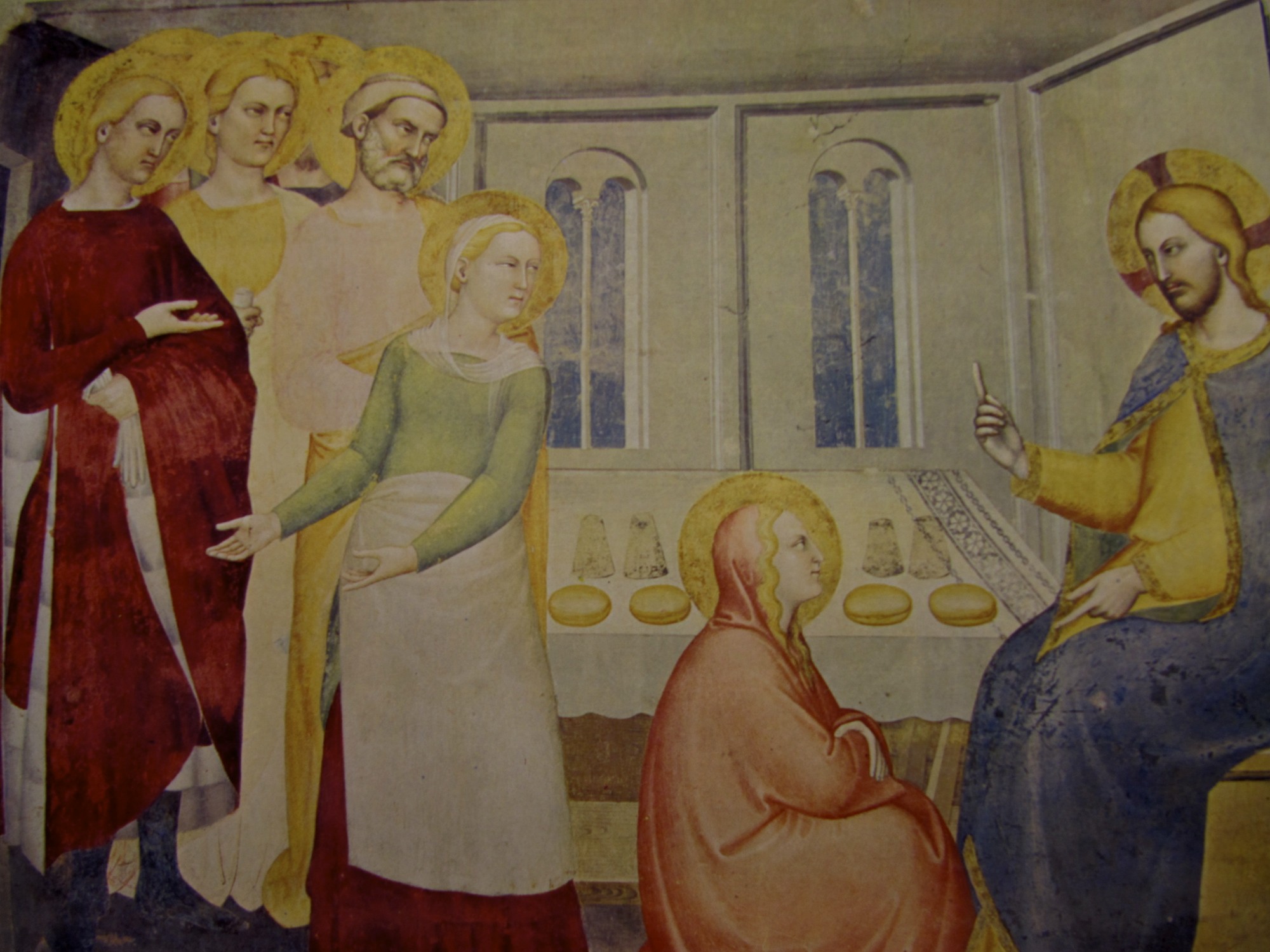
We listen to scholars who study the bible. How about artists too? Here’s  the 13th century Tuscan artist, Giovanni di Milano, looking into Luke’s gospel about  Jesus with Martha and Mary at Bethany.

The artist adds some delightful details of his own to Luke’s account. He’s let his imagination roam. The table’s set for four people. That would be Jesus, Lazarus, Mary and Martha.

But, who are those others coming in the door?  Obviously, they’re Jesus’ disciples, led by Peter. One of them gestures towards Peter, as if saying, “He told us to come.”

Poor Martha in her apron holds up her hands, “What are we going to do?”

There will be no miracle, except the miracle of Martha’s hospitality.

More than four are going to be fed.

We need to read the gospels like this too.

Almighty ever-living God, your Son was welcomed in Martha’s house as a guest, grant, we pray, that through her intercession, serving Christ faithfully in our brothers and sisters, we may be received by you in the halls of heaven.Through our Lord Jesus Christ, your Son, who lives and reigns with you in the unity of the Holy Spirit, one God, for ever and ever.