He’s running into a burning building to rescue a small child.
He’s chasing down a thief who nabbed a pocketbook from a helpless old lady.
He’s performing CPR on a middle-aged man in the midst of a heart attack.
He’s keeping diligent watch over the safety of a nation.
But there is no “burning building”, no “thief”, no “heart attack.” And the “nation” he watches over is his own home.
Oh, but there is crisis, there are certainly trials.
There are countless situations and scenarios that require heroic virtue.
For the child he rescues lives in a foreclosing home, the helpless old lady he aides is robbed by dementia, the middle-aged man he resuscitates is his own brother who desperately needs a sober ride home.
And “he”, our hero, is not just one man. He is several, and numerous, and he wears all kinds of different clothes.
And like that ultimate superhero, the one our childhood comic books ceaselessly proclaim, he spends most of his other waking hours in a job that appears rather mundane.
His “telephone booth”—where he quickly straps on his boots, belt, and cape—is often a tiny bathroom—into which he quietly enters and calmly closes the door, only to clasp his face and let out a silent cry. He sometimes even falls to his knees, begging God for strength. But he only has a minute.
He cant help but look in the mirror as he regains his composure and dries his face, preparing to head back into the arena. What he sees looks old and unfamiliar. That’s not the face of adolescent dreams.
And the door is opened and out walks our hero to save the scene.
“Comfort, give comfort to my people, says your God. Speak tenderly to Jerusalem, and proclaim to her that her service is at an end.” The tender words of Isaiah in today’s reading end with this promise: ” Like a shepherd he feeds his flock; in his arms he gathers the lambs, carrying them in his bosom, and leading the ewes with care.” (Isaiah 40,1-11)
“I am the Good Shepherd,”Jesus says
A few years ago Carol Rothstein took the picture above of shepherds in the Jordan Valley along the road to Jericho . Jesus and his followers likely traveled this same road on their way to Jerusalem and surely passed a scene like this. Would he have told them the story of the Good Shepherd then?
The mountains in the distance make the picture so interesting. Can you imagine a shepherd taking off in search of one of his flock lost in those distant hills? What an effort it would be! An impossible task! The wondrous merciful love of God for each of us is like that, our gospel today says.
“If a man has a hundred sheep and one of them goes astray,
will he not leave the ninety-nine in the hills
and go in search of the stray?
And if he finds it, amen, I say to you, he rejoices more over it
than over the ninety-nine that did not stray.
In just the same way, it is not the will of your heavenly Father
that one of these little ones be lost.” (Matthew)
That’s a story of God’s mercy. Ending his earthly journey, Jesus will reach out to a thief who’s lost as he turns to the thief on the Cross and brings him to Paradise.
John the Baptist may look and sound forbidding, but don’t let appearances put you off. He spoke in the wilderness, where looks are not important and you can’t keep up appearances. The wilderness symbolizes the hard places we all must pass through.
So we shouldn’t deny they exist. Or think a simple sentence will take them away. I suppose that’s why I prefer John the Baptist to Joel Osteen.
John’s father was Zachariah, a priest in the temple, a much more secure place to be. He told John: “You, my child shall be called the prophet of the most high, for you will go before the Lord to prepare his way.” (Luke 1) God called John to the wilderness to show people the way to God from there.
The Judean wilderness where John the Baptist baptized lay about 15 miles east of Jerusalem in the Jordan Valley north of the Dead Sea. Pilgrims from the north took an ancient road along the River Jordan and followed it as it veered right near the town of Jericho to ascend steeply about 3,500 feet up to the Holy City, about an 9 hour walk. A tough road in itself to travel.
Near where the road begins to ascend, John baptized great crowds in the river’s refreshing waters. He baptized Jesus and his disciples in these waters and then pointed Jesus out as “the Lamb of God” and told his followers to follow him as their Shepherd and Way.
John was a voice pointing Jesus out in the wilderness. He still points him out in the wilderness today and tells us to follow him. “You’ll make it through the wilderness,” he says.
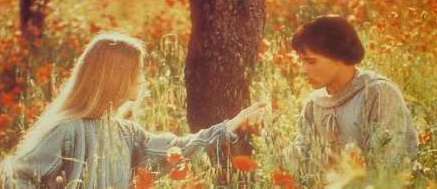
Saint Francis and Saint Clare from the movie “Brother Sun, Sister Moon”, (Franco Zeffirelli) (1972)
. A garden enclosed, my sister, my bride, a garden enclosed, a fountain sealed!
—Song of Songs 4:12
.
.
From memory it is not easy to recall. I do have a clear image, but if it is accurate that remains to be seen. Here we go.
It was downhill. A sloping path. As I approached the stone church, a few people wandered around out front. There was somewhat of a courtyard, well not a courtyard, more like a little wall hugging into existence a welcoming space. This wall was about bench height, made also of stone, and extended outward from the building. It created what I would normally call an out-front patio space, but in Italian terms, perhaps it would be called a terrazza, or maybe even be considered a piazza, or perhaps most accurately, a piazzetta. Then again, maybe it is just a patio to Italians too.
Well, sitting on this low wall was a friar. And running around the open area was a small brown dog with a shaggy little beige beard.
I entered the church. It was small, almost cave like. A curved ceiling. Dark. Old. There was the cross, a crucifix. Not the actual one that spoke to Saint Francis—no, that one was moved up into the Basilica of Saint Clare located in the central part of the still small but no-longer medieval town of Assisi.
The reproduction spoke to me.
I’m an early companion of Francis. .
.
I remained in the chapel for a while. I’m not sure if I was praying or not. I’m pretty sure I got on my knees. But from that day’s perspective, prayer was not known to me. So from that perspective, I wasn’t praying. But from today’s perspective, I most certainly was. For I was there. I was in Italy, in Assisi, in the Church of San Damiano. I was there intentionally. I was lost but I was found. I was looking, and I was obeying. Obeying what I didn’t know. I had no idea why, but I wanted to be there. And I felt something. It was heavy, literally. I remember feeling bent over. I remember thinking about all the prayer that must have taken place in that small space over the past thousand years. I remember thinking that all that collective belief must have an effect. It did. It does. It will. I was certain that I felt it. It bowed me down. It bent me over. And I remember liking it.
Faith is common.
I was a pilgrim and didn’t know it. .
.
I don’t remember much about the convent itself. I do remember walking from room to room, the communal rooms where Saint Clare and her companions, her biological mother and two sisters among them, ate and prayed and cared for their sick. I remember the small warm inner garden, with it’s old well. And the spot marked as the place where Clare liked best to sit. I’ve always loved internal courtyards. The thought of being outdoors and yet enclosed. Architecturally, it best represents the beauty of true solitude. Open. Yet safe. Free. Yet sheltered. Alone. Yet surrounded by those who believe the same.
In that sense, solitude—when it’s truly interior, truly spiritual—is like love: you can never get enough of it, and once you have it, once you truly live within it, you’re never again alone.
Solitude is love. And love is never solitary. .
.
Therefore the Lord himself shall give you a sign. Behold a virgin shall conceive, and bear a son, and his name shall be called Emmanuel.
Luke begins his account of Jesus’ public life by recalling his return to Nazareth after his baptism by John in the Jordan. This Sunday and next Sunday we read from Luke’s long account of that event.
Mark and Matthew tell this story later in their gospels, but Luke, who concentrates more on Jesus’ early life than the other evangelists, puts the beginning of Jesus’ public life in Nazareth, in the synagogue where he worshipped, among those who knew him best. (Luke 4, 14-21)
Luke paints the coming of Jesus into this world in broad, sweeping terms in his gospel. Caesar Augustus was the world’s ruler, Herod ruled in Palestine, others ruled under them. At the same time, he focuses on Jesus’ own personal history. Born in Bethlehem, Jesus’ first home is an obscure village in northern Galilee– Nazareth, where he grows “in wisdom and age and grace, before God and man.” There he was brought up.
The synagogue at Nazareth was probably like other synagogues in the towns of Galilee. Some, like that at Magdala on the Sea of Galilee, have been excavated in recent times. It was a small one story rectangular building, with two tiers of seating all around its walls, made for a town of no more than 500 people. In the middle of the synagogue was a stand holding copies of the various books of the scriptures. The synagogue was the center of life in those towns.
Jesus has returned to Nazareth after beginning his ministry “all through Galilee, teaching in their synagogues and praised by all. (Luke 4, 14-15) Now, back home, he goes into the synagogue on the Sabbath, “as he was accustomed to do.”
He gets up from his place to read the scriptures. (From the same place where he sat for years? Was Mary his mother there with him?) He’s “ handed a scroll of the prophet Isaiah.
He unrolled the scroll and found the passage where it was written:
The Spirit of the Lord is upon me,
because he has anointed me
to bring glad tidings to the poor.
He has sent me to proclaim liberty to captives
and recovery of sight to the blind,
to let the oppressed go free,
and to proclaim a year acceptable to the Lord.
Rolling up the scroll, he handed it back to the attendant and sat down,
and the eyes of all in the synagogue looked intently at him.
He said to them,
“Today this Scripture passage is fulfilled in your hearing.”
A short sermon, and a powerful statement. “This scripture passage is fulfilled in your hearing.” The Spirit of the Lord is upon me, Jesus says. I’m anointed to bring glad tiding to the poor. Jesus claims a messianic calling.
His neighbors, who have known him for years, are first impressed, then question him, then deny his claims, then threaten to put him to death.
In their gospels, Mark and Matthew describe opposition to Jesus coming first from the scribes and Pharisees, the leaders from Jerusalem, but Luke sees opposition to Jesus coming first from his own hometown, from family, neighbors and friends. He knows how important this rejection is.
It’s true, isn’t it? When we enter this world, we enter the small unit of human life, a family, and beyond the family, the people and places that shape us early in life. We’re subject to this important smallness, our “Nazareths” where we grow “in wisdom and grace.” We’re first nourished there; we look for lasting love and support there. It means so much to us.
Throughout his ministry, Jesus will know opposition. Leaders of the people, public officials will oppose him. In his final days, his own disciples will abandon him. Only a few will stand by his cross. The physical sufferings he endured were great. He was scourged, his head was crowned with thorns, his hands were nailed to a cross, he died hanging there long hours alone.
But rejection from his own at Nazareth will weigh heavily on him. It was a big part of the mystery of his cross. “He was amazed at their unbelief.” Yet, Jesus who embraced humanity with love, embraced Nazareth too. He loved it with God’s great love.
We have to pay a lot of attention to where we’re born, where we’re brought up, our families, the people we live and work with. Nazareth is important to us.
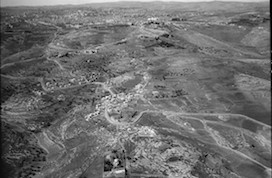
In the time of Jesus when pilgrims from Galilee came up to Jerusalem to pray in the temple, they came a number of ways. Many came down the Jordan Valley, a journey of 90 miles. When they reached the city of Jericho they turned eastward onto a steep, winding road that ascended for 3500 feet and went on for 15 miles to the city of Jerusalem. I have a picture taken from an airplane in the 1930s showing that winding, climbing road through the desert. It had to be the hardest part of their journey.
In the bible the journey to Jerusalem, especially the last part up that steep winding road through the desert, became a symbol of the journey to God we all make. We’re pilgrims on our way to meet God, and that way, our life journey, can seem hard. It’s not always easy. I think that’s why John the Baptist went into the desert to preach, where the hard winding road began.
John’s father, Zachariah, a priest in the temple in Jerusalem, told John at his birth: “You, my child shall be called a prophet of the most high, for you will go before the Lord to prepare his way.” (Luke 1) Where precisely did John prepare the way? We can’t be sure, but many think it was at the River Jordan near Jericho where he welcomed weary pilgrims and invited them into the refreshing waters of the river, that they might be strengthened for the last part of their journey. But more importantly, he strengthened for the journey of life they were living.
In today’s gospel, we see ordinary people, soldiers and tax-collectors among them. John spoke to each of them, not eloquently, but simply. He told them to do God’s will all their lives. If they did that, God would bring them into his presence.
Certainly, John would use the words of Prophet Isaiah, as we do all through Advent. Isaiah also knew the road to Jerusalem and saw it as a hard journey, but God would make sure we would make it, he said. God would lead the blind on that road, the deaf, the lame– no one was too weak or too small. God would help the lost sheep to make that journey. The weakest of humanity would make the journey by God’s mercy.
This week we began, as Pope Francis has asked, the Year of Mercy. He opened the door of St. Peter’s Basilica on the Feast of the Immaculate Conception of Mary to begin the year.
We might see this year as simply a Catholic event, but it’s more than that. Right now, our world needs to hear of God’s mercy.
In his encyclical Laudato Si, on the care of our common home. The pope mentions that for almost 200 years, since the beginning of the Industrial Revolution and the time of the Enlightenment, our world has been convinced of the unlimited progress of human power and potential. Unlimited human progress. We can do anything. But there are signs in our world now, ominous signs, that our world is weak and blind and lame. There’s increasing skepticism, increasing fear, an increasing option for violence. We’re worried about the way ahead. We’re worried about the future.
We have to open the door of our own minds, in this year of God’s mercy, to know that this is God’s world. Yes, the journey isn’t going to be easy. It’s a winding, wearying, road where the end isn’t in sight. We don’t have all the answers, but we have the one important one. God is with us and he is with our world, weak and blind and lame as it is.
The Old Testament readings this week, mostly from Isaiah, describe our journey through the desert as a hard journey, but the desert will bloom and a highway will be there, a holy way. (Monday) We’ll hear tender, comforting words as we go. (Tuesday) Those who hope in God will renew their strength, soaring on eagle’s wings. (Wednesday) We’re as insignificant as a worm, the prophet says, but God takes us in hand and says: “Fear not; I am with you.” (Thursday) God teaches us the way to go. (Friday) We meet prophets like Elijah and John on our way. (Saturday)
Above all, Jesus is our way, the gospel readings say. The paralyzed man lowered through the roof in Caphernaum got up and was ready to make the journey. He symbolizes paralyzed humanity enabled to walk again. (Monday) Jesus the good Shepherd searches for and finds the stray sheep. (Tuesday) “Come to me all who are weary…” he says. (Wednesday) We’ll find prophets and guides like John the Baptist and Elijah. (Thursday) Though rejected like John the Baptist, Jesus still teaches. He will always teach. (Friday) He saves us, even though he goes unrecognized like John and Elijah. (Saturday)
To listen to the audio for today’s homily please select file below:
Every once in awhile I watch Jeopardy on television. At one point the host poses a question and waits a few seconds for a contestant to get the answer. Here’s my question. What’s the last of the seven capital sins?
If you got the answer, Sloth, you’re right. Sloth is the last of the capital sins and that’s where you would expect to find it, at the end of the list. It’s sleeping there, because that’s what sloth is. It’s laziness; it’s complacency. It can be spiritual or intellectual or physical laziness or complacency. It could be one or all of them together.
The passage in St. Mark’s gospel we’re reading today begins on the Mount of Olives. Jesus and his disciples have just visited the temple in the city of Jerusalem and one of his disciples points out the majestic temple across the Kidron Valley. “Look, teacher, what stones and what buildings!” Jesus said to him, “Do you see these great buildings? There will not be one stone left upon another that will not be thrown down.”
Can we hear complacency in the disciple’s voice. “ We have everything here, a great place, what more could we want.” Sloth is complacency in that it thinks there nothing more to do; we’ve made it and we don’t need anything more. The Advent season warns us about complacency.
You can see laziness,too, another characteristic of sloth, in the servants Jesus mentions in today’s gospel. The Master goes away and they seem to breathe a sigh of relief. “He’s gone, now we can do whatever we want. We can take it easy.”
The message we hear at the beginning of Advent is the same message Jesus spoke to his disciples on the Mount of Olives. “Watch! Stay awake!” You don’t know when I will knock on your door.
Our first reading today from the Prophet Isaiah is filled with similar warnings about not paying attention to God. You’re like dirty rags, withered leaves, he says to them. You’ve become like mud, hard clay that stuck and hardened in place. You need a potter to come along and water the hardness in you and mold you again. You need the potter’s hands to soften you and give you new life.
That’s what the Advent season is about. We asking God to awaken us from complacency, from laziness, from sloth. The psalm response in our today’s liturgy sums up that prayer so beautifully.
“Lord, make us turn to you, let us see your face and we shall be saved.”
What is the face of God we are to turn to in this season? It’s the face of Jesus Christ, first as a child, born in Bethlehem. Then as a man, who speaks God’s words to us, who reaches into our lives and shares our sufferings. Then, as our Risen Lord whom we hope to see and who promises us life everlasting.
Advent, the season we begin today, is filled with the grace of God. Let’s watch for it.
God’s shows his love for his people by calling them to a banquet. During the Advent season, the Prophet Isaiah offers that promise of God to his people Israel. On Wednesday in Advent’s first week, he speaks of a holy banquet of rich food and drink that God will provide on his holy mountain in Jerusalem for all people. (Isaiah 25,6-10)
In the days after the Epiphany, the evangelists describe a holy banquet in Galilee. There Jesus, whose heart is moved with pity for those who follow him, feeds a vast crowd bread and fish, “And they all ate and were satisfied.” (Mark 6, 34-44) There in “the Galilee of the Gentiles” God’s promise is fulfilled. “All” people eat and are satisfied. We recall that sign of God’s love in our gospel reading today from Mark.
The love of God should fill us with wonder and praise. Yet Mark’s gospel goes on to say that the people who ate the loaves “did not understand” the mystery they had experienced. Still true? Do we understand the mystery of God’s love and the signs we experience here and now? One of these signs is the Holy Eucharist.
Sometimes the best view you get of the world is from above. Here’s a picture taken from a plane in the 1930s or so of the road up to Jerusalem from Jericho and the Jordan Valley. I add another from the ground of the road outside Jericho from more recent times.
Both pictures tell us the road to Jerusalem is a climbing, winding road. It wasn’t easy to take when prophets like Isaiah and John the Baptist knew it. Of course today it’s easily managed by car or bus. But in those days, walking or on a donkey, you didn’t always know what to expect when you went through deserts and mountains and some fertile areas where crops were grown.
Isaiah and John the Baptist knew this road very well and they used it to explain our way to God. First, it’s an image that says life will never be easy. On that road you’re going to get hungry, tired, even wonder whether you will make it or not. Unexpected things can happen: you may get robbed like the man did in the parable of the Good Samaritan. That happened on the road up from Jericho to Jerusalem, remember. You might be blind, like the two blind men from Jericho who couldn’t find their way.
But if you want to get to Jerusalem and enter the house of God, you have to take that road. Jesus took it when he went up to the Holy City. He began in the wilderness.
The message of Isaiah and John the Baptist, so beautifully expressed in our first reading for today (Isaiah 35,1-10), is that God will bring us there.




 The Victor's Place