Tag Archives: hope

Saving Advent and Christmas

Wikipedia’s article on Advent offers a description about how Christian denominations– Catholic, Anglican, Lutheran, Presbyterian, Methodist– approach the feast of Christmas, through devotional prayers and practices like the Advent wreath, the Christmas tree, musical performances like the Nine Lessons of Carols and Handel’s Messiah. Purple is the color of the season in most of these churches, blue in the Scandinavian countries.

The Wikipedia article features the devotions of Advent. Little is said ofGreek church’s Nativity Fast or the Roman Catholic liturgy of Advent. The Catholic liturgy of Advent “remained unchanged until the Second Vatican Council introduced minor changes,” it says.

That’s not accurate. The Roman Catholic Advent liturgy underwent a major change after the Second Vatican Council. A better schedule of readings and new Eucharistic prefaces were introduced to the liturgy; morning and evening prayers and other parts of its liturgy were enhanced. The Catholic Advent liturgy is a ringing affirmation of hope.

Advent hope is nourished by the first coming of Jesus Christ, but also by the promise of his second coming. It’s hope defying human calculation or human logic – an impossible hope. A hope spelled out in the devotions like the Advent wreath and the Christmas tree, but above all proclaimed in the Advent scriptures and liturgy.

Isaiah’s oracles from 8th century Judea are heard in the first few week of Advent, They proclaim that kind of hope.  Even as Assyrian armies capture and destroy his land, Isaiah sees a sign, the root of Jesse, set up before the nations. 

“His dwelling shall be glorious. The wolf shall be a guest of the lamb, and the leopard shall lie down with the kid; The calf and the young lion shall browse together, with a little child to guide them. The cow and the bear shall be neighbors, together their young shall rest; the lion shall eat hay like the ox. The baby shall play by the cobra’s den, and the child lay his hand on the adder’s lair. There shall be no harm or ruin on all my holy mountain; for the earth shall be filled with knowledge of the LORD, as water covers the sea.”

Wolves and lambs, leopards and kid goats, calves and lions lie down together on God’s holy mountain. The impossible becomes possible. That’s the  kind of hope we need today. 

Our Christian holidays and seasons are suffering more and more from secularization and commercialization. Like Santa Claus they need to be saved. They celebrate a greater hope than human imagination dares – hope in God and the promises God offers in Jesus Christ.

Let’s celebrate that hope in our liturgy.

Feast of St Luke: October 18

Luke copy

The Feast of St. Luke is October 18th.  If you’re beginning to read the New Testament  Luke’s Gospel is a good place to start. His gospel is the longest gospel, followed by the Acts of the Apostles. Together they present a magnificent picture of the life of Jesus followed by the life of his church.

Luke’s gospel provides many  of  readings for the various liturgical feasts we celebrate yearly in the church, especially the feasts celebrating Jesus’ early life, like those in the Christmas season, for example. We are reading from Luke’s Gospel these days.

Luke takes over into his gospel about 65% of Mark’s Gospel, which he modifies for his own purposes. He shares with Matthew’s Gospel material from another source, and he also offers material not found in the other gospels–the infancy narratives, for example. (Luke 1-2). He must be the companion St.Paul mentions in his letter to Timothy, read in today’s Mass. “Luke is the only one with me.” (2 Tim 4: 10 ff) He’s the narrator of Paul’s missionary journey in Acts.

Like other evangelists, Luke has his own plan. In his commentary on Luke’s gospel, Timothy Johnson speaks of the way Luke’s positive outlook on the world influences his writings:

“Luke-Acts is positive toward the world, not only as God’s creation but also as the arena of history and human activity. It is perhaps the least apocalyptic of the NT writings, and the least sectarian. Not only is Luke relatively unconcerned about the end time, his historical narrative bestows value on time itself. Luke is also generally approving of those outside the Christian movement. Outsiders-not counting the Jewish opponents who are not outsiders at all– are generally regarded as reasonable and open-minded, which is a high compliment paid by apologetic literature.” (The Gospel of Luke, Liturgical Press, Collegeville, Md. 1991)

Carry the cross with me each day, Jesus says,  and don’t worry or be anxious. Be vigilant and prayerful each day, the Lord will return on the clouds of heaven. No, we don’t know the day or the hour, but we’ll we ready for the last day if we prepare for that day each day. Jesus says we can stand strong and fearless on that day, if we live each day well in the meantime. Be especially mindful of the poor. Luke emphasizes that teaching of Jesus in his writings especially.

Isn’t that  good advice for times like ours when enormous problems confront our world and clear solutions and grand designs are nowhere to be found? We can so easily fall into pessimism (a form of spiritual sleep) and lose hope. We can also turn away from the poor.

We can use Luke’s optimism today.

Father,
you chose Luke the evangelist to reveal by preaching and writing
the mystery of your love for the poor.
Unite in one heart and spirit all who glory in your name,
and let all nations come to see your salvation.
Grant this through our Lord Jesus Christ, your Son, who lives and reigns with you in the unity of the Holy Spirit,
God, for ever and ever.
Amen.

On to Jerusalem: Mark 9: 14-29

It takes time to believe. The disciples of Jesus needed time to believe in him and understand the meaning of his life, death and resurrection. So did the man in today’s gospel from Mark who asks help in his unbelief. So do we.

As Jesus came down from the mountain with Peter, James, John
and approached the other disciples,
they saw a large crowd around them and scribes arguing with them.
Immediately on seeing him,
the whole crowd was utterly amazed.
They ran up to him and greeted him. 
He asked them, “What are you arguing about with them?”
Someone from the crowd answered him,
“Teacher, I have brought to you my son possessed by a mute spirit.
Wherever it seizes him, it throws him down;
he foams at the mouth, grinds his teeth, and becomes rigid.
I asked your disciples to drive it out, but they were unable to do so.”
He said to them in reply,
“O faithless generation, how long will I be with you?
How long will I endure you? Bring him to me.” 
They brought the boy to him.
And when he saw him,
the spirit immediately threw the boy into convulsions.
As he fell to the ground, he began to roll around   
and foam at the mouth. 
Then he questioned his father,
“How long has this been happening to him?” 
He replied, “Since childhood.
It has often thrown him into fire and into water to kill him.
But if you can do anything, have compassion on us and help us.”
Jesus said to him,
“‘If you can!’ Everything is possible to one who has faith.”
Then the boy’s father cried out, “I do believe, help my unbelief!”
Jesus, on seeing a crowd rapidly gathering,
rebuked the unclean spirit and said to it,
“Mute and deaf spirit, I command you:
come out of him and never enter him again!”
Shouting and throwing the boy into convulsions, it came out.
He became like a corpse, which caused many to say, “He is dead!”
But Jesus took him by the hand, raised him, and he stood up.
When he entered the house, his disciples asked him in private,
“Why could we not drive the spirit out?”
He said to them, “This kind can only come out through prayer.” Mark 9:14-29

Where are we now?

Since the Christmas season we have been reading from Mark’s Gospel, which end when Lent begins. Through lent we follow Jesus from Matthew’s Gospel mostly, as he journeys on to Jerusalem where he will die and rise again.  

Do his disciples fully understand him? Peter certainly doesn’t. (Mark 8, 27-33) Despite miracles and his inspired teaching,  his own family and hometown turn away from him. (Mark 3,1-5;  6, 1-6) Pharisees and scribes from Jerusalem come to Galilee to dismiss and condemn him.( Mark 7,1-15)

Yet, Jesus goes on to Jerusalem, with his disciples and with all of us. The lenten season’s readings and feasts will take us, like his disciples, from Galilee to Jerusalem. Lent will call us, as Jesus does in today’s gospel, to prayer.

Will this lent and Easter turn more people to join him?  Maybe. The world we live in is a lot like Galilee and Jerusalem. Still, like the disciples who first followed him there, we’re going up to Jerusalem. There will always be transfigured moments to lead us on.

In today’s gospel listen to a merciful God. “O faithless generation, how long will I be with you?” Jesus says. Yet then he says “Bring him to me.” And he cures the young boy possessed from childhood. He helps the half-believing father.

Is he unique? Isn’t faith itself always half-believing, always marked with the unbelief that comes from who we are, finite human beings who only see so far?


CHRISTMAS Eve

The Advent season closes today December 24th. The Christmas season begins with the vigil Mass this evening. 

Advent is a season rich in the scriptures. Isaiah speaks strongly throughout the season, calling Jewish exiles and all nations to the holy mountain and God’s banquet with his people and all creation. “Swords will be turned into plowshares and spears will be turned into pruning hooks and they will not train for war again.” 

John the Baptist and his parents Zachariah and Elizabeth have important roles in the coming of the Child born of Mary.  Of course, Mary and Joseph are key figures responding to the messengers of God. 

Faith and hope do not come easily, the Advent season tells us. Political unbelief appears in Ahaz who “will not tempt the Lord.” Zachariah, a priest, is struck dumb for his unbelief. John the Baptist asks if Jesus is really “the one who is to come.” Mary wonders “how can this be?”

The gospel reading today, Zachariah’s song of belief, seems to promise faith and hope conquers in the end. 

“Blessed be the Lord God of Israel, he has come to his people and set them free.

Christmas carols, more than the scriptures seem to dominate the Christmas season. They bring the shepherds from the dark hills and magi from the east  to the Child. They also speak of those who not believe, like Herod who goes in search of the Child. But people of faith, like Simeon and Anna, welcome the Child in the temple and take him into their arms. 

Advent and Christmas are seasons rich in the wisdom of faith. A faith that leads to great truths, as the feast of John the Apostle reminds us. A faith one should  die for, as we are reminded by the feasts of the Holy Innocents and Stephen the first of many martyrs.  

MERRY CHRISTMAS

Advent Weekday Readings: 1st Week

The Old Testament readings for the 1st week of Advent– all from Isaiah–  are a message of universal salvation. Isaiah 2:1-5 (Monday) is the prophet’s classic announcement that all nations will stream to God’s mountain and listen for God’s instruction. “They will beat their swords into plowshares and their spears into pruning hooks.” Wars are over; the fragmentation destroying humanity comes to an end.  

For Isaiah, the mountain of the Lord– site of the Jewish temple in Jerusalem– has a central place in God’s promise. All nations will come there; they will be fed a rich banquet (Wednesday), there the poor will triumph (Thursday), the blind will see (Friday); it’s the rock where people dwell in safety, where children play around the cobra’s den, and the lion and the lamb lie down together (Tuesday). The prophet’s poetic imagery in the readings for the 1st week of Advent is strikingly beautiful. 

The gospels in the 1st week point to the Isaian prophecies fulfilled in Jesus Christ. The Roman centurion humbly approaching Jesus in Capernaum represents all the nations coming to him. Jesus feeds a multitude on the mountain. He gives sight to blind humanity, he affirms that his kingdom will be built on rock. He praises the childlike, who will enter the kingdom of heaven.

Matthew’s gospel, source of many of our Advent readings, portrays Jesus teaching on a mountain (Isaiah’s favorite symbol) and working great miracles there that benefit all who come.  He is also the new temple, the new Presence of God, Emmanuel, God with us.

Mary’s Mother

by Howard Hain

durer

Albrecht Durer, “Virgin and Child with Saint Anne”, ca. 1519 (The Met)

Christmas is a time for grandmothers.

They bake and cook and decorate. Their homes become mini North Poles, diplomatic outposts of Santa’s Castle.

At its core, Christmas is of course all about Jesus. All about Jesus, Mary, and Joseph. All about the Holy Family.

The Holy Family is an extended family though. And it doesn’t stop at grandmothers and grandfathers, aunts and uncles, or even cousins and distant cousins.

Just ask Saints Joachim and Anne, Zechariah and Elizabeth, or John the Baptist—not to mention all the unknown relatives whom the child Jesus surely encountered throughout His Galilean days. Ask any one of them about the far-reaching ripple effects of family grace.

Those touched by Jesus have a tendency to appear bigger than life.

Look at Santa Claus.

Most of us are aware that he is really Saint Nick.

But do we stop to wonder who Mrs. Claus really is?

I think she’s Saint Anne.

After all, Mrs. Claus is seen as everyone’s grandmother, especially when it comes to holiday cheer. But when it comes to truly celebrating the birth of Jesus, it is through Saint Anne that we approach the gates of Christ’s Nativity.

Mary’s Mother holds a special key. She is first among grandmas, first among those who pinch chubby cheeks, who pass along one more extra sugary treat.

———

Saint Anne help us. Speak to us. Show us how to be grand parents to all those around us, especially the little ones. Stir up the spirit of Advent. Bake away the holiday blues. Cook up a dish of Christmas love that only your hearth can serve.

———

Come one, come all, to the home of Saint Anne. Come with me to Grandma’s house for a holiday visit. Taste and see. Enter her kitchen, where the hot chocolate can always fit a little more whipped cream, where you hear the constant refrain: “eat…eat…eat…”

At Grandma’s your plate is never empty.

Her table is continually set.

She always sees Jesus as having just been born.

She is always wrapping Him up tightly in swaddling clothes.

It is simply grand.

To Grandma, Jesus is always an innocent child.

And she can’t help but see Him deep within both you and me.


(Dec/21/2017)

Howard Hain is a contemplative layman, husband, and father. He blogs at http://www.howardhain.com


Web Link: Metropolitan Museum of Art. Albrecht Durer, “Virgin and Child with Saint Anne”, ca. 1519


Morning Thoughts: Little Drummer Boys and Girls

by Howard Hain

Yesterday I witnessed a “dress” rehearsal for a live nativity. The cast was made up of first and second graders, and the audience was mostly composed of residents of a retirement home for religious sisters, Franciscans. It was spectacular.

Last week I was at Radio City Music Hall to watch the Rockettes in their “Christmas Spectacular”. It was quite a production.

Sitting in the dark this morning I cannot help but contrast the two.

I also cannot help but relate to the seven-year old who played the part of The Little Drummer Boy.

As that child walked so slowly toward the foot of the altar, where the rehearsal was being staged, I saw my vocation in an entirely different light.

The children were all singing their hearts out, and many of the eighty and ninety year-old sisters were mouthing the words. The boy with the drum didn’t utter a sound. He just kept walking, slowly, extremely slowly toward the altar, every once in a while ever so slightly pretending to tap two tiny sticks upon a toy drum. He was beautifully awkward.

There was no greater spectacle on earth at that very moment. Shall I dare to say, no greater event that heaven or earth has ever known?

For a child was born. We were all being born.


Come they told me, pa rum pum pum pum
A new born King to see, pa rum pum pum pum
Our finest gifts we bring, pa rum pum pum pum
To lay before the King, pa rum pum pum pum,
rum pum pum pum, rum pum pum pum,

So to honor Him, pa rum pum pum pum,
When we come.

Little Baby, pa rum pum pum pum
I am a poor boy too, pa rum pum pum pum
I have no gift to bring, pa rum pum pum pum
That’s fit to give the King, pa rum pum pum pum,
rum pum pum pum, rum pum pum pum,

Shall I play for you, pa rum pum pum pum,
On my drum?

Mary nodded, pa rum pum pum pum
The ox and lamb kept time, pa rum pum pum pum
I played my drum for Him, pa rum pum pum pum
I played my best for Him, pa rum pum pum pum,
rum pum pum pum, rum pum pum pum,

Then He smiled at me, pa rum pum pum pum
Me and my drum.*


.

.*(Little Drummer Boy was composed by Katherine K. Davis, Henry Onorati and Harry Simeone in 1958.)


Broken Baby Jesus

by Howard Hain

(Note: This post was originally published on December 24, 2011.)

broken-baby-christ-2-1


We have not put up a tree in years.

For nearly a decade we have been moving—no longer than two years in any one house and no less than ten different not-so-humble abodes. Between and during the moves we were very much engaged with the world. A seemingly endless movable beast.

This December marks one year in our current house. I am happy to say it is our home. The Lord has blessed us with great peace. And with that peace comes a tree. A simple, well-shaped tree. Fittingly, a dear friend offered it to us as a gift.

Francesca could not be more ready to be initiated into the act of trimming. Before the tree arrived, her two-year-old fingers pointed out every tree, artificial or real, that graced the pages of a holiday flyer or the commercial floor of a Rite Aid or Dollar Store.

Up the stairs came the evergreen, into the old stand that has been in storage since my father last used it several decades ago. I cut off the mesh and out popped the branches.

We hung the lights and old glass ornaments that my mother-in-law washed a few days before.

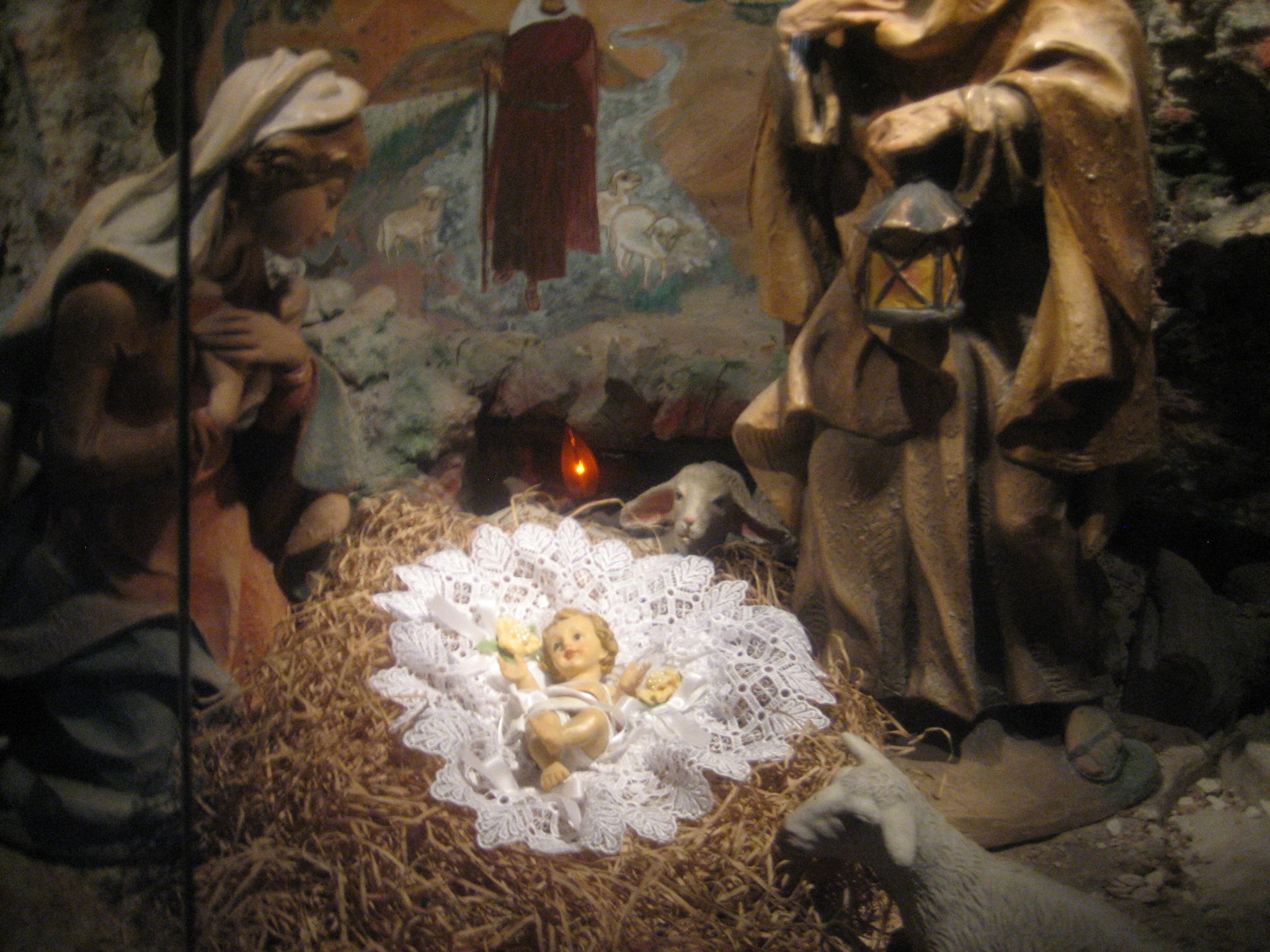
The main attraction for Francesca was the Nativity.

Not since St. Francis of Assisi assembled the first Nativity in Greccio in 1223, has there been such admiration for each and every witness who Our Lord assembled to adore His Son that first Christmas two millennia ago. Francesca kissed and hugged every shepherd, sheep, donkey, angel, and king. Most of all she adored the Holy family, calling Mary and Joseph, Ma-ma and Da-da, respectively. And Jesus, He was simply called: “ba-be.”

She carried them around the apartment. I did not want to ruin her fun, but they are ceramic. I explained a few times to be very careful.

“Gentle, Francesca…gentle…”, I harked a host of times.

Boom. To the wood floor went the shepherd. Amazing, grace held him intact. I took that as a great sign to put an end to her carrying the animals, angels and representatives of mankind.

I was fixing my coffee when I turned to see Francesca with Baby Jesus in her tiny hands. But He is so small, so tiny, what harm could come from holding Him? So I let her get away with carrying the Savior.

As I stirred my spoon Christ crashed to the floor, the tile floor. Francesca immediately looked at me, as if expecting all hell to break loose. I think I sighed but that was about all. It is Christmas, right? And it is, after all, only a ceramic figure purchased at Target.

After assuring Francesca not to worry and guiding her toward a few coloring books in the living room, I bent down to retrieve the broken Christ.

———

St. Francis was told by a Crucifix in an old abandoned chapel: “Restore my Church.”

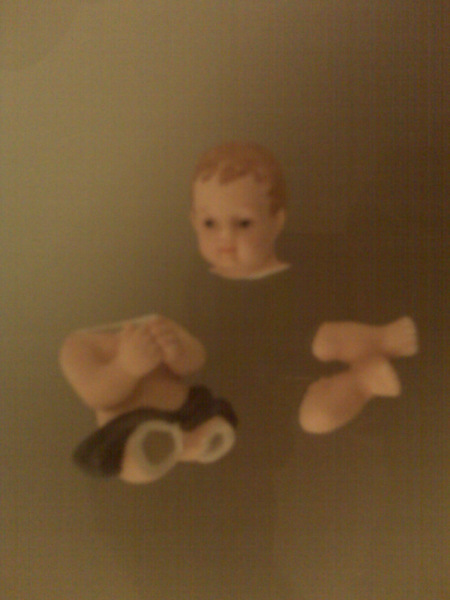
In my small one-bedroom apartment, I found Baby Christ, broken into exactly three: The Head, the Torso, and the Crossed Legs.

“Restore the Trinity,” was spoken to me.

———

For half of my forty years I can honestly say I have tried to pursue Truth, wherever it lie. In philosophy, in scripture, in literature, in art, in nature, in history…

Now, the entire Gospel of Christ lie naked on my kitchen floor.

We separate, we distinguish, we categorize, we breakdown. The Fall of Adam was a fall into denomination.

Christ’s body is One. His Church cannot be broken. Only mere men can get things so wrong.

I think of the great “Angelic Doctor” of the Church, St. Thomas Aquinas, who after spending a lifetime in unparalleled pursuit of human understanding, said after glimpsing a vision of what Our Lord has in store for those who love God:

“All that I have written seems like straw compared to what has now been revealed to me.”

Yes… “straw”…my brother Thomas…merely straw. Straw that lines the manger within which Our Savior is laid bare.

———

It is tradition to leave the crib empty until Christmas morning. Only then do we place the figurative baby Jesus into the scene, after all until that moment he was not yet brought forth from Mother Mary’s womb.

This Christmas morning I will glue together a Broken Baby Christ. The Head, the Torso, and the Crossed Legs will again be One.

Like the world after the birth of Christ, I will never be the same.

For what has now been revealed to me, no fall can break apart.


Howard Hain is a contemplative layman, husband, and father. He blogs at http://www.howardhain.com


Morning Thoughts: She Planted The Sun


.

There once was a little girl who loved to write “love”.

Over and over she wrote the lovely word.

Straight. Crooked. Curved. Upside down.

“Love”, “Love”, “Love”…

She drew hearts and placed all around.

And in a corner she planted the sun.

Day after day she pecked away.

A little hen marking the ground where she play.

All kinds of chicks came to stay.

She lined her dolls in pretty little rows.

A beauty pageant, all kinds of hair.

Straight. Curly. Blond. Brown.

She loved them all.

Did she favor?

She rotated each day.

She knew who needed extra care.

Though all to be happy.

That the only rule.

No room in her garden for overcast days.

And how her family grew.

She had, my God, so many to attend!

Amazing she could even keep track.

Yet each tiny doll held a special place.

She simply made room.

A little girl who loved to write “love”.

Over and over she wrote the lovely word.

Straight. Crooked. Curved. Upside down.

“Love”, “Love”, “Love”…

She drew hearts and placed all around.

And in a corner she planted the sun.

———

Miriam…Marie…Maria…

Mary…

I guess it depends on the day.

Accent. Pronunciation. Spelling.

Even eye color may change.

But it’s always the same little girl.

Age to age.

Place to place.

The same little girl

Helping save the human race.

The same little girl

In the fullness of time

Forever known:

Full of Grace


.

—Howard Hain

.

Hummingbird and Passionflowers

by Howard Hain

1509123983639705942327.jpg

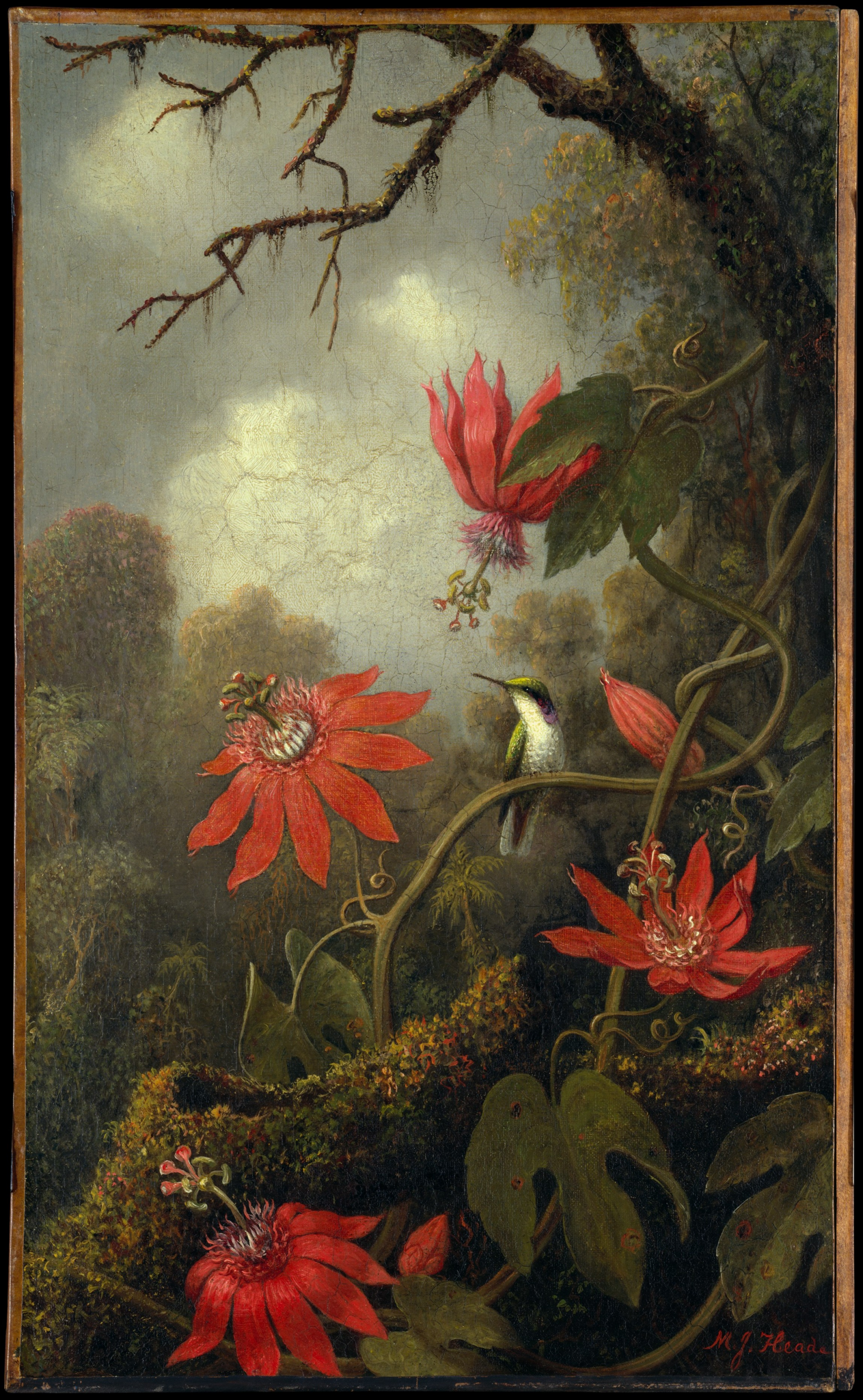
Martin Johnson Heade, “Hummingbird and Passionflowers” (ca. 1875-85) (The Met)

The delicate little bird that resides within each of us.

It hops to and fro. It stands startlingly still.

Very often we are the very ones who chase it away.

But it doesn’t fly far.

Just to the closest branch, that’s just beyond our reach.

And it looks back at us, as if to ask, “Why are you afraid?”

The tiny head of a tiny bird, slightly cocked to the side—a question mark floats from its beak.

It longs to return, to live within us, to build a nest, to raise its young.

But it doesn’t rush back.

No, it waits.

It waits for us to ask for it to return.

It’s a patient creature, that tiny bird.

One may be tempted to say it’s not very smart, but that’s not it at all.

It’s simple. It’s holy. It knows who it is. It’s not afraid of the fall.


Howard Hain is a contemplative layman, husband, and father.


Web Link: The Met Museum. Martin Johnson Heade, “Hummingbird and Passionflowers” (ca. 1875-85)