Tag Archives: David

December 24: Jesus, Son of David

BYVANCKB_mimi_74g39_080r_min

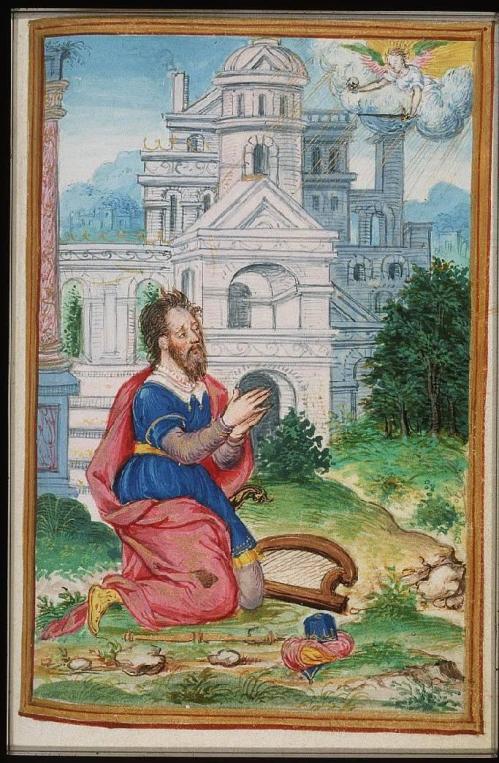
What does our reading today from the Book of Samuel say about the birth of Jesus Christ? King David tells the Prophet Nathan that he’s going to build God a kingly palace like his own. The grand palace in our picture above is what he plans to build.

In reply God says: “Should you build me a house to dwell in? I took you from the pasture and from the care of the flock to be commander of my people Israel.I have been with you wherever you went.” There is no way you can match the love of a God who humbles himself to come in a stable, David is told, A stable door, always open, is more easily entered than the door to a palace..

“The LORD also reveals to you

that he will establish a house for you.

And when your time comes and you rest with your ancestors,

I will raise up your heir after you, sprung from your loins,

and I will make his Kingdom firm.

I will be a father to him,

and he shall be a son to me.

Your house and your Kingdom shall endure forever before me;

your throne shall stand firm forever.’” (2 Samuel 7)

In this great prophecy, called the “Dynastic Oracle,” God promises to be with David and his descendants forever. God will give him an heir whose kingdom will be firm. “I will be a father to him and he a son to me.” Even if his descendants  are unworthy, sinful, God will not turn away, as God did with Saul. His promise stands unbroken, forever.

How often in the gospels Jesus is called “Son of David.” No passing visitor, who come and goes, his kingdom endures; his throne stands forever. He will never turn away. His door is always open. Each morning at prayer we hear Zachariah’s canticle.” The tender compassion of our God. like the dawn, is ours each day.

December 17: The Tree of Jesse

From December 17th until Christmas, we read from the infancy narratives  of Matthew and Luke to prepare for the  Christmas feast.

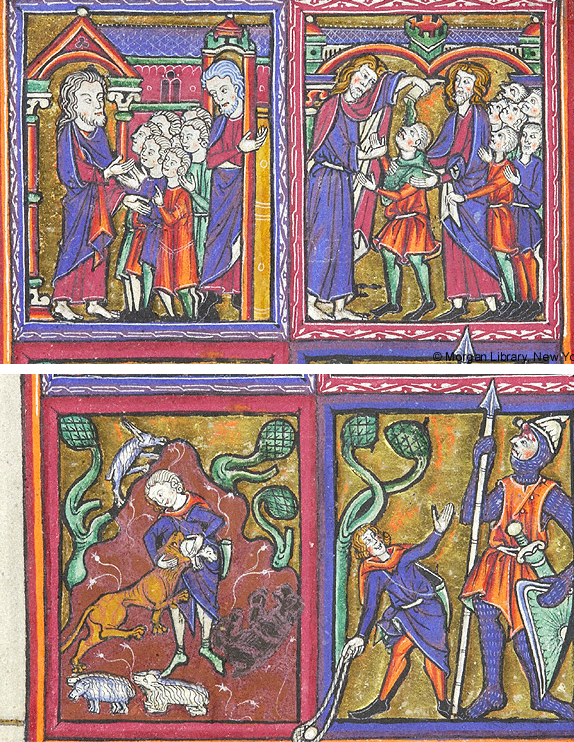
  Matthew’s genealogy of Jesus Christ traces his ancestry as “the son of David and the son of Abraham.” Descended from Abraham Jesus fulfilled the promise God made to the patriarch: “in your descendants all nations would be blessed.” Matthew ends his genealogy with “Joseph, the husband of Mary. Of her was born Jesus who is called the Messiah. ” In our portrayal above Mary points to Joseph as the one who can explain it to us all.

Matthew’s genealogy offers a Messiah whom Jew and Gentile can claim for their Savior. His ancestors reach beyond Palestine; his roots are worldwide. He’s not just a Jewish Messiah in Matthew’s listing either. His bloodline includes women like Tamar, Ruth and Bathsheba– foreigners and even women with questionable backgrounds.

 In his humanity,  Jesus didn’t come from perfect ancestors or untainted Jewish royalty ; he’s rooted in all humanity. His bloodline includes saints and sinners; he comes from a line of sinners and some saints. He shares our human DNA.

Matthew obviously wants us to look at Jesus’ family tree and see it as our own. We’re at home there. The Tree of Jesse, based on Matthew’s genealogy  was a favorite subject for medieval artists working on illuminated manuscripts or creating stained glass windows for churches. A great way to see the humanity of Jesus Christ.

Luke’s genealogy goes further and brings Jesus beyond Abraham to Adam. He becomes the new Adam. We are born from his side, we share his blood; he is the first born of many like us. So we pray:

“O God, Creator and Redeemer of human nature…your Only Begotten Son, having taken to himself our humanity, may you be pleased to grant us a share in his divinity.” (Collect)

O Wisdom of our God Most High,
guiding creation with power and love:
come to teach us the path of knowledge!

David, the Penitent

We’re reading at Mass from the Second Book of Samuel. The first 8 chapters describe David’s accomplishments as an ideal king. He unites the tribes of Israel, conquers Jerusalem and makes it his capitol. He brings the Ark of the Covenant and places it in a special tent in Jerusalem. He acknowledges God’s primacy over this kingdom. He listens to the Prophet Nathan who tells him “Your house and your kingdom shall endure forever before me; your throne shall stand firm forever.’” David is blessed by God.

Chapters 9-20 of Second Samuel describe the darker side of David, culminating in his murder of Uriah and taking his wife Bathsheba. The Prophet Nathan accused him of sin and tells him he must face the consequences. 

The consequences? David’s own son Absalom betrays him and turns the people against him. Pursued by his son he escapes from Jerusalem over the Mount of Olives and meets a relative of Saul who curses him and throws rocks at him. The king humbly accepts it all. 

Have mercy on me, God, in your kindness.

  In your compassion blot out my offence.

O wash me more and more from my guilt

  and cleanse me from my sin.

My offences truly I know them;

  my sin is always before me.

Against you, you alone, have I sinned;

  what is evil in your sight I have done.

That you may be justified when you give sentence

  and be without reproach when you judge,

O see, in guilt I was born,

  a sinner was I conceived.

Indeed you love truth in the heart;

  then in the secret of my heart teach me wisdom.

O purify me, then I shall be clean;

  O wash me, I shall be whiter than snow.

Make me hear rejoicing and gladness,

  that the bones you have crushed may revive.

From my sins turn away your face

  and blot out all my guilt.

A pure heart create for me, O God,

  put a steadfast spirit within me.

Do not cast me away from your presence,

  nor deprive me of your holy spirit.

Give me again the joy of your help;

  with a spirit of fervour sustain me,

that I may teach transgressors your ways

  and sinners may return to you.

O rescue me, God, my helper,

  and my tongue shall ring out your goodness.

O Lord, open my lips

  and my mouth shall declare your praise.

For in sacrifice you take no delight,

  burnt offering from me you would refuse,

my sacrifice, a contrite spirit.

  A humbled, contrite heart you will not spurn.

In your goodness, show favour to Sion:

  rebuild the walls of Jerusalem.

Then you will be pleased with lawful sacrifice,

  holocausts offered on your altar.

Glory to the Father and to the Son,

  and to the Holy Spirit:

as it was in the beginning, is now,

  and will be for ever. Amen.

Be Merciful, O Lord, For We Have Sinned

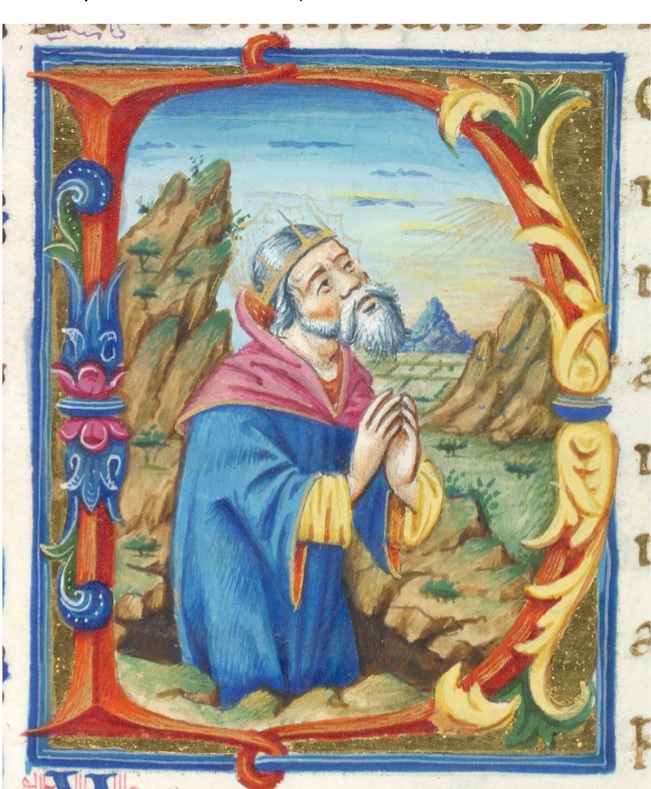
David penitent


Because Jesus is often called “Son of David” in the New Testament and so many of the psalms are attributed to David, we may tend to idealize the great king. David united the tribes of Israel and established a nation with its capitol in Jerusalem. Jesus himself appealed to David’s example when his enemies accused his hungry disciples of eating grain on the Sabbath.

Yet, the long narrative we read in the Book of Samuel today and tomorrow at Mass offers a darker picture of the famous king– he was a murderer and an adulterer. David had Urriah the Hittite, a faithful soldier in his army, killed so that he could have Bathsheba, his wife. (2 Samuel 11, 1-17)

Psalm 51 is the response we make at Mass after listening to the king’s sordid deed. Tradition says it’s David’s own response after he realized what he had done. The Book of Psalms calls Psalm 51: “A psalm of David when Nathan the prophet came to him after he had gone in to Bathsheba.”

“Have mercy on me, O God, in your goodness;
in the greatness of your compassion wipe out my offense.
Thoroughly wash me from my guilt
And of my sin cleanse me.”

The psalm, the first of the Seven Penitential Psalms, asks God to take away both the personal and social effects of our sin, for our sins do indeed have emotional, physical and social consequences. Only God can “wash away” our guilt and cleanse our heart. Only God can “rebuild” the walls that our sins have torn down and the lives they have harmed. Only God can restore joy to our spirits and help us “teach the wicked your ways, that sinners may return to you.” Only God can bring us back to his friendship.

In the scriptures, David is a complex figure– a saint and a sinner. He’s also a reflection of us all. That’s why our response in the psalm at Mass today takes the form that it does –

“Be merciful, O Lord, for we have sinned.”
Does God Care About Politics?

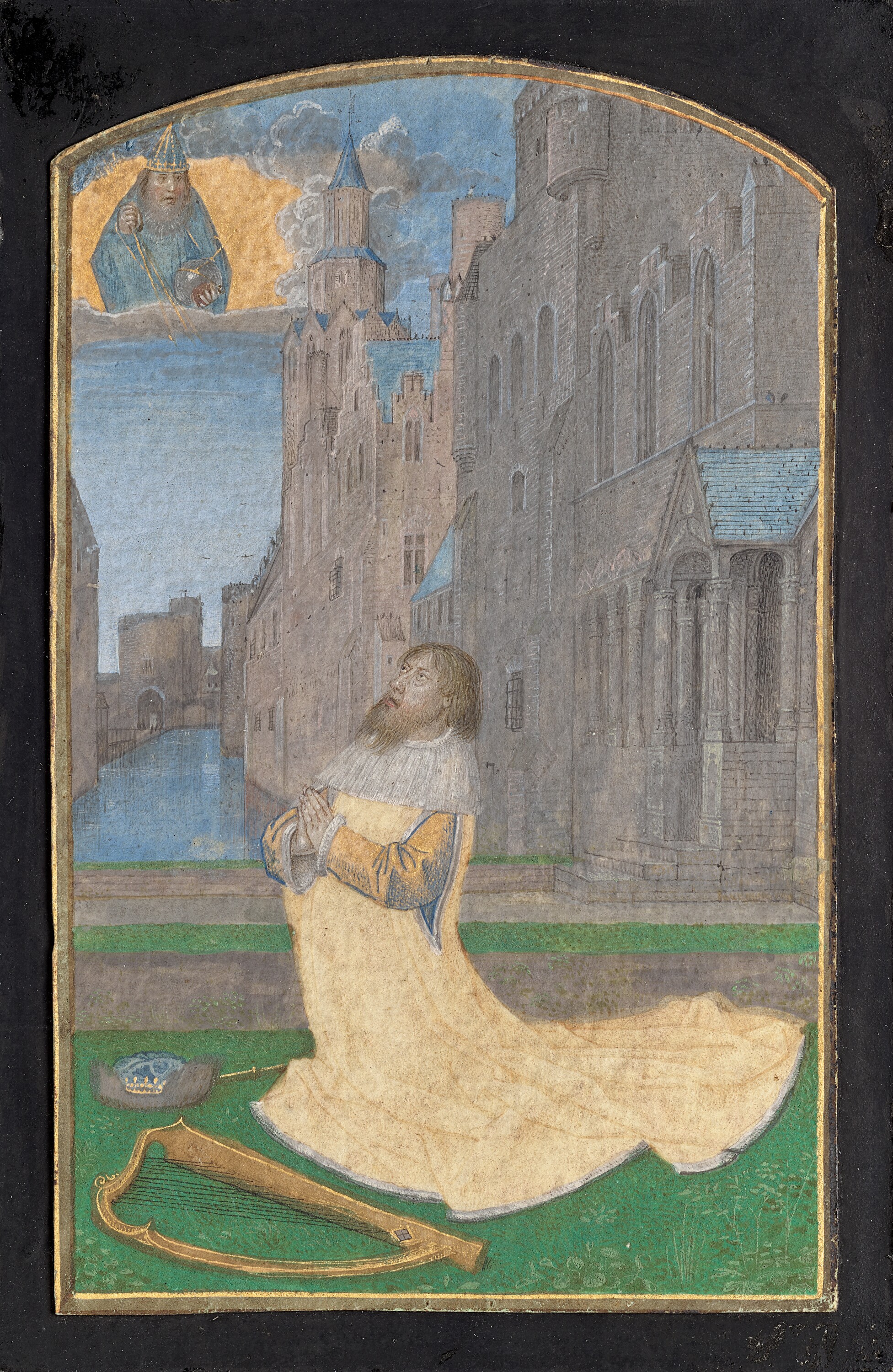
Story of David. Morgan Library, NY

Watching the fierce wars and political fights in our confused world today we ask if God cares about it all? Does he keep out of it and want us to keep out of it too? Our reading from the Book of Samuel these days tells us God is involved in what happens here and now more than we realize.

“Fill your horn with oil, and be on your way,” God says to Samuel, “I am sending you to Jesse of Bethlehem, for I have chosen my king from among his sons.” Samuel goes through all of Jesse’s sons, but none fit the bill. “Not him, not him, not him,” God says as one after another are brought to Samuel. “Are these all the sons you have?” Samuel asks.

Jesse replied, “There is still the youngest, who is tending the sheep.” “Send for him,” Samuel says, “we will not begin the sacrificial banquet until he arrives here.” So David is brought to them, ” ruddy, a youth handsome to behold and making a splendid appearance.”

The LORD said, “There–anoint him, for this is he!”

Then Samuel, with the horn of oil in hand, anoints him in the midst of his brothers;   ‘and from that day on, the Spirit of the LORD rushed upon David.” (I Samuel 16,1-13)

“Anoint him, there he is,” God says. The prophet pours the horn of olive oil on David. What does the oil signify? A power not his own, a power that is God’s grace, to lead his people. The grace of God is needed to lead.

We can’t block out the world we live in. The messy, uncertain, brutal, sometimes going nowhere world we read about in the Book of Samuel reminds us that God never abandons the world as it is. It’s not Saul’s world or David’s world; It’s God’s world and God’s plan.

Hard to see in the constant blast of news and political commentaries we get from the media. We think like humans do.We can throw up our hands and turn it all off, but this is our world to understand and care for and pray for.

We’re told to pray for our world, our leaders and ourselves that we may receive God’s wisdom and grace to see and hear God here and now

Almighty and eternal God,
you have revealed your glory to all nations.
God of power and might, wisdom and justice,
through you authority is rightly administered,
laws are enacted, and judgment is decreed.

Assist with your spirit of counsel and fortitude
the President of these United States,
that his administration may be conducted in righteousness, and be useful to your people over whom he presides.

May he encourage due respect for virtue and religion.
May he execute the laws with justice and mercy.
May he seek to restrain crime, vice, and immorality.

Let the light of your divine wisdom
direct the deliberations of Congress,
and shine forth in all the proceedings and laws framed
for our rule and government.
May they seek to preserve peace, promote national happiness, and continue to bring us the blessings of liberty and equality.

We pray for the governor of this state 

for the members of the legislature,
for judges, elected civil officials,
and all others who are entrusted to guard our political welfare.
By your powerful protection, may they discharge their duties with honesty and ability.

We likewise commend to your unbounded mercy
all citizens of the United States,
that we be blessed in the knowledge and sanctified in the observance of your holy law.

May we be united in that peace which the world cannot give and, after enjoying the blessings of this life, be admitted to those which are eternal.

We pray to you, who are Lord and God,
for ever and ever. Amen.

(Adapted from a prayer for the inauguration of George Washington by Archbishop John Carroll, first Catholic bishop in the United States)

“Absalom, Absalom, my son”

Stories from the Old Testament often have a raw quality that may cause us to turn away from them. Too much murder, rape, lies and disloyalty in them, we say. Not uplifting at all.

After the Prophet Nathan accuses David of his sins of murder and adultery, he tells him “the sword shall never depart from your house.” (2 Samuel 12, 10) In our first reading today at Mass the prophet’s message is fulfilled. David’s son Absalom  betrays his father and tries to take his throne. (2 Samuel 15, 13 ff) All that’s said about Absalom points him out as a bad kid.

“An informant came to David with the report, ‘The children of Israel have transferred their loyalty to Absalom.’” David flees from Jerusalem to escape Absalom and his army; he crosses the Kidron Valley to the Mount of Olives and then heads for the wilderness around the Jordan River for safety.

Jesus came to Jerusalem by that same route, we remember. He also crossed the Kidron Valley to the Mount of Olives to pray as he faced betrayal and death.

David’s advisors want him to kill his scheming son, but David refuses, because of his deep love for him. He becomes inconsolable when the young man meets a tragic death. “Absalom, Absalom, my son!” His love seems unexplainable.

And so is the love of Jesus, unexplainable.

11th Sunday C: The Mercy of God

To listen to today’s homily, please select the audio file below:

This Sunday there are two stories about forgiveness in our liturgy at Mass. From the Second Book of Samuel we hear the story of King David whose sin is pointed out to him and then declared forgiven by the prophet Nathan. The gospel reading from Luke tells the story of Jesus forgiving a sinful woman in the house of a Pharisee, who can’t seem to believe in forgiveness when he sees it.

The two stories complement each other. They remind us that forgiveness is not a simple matter; it’s a mysterious gift of God.

King David’s sins are well known and nothing to be proud of. He lusts after Bathsheba, the wife of Urriah, one of his officers. When David fails to disguise his adultery, he arranges to have Urriah killed and then marries his wife. The king’s sins are more than sins of lust or murder; his sin is an abuse of power. David’s the king, with absolute power over his subjects, answerable to no one, he thinks. He can do anything he wants and no one stands in his way. Unfortunately, he’s lost a sense of guilt; his conscience doesn’t bother him. He’s a king who can do no wrong.

Notice, though, that David recognizes sin and injustice in others. When the prophet Nathan tells him the story of someone who robs a poor man of his precious lamb, David immediately wants to right the wrong. Nathan says “ You are that man.” But David’s blind to his own sin, and so the prophet must awaken him to see what he has done. If you’re blind to sin, how can you be forgiven?

Finally, David admits; “‘I have sinned against the LORD.’ Nathan answered David: ‘The LORD on his part has forgiven your sin, you shall not die.’”

Now, the woman in Luke’s gospel who goes to the house of the Pharisee, unlike David, knows she’s a sinner and rejoices in the forgiveness she finds in Jesus. She expresses herself with that extravagant gesture of love. “Bringing an alabaster flask of ointment, she stood behind Jesus at his feet weeping and began to bathe his feet with her tears. Then she wiped them with her hair, kissed them, and anointed them with the ointment.”

In Luke’s story, it’s the Pharisee who’s blind. He can’t see forgiveness or the love behind it. He’s blind to God’s love, first of all, welcoming the sinner, and to the woman’s love that comes from being loved so much. He doesn’t seem to think forgiveness exists and he doesn’t understand it.

Simon, the Pharisee in our story, is like the Pharisee in Luke’s parable about the two men praying in the temple. He sees himself “unlike the rest of humanity, greedy, dishonest, adulterous.” He’s too good to need forgiveness. His blindness comes from self-righteousness.

Luke’s gospel is filled with sinners. Let’s be like them: the sinful woman, the prodigal son, the tax-collector Zacchaeus. They all recognize they’re sinners and they end up rejoicing at a banquet. They enjoy the mercy of God.