Tag Archives: Church

By Faith, Not By Sight

At Mass today we hear St. Paul reflecting on his life in his Second Letter to the Corinthians. “We walk by faith and not by sight,” he says. You can look at yourself by faith or by sight. Obviously, some at Corinth are looking at Paul “by sight,” what they think he is, but Paul sees himself in another way, by faith.

“We are treated as deceivers and yet are truthful;
as unrecognized and yet acknowledged;
as dying and behold we live;
as chastised and yet not put to death;
as sorrowful yet always rejoicing;
as poor yet enriching many;
as having nothing and yet possessing all things.”   ( 2 Corinthians 5,1-16)

Some in Corinth see Paul as a deceiver, a nobody, on his way out, beaten, sorrowful, poor, having nothing. Paul sees himself by another light. The NAB commentary on 2 Corinthians says that, though Paul speaks personally he assumes his experience is shared by other people of faith. We’re all called to walk by faith and not by sight.

And so, how do we see ourselves today?

Today, the 58th year of my priestly ordination, I’m beginning a Mission at St. Mary’s Church in Kingston, New York at 7 PM. It’s the last of the Revive Missions sponsored by the Archdiocese of New York that I’m taking part in.

Some would say the church is responsible for the ills of our world, it’s passing away, beaten, a sad thing, having nothing to say any more. But, Paul begins his reflections proclaiming “Now is an acceptable time. Now is the way to salvation.” So, “We walk by faith, not by sight.”

Friday Thoughts: Up From The Ashes

.

I saw a ladder extended high up into the sky.

It seemed to reach into heaven.

Were angels ascending and descending?

Perhaps.

Firefighters can be seen as angels, that’s for sure.

“The church is on fire.” That was the reality. The flames that consume wood and air have now been extinguished. Our parish has been pushed into the street. Most of the material damage was done to the steeple. It is pretty much gone. The bells collapsing inward. The large copper cross crashing onto Central Avenue. The roof too suffered. A large hole, allowing direct sunlight, presides directly above the altar.

The tabernacle and the statues are perfectly intact.

In other words, Jesus’ real presence and His Communion of Saints are alive and well.

No Resurrection without Crucifixion. No Easter Sunday without Good Friday.

The last service before the fire was The Holy Sacrifice of the Mass—Friday after Ash Wednesday—the first Friday of Lent. The Mass was preceded by the Stations of the Cross. It was led by the women of The Sacred Heart Society.

The best poetry, the most romantic images, the most apropos settings are constructed by God Himself. Like good, basic, simple, yet shockingly profound haiku poetry—God’s work always contains three lines: One of Faith, One of Hope, One of Love.

Faith: There is a God. He is our father. He is good. All He does is good. He is ultimately in control. Nothing happens without His active or passive permission. He brings all to good. All back to Himself. His promises are good as gold. Better. Much. His promises are eternal. He promises everlasting peace. He promises joy beyond comprehension.

Hope: Jesus is with us every step of the way. Everything that happens to us can become an event that teaches us, instructs us, encourages us, and helps us become more like Him. It can propel us deeper into His presence. And Jesus is already victorious. He died for us, for you and for me, personally. He defeated death. Completely. And He has perfectly shown the way through. For Jesus not only makes His Father’s promises possible, He fulfills them. He not only provides salvation but also all the help and assistance we will ever need to reach salvation, our eternal home. All will be ok.

Love: The Holy Spirit—the Love of the Father for the Son, the Love of the Son for the Father—is awesome. Period. And there is nothing that can stop God from loving us, each and every one of us, as individual and greatly prized children. Love. Love. Love. Say it out loud. Breathe it. It is the breath of life. With Faith and Hope we can freely Love. With Love we can continually Believe and Hope.

But He never says it will be easy, this pilgrimage on earth. But He says it is worth it.

Suffering is not a choice. We will experience suffering. No one gets out alive. The only real question then is this: How will we receive suffering, and how will we handle it?

There is only one acceptable answer: In Union With Jesus.

If we suffer in union with Jesus, then our suffering is His suffering. And Jesus’ suffering is fruitful, always. It redeems. It brings to life. It resurrects.

How then can we do it?

The answer is always the same: Grace

We must cooperate with God’s grace. And that cooperation begins with posture, with how we position ourselves. And the posture needed is prayer. In His Holy Name. We need to ask Jesus for what He will not deny: To participate in His salvation of the world.

To participate in His life, His death, and His resurrection:

Lord, grant me the grace to endure all suffering in perfect union with You. Grant me the patience and strength and courage to accept and carry my cross daily. The grace to not desire that the circumstances be immediately changed, nor the desire that I be removed from the struggle—but instead the grace of walking with You, Lord Jesus, through the suffering—praising You constantly—thanking You continually for the privilege of no longer being a mere bystander, but now instead an active participant in Your great work of salvation—filled the entire time with Faith, with Hope, and with Love—knowing that great work, heavenly work, tremendous good is being done. Whether it is seen or unseen. And also please grant, my Lord and my God, the grace of always giving all honor and praise to You and You alone. “For the kingdom, the power and the glory are yours now and for ever.”

Amen.


.

—Howard Hain

.

2nd Sunday of Easter (C): The Promise Unfolds

To listen to today’s homily, please select the audio file below:

Acts 5,12-16 The Jerusalem Church
Revelations 1, 9-11a, 12-13.17-19 The Promise of the Risen Lord
John 20,19-31 Doubting Thomas

The resurrection of Jesus happened centuries ago, but today’s three readings remind us it’s a mystery still unfolding even now. Jesus is the “first fruits,” others must still follow him to share in his life. His resurrection gave birth to a church, which must still reach out to a doubting humanity symbolized in the apostle Thomas for its growth. All creation is still “groaning” till it reach its completion when  God’s kingdom comes.

When Jesus entered Jerusalem to face death, he used the familiar figure of the seed to describe the mystery before him. “The hour has come for the Son of Man to be glorified. Amen, amen, I say to you, unless a grain of wheat falls to the ground and dies, it remains just a grain of wheat; but if it dies, it produces much fruit.”

Like the seed the mystery of the resurrection grows to bear much fruit.

Our gospel reading, Jesus appearance to Thomas, reminds us that the Lord still reaches out to a humanity whose faith is imperfect, like Thomas, like Nicodemus, like the crowds whom he feeds with the loaves and the fish in Galilee, like his own disciples at the Last Supper. He still draws into this great mystery people with imperfect faith, slow to believe, like us.


The church he brought into being was a small seed at first in Jerusalem,  but it’s spreading its branches throughout the world, despite the thorns and hard ground that resists its growth. And creation itself despite fears about its future is makings its way to a completion beyond what we know now.

The Risen Jesus remains with us . “There is nothing to fear,” he says to his disciple on the Lord’s day, “ I am the First and the Last and the One who lives. Once I was dead, now I live–forever and ever. I hold the keys of death and the nether world. Write down, therefore, whatever you see in visions-what you see now and what you will see in time to come.” (Revelations 1.17-19)

We see him now by faith, in time to come face to face.

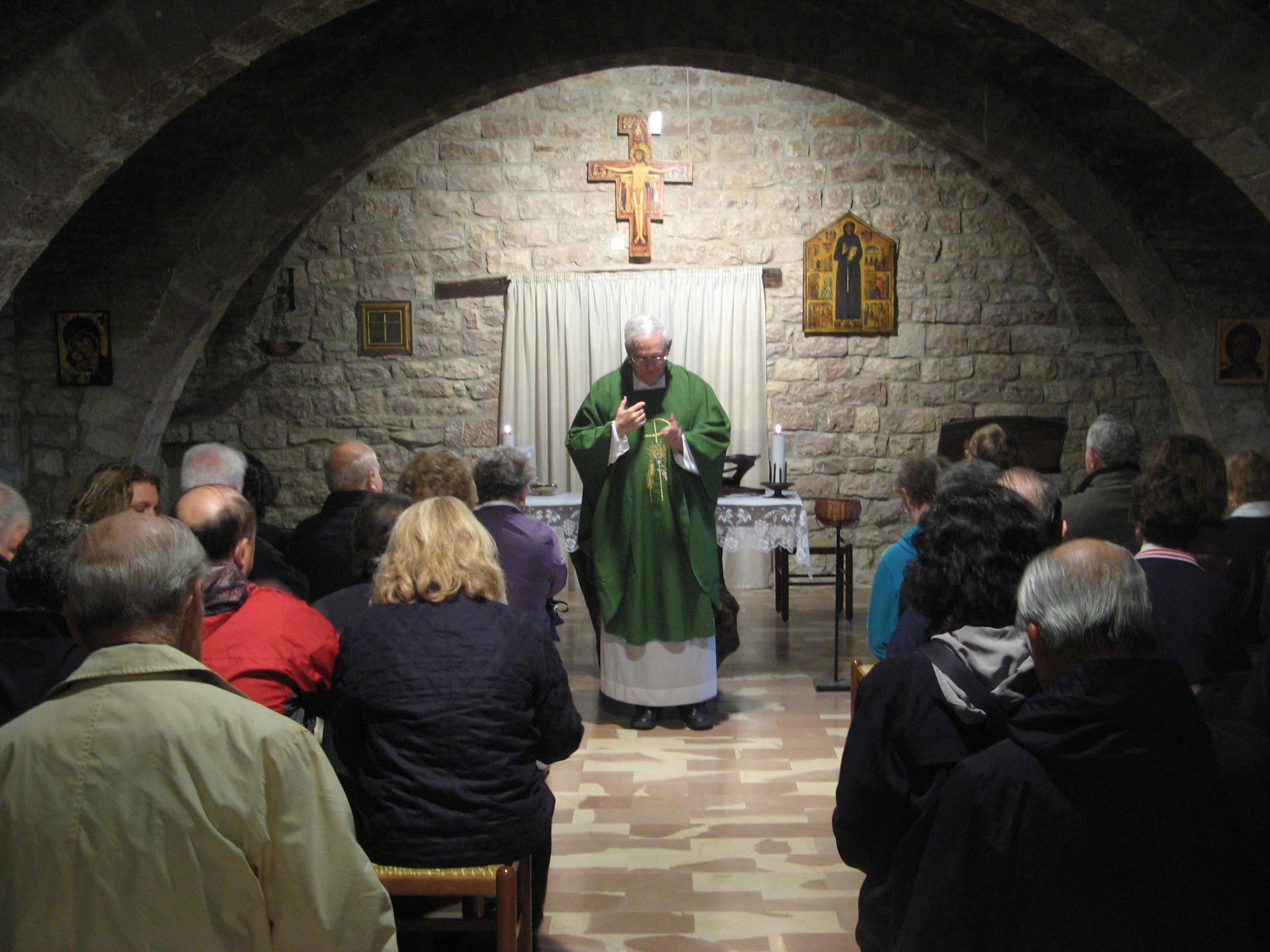
Praying at Mass

IMG_1517

Catholics are not going to Mass as much as they did.  People are busy, of course. Some say they don’t get much out of it. Whatever the reasons, US Catholics aren’t going to Mass as they did before.

We have new texts for Mass, will they turn things around?  I don’t know. Better preaching? That would help. But there’s more. We need to look at the way we pray and participate at Mass.  The Mass is the central act of our faith, and we need to bring everything we have– our bodies, our minds, our memories, ourselves– to it.

We’re there to pray, from the moment we enter the church to the moment we leave. Only by praying at Mass will we appreciate it.

The way we pray at Mass is simple. It begins as we enter church and make the Sign of the Cross. It’s a key to a world of faith. Taking  holy water  we bless ourselves “In the Name of the Father and of the Son and of the Holy Spirit. Amen.” We are reminding ourselves  that we’re blessed by God with the gift of life and everything it means through Jesus Christ. Water is a sign of that life. 60% of the human body is made up of water, and so it’s a reminder we are being blessed by the God of life.

Water, like bread, is a sign of life.The signs of water and bread stand for the totality of blessings we receive , and we acknowledge our blessings and give thanks through them.

Jesus said “If anyone is thirsty come to me.” He also said “I am the bread of life.” As we make the Sign of the Cross,  we’re reminded we’re at the source of life now and of life everlasting, Jesus Christ. We’re blessed by his life, death and resurrection. We trace his sign on ourselves, on our foreheads, our hearts and our shoulders. We’re blessed in mind and heart and all our being.

So, as Mass begins, the priest leads us into this great  act of blessing and thanksgiving by inviting us to make the Sign of the Cross.

Notice we bless ourselves  a number of times at Mass besides its beginning.  We bless ourselves as the gospel is proclaimed, asking that our minds and hearts be blessed to hear God’s Word. We bless ourselves as we leave the church at the end of the Mass, because we carry God’s blessings to our world.

Besides the Sign of the Cross,  simple acclamations at Mass  draw us into this blessed mystery. So,  as the priest concludes a prayer or action, we often say “Amen” an ancient Hebrew word, which means “Yes” we agree. The “Amen” at Mass calls us into the blessing of God. Simple word like “Amen”  draw us to the prayer of the church.

“The Lord be with you.” “Lift up your hearts.” “Let us give thanks to the Lord our God.”

Listen carefully to those words and the readings, the songs and the music at Mass. Say them and mean them. Sing them when they’re sung, for“Someone who sings well prays twice.” So we join our voices in song. At Mass we pray together.

We pray with our eyes, too, as we see the actions and signs of Mass. Walking, kneeling, standing are prayers. Simple actions, like bowing and offering our hand to receive the Host are prayers. At Mass we pray with our whole being. Our walking, seeing, listening, speaking become acts of prayer that bring us into the presence of God.

Of course, we often come to Mass with a lot of things on our mind that distract us from this great mystery. So often we’re on overload. Our faith may not be the strongest. We have our doubts. We get sunk in the everydayness of our own lives.

But God’s grace is here in this great mystery and God will draw us–weak as we are–into this great mystery.  God will give us– all of us– the gift to pray and find blessings here. God draws us here to bless us.

Looking Ahead

Looking ahead realistically is always hard, but maybe it’s harder today, especially for a religious congregation like mine, whose membership is old and whose financial resources are stretched.

We mirror the church in this country, in fact, which is losing members and running short on finances. So, we have to plan for diminishment’

But God’s plan is not to fade away, but to grow; to live and not to die. The wonderful first reading from Zechariah for today’s Mass talks about growth, not decline. Keep a “measuring line” in your hand for what is new, it says. Don’t be afraid to think big.

Here’s the reading from Zechariah in full:

“I, Zechariah, raised my eyes and looked: 
there was a man with a measuring line in his hand.
I asked, “Where are you going?”
He answered, “To measure Jerusalem,
 to see how great is its width and how great its length.”

Then the angel who spoke with me advanced,
and another angel came out to meet him and said to him,
“Run, tell this to that young man:
People will live in Jerusalem as though in open country,
because of the multitude of men and beasts in her midst.
But I will be for her an encircling wall of fire, says the LORD,
and I will be the glory in her midst.”

Sing and rejoice, O daughter Zion!
See, I am coming to dwell among you, says the LORD.
Many nations shall join themselves to the LORD on that day,
and they shall be his people and he will dwell among you.”

We need God’s “measuring line” when we look ahead.

A Community of Believers

The church is a community of believers–that’s the way the Acts of the Apostles, which we’re reading after Easter, describes it. We look so often at church leaders, like Peter and Paul, and we miss the crucial part ordinary believers play. They’re more than passive spectators.

Some time ago visiting a parish, the director of religious education was getting the young people ready for confirmation and first communion. “The parents are the ones who make these things stick,” she said. “If they don’t bring the young people to church; if they don’t think it’s important, neither will they. You can have the best preparation program around, but if parents don’t back it up with their own example, the young people wont be back.”

Families and friends still turn out for First Communions, I notice. Good they do. But in some way the community– families, friends, all of us– have to communicate our belief that sacraments are important signs of the presence of the Risen Christ.

We’re a community of believers.

The Resurrection of Jesus

photo copy

We’re concluding our parish mission in Shelter Island, NY, today with some reflections on the Resurrection of Jesus.

People today wonder about life after death. That’s because we want to live. We wonder about ourselves, first of all. Do we live after we die? A couple of books on the subject are popular these days: one by a scientist who claims he’s come back from death, the other is an account of a little boy who supposedly died and went to heaven and come back to life. Both are best sellers.

Our questions about life beyond this one also surface in  popular culture; the media is big into life in space and dark alien forces that invade our ordinary world. Must be life out there, but it looks scary, according to the media.

As Catholics we believe this world is connected to a world beyond. We believe in “the communion of saints, the resurrection of the body, and life everlasting.” Big beliefs. We believe there are tangible signs of our connection with this world, for example, apparitions of the Blessed Mother at Lourdes and Fatima.

Besides wondering about ourselves, we wonder too about our universe. Will it go on forever?

A couple of years ago I followed Harold Camping on television, who predicted the end of the world was coming on May 21, 2011 at 6 PM. The world was going to explode in fire, he said, destroying everything and everyone except those who read the bible; he didn’t have much hope for the world or most of the people in it.

A lot of people wondered if his crazy calculations were accurate. They weren’t. The world is still here and most of us are too, but at a time when many have lost confidence in our institutions, including our churches, people listened to him.

We  believe in Jesus Christ, who came into our world to teach, heal and offer the promise of eternal life. His death and resurrection answer our questions about death and life beyond this one; he also offers hope for our created world.

“On the third day, he rose from the dead,” we say in our creed. At first, his startled disciples spoke of their experience of Jesus risen from the dead in short statements like that, because his risen presence was unlike anything they had experienced before or knew from the past. They knew he was real, but his new existence was something they could hardly put into words. Their initial confusion is evident in the New Testament.

Jesus did not come from the tomb the same as he was before. He was not like Lazarus who came from the tomb and was easily recognized by all as he rejoined his sisters and went back to his own home in Bethany and took up his daily routine. Lazarus would die again.

Risen from the dead Jesus would not die again. He did not a return to the normal biological life he had before, but entered a new level of being; he experienced an evolutionary change that not only enhanced his humanity but ours too. Death would not affect him. He was changed, yet his love and care for his own in this world remained.

The Resurrection of Jesus, Pope Benedict XVI wrote, is “an historical event that nevertheless bursts open the dimensions of history and transcends it. Perhaps we may draw upon analogical language here, inadequate in many ways, yet still able to open a path towards understanding…we could regard the Resurrection as something akin to a radical ‘evolutionary leap,’ in which a new dimension of life emerges, a new dimension in human existence.”

Pope Benedict’s book, Jesus of Nazareth, is a good source for understanding the mystery of the Risen Jesus.

The gospels of Matthew, Mark, Luke and John are later statements about the resurrection of Jesus meant for particular churches and situations, so we should read them with their world in mind. Each gospel offers its own unique insight into mysteries of Jesus.

At our mission today we read from Luke’s account of the resurrection of Jesus, which centers on the two disciples on the road to Emmaus. Like the other gospels, Luke begins with the women at the tomb on Easter morning, but they don’t find  Jesus at the tomb. The Lord enters the world at large to share his risen life with his disciples and all creation.

In his gospel and the Acts of the Apostles, Luke sees God’s plan of salvation realized in Jesus who brings God’s salvation to all humanity through his church as it goes out from Jerusalem to Rome, then considered the center of the world.

The two disciples on their way to Emmaus represent the church on it’s journey through time,  one of the themes of Luke’s gospel.  As he did with the two disciples, the Risen Lord walks with his church on its mission through the ages.

Not an easy journey. Like the journey of the two disciples, it’s no triumphant march. Disillusionment, questions and gradual enlightenment are part of their journey. If the Risen Lord were not with them, they would continue in  hopelessness. The church ends up hopeless too, if Jesus were not with her.

Like the two disciples we find the Risen Christ slowly in the scriptures and in the breaking of the bread. Like them, he makes our hearts burn within. He is always with us.

The resurrection narrative from Luke is a good corrective to a triumphalist view that sees the church as perfect. It isn’t. It’s also a good corrective to a perfectionistic view of ourselves. We aren’t.

Like the two disciples, we have questions and  disappointments, but the Risen Christ walks with us. He engages  our questions and helps us understand, slowly. He is present in the breaking of the bread, the Holy Eucharist. We don’t see him; the Risen Lord has vanished from our sight, but he’s with us, guiding us to his kingdom.

Jesus also brings all creation into the mystery of the resurrection. “He took flesh and now retains his humanity forever, he who has opened up within God a space for humanity, now calls the whole world into this open space in God, so that in the end God may be all in all and the Son may hand over to the Father the whole world that is gathered together in him. (cf. 1 Cor 15,20-28) (Benedict XVI)

Harold Camping didn’t understand this.
The Resurrection Story

On Wednesday night of our mission at St.Charles Borromeo, in Port Charlotte, Florida, I preached on the Resurrection of Jesus. It’s a mystery that predicts our future.

Recent scriptural studies have made us aware that the gospels of Matthew, Mark, Luke and John were originally meant for particular churches and situations, and so when we read them it’s good to keep in mind the world and circumstances behind each one. Each gospel offers its own unique insight into mysteries of Jesus, and to gain that insight we have to resist our tendency to harmonize one gospel with  the others.

Luke’s account of the resurrection of Jesus centers around the story of the two disciples on the road to Emmaus. Like the other gospels, Luke begins with the women at the tomb that Easter morning, but the Risen Jesus does not stay at the tomb. The Lord engages the world at large and shares his risen life with his disciples and all creation.

In his gospel and the Acts of the Apostles, Luke shows God’s plan of salvation being realized in the person and life of Jesus and then extended to all humanity in his church as its spreads from Jerusalem to Rome, which was then considered the center of the world.

He offers the journey of the two disciples on their way to Emmaus as a way to understand the church’s journey through time.  Just as he did with the two disciples, the Risen Lord walks with his church on its mission through the ages.

It’s not an easy journey. Like that of the two disciples, it’s not a triumphant march. It’s marked by disillusionment, by questions and gradual enlightenment, as their journey was. If the Risen Lord were not with them as they left Jerusalem at the end of the Passover feast, they would have ended up hopeless. The church would fall into hopelessness too, if he were not with her.

Like the two disciples we find the Risen Christ slowly in the scriptures and in the breaking of the bread. Like them, he makes our hearts burn within.

Luke’s resurrection account offers us a way to look at the church today. It’s a good corrective to a triumphalistic view that expects the church to be perfect. It isn’t. It’s also a good corrective to a perfectionistic view of ourselves.

Like the two disciples, we have our questions and suffer our disappointments, but the Risen Christ walks with us. He engages our questions and helps us to understand. He is present in the breaking of the bread, the Holy Eucharist. We don’t see him; he has vanished from our sight, but he is with us. We can rejoice in the Risen Lord with us and guiding us to his kingdom.


The Heavenly Marathon

The New  York Marathon was run yesterday involving thousands of people. An interesting homily in the Office of Readings today ends with a glimpse into the 2nd century when they ran marathons too:

“So, my brethren, let us move forward to face the contest before us. In the contests of this world victory does not come to all competitors but only to a few who have trained hard and fought well; but in our contest, let us fight so that all may have the victory. Let us run the straight race, let us compete in the eternal contest, and let whole crowds of us steer our course towards the crown of victory. If we cannot all be victors let us at least come close.”

So in the great run of life, it’s not just one or a few that run the race. We’re all in it, “whole crowds of us.” It’s not just my run, but our run. We have to run together, and cheer each other on toward “the crown of victory.”

Nice image for the church, isn’t it?

We are His Flock


Last Saturday I celebrated Mass in a parish whose pastor was retiring and a new one was coming in to take over. It was the Feast of Corpus Christi, a vivid reminder of the presence of Jesus Christ among us. He is our shepherd and we are his flock.

We’re very conscious today of human leaders, whether they are politicians, business leaders, bishops or pastors. We want them to keep things going, to solve problems and to lead us into the future. When things go wrong, they’re the first we blame. Often they are all we see.

But there is another who leads us. “We are his people, the flock of the Lord.” St. Augustine comments on this verse from the psalms:

”  In this song we have declared that we are his flock, the people of his pasture, and the sheep of his hands… You are my sheep, he says. Even in the midst of this life of tears and tribulations, what happiness, what great joy it is to realise that we are God’s flock! To him were spoken the words: You are the shepherd of Israel. Of him it was said: The guardian of Israel will not slumber, nor will he sleep. He keeps watch over us when we are awake; he keeps watch over us when we sleep.

A flock belonging to a man feels secure in the care of its human shepherd; how much safer should we feel when our shepherd is God. Not only does he lead us to pasture, but he even created us.”The words we have sung contain our declaration that we are God’s flock: For he is the Lord our God who made us. He is our God, and we are the people of his pasture and the sheep of his hands.

Human shepherds did not make the sheep they own; they did not create the sheep they pasture. Our Lord God, however, because he is God and Creator, made for himself the sheep which he has and pastures. No one else created the sheep he pastures, nor does anyone else pasture the sheep he created.

“The Lord is my shepherd,” we say. And he shepherds the world as well.