Tag Archives: Christian

Friday Thoughts: Francesca and William

pierre-auguste-renoir-julie-manet-with-cat-1887

Pierre-Auguste Renoir, “Julie Manet with cat”, 1887


Francesca, like most 4-year-olds, is not particularly gentle when it comes to petting a cat. Well, let me put it another way, her gentleness as compared to her zeal when It comes to petting a cat is somewhat lacking. Hence, our cats spend most of their time in the attic of our apartment, hiding from the over-affectionate hand of Francesca.

One morning I was on the couch and Francesca was sitting at the coffee table working on a coloring book. From the door leading to the attic peaked the head of William. Francesca saw him and quickly looked at me, and for some reason this time she attempted to implement what she had been told many times before.

In a barely audible whisper, she looked for affirmation: “Daddy, I shouldn’t move, right?”

“No, Francesca, stay still…”, I whispered back, “…let him come to you. Just leave your hand down by your side.”

And lo and behold, William began to make his way toward us, and began to even approach Francesca’s still fingers. He sniffed. He balked. He approached again. Francesca went to move and stopped. William and Francesca courted each other, one filled with fright, the other excitement, both nearly shaking with emotion.

Francesca broke the tension and attempted to pet his head. William allowed it but could not hold together the nerve to stay put once Francesca’s hand moved past his neck. Off and up the stairs William went.

I realized something. Sometimes, when a person is filled with fear he can not be approached. No matter how kind, soft, sincere our intention, he just can not take the approach, any approach. He needs to make the first move. And we on our part need to simply stay still, patiently waiting for him to come closer, and then maybe, just maybe, we can make a kind gesture. But even if the person runs away at that point we need not take it personal. It is fear that is the cause. Neither the person giving nor the person receiving is to blame.

But unlike cats, who usually show fear just as it is, perhaps with an occasional threatening hiss, humans on the other hand show fear through a different type of tremble. They often preemptively throw insults, curses, mocks, pushes, and even outright physical strikes.

And just as it is hard to ignore the sharp claws of a frightened kitten digging into your arm—even when we fully understand that the kitten truly means no personal harm to us—it is hard to ignore such “attacks” from our fellow man. It is hard to strip them down to what they really are: pathetic attempts at self-preservation. But then again, was not Jesus striped down? And shouldn’t we always keep Christ’s Passion in our hearts? Well, then, as a sign of gratitude, we owe it to Jesus to see His Passion in all our interactions, especially the encounters that cause us pain, be it a superficial abrasion or a wound that pierces the core of our soul.

Let us then employ God’s grace in seeing all harshness, in any form, from any human being toward us, as fear. And by doing so we find ourselves very much in the actual footprints of Christ. For what nailed Him to the Cross was not jealousy nor anger nor even resentment, but fear, fear of the worst kind, fear of the truth. And in the case of Jesus, Truth had a very real face.

But we too are alive. We too have within us the divine presence, a presence that some find dreadfully frightening.

No, we can not like Jesus be sinless, but we can see our persecutors as he did: men to be pitied not punished, men that need mercy not condemnation, men who if we don’t offer forgiveness to are less likely to find it within themselves when they are at the other end of the sword—when it is their turn to be insulted, cursed, mocked, pushed, and even outright physically struck for simply wanting to love.

In the mean time, Francesca continues to color and William sleeps peacefully up in a tight nook of the attic. In the fullness of time, they’ll see eye to eye, as shall you and me.


.

—Howard Hain

.

Morning Thoughts: Saint Francis for 4-year-olds (and you and me)


saint-francis-coloring-page

“Saint Francis of Assisi”, coloring book page, colored by a “4-year-old”


(My wife teaches 4-year-olds in a Catholic elementary school. The school’s patron saint is Saint Francis. They call this week “Saint Francis Week” and hold various events throughout the week to celebrate the feast of this great saint (Oct. 4th). My wife and her co-teacher were looking for a short, simple biography that would be appropriate for their 4-year-old students. They didn’t find anything that seemed to be the right fit. So here’s what I jotted down for their pre-K-4 class. The kids really seemed to enjoy it. Maybe you will too. Let us “become like little children”.)


.

Saint Francis, a Knight for God

———

There once was a young man. He lived in a land called Italy. He lived a very long time ago. He lived over 800 hundred years ago!

He lived with his family in a small city named Assisi.

The young man was quite silly. He loved to dream and he loved to sing and he loved to dance. He loved to play with his friends all day long.

The young man’s name was Francis.

His father wanted Francis to be more serious. His father wanted Francis to be just like him. He wanted him to sell expensive fabric to people who were very rich. Fabric is what you use to make pretty things like curtains, tablecloths, and clothes.

Francis’ father wanted him to work in the family shop. But Francis was not very interested in that kind of work. Francis wanted to be a great knight!

And one day Francis went off to do just that.

Francis went off to become a knight. He began to travel to another city where he would fight with a sword and a shield. Francis thought that he would become a great hero.

But on his way Francis got very sick. He had to return to his home. His mother took care of him. And while Francis was getting better he began to dream of different adventures.

He began to spend a lot of time walking around the woods and looking at the flowers and at the trees. He began to watch closely all the animals, especially the birds that flew high up into the sky. Francis began to think a lot about God!

Francis began to dream about heaven. He began to wonder about love. He saw that there was another kind of knight!

Francis decided that he would be a knight for God.

Francis wanted Jesus to be his king and for Mary to be his queen.

Francis no longer wanted to use a sword or a shield. No, Francis wanted to teach all the world how to love. Francis wanted to sing and dance and show everyone how be more like Jesus.

He began to live very simply. He had very few things. His only clothing was an old brown robe. He lived almost like a little animal in the forest. Francis was very free. Francis was filled with joy. He was very happy.

And soon many other young men came to join him. They too wanted to be knights for God. They all lived together. They called each other brother. They shared all they had. They were kind to each other. They loved God together.

And one day, even a young lady wanted to join. She brought other ladies and they started a home of their own. They called each other sister. That young lady’s name was Clare.

A new type of family was beginning to grow. A family who lives very much like Jesus. We call them Franciscans.

We now call that young man, Saint Francis. We now call that young lady, Saint Clare.

Saint Francis and Saint Clare are now in heaven with Jesus and Mary and all the holy angels and saints. They live in perfect peace with God the Father and the Holy Spirit. They see us right now. They pray for us too.

Hey, who knows, maybe one day a few of you boys and girls may become knights and ladies of God, like our patron saints, Saint Francis and Saint Clare!


..

—Howard Hain

.

Friday Thoughts: Pure Extra Virgin

by Howard Hain
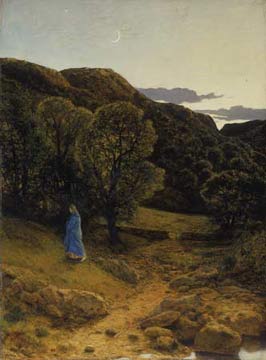
william-dyce-the-garden-of-gethsemane-1860

William Dyce, “The Garden of Gethsemane”, 1860*


To your eyes a thousand years are like yesterday, come and gone, no more than a watch in the night.

—Psalm 90:4


.One good olive.

There are so many factors.

The altitude. The light. The soil. The temperature. The rainfall. The wind. The dew point and humidity. The age of the tree.

Then there are those factors that we can control: pruning, watering, fertilizing, fanning, netting, and wrapping chilly trees with burlap or fleece.

And of course there are those other factors, those that fall somewhere in-between, between our control and our complete lack thereof: most of these relate to the sneaky work of numerous little thieves—animals, birds, insects, and perhaps even fellow farmers or other hungry travelers who just happen to pass by.

But when all is said and done—when all the factors are poured into the olive equation, mixed-up well, and left to unify or settle out—the fruit that’s produced by the world’s most nostalgic, symbolic, and romantic of trees means very little (at least in digestive terms) if it’s simply left to shrivel up and fall to the ground.

———

Picking an olive is perhaps the highest part of the art.

———

When to do so? And toward what end?

If too early, great potential is squandered.

If too late, great taste is lost.

If indecisive, we might as well let nature enjoy it for the time being—for one way or another—God’s process will eventually return it to the earth.

———

And yet, we’re still not done, for even if the olive is picked at just the right time, from just the right tree—the one that has grown in all the right circumstances—when it comes to the culmination of olive production, all is moot if the precious fruit of the womb is never squeezed.

For no matter how good the olive, without applied pressure, there’s nothing left to be labeled “pure extra virgin”.


.But when the fullness of time had come, God sent his Son, born of a women…

—Galatians 4:4


* Gethsemane is the name of a garden on the Mount of Olives in Jerusalem. It appears in the Greek of the Gospel of Matthew and the Gospel of Mark as Γεθσημανή (Gethsēmanē). The name is derived from the Aramaic ܓܕܣܡܢ (Gaḏ-Šmānê), meaning “oil press”.


(Dec/23/2016)


Thoughts Upon The Cross: Doxa. Doxa. Doxa.

by Howard Hain

.

And we have seen his glory,

the glory of an only Son coming from the Father,

filled with enduring love.

—John 1:14


.

The power of God.

A tiny leaf caught between two worlds

Suspended by invisible threads

Dancing to the still small voice.

Deeper and deeper

Into the person

The Son of Man

Who is God.

Glory.

And Might.

Power.

And Majesty.

Fully Alive.

Beautifully Human.

Walking Wisdom.

The Lightness of Fullness.

The Heaviness of Simplicity.

Doxa. Doxa. Doxa.

Honor.

Adoration.

And Praise.

Doxa. Doxa. Doxa.

Beyond praise.

The Power of One.

He Is.

We’re not.

He stands.

We fall down.

He dies.

We live.

Doxa to the Father.

Doxa to the Son.

Doxa to the Holy Spirit.

Doxa. Doxa. Doxa.

Between two worlds.

Is a man.

Who says “I AM”.

A tiny leaf suspended.

He is Lord.

He is God.

Invisible threads.

He Is.

And so now are we.

Dancing.

Still.

Small.

Voice.

The Word.

The Depth.

Beyond the signs.

To the Person Himself.

The Person of Jesus.

Deeper.

And deeper.

Into His flesh.

Into His Glory.

Doxa is Thy Name.

Dwelling among us.

Abiding within us.

Still small leaves caught between two worlds.

Suspended by invisible threads.

Dancing to the breath of God.

From deep to deep.

Depth to depth.

It never ends.

Doxa. Doxa. Doxa.

Doxa in the highest.


.

(May 6, 2017)

The Most Common Occurrence

by Howard Hain


Christ lives in the Eucharistic Prayer.

He listens carefully.

The Father listens too.

We listen with Them.

The Holy Spirit speaks.

He speaks a great silence.

He listens to the listeners.

We collectively hear.

God.

Three Persons.

His Entire People.

All Creation.

The Sound of One Breathing.

The Sound of Life.

Communion.

Amen.


(Jan/4/18)

Still Life with Nativity

by Howard Hain


Can’t keep it neat

Bunched-up cloth

Shifting sand

An avalanche of gifts

Those toward the outside move the most

The trough is fixed in place

The world turns, the Cross stands still” *

Manger, manger, what happened to you?

Sprouted roots

Began life as a tree

…..A table

……….A sawhorse

……………A wagon wheel

Dusty bumpy road

Excitement of a coming feast

Not quite yet

To and fro

Which place is home?

Bethlehem, Nazareth, Jerusalem

The land of Cana

A wedding toast

Now a wooden throne

Plenty of wine to go around

The world turns, the Cross stands still” *

Manger, manger, what happened to you?

Sprouted roots

Began life as a tree


* this line is a loose paraphrase of the Carthusian motto: “Stat Crux Dum Volvitur Orbis” (The Cross Stands Firm, While The World Turns)

Posture of Prayer

by Howard Hain
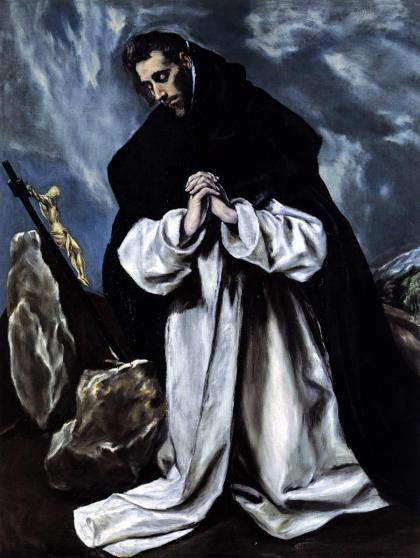
el_greco_st_dominic_in_prayer-1595

El Greco, “St. Dominic Praying”, c. 1588

Sometimes just showing up is all we can do.

To put ourselves in position to pray and worship—at least physically, even if we just cannot seem to get there spiritually—is an act of prayer and worship in itself. And quite often, it is the best we have to offer.

By confessing our aridity through physical obedience alone, we approach God’s altar with humility, for we come to God in our “nothingness”.

The bowing of head, the placement of knees, and the closing of eyes return us to the dark warmth of the womb. It is no coincidence that the posture of prayer and the fetal position bear great semblance.

It is in the womb that we are closest to God, furthest from the corruption of the world, and possess the least of what our “flesh” considers of value—our “brilliant” ideas, our “magnificent” plans, our “heroic” acts—our self-aggrandizement.

It is in the womb that we find ourselves in complete dependence. We receive all we need without knowing, without speaking, without cost.

In that sense, being in the womb is much the same as being in the world—for in the world we are still completely dependent—it is just that without the obvious reminder of the umbilical cord, we so easily forget our total and complete dependence on God, our Creator, our Sustainer, and our Ultimate End.

Hence we find ourselves “knowing,” “telling,” and “paying a price.” When in reality, the only thing that we can somewhat even come close to taking credit for is being physically present to receive His Word, His Wisdom, and His Will. All of which come free of charge, His Son having already paid the price.

———

“Lord, let me place my knees to the earth. Let me feel the foot of the cross against the caps of my knees. Let me close my eyes and bow my head. Let my brow lay upon your bloodied feet. Let me humbly raise my eyes to gaze upon your battered body. Oh my Lord and my God, let your blood and water rain down upon me.”

Amen.


Howard Hain is a contemplative layman, husband, and father. He blogs at http://www.howardhain.com

Follow Howard on Twitter @HowardDHain

twitter.com/HowardDHain

If you enjoyed this post, please consider “liking” it, adding a comment, becoming an email subscriber, or passing it along via the social-media links below. Your support is greatly appreciated. Step by step. All for God’s glory.

Sure and Steady

by Howard Hain
jusepe-josc3a9-de-ribera-tightrope-walkers-1634

Jusepe (Jose) de Ribera, “Tightrope Walkers”, 1634


The brighter the light the more we squint.

The closer we get the less we see.

And if we stare we go blind.

Now what?

You have to trust.

In what?

Not in yourselves.

In total darkness the answer is clear.

All other ways disappear.

Close your eyes.

Shutter your ears.

Forget the past.

Ignore what is below.

Chin slightly elevated.

Now walk.

No need to go too slow.

Sure and steady.

Heart on the goal.

And if we slip?

Don’t worry.

I made the rope.

I hold it tight.

My Son is “the way and the truth and the life”.

In Him you never fall.

In Him you know.

In Him you live.

He walks before you.

You may not see Him but He is there.

Follow close behind.

It is a tight walk.

That’s why I gave Him a pole.

I gave you one too.

And because it can get very dark.

I made them easy to identify.

They are made of thick dead wood.

Your hands know their splinters and knots.

Hold tight.

Say thank You.

Kiss in the dark what you cannot see.

For that old piece of wood.

Will get you across the gorge.

Where on the other side.

It will be planted.

Grafted into the Tree of Life.


Howard Hain is a contemplative layman, husband, and father. He blogs at http://www.howardhain.com

Follow Howard on Twitter @HowardDHain

twitter.com/HowardDHain

If you enjoyed this post, please consider “liking” it, adding a comment, becoming an email subscriber, or passing it along via the social-media links below. Your support is greatly appreciated. Step by step. All for God’s glory.

Clean Enough To Care

by Howard Hain
DP801172.jpg

John Downman, “Child Holding a Doll”, 1780 (The Met)


What if someone handed you a child?

A small child.

A tiny child.

An infant.

A few hours…a few minutes old.

What if you were the only one that the child could be handed to?

Only you.

No one else around to help.

Would you receive that child into your arms?

There’s no sterilized room, no sanitary precautions, no sink, not even a bar of soap—just plain old you, a bunch of imperfect circumstances, and a poor tiny child that needs to be embraced.

You know what you would do.

Even if your hands were filthy, completely covered in soot and mud, you know what you would do.

You’d quickly rub your hands against your pants or shirt and wipe away the obvious dirt.

Then you’d hold out your hands.

Wouldn’t you?

Yes. You would.

We all would.

That’s what makes us human.

That’s what makes us children of God.

We’d do what we could with what we have to help an innocent child.

We know that “cleanliness” in such cases really doesn’t matter. For even if the circumstances were “perfect” we’d still have that uneasy feeling. That feeling that we’re not worthy to hold such innocence, to be entrusted with such treasure.

It’s a holy hesitancy that only true humility can bear.

Yet, it’s the necessity to help, the clear need for our assistance—the abundantly clear reality that we’re the only “hands” on deck—that drives us to overcome such holy and righteous fear—a fear that reveals just how poor we really are, much poorer in fact than even the helpless child we are about to embrace.

It is preciously this beautiful fear of God that propels us to love boldly—to boldly reach out beyond ourselves, to boldly become part of God’s mystical body, to become His very arms and hands—to embody Divine Love Itself—that perfect love of the eternal Father for each and every child ever created.

For it is the Father’s love that creates us, and sustains us, and longs to flow through us.

We just sometimes need extreme circumstances—ridiculously obvious situations—in order to tap the needed courage to let it to flow beyond our own borders and into those around us.

You are in such a situation. Right now.

We all are.

This very moment.

No matter where you are or what you’re doing.

Such a situation is at hand.

A child, a new born—cold, hungry, and without a home—desperately needs to be held.

Quick then, wipe your dirty hands, make due with what you’ve got—believe the Word of God, it’s good enough—now hold out your hands.

You’re clean enough to care.


Howard Hain is a contemplative layman, husband, and father. He blogs at http://www.howardhain.com

Follow Howard on Twitter @HowardDHain

twitter.com/HowardDHain

If you enjoyed this post, please consider “liking” it, adding a comment, becoming an email subscriber, or passing it along via the social-media links below. Your support is greatly appreciated. Step by step. All for God’s glory.


Web Link: The Metropolitan Museum of Art. John Downman, “Child Holding a Doll”, 1780

Bozza Imperfetta (imperfect sketch)

by Howard Hain


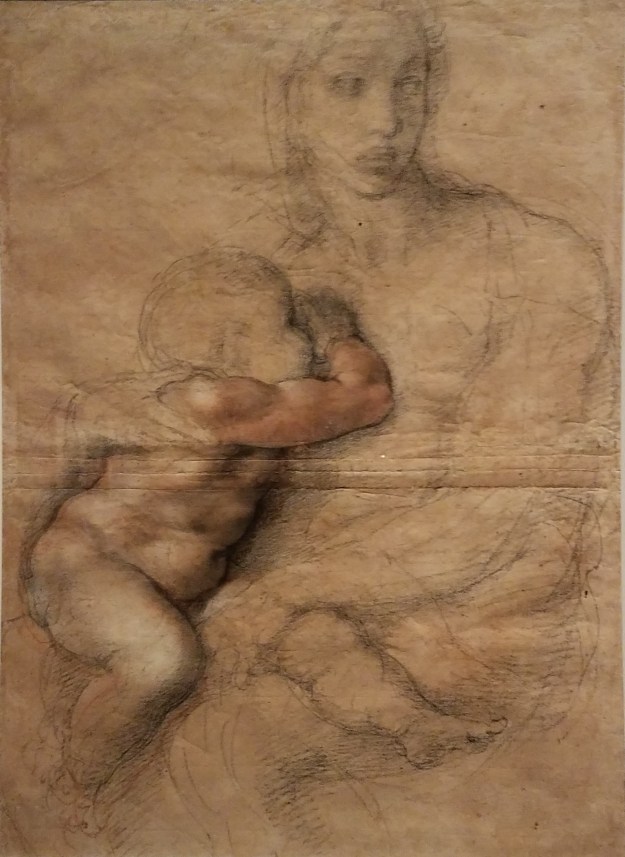
20171121_104929

Michelangelo Buonarroti (Italian, Caprese 1475–1564 Rome). “Unfinished cartoon for a Madonna and Child.” 1525–30. Drawing, black and red chalk, white gouache, brush and brown wash. Casa Buonarroti, Florence


I know almost nothing.

What I do know leads me up the ladder of not understanding.

To my perch upon the Cross.

Within the heart of my child Jesus.


20171121_110016

Museum Wall Card for Work Above, from: Michelangelo: Divine Draftsman and Designer, on view at The Met Fifth Avenue from November 13, 2017 through February 12, 2018.