Tag Archives: Christ

Morning Thoughts: Prayer

by Howard Hain

.

I sat toward the back. Near the cooler. At the third table of three.

Looking through the line of bakery customers, I see out the storefront window, across the somewhat crowded street—that seems to be undergoing never-ending construction—a woman waking by. She passes before the window of the corner convenience store. She crosses herself. I don’t know why. But I believe.

I don’t understand.

But I trust.

I don’t desire. I don’t will. I don’t want.

I respond with faith.

She is good. She is like you—trying her best. She is like me—she could do better.

God loves her. God loves you. God loves me. Nonetheless.

The desire to love is love.

The will to union is union.

The Freedom of Christ is a Cuban pastry with three holes.

I eat away.

I taste and see.

My food is to do the will of Him who sent me.

Faith. Hope. Charity.

All else is a small pile of crumbs—gently laid to rest—the edge of the bakery table—on the well-worn tile floor.


.

“There is nothing more gracious than to think well of our neighbor.”

—Saint Therese of Lisieux


.

.

Friday Thoughts: Simple Awe

Picasso, The Blind Man's Meal, 1903

Picasso, “The Blind Man’s Meal”, (1903)

.

The ear that hears, the eye that seesthe Lord has made them both.

—Proverbs 20:12

———

It is the simple times. It is when we are doing life one dirty dish, one utility bill, one ordinary errand at a time that deepened faith creates an awe-filled stir.

For much is said of the bells and whistles of supernatural faith—but what is most supernatural is the presence of “all”, of “everything”, of “heaven and earth” in each dirty dish, each electric bill, each trip to the dollar store. What is most supernatural is the acknowledged presence of God in day-to-day life.

The deeper our trust, the more complete our surrender, the less “exciting” the external signs need to be. Or to express it differently: The least “exciting” times become so overwhelmingly profound that bells and whistles are hardly noticed.

We are told that we need an ear that hears and an eye that sees.

But what is it to have them?

Is it being still within God’s presence while the sponge soaks, the envelope seals, the cash register line slowly shortens?

The skeptic may see such a man as confined by complacency, dangerously satisfied, or simply numb. The skeptic may even call such a man “blind”.

That is certainly one way to look at it.

There is another:

Or is it that the mighty awe of a salvaged life has finally taken hold?

———

Turning to the disciples in private he said, “Blessed are the eyes that see what you see. For I say to you, many prophets and kings desired to see what you see, but did not see it, and to hear what you hear, but did not hear it.”

—Luke 10:23-24

.

.

—Howard Hain

.

Friday Thoughts: School of Athens

by Howard Hain
Raphael School of Athens Vatican Museum

Raphael, “School of Athens”, 1509-11, Vatican Museums, Raphael’s Rooms, Room of the Segnatura


.

I see you there

Somewhere near the back

Hiding

Thinking no one can see

A priest

A prophet

A king to be

———

Socrates?

A profile

Like the head on a coin

Another good man

Snubbed for what he knows

Can’t see your face

Not fully

Say the least

Though perhaps

We too would die

A drop of hemlock

Is hard to swallow

———

Like that fine-feathered friend

All philosophers are

Little birds

Not too fat to fly

Aerial feeders

Circumventing the globe

Following truth

Wherever it go

———

Plato?

Yes

Now you

We see for sure

After all

Like a son

You and Socrates

Your father figure

Setting up shop

Hanging out

A common shingle

Hard to distinguish

In fact

The fiction

Son from Pop

One generation

Stumbles upon truth

The next

All about father’s business

Selling sovereignty

The sovereignty of Good

Not by peddling answers

By asking simple questions

———

Aristotle?

Yes

He made the frame

The third person

The younger brother of sorts

In some sense

Stealing the show

A third amigo

A sort of philosophic trinity

Aristotle the great

Teaching emperors to be

A bright bronze star

Mentioned last

Never least

A meta-physician

Looking not to the past

He expanded business

Once Plato left the scene

Pointing the way

He thought it should go

Down to earth

Keep it real

Hover low

Eyes on substance

On the truth below

———

Quite a team

These three musketeers

Sharp whiskers

Well-trained tongues

Doubled-edged swords

Wielded about

In universal hands

Yet many others

Names we might know

The great wall of knowledge

An army

To remain

The great unknown

———

Truth

Beauty

The noble pursuit

Lady Wisdom

Her many lovers

And each takes her as his own

A cloud of witnesses

Testifying one truth

The Communion of Saints

Under a different kind of roof

———

Look at that structure

Who built the arch?

It overrides

Every branch of the tree

If colored

It’d be a rainbow

Yes

That once great sign

Now brought so low

Meant so much

Primary color

Fragmented light

Quite a choice

Magic marker

Cross the sky

God’s endless love of life

A sacrament

One might say

A sign

As natural as natural can be

The offspring of union

A pledge

A covenant

A promise

The kind that brings new life

Adam

Then Eve

Woman created

From the lonely side of man

To lovers

Of such wisdom

Truth is clear

The rainbow redeemed

It will once more

Point to the sun

After yet another storm

The fullness of noon

Its rightful place

Where nothing disordered

Continues to loom

———

Welcome home

Child of wonder

Come on in

The water’s warm

Jump high

Up over the frame

Roman columns

Marble floor

Robes in many shades

Your heart

Away from home

Bring nothing more

Leave your sandals

At the door

A burning bush

Holy ground

Children at play

A clubhouse of truth

Safe and sound

Slides and swings

Monkey bars

Hang on tight

Hold on loose

No possessions

Got to share

Acts

Appreciation

Sons of liberty

Daughters of revolution

The mulberry tree

What’s that?

Your degree?

Of such things

We just don’t care

———

Poetry

Completely still

Motion

In dialogue

Statues

Alive

Silent features

Arch

And texture

Every detail

All one view

Did you hear?

Have you seen?

The latest

No not the news

What’s truly new

Not the fleeting

Nor the slice

Not cutting edge

What’s new is old

All under the sun

Originality

Yesterday

Genesis just begun

Just a few rules

Keep perspective

A frame

If you will

A type of kind

Boundless

Creativity

Yes

But not for sale

Bring what’s prized

Not the least

Only one item

The book of life

———

God became man

Truly human

Not veneer

Truth among us

Not to abolish

Bring to fullness

Humanistic pursuit

The glory of God

Made manifest

In man’s pursuit

Of God Himself

———

Jesus

In disguise

The philosopher’s cloak

Reaching upward

To shake His own hand

At the right side

God the Father


Raphael School of Athens 1509-1511.jpg

Raphael, “School of Athens”, 1509-11, Vatican Museums, Raphael’s Rooms, Room of the Segnatura

.

http://www.museivaticani.va/content/museivaticani/en/collezioni/musei/stanze-di-raffaello/stanza-della-segnatura/scuola-di-atene.html


Friday Thoughts: Le Madras Rouge

by Howard Hain

Henri Matisse Red Madras Headdress Le Madras rouge 1907

Henri Matisse, French, 1869-1954
Red Madras Headdress (Le Madras rouge)
1907, Oil on canvas, The Barnes Foundation


.

Rosy cheeks

Crimson lips

A funky handkerchief upon your head

Taking a break from cleaning?

Or just pretending?

Ah!

Perhaps a gypsy?

No, perhaps all three.

———

Yes

More to be seen

A portrait from the past

A figure of old

A testament

Of what’s redeemed

A harlot

No more

Seven demons

Cast away

Setting sail

Completely freed

Eyes on distant shores

Flag full staff

Bones properly buried

A pirate turned parakeet

Pastels all a flutter

Colors abound

Novelty renewed

A romance for sure

Mysterious winds

Exotic islands

Far off lands

Yet so close

Milk and honey

Set before

Within arm’s reach

Right and just

An adopted child

Now full heir

———

Innocence discovered

Virginity returns

Chastity on full display

Fact as fiction

Stories unfold

Promises foretold

A man and then a woman

A rib and a garden

A paradise and nothing to do

A lie and a sneaky snake

A revolving sword

Set a fire

Brother against brother

An ark that floats

Sent off in twos

A raven and a dove

A father in faith

Journey unknown

A far-flung place

Boys will be boys

Brotherly mischief

Here we go again

Slavery and sphinx

Mercy tries once more

Thru the red gate

Chariots and legions

Encased in sea

Wandering and wandering

“Listen to me!”

Bread from heaven

Fowl falling from the skies

Striking rocks

Water shoots forth

Time to settle down

Conquer some giants

Crisscross a river

An ark on two poles

A new occupied land

Vineyards and fields

Laws and oaths

Judges and kings

Forgetting and forgetting

Just who it is

Who gives them life

What is God to do with such a man?

The shepherd boy

Last in line

One more try

Singing psalms

Prophecy

He fits the mold

The mind of Christ

We are told

———

A tiny young woman

A just upright man

Stables and sages

Stars and circumcision

“The carpenter’s son?”

Yes, crafting a table

To stand upheld

Shape of a cross

Used too as a crib

A born-again bed

For those about to die

Back to a table

A kingdom spread

A feast to behold

The Son not spared

The Bread of Life

Broken and blessed

“Father forgive them…”

“They know not what they do…”

———

Mary of Magdala

First to the tomb

Her and the gardener

Alone and renewed

“Mary”

“Rabboni!”

“Don’t yet cling to me”

“But what then shall I do?”

Sit and stare

Inwardly explore

Externally ignore

Signs of the past

Others still may see

But within your chamber

Mine all mine

Extra virgin

The Garden of Eve

Betrothed and beautified

Originality set free

No trace of sin to fall

Now cover your hair

You are my bride!

For you I shall return

A dove within a cleft

Won’t be left alone

———

A handmaid

A wife

A disciple

A model

A muse

Positioned in a cane-back chair

Awaiting the Word

To open the door

Now

Yes now

An acceptable time

Behold

“I stand”

“I knock”

“I AM”

Open the door:

“Lift high your heads…”

“Grow higher, ancient doors…”

“Let him enter, the king of glory!”

.


Henri Matisse Red Madras Headdress Le Madras rouge 1907

Henri Matisse, French, 1869-1954
Red Madras Headdress (Le Madras rouge)
1907, Oil on canvas, The Barnes Foundation


.

http://www.barnesfoundation.org/collections/art-collection/object/6365/red-madras-headdress-le-madras-rouge

..

Friday Thoughts: Adolescent Cardinals

by Howard Hain

northern_cardinal_8

Adolescent Cardinal

.

Brilliant Red?

Not quite yet.

The color of martyrs?

That remains to be seen.

A touch of green?

Yes, that’s for sure.

It’s the obscurity of ordinary time.

But what about the shade of gray?

An undyed robe.

One way or another, the ascetic life.

They have to learn to let go.

But they seem so unaware?

Certainly the case.

Too busy with growth.

No time to kill.

Branch to branch.

Tree to tree.

Upward.

Onward.

“Let’s find a new field!”

Though they always follow the lead.

Willingly or not.

Of the one bright red.

Hot on his heels.

They tweet and swipe:

“Let me in.”

“I’m ready to fly.”

“Let me lead the way.”

But maybe not yet?

Thinking they’re ready.

Sure sign they’re not.

Blood orange.

The bitter color.

Right before red.

A shade.

A difference.

A single feather.

Off the top of the head.

But avoid the cat.

And their day shall come.

Red.

Like the exhausted sun.

About to explode.

End of a hot August day.

Crushing the horizon.

Making it almost disappear.

But there on the cusp.

Just before another world.

We see the spectrum.

All yellow now gone.

The orange too has disappeared.

And the green?

Vanquished for eternity.

Even purple is held at bay.

Only the sincerity of red can sustain.

A pure offering.

A humble heart.

The undyed pigment.

Of a completely different sort.

The deepest kind of red.

Almost a shade of blue.

Blinding even the sun.

For Justice is duly at hand.

And a small bird of mercy.

White as white can be.

Flies incredibly low.

In friendship.

With him who bowed down.

Hand in hand.

A cardinal and a dove.

Into the jaws of death.

Though ever so certain.

There will be at least one more.

Yes, certainly another.

An heir, an offspring, a sturdy new branch.

At least one more.

For the young one watches.

Witnesses the entire display.

He sees the fully mature.

Return to their mother’s nest.

And lo and behold.

Dusk becomes dawn.

The newest day of all.

Rising from the west.

For the brightest color.

Has none at all.

What a display.

Life outdoing death.

The power of meekness.

Gaining the upper outstretched hand.

And with a gentle gesture.

Breaking the gates of hell.

Opening wide.

Heaven’s once narrow door.

Red all a flutter.

Now only joy and peace.

A cardinal is no more.


red-cardinal

Mature Cardinal

Morning Thoughts: Joy Of The Cross

by Howard Hain

.

My parish church was seriously damaged in a fire a few months back. It was pretty dramatic, devastating in many ways.

Since then the parish has continued on, celebrating Sunday Mass in a Union City public school gymnasium. Ironically, that public school is housed within a building that was once part of our parish community, built to stage an annual Passion Play—amazing how consecration begets consecration—grace begets grace.

Seeds long forgotten, suddenly popping up through cracks in the sidewalks.

———

“…where sin increased, grace abounded all the more…”

(Romans 5:20)

———

Overall, the parish community over the last few months—during this period of “destruction” and “darkness”, of “uncertainty” and “grieving”—has been more alive than ever before. Amazingly enough, surely by grace, the various parish ministries seem to have expanded, at least in my unofficial and non-statistically-supported opinion. All this despite the fact that most of us have been hiding in our own upper rooms—doors tightly locked. Praying nonetheless.

No, praying all the more.

———

“You are indeed Holy, O Lord….sending down your Spirit upon them like the dewfall…”

(Eucharistic Prayer II)

———

Well, sparing you the details of our own little acts of the apostles, we received official word from the Bishop just this past weekend—Solemnity of the Most Holy Trinity—that the church building will be reconstructed.

Believe me, this was not a forgone conclusion. In fact, there was good (and perhaps a better way to express it, “sober”) reason to brace for news quite the contrary.

But it will be rebuilt.

And renewed.

Praise the Lord.

———

Sitting in the elementary school chapel of Saint Francis Academy this morning, just a few city streets from our still burnt-out parish structure, I thought about this fresh news. The Good News.

The Church will be rebuilt.

But that’s not how I heard it now.

No, that’s how man reported it.

God says it differently. He doesn’t report.

He speaks into being. God is the News.

And when He is most loving, He is most commanding:

“Rebuild My Church.”

———

The irony is delicious, I tasted and saw; I was sitting in a little chapel named after the Original Knight of Lady Poverty, Francesco d’Assisi.

It’s a beautiful, joyful chapel, where God becomes man over and over again, and where children become disciples time and again. It is also the place where we adults, so very much pretending to be in control, came crawling to receive sanctuary—to be cared for during our days of distress.

———

“Lord…look not on our sins, but on the faith of your Church…”

(Order of Mass)

———

Irony upon irony. Saint Francis Academy was originally an orphanage. For the past several generations it has been a beacon of what true elementary education—what true human formation—should look like—when led by the Spirit.

We have celebrated weekday Mass in the academy’s chapel almost every morning since the fire. Such generosity. Such openness. Such hospitality.

So welcoming. So joyful. So Franciscan.

So Christian.

God uses everything, always and in every way, for Good.

And He is never so creative as when manifesting new forms of humility.

For there we are, day in and day out, the homeless “know-it-alls” within the home of tiny tots. Roles reversed. Upside down. Little lambs feeding the uncertain shepherds.

———

As I pondered this mystery this very morning, my little Francesca—my own little “flower”, my own little troubadour of God, my own incredible little girl—God’s little girl—to whom I have been chosen “to light and guard, to rule and guide”—tends to her studies just a few floors above.

The first-grade classroom at first glance seems impossibly small. But it’s truly a delight—safe, bright, full of promise—in spiritual reality, there is so much room.

Francesca finishes the school year this week, a week of events and performances and feasts, a week designed to catapult her and her fellow “novices” into a summer of playful absorption and merry-filled mission: public pools, French-braid festivities, and watermelon days and Italian-ice filled nights at the ever-popular Camp Grandma.

Ah, the goodness of God.

———

“O Bonitas!”

———

The old phase, “goodness gracious”, takes on totally new meaning. It becomes a sacrament. A sacred sigh. With divine significance. A poem made of breath. A cry announcing life.

That little one of whom I speak I love. Deeper and deeper each day. And I pray it’s all for the sake of God. For the love of God. Of His Divine Presence. The King of Kings—The Monarch of Mercy—an eagle and a butterfly—held completely captive—voluntarily held hostage—within the liquid heart of a ever-emerging child.

She is the entire universe within an ark of angelic giggles…all of creation within a jar of ceaseless surprise…the totality of God’s promise within a tabernacle of painfully-sweet joy—O Lord, may we truly learn how to pray!

———

“I have much more to tell you, but you cannot bear it now. But when he comes, the Spirit of truth, he will guide you to all truth.”

(John 16:12-13)

———

Francesca is all children. All children are Francesca. And by the Blood of Christ and the Holy Spirit of Adoption we too are now God’s children.

We are all God’s Francescas.

———

Thank You, Lord, for the news. The practical and the permanent. The circumstantial and the promissorial. And thank You for expressing it Your unimaginable way.

For it is You, Lord God—the very same God who spoke to Francis nearly a thousand years ago through the Crucifix of San Damiano, a church almost completely in ruins—who now says to me, to all parishioners of the parish of Saint Joseph and Saint Michael, to all of Union City, to all of New Jersey, to all of America, and to all the world—both the world that is and the world yet to be.

And You Lord, speak quite clearly.

In fact, You speak with unbelievable clarity:

“Rebuild My Church.”


.

.

Thoughts Upon The Cross: Bold Humility

by Howard Hain

.

We should always strive to be fully united with The Body of Christ, in both thought and prayer. To think prayerfully, and to prayerfully think.

Let us then prayerfully embrace this particular moment:

Lord God, Father Almighty, let us use the talents, the gifts, and the abilities—that come from You, that will return to You, but that You have lent us for the time being—with maximum effectiveness, maximum efficiency, and bold humility—all for Your glory.

In the name of Jesus—in the person of Christ—as the Messiah Himself would offer.

Amen.

———

Now, let us think, prayerfully.

What is “bold humility”?

Let’s explore an answer, slow and steady.

First, like all manifestations of God’s glory, “bold humility” is a matter of transcendence.

Second, transcendence is not merely a type of balance. Balance is something else entirely. It is something less than divine. Balance is a man-made religious concept. It is practical human philosophy at work in the world, depending on and functioning within human limitation. Unlike transcendence, balance does not stem from the theological posture of divine providence, and more so, it does not rely on the acknowledged power and faithful acceptance of divine grace.

For example, with regard to the matter at hand, “bold humility” is not merely the balancing of boldness and humility—it is not a matter of being equally bold and equally humble—as if on a scale of 1-10, a score of 5 for boldness and a score 5 for humility is achieved simultaneously—adding up to 10 and at the same time keeping the “seesaw” of virtue straight and parallel to the earth lying below.

No, “bold humility”, like all Christian (and therefore preternatural) virtue is not a matter of equally limiting each natural characteristic in order to fit them all within the confines of human potential and logical limitations.

In plain language then, “bold humility” is not simply a healthy combination of two virtues, namely “boldness” and “humility”.

And most directly to the point: Christ didn’t balance. He transcended.

Then what does transcendence mean in this supernatural sense?

Well, let us rule out a few more false understandings before positing a possible positive understanding.

It will prove helpful to also establish this negation: To transcend is not merely to eliminate. Nor is it merely to deny. By transcending one does not destroy the categories it transcends. So in this particular case we can say that “bold humility” does not “eliminate” or “deny” the category of “boldness” or the category of “humility”.

Now let us begin to state positively what Jesus accomplished—for Jesus most certainly transcended.

To transcend is to rise above and beyond. It is to journey through. It is to transform.

Transcendence fulfills the “categories” it leaves below—it completely and utterly fulfills each and every virtue that man could ever conceive—and not only at the same time or simultaneously, but eternally and to a maximum degree. Transcendence is perpetual fulfillment of all “goodness” to an infinite “degree”.

Transcendence is then what we might call: Active Shalom.

It is living, breathing “Fullness”. It is “True Peace”. It is “Oneness” and the “Unity of God”—alive and constantly in motion. For to transcend is also to enter and live within the Internal Consistency of The Eternal Creator Himself.

Transcendence is the ultimate simplicity of “I AM.

It is Ipse Christus—Christ Himself—God made man, the Word made flesh, the magnificence of God brought into visible light.

And it is human redemption at work.

For the person of Jesus is just that: He is the glory of God woven into and through the very fabric of humanity—taking humanity above and beyond itself—transforming it on earth and simultaneously bringing it back with Him to the Father in heaven—as a new, glorified, and righteous form.

Jesus both lifts humanity into heaven and manifests fully God’s glory on earth.

Bold Humility” is Jesus Himself.

He alone fulfills completely both “boldness” and “humility” without ceasing.

And by doing so He straddles two worlds—making them one. But yet He is much more than a bridge, much more than a mere mystical ladder. Jesus, if you will, is Jacob’s Ladder but built of human flesh—upon Whom not only holy angels ascend and descend between heaven and earth—but through Whom the very helix of humanity is redeemed and glorified.

———

But enough words.

For they can never capture.

Jesus is profoundly free.

The best we can hope for is a glimpse—a fleeting image of the living, breathing manifestation of “Bold Humility” in ultimate action.

It takes silence.

It involves leaving the senses and faculties behind.

It requires “spirit and truth”:

We must stare at The Cross.

We must experience—firsthand—The Crucified Christ.


..

Let us then pray once more:

Lord God, Father Almighty, let us use the talents, the gifts, and the abilities—that come from You, that will return to You, but that You have lent us for the time being—with maximum effectiveness, maximum efficiency, and bold humility—all for Your glory.

In the name of Jesus—in the person of Christ—as the Messiah Himself would offer.

Amen.


.

.

Thoughts Upon The Cross: Act Like A Man

by Howard Hain

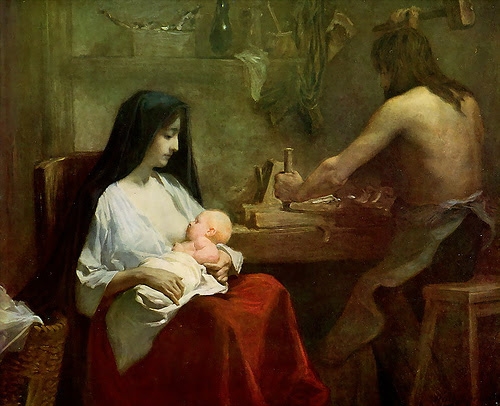
saint joseph, holy family.

To all men it may concern (definitely including me):

.

Complaining is not strength.

It is actually quite unbecoming, to say the least.

In fact, it can easily become extremely boring.

And when it spills forth from the mouths of men who are appointed to lead, it manages to take on a whole new level of tediousness.

It becomes outright pathetic.

Of course, I am not talking about having private conversations with friends or colleagues, the kind of back and forth that can often strengthen and give great consolation. No, that falls under fellowship, under spiritual friendship. In those situations, practicing vulnerability and allowing oneself to be seen as truly struggling is actually a sign of strength.

What I am referring to are those too-often times when “leaders” openly and repeatedly complain in front of the very people they are chosen to lead and inspire—in front of the very people they are chosen to protect, guide, and encourage. Or to put it in more spiritual and pastoral terms—in terms of the “Good Shepherd” if you will—instead of feeding their sheep a sense of hope, a sense of security, and a sense of peace, the shepherds themselves cultivate and offer their flocks an atmosphere of worldly concern, a stream of ongoing despair, and a diet of downright near hysteria.

It is so embarrassing.

And the scope is broad, for appointed “leadership” comes in many forms: public officials, all kinds of employers, managers, politicians, coaches, pastors, administrators, teachers, and most certainly, and perhaps most significantly, every married man and father in the world.

God have mercy on us.

Forgive us our many failures.

Especially for us Catholic Christians, called to imitate in a special manner the Crucified Christ.

And this isn’t simply a matter of ever-changing public opinion. No, it’s a matter of being inherent in the very idea of leadership itself.

Shepherds lead, sheep follow.

Think about it, when was the last time you saw an artwork depicting a small group of little lambs carrying a full-grown living breathing Jesus?

Needless to say, never.

And in terms of practical and applied philosophy, let us then keep this significant and relative reality in mind: When it comes to real and everyday concerns, chances are that the most grueling day for most of us modern men is only as difficult as the normal, run-of-the-mill, daily employment of a mother of three—not to mention if that mother is also working full-time, single, in an abusive relationship, and/or barely speaks English—then it’s no contest—and in our current “ever-progressive” society, these conditions unfortunately too often apply.

So, if this not-so-gentle “correction” applies to you (as it most certainly applies to me) know that many are praying for us, many feel for us, many love us, many even need us, but we need to do our part:

Act like a man.

For sake of Christ.


.

Let us pray:

Lord God, Father Almighty, Creator of heaven and earth, we give you praise. Help us Father, help all men, all those called by You to lead. Help us to follow the only True Man, Your Only Begotten Son, Christ Jesus—our Lord and our God, and living Innocence itself. May we follow Him and Him alone, so we may be properly equipped—emotionally, physically, and spiritually—to lead those You have entrusted to our care. Make us strong and patient, courageous and persevering. Let us learn through the example of Saint Joseph the true meaning of humility, obedience, and selfless sacrificial service. Teach us to cherish silence and value greatly the grace of a truly developed interior life. Inspire us to love our wives and children with sincerity and integrity and profound gratitude. And when need be, Heavenly Father, show us how to be truly decisive, how to act with boldness in defending Your truth, and how to be utterly fearless in helping rescue those crushed by injustice and hypocrisy.

In all matters may we always do Your will and act on Your behalf—with minds made spotless, hearts made pure, and bodies kept chaste.

We ask this in the name of Jesus, in the perfect unity of the Holy Spirit, for Your endless glory.

Amen.


.

.

Thoughts Upon The Cross: Speak Life

by Howard Hain

Sandro Botticelli, The Last Communion of Saint Jerome, early 1490s (detail)

Botticelli, “The Last Communion of Saint Jerome”, early 1490s, (detail), The Met


.

Heal us.

In the form of bread.

Our tongues like cribs.

You come to rest.

A sacred place.

A mother watches.

A father can hardly believe.

Greatness simply conceived.

Silent.

Yes let us be.

Help us not to speak.

No words can be.

No thoughts except those that flee.

Yes.

Hold our tongues.

Into quiet place.

Stillness.

Let us wait.

Till hear You cry.

A hungry child.

Tucked in for night.

A drop of milk.

In reality blood.

In the form of wine.

The angels sing.

Holiness explodes.

Heaven down to earth.

Saints to and fro.

Blessings forth.

Grace abounds.

The sick are healed.

The blind can see.

The lonely find friends.

Children unwanted?

They finally reach home.

We look.

We see.

We wonder.

How could it be?

It’s Him!

It’s Him.

Right there.

The One nailed to the tree.

Alive again.

Within my mouth.

And at my right hand.

And to the left.

And straight ahead.

And there!

Yes, there too!

In that hopeless situation.

We thought all was lost.

But, no, it’s Him.

He really does care.

And He calls us over.

To Himself.

And yes.

Silence changes forms.

It’s again time to speak.

What else can we do?

The Eternal One.

The Son of Man.

The Conqueror of Strife.

Let us smile at one another.

Let us speak life.


.

http://www.metmuseum.org/art/collection/search/435728

..

Thoughts Upon The Cross: The Imitation of Christ

by Howard Hain

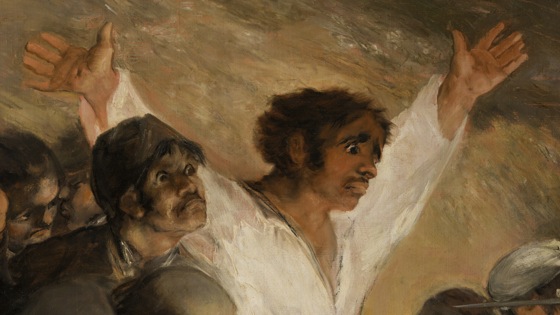
Francisco Goya, The Third of May, 1808 in Madrid, 1814-15 (detail), oil on canvas, (Museo del Prado, Madrid)

Francisco Goya, “The Third of May, 1808 in Madrid”, 1814-15 (detail)


.

I hear, ironically mostly among clergy, that the spiritual classic “The Imitation of Christ” is no longer really relevant—that it is too hard, too negative, too oppressive—written for a time when plagues and famines and wars were rampant, when men hardly lived to what we now call “middle age.” But most of all, perhaps, I am told through cute smirks and smug expressions that it is a book not for our “age”, that it no longer applies to our advanced “civilization”, that it no longer rings true in the triumphant “West”.

I ask: Are we free of plagues, free of war, free of famine?

Are not our priests and religious sisters dying off rapidly? Are not babies systematically massacred inside their mothers’ womb? Are not children starving for their fathers to marry their mothers, for there to be a man who actually lives in the same home?

Do we no longer thirst?

Or have we “moved passed” Christ’s inconvenient cry from the Cross?

It seems to me that Christ Himself put little value on living past “middle age”.

Perhaps imitating Him would not be such a barbaric idea.

Lord, have mercy on us.


.

Francisco Goya, The Third of May, 1808 in Madrid, 1814-15 , oil on canvas, (Museo del Prado, Madrid)

Francisco Goya, “The Third of May, 1808 in Madrid”, 1814-15, oil on canvas, (Museo del Prado, Madrid)


.