Tag Archives: catechesis

Mystagogic Catechesis: Learning from Signs

This week we’re coming to the end of the Easter season and the time devoted especially to Mystagogic Catechesis. Mystagogic Catechesis is an old term inspired by the time that Jesus after his resurrection began to wean his followers away from knowing him physically to knowing him through signs, like water, bread and wine, like gathering together to remember him in the scriptures, like seeing him in the poor and suffering who are wounded like him, also seeing his plan in the signs of the times they were living in. Mystagogic Catechesis is a catechesis for recognizing Jesus Christ in signs.

 Even though “they rejoiced at the sight of the Lord” the disciples of Jesus found this new way hard to understand. They saw Jesus physically less and less. We see their uneasiness, their questioning, in the gospel narratives read in the Easter season. He taught the patiently, but still they found it hard to see him in another way, through signs.

The Old Testament scriptures were important signs Jesus offered his disciples after rising from the dead. (Luke24L13-27) During the Easter season the scriptures are important signs offered to us. The resurrection appearances of Jesus from the four gospels, especially from the Gospel of John, are gospels we read in the early weeks of Easter. The meeting of Jesus with Nicodemus, the miracle of the loaves and fish, and the Last Supper Discourse of Jesus– all from John’s Gospel– are read on the following weeks. The Acts of the Apostles, describing the surprising growth of the church after the resurrection, is read all through the Easter season.

Those who follow Jesus share the experience of his disciples as they face the mystery of his death and resurrection.

In their catechetical sermons after easter, saints like Ambrose and Cyril of Jerusalem saw the unease in the newly baptized they taught.  “Is this it?” St. Ambrose begins one his catechetical sermons to newly baptized Christians.  “Is this it? You’re saying to yourself.” The Christian life is not Paradise, the saint reminds them.  The Christian life here on earth is not seeing completely or knowing everything clearly. The Christian life is a life of signs, signs that come with the sign of the cross.

Following the Second Vatican Council, the church gives Mystagogic Catechesis a more prominent place in her liturgy. In the past, Mystagogic Catechesis took place in the one week after Easter and was focused on the newly baptized.  In the church’s liturgy now Mystagogic Catechesis takes place, not for just one week, but for all the Easter season, and beyond the Easter season to every Sunday celebration. It is meant, not just for the newly baptized, but for the whole Christian community.

Mystagogic Catechesis is not limited to the seven sacraments, but is sacramental in the broad sense the early church understood the term. For example, it sees the church as a sacrament.  That’s why we read the Acts of the Apostles all through the Easter season, to understand the mystery of the  church. 

The church’s promotion of Mystagogic Catechesis also brings a shift in catechesis and preaching.  Mystagogic Catechesis is based on the scriptures, rites and prayers of the liturgy, not the catechism. It moves us into another way of teaching and praying. Not a new way, but a way found in the early church and in the church up to the Council of Trent. 

Mystagogic Catechesis puts an emphasis on the liturgy, its prayers, readings and signs, as the preeminent place where we learn and pray. “Christ is always present in His Church, especially in her liturgical celebrations…The liturgy is the summit toward which the activity of the Church is directed; at the same time it is the font from which all her power flows. (SC 7, 10)
Is This All There Is?

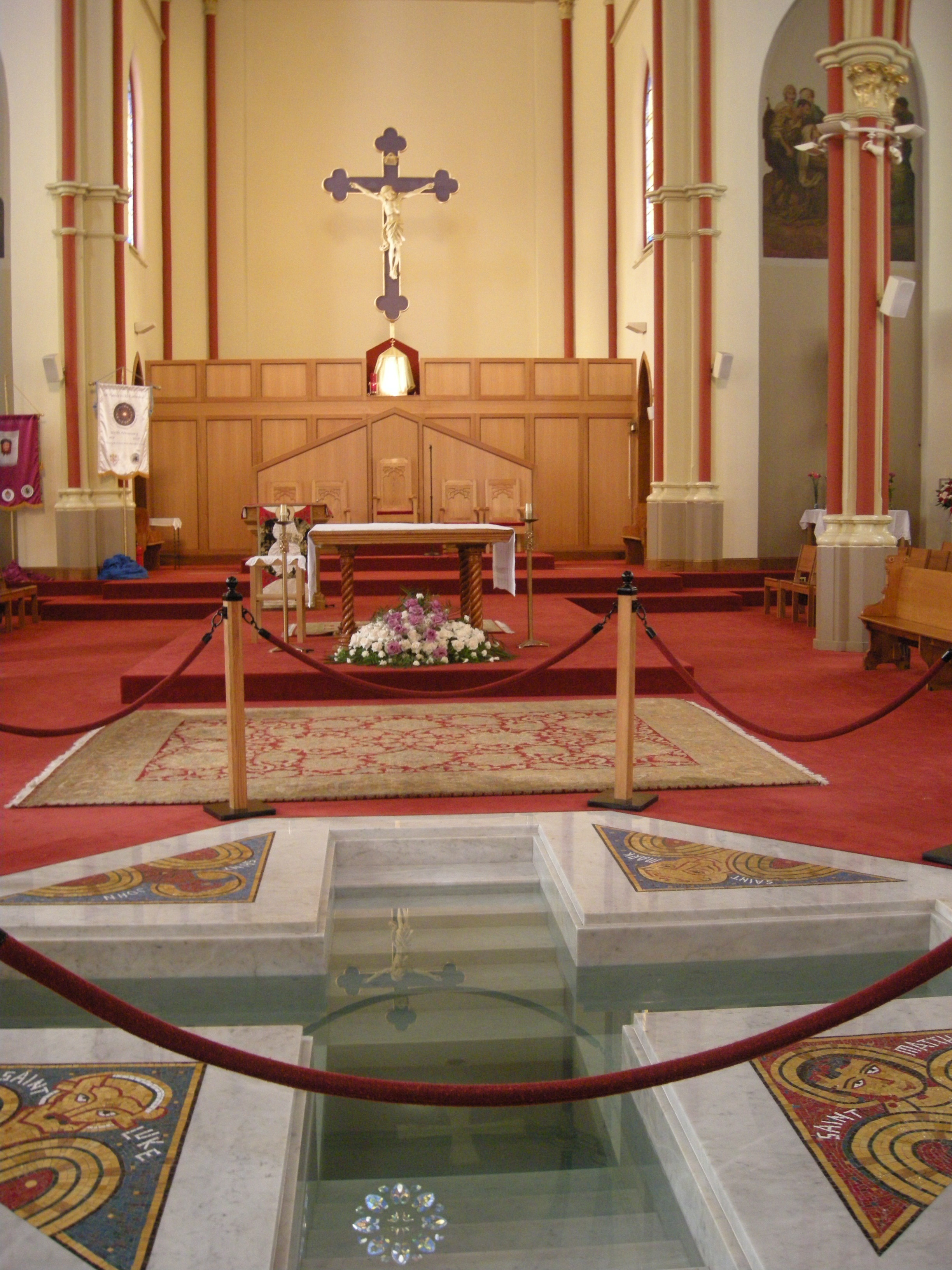
DSCN1720

In John’s readings from the Last Supper today and tomorrow, Jesus’ disciples , Thomas and Philip, appear unsure of the way and the power of Jesus himself. An important question raised in mystagogic catechesis.

 St. Ambrose in the 4th century met the same uncertainty of signs as he spoke to the newly baptized of his time. They signify so much, but we find them hard to accept. “Is this it?” he hears them say as they approach the waters of baptism and the table of the Eucharist.

Encountering God through sacraments in weakened further today by a lack of a symbolic sense, Pope Francis writes in his letter Desiderio Desideravi . Now, more than ever, human beings, like Thomas and Philip, want to see. We want immediate experience.

Ambrose calls on stories of the Old Testament. The Israelites were saved as they flee from Egypt through the waters of the Red Sea, the cloud that guides them on their way–foreshadowing the Holy Spirit, the wood that makes the bitter waters of Marah sweet–the mystery of the Cross.

“You must not trust, then, wholly to your bodily eyes. What is not seen is in reality seen more clearly; for what we see with our eyes is temporal whereas what is eternal (and invisible to the eye) is discerned by the mind and spirit.” (On the mysteries)

The Assyrian general, Naaman, doubted as he stood before the healing waters of the Jordan, Ambrose reminds his hearers. There’s more here than you see or think.

So we’re invited into an unseen world. Still, we’re like those whom the gospel describes and the saint addresses. Is this it? Moreso now, schooled as we are in the ways of science and fact, we look for proof from what our eyes see. We live in a world that tells us what we see is all there is.

Faith is a search for what we don’t see. God desires to approach us through signs. Will he not help us approach him that way? Believe in me, Jesus says.

Readings here.

Praying with the Creed

I often find myself these days praying the Apostles’ Creed and dwelling especially on that first statement: “I believe in God the Father Almighty, creator of heaven and earth.” I need to strengthen my belief  that God created our world, sustains it in being and guides it to glory.

Two different versions of the creed have come down through the centuries. The Apostles’ Creed is the oldest, still in use today. It’s a summary of faith given to men and women who were being baptized in the early church to help them remember Christian belief. It summarized a faith taught by the apostles.

I like that creed because it’s so simple. In the Catholic church it can be used in the liturgy during Lent and at other times in place of the Nicene Creed. It’s traditionally said at the beginning of the rosary. Prayer books recommend we say it at the beginning of prayer. Good idea.

In a sermon preached in 4th century to prepare people for baptism, St. Cyril of Jerusalem said the creed is related to the scriptures and the rest of the things in church.

“Although not everyone is able to read the Scriptures, some because they have never learned to read, others because their daily activities keep them from such study, still so that their souls will not be lost through ignorance, we have gathered together the whole of the faith in a few concise articles…

“So for the present be content to listen to the simple words of the creed and to memorize them; at some suitable time you can find the proof of each article in the Scriptures. This summary of the faith was not composed at man’s whim, the most important sections were chosen from the whole Scripture to constitute and complete a comprehensive statement of the faith.

“Just as the mustard seed contains in a small grain many branches, so this brief statement of the faith keeps in its heart, as it were, all the religious truth to be found in Old and New Testament alike. That is why, my sisters and brothers, you must consider and preserve the traditions you are now receiving. Inscribe them in your heart.”

The creed sums up all our belief; like a searchlight it gives power to see so much more, it leads us into the most profound  mysteries, and at the same time in its simplicity it helps us find our way through an often bewildering world. The creed is something we can fall back on to go forward.

Here’s  the Apostles’ Creed:
I believe in God, the Father almighty,
creator of heaven and earth.
and in Jesus Christ, his only Son, our Lord.
who was conceived by
the Holy Spirit,
born of the Virgin Mary,
suffered under Pontius Pilate,
was crucified, died and was buried;
he descended into hell;
on the third day he rose again
from the dead.
He ascended into heaven
and is seat at the right hand
of God the Father almighty;
from there he will come to judge
the living and the dead.
I believe in the Holy Spirit,
the holy, catholic Church,
the communion of saints,
the forgiveness of sins,
the resurrection of the body
and life everlasting. Amen


Browsing Through A Library

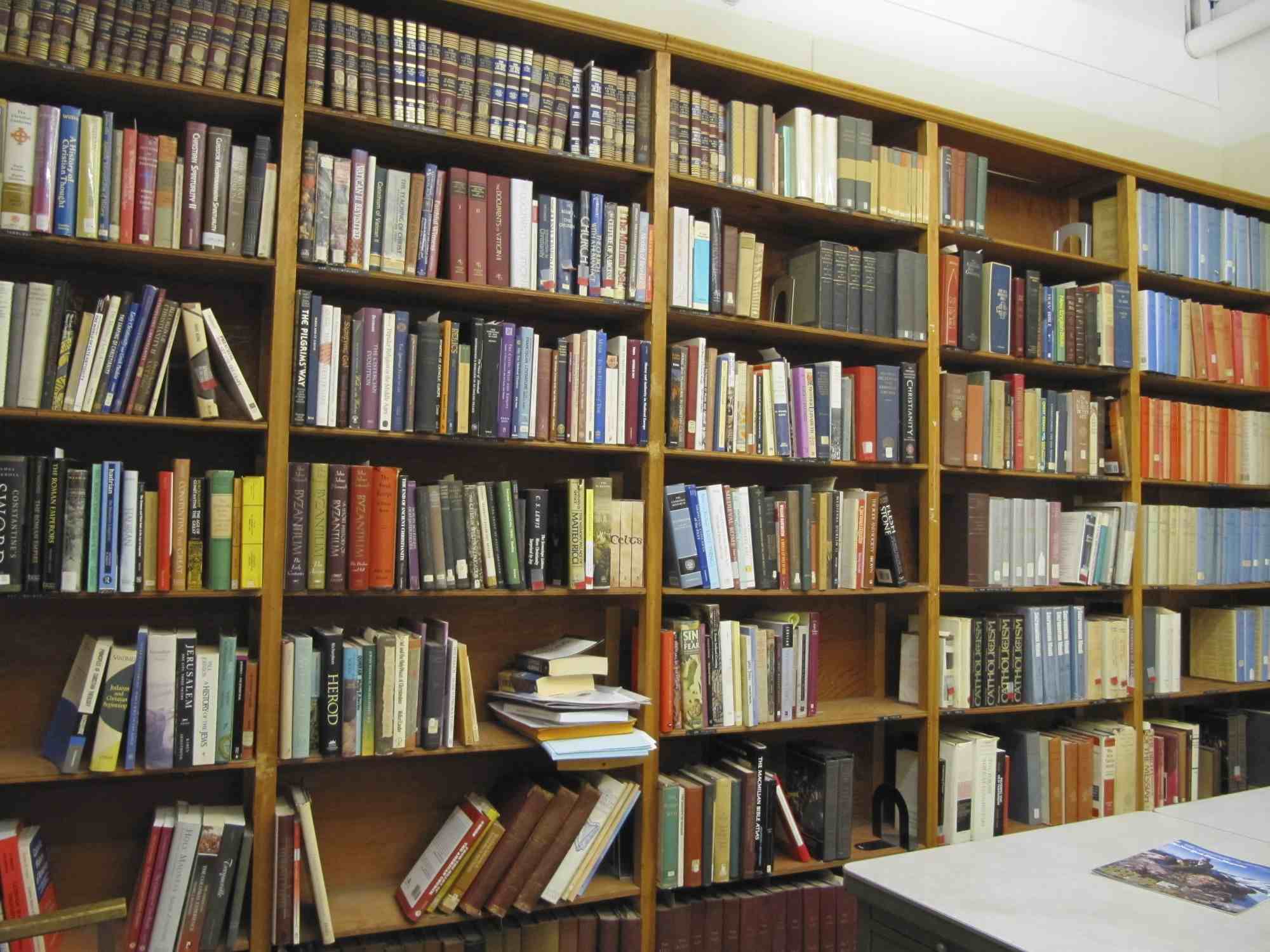
From time to time I like browsing through the large collection of books we have downstairs. Libraries, bookstores, now the internet, are treasuries and junkyards all at once. You never know when you’re going to stumble upon something that sparks questions or open your mind. 

Awhile ago, I stumbled on a book called Pride of Place: The Role of Bishops in the Development of Catechesis in the United States, by Sr. Mary Charles Bryce. It’s  a study of catechisms and catechesis in our country from the time of Bishop John Carroll, way back in the 18th century, to the 1980’s. How are we going to teach and form our people in faith? That’s the question they were asking then. It’s a question we face now.

Catechesis is on my mind lately. We’ve had a big development in theology and scripture and liturgy since the Second Vatican Council in the 1960s, but has that reached the ordinary people of the church, young or old? I think we need a better way to make the riches of our faith available to them. Catechesis is one of our prime needs as Catholic schools decline and dioceses, parishes, religious orders and their resources diminish.

“Pride of Place” Sister Bryce called her book, a title from an old pastoral letter of the American bishops on catechesis. Not a bad priority for the church today. How are we going to pass on the faith we have received in our time. What are the words and ways we’re going to use? Pope Francis in his recent letter Desiderio Desideravi calls us to see the liturgy as a catechetical school.

The Eternal Word needs to become incarnate from age to age:

“For last year’s words belong to last year’s language
And next year’s words await another voice.”  (T.S. Eliot)

We need to renew our liturgical life. We need  good catechetical sites online and there’s still something to be said for the books in our library downstairs. They were gathered by people before me, who were wondering about things as I am now.  Someone recognized  Sister Bryce’s book was a good book to hold on to.

Thanks.

How Do We Learn and Pray Now?

Education is up in the air these days. Our schools are struggling. How will kids be educated?

Our faith formation programs are struggling too. The Mass and sacraments–ordinary ways we pray–are drastically curtailed. What do we do?

Could our homes and families become our churches? Can we find teachers and  temporary sacraments there?

A friend of mine was in prison for awhile and ended up once in solitary confinement after a fight he had with another inmate. He told me he remembered in the dark what a nun had told him about the rosary. Ten Hail Mary’s and an Our Father. He started counting the prayers on his fingers and, after awhile, he found a great peace came over him, so much so that after getting out of confinement he asked the chaplain for a rosary. It led to a profound conversion. He was changed by the experience there in the dark.

We’re living in the dark these days, but do these days have to diminish us? Maybe we can learn to pray more simply these days. Simple prayers we may have abandoned, maybe there’s a bible or a prayerbook lying forgotten in a drawer. Simple prayers are always the best,  because God takes simple form to come to us. Jesus came “in the form of a slave,” remember, he used simple things like bread and wine to bring us his greatest gift. 

This could be a time to pray simple prayers and to teach them to our kids. You never know when they’ll bring them peace.

Friday Thoughts: Young Mother Sewing

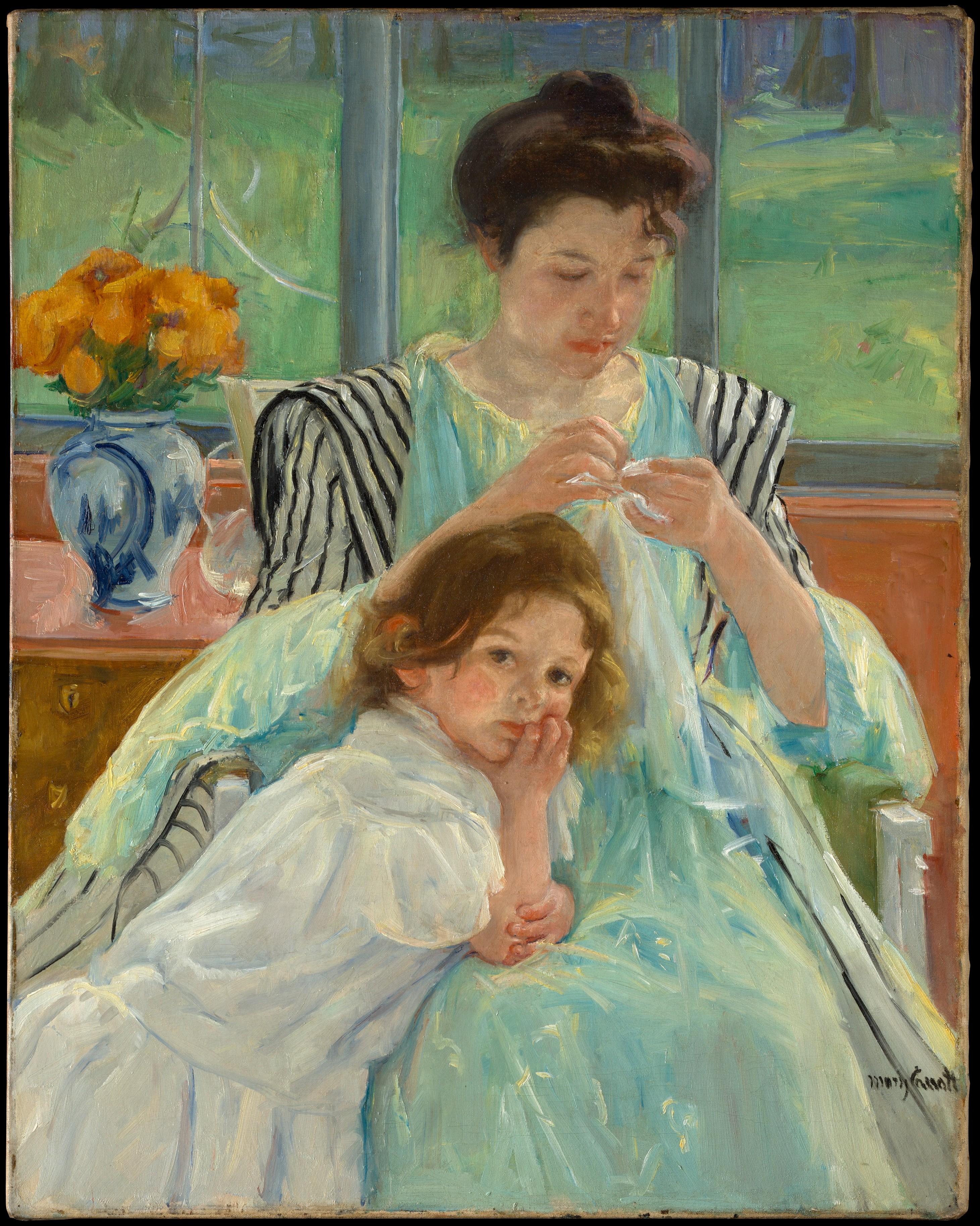
Mary Cassatt Young Mother Sewing 1900 Met

Mary Cassatt, “Young Mother Sewing”, 1900 (The Met)


.

A living faith works. It is always active, especially when we are docile to the Spirit.

When we walk by faith we see, we hear, we speak what God intends, especially when we are blind to the cares and anxieties of the world.

Small children are wonderfully active, superbly passive, and at times they seem completely blind, fantastically blind. They are alive. They see. They hear. They speak. They watch. They feel.

Mother Church calls all of us home, even when she is silent. She is always at work. She watches us even when her eyes are busy with the business of the day.

She sews. We just need to obey. To trust. To allow ourselves the freedom to lay across her lap.

In the short description upon the little museum card hanging beneath the painting shown above, God has planted great instruction. The work is by American impressionist Mary Cassatt.

According to the card, about the year 1890 “Cassatt redirected her art toward women caring for children and children alone—themes that reflected her affection for her nieces and nephews and the prevailing cultural interest in child rearing.” And then, after informing us that for this particular painting Cassatt “enlisted two unrelated models to enact the roles of mother and child”, the card completes its little catechesis by blessing us with a precious little anecdote and quote:

Louisine Havemeyer, who purchased it in 1901, remarked on its truthfulness: “Look at that little child that has just thrown herself against her mother’s knee, regardless of the result and oblivious to the fact that she could disturb ‘her mamma.’ And she is quite right, she does not disturb her mother. Mamma simply draws back a bit and continues to sew.”

God are we blessed. So blessed to have such a mother. All of us. Maybe give her a call today. Better yet, perhaps even stop by. She’d love that. She’d love to see your face. You’re always on her mind and in her heart. She lives in the closest church you can find, any building that truly houses her Son.

If she seems a little occupied with the “cooking and cleaning”, with all “the business of life”, don’t let that stop you or cut your visit short. No, throw yourself against your “mother’s knee regardless of the result and oblivious to the fact” that you could disturb your “mamma.”

 It most certainly does not.

“Mamma simply draws back a bit and continues to sew.”

.


.

—Howard Hain

.

http://www.metmuseum.org/art/collection/search/10425

.

Learning from the Bible

In my last blog I mentioned an article about Catholics reading the bible. They don’t read it much, in fact, and those who do may read it as biblical fundamentalists do. The author quoted from a 1998 report from the Pontifical Biblical Commission, the pope’s advisors in biblical  matters, which said that “Fundamentalism actually invites people to a kind of intellectual suicide.”

It can also lead to political damage as well according to an article in the Op-Ed section of the New York Times today “Why the AntiChrist Matters in Politics” by Matthew Avery Sutton.

Especially in troubled times, some may see political consequences in the bible and its prophecies that really aren’t there.

“Biblical criticism, the return of Jews to the Holy Land, evolutionary science and World War I convinced them that the second coming of Jesus was imminent. Basing their predictions on biblical prophecy, they identified signs, drawn especially from the books of Daniel, Ezekiel and Revelation, that would foreshadow the arrival of the last days: the growth of strong central governments and the consolidation of independent nations into one superstate led by a seemingly benevolent leader promising world peace.

This leader would ultimately prove to be the Antichrist, who, after the so-called rapture of true saints to heaven, would lead humanity through a great tribulation culminating in the second coming and Armageddon. Conservative preachers, evangelists and media personalities of the 20th century, like Billy Sunday, Aimee Semple McPherson, Billy Graham and Jerry Falwell, shared these beliefs.”

Last week was catechetical Sunday, marking the beginning of our religious education program at St.Mary’s. We blessed our catechists who are going to be involved in the religious education of our young people.

But religious education involves more than young people. All of us are called to grow in our faith and live what we believe. Unfortunately, as adults we may see faith as something you learn as a child in school or in a religious education program and you never have to learn about it again.

The Catholic writer Frank Sheed said the problem with adult Catholics is that they don’t keep engaged in the faith they learned as children. He used the example of our eyes. We have two eyes. Let’s say one of them is the eye of faith; the other is the eye of experience.

As children, with a religious education, we may  see the world with two eyes; but as adults losing our engagement with faith we gradually come to see the world only with the eye of experience. We lose the focus that faith gives, another dimension. We won’t see right. Faith is what  helps us to see.

“You are all learners,” Jesus said to his disciples in the gospel. It’s not just children who learn, all of us learn. We are lifelong learners. Lifelong believers, engaged believers, struggling believers, even till the end.

One of the areas we have to learn about today in the Catholic Church is the Bible. It’s there every Sunday and every day of the week. It’s our new catechism and prayerbook, one of the gifts our church gives us.  We need to learn about it and pray from it as much as we can.

Changes in the Liturgy

The American Catholic Church is gearing up for changes in the liturgy. There’s a site on the bishops’ web pages outlining the changes. The opening page captures some of my questions about the new changes, to be voted on by the bishops this November, submitted to Rome afterwards, and likely introduced in Advent of 2011.

“New Words: A Deeper Meaning but the Same Mass,” reads the heading announcing the changes: “Prayers for the observances of recently canonized saints, additional prefaces for the Eucharistic Prayers, additional Votive Masses and Masses and Prayers for Various Needs and Intentions and some updated and revised rubrics (instructions) for the celebration of the Mass.”

“The English translation of the Roman Missal will also include updated translations of existing prayers, including some of the well–known responses and acclamations of the people.”

The last sentence announces the changes that will impact ordinary church-going Catholics most of all. I was thinking of recent complaints against drug companies for introducing new medicines and applications without proving they are better and more cost effective than previous ones. Will the new words lead us to a deeper meaning of the Mass? I’m not sure.

A picture on the site’s opening page shows the back rows of a congregation at church at Mass. From where the picture’s taken those back row Catholics can hardly see the altar in the distance. Is that going to be the experience of most ordinary people when the new words are introduced?

Looks like some dark clouds ahead.

Let’s Go To Mass

I have been working on some simple explanations of the Mass in video form and here’s the latest. You can get it on Vimeo; it’s based on the miracle of the loaves and the fish.

The first video in the series you can also find on Vimeo, same place.  I reworked it lately. That’s what you have to do: work and rework.

In the future I hope to do instructions on how you pray at Mass, where do the scriptural readings come from, the Mass and the Cross of Jesus, its history, and so on.

Who knows, maybe they will get done.

Thy Will Be Done

We forget how rich in wisdom are the words of our prayers. Unfortunately, they become words we say unthinkingly. Listen to the commentary of St. Cyprian on one phrase of  The Lord’s Prayer, the Our Father.

“Thy will be done, on earth as it is in heaven. This is not that God should do what he wills, but so that we may be able to do what God wills. For who could resist God in such a way as to prevent him doing what he wills? But since the devil hinders us from obeying, by thought and by deed, God’s will in all things, we pray and ask that God’s will may be done in us.

For this to happen, we need God’s good will – that is, his help and protection, since no-one is strong in and of himself but is kept safe by the grace and mercy of God.

Moreover, the Lord, showing the weakness of the humanity which he bore, said Father, if it is possible, let this cup pass from me, and showing his disciples an example, that they should do not their own will but God’s, he went on to say nevertheless, let it not be my will, but yours.”