This 3rd week of Lent is an important week for people entering our church and participating in its sacraments. It’s a school for catechumens seeking Baptism; others are receiving sacraments. Three readings this week are especially important: the story of the Samaritan woman, the story of Naaman the Syrian, and then, Luke’s account of Jesus visit to Nazareth.
The Samaritan woman, who meets Jesus at Jacob’s well, is an important teacher for those approaching the church and its sacraments. It’s a story so important that the liturgy recommends this gospel be read in place of another gospel this week, if it’s not read on Sunday.
Like the Samaritan woman, we are people of our own time and place, with our prejudices and deep desires. Like her, Jesus leads us gradually to a new understanding of who we are and what we are called to be. Like her, he promises us living water.
What does “living water” mean? Baptize in living waters, the early baptismal rituals say. They forbid baptism in stagnant water. Why? Stagnant water goes nowhere. Living water brings us to all life, to all creation, to a greater life. It’s not a water that restricts; this water makes us grow.
For the Jews the Jordan River was living water. Entering the Jordan at his baptism Jesus empowered it with new life. His Spirit entered the waters. Just as water once flowed out in four rivers over the whole world – according to the Book of Genesis – the waters of the Jordan flowed out over the world after Jesus was baptized.
Monday’s reading recalls Naaman the Syrian. Like the Samaritan woman, he was not a Jew. He came somewhat skeptically to the waters of the Jordan to be cleansed of his leprosy. Not only was he cleansed of leprosy, but he came to new knowledge: “Now I know that there is no God in all the earth, except in Israel.” Like the Samaritan woman, Naaman received the gift of faith.
The stories of Naaman and the Samaritan woman are great stories for reflecting on the mystery of the church, baptism and the sacraments.
Why do we catechize and baptize people entering the church and her sacramental life during Lent? Because Lent leads to the mystery of the death and resurrection of Jesus. Living water came from his side at his death. Blood and water from his side gave life to the Church and her sacraments.
During this third week of Lent, the gospel of the rejection of Jesus at Nazareth is also read. (Monday) The story is important because it presents “the scandal of the Incarnation.” Jesus was rejected at Nazareth as the carpenter, Mary’s son. Those who enter the church and participate in her sacraments will face a similar “ scandal of the Incarnation.”
The church is a complex reality, Pope Leo said in a recent address, it is a reality of saints and sinners. We have to live in that reality.
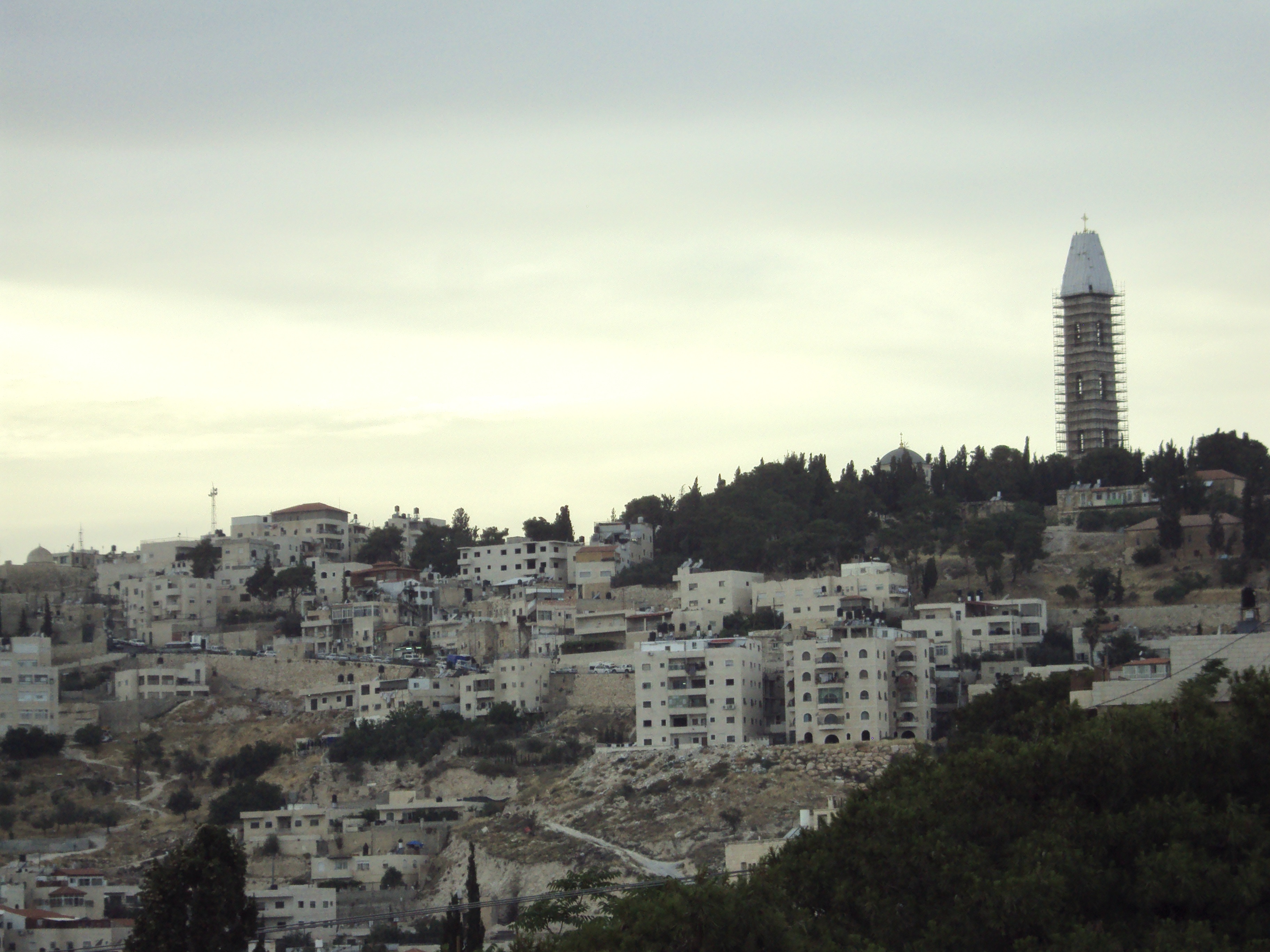
On the Mount of Olives in Jerusalem the Russian government in the last century built a high tower (above) so that Christian pilgrims could see key places associated with the life, death and resurrection of Jesus.
Looking westward is the Church of the Holy Sepulcher where he was crucified and rose from the dead. Just down below is the garden of Gethsemane where Jesus prayed and was arrested. In the distance to the southeast is Bethlehem where he was born. On the eastern side of the Mount of Olives where this picture above was taken is the village of Bethany where Jesus stayed when he came to Jerusalem and where he raised Lazarus from the dead. Further east, about 20 miles down the Jordan Valley is where he was baptized in the Jordan River by John the Baptist.
The tower was built, I understand, because some pilgrims could not get to one of these destinations, a 20 mile trip to the Jordan River.
The tower attests the importance of pilgrimage to the Jordan River where Jesus was baptized. The Baptism of Jesus is a mystery that includes all the mysteries of Jesus we celebrate as Christians. That’s why we celebrate it as we conclude the mysteries of the Christmas season. In our baptism we are brought to share in his baptism and in his life.
In the Jordan River, God the Father, “a voice from heaven,” proclaimed him “my beloved Son, with you I am well pleased.” (Mark 1,11) We believe that when we are baptized we become children of God with him..
As we take Holy Water into our hands and bless ourselves, we remember the great gift we have in Jesus Christ. “In the name of the Father, and of the Son and of the Holy Spirit. Amen.”
We celebrate the Feast of the Baptism of Jesus today. This week we begin readings Mark’s Gospel at Mass till Ash Wednesday. Mark is a good follow-up for this feast since it begins with the baptism of Jesus and relies heavily on the symbolism of baptism and water in his narrative.
The Feasts of the Epiphany and the Baptism of Jesus are celebrated on cold days in my part of the world. The New York papers sometimes carry a story around this time about the Greek Archbishop of New York going down to the Hudson River and throwing a cross into its waters, which is then retrieved by some hardy Greek divers.
Like the world itself, the waters of the Hudson are grim and cold this time of year, but that dramatic gesture– the cross in the water, the cross representing Jesus Christ —says the Hudson River is blessed. Whatever it looks like, uninviting as it seems, Christ’s presence and Christ’s blessing are there.
When Jesus entered the River Jordan, he entered the Hudson, the waters of Long Island Sound, the rivers and waters of the world. The waters are holy the world over, this gesture says. The Spirit still broods over the waters. The grace of God is given to the Magi and all the peoples of the world they represent.
Here’s the way one of the saints of the Greek church, St. Proclus of Constantinople explains it:
“Our feast of the Epiphany and the Baptism manifests even more wonders than the feast of Christmas… At Christmas our King puts on the royal robe of his body; at Epiphany he, as it were, clothes the river.
On the feast of the Savior’s birth, the earth rejoiced because it bore the Lord in a manger; but on today’s feast the sea is glad because it receives the blessing of holiness in the river Jordan.”
The United States Geological Survey has a wonderful site on water. Water is everywhere, not only in the seas and rivers, but in the air, the foods we eat, even our bodies. 71% of the earth’s surface is water. 60% of our bodies is water. Water’s a precious gift, a pervasive presence in our world.
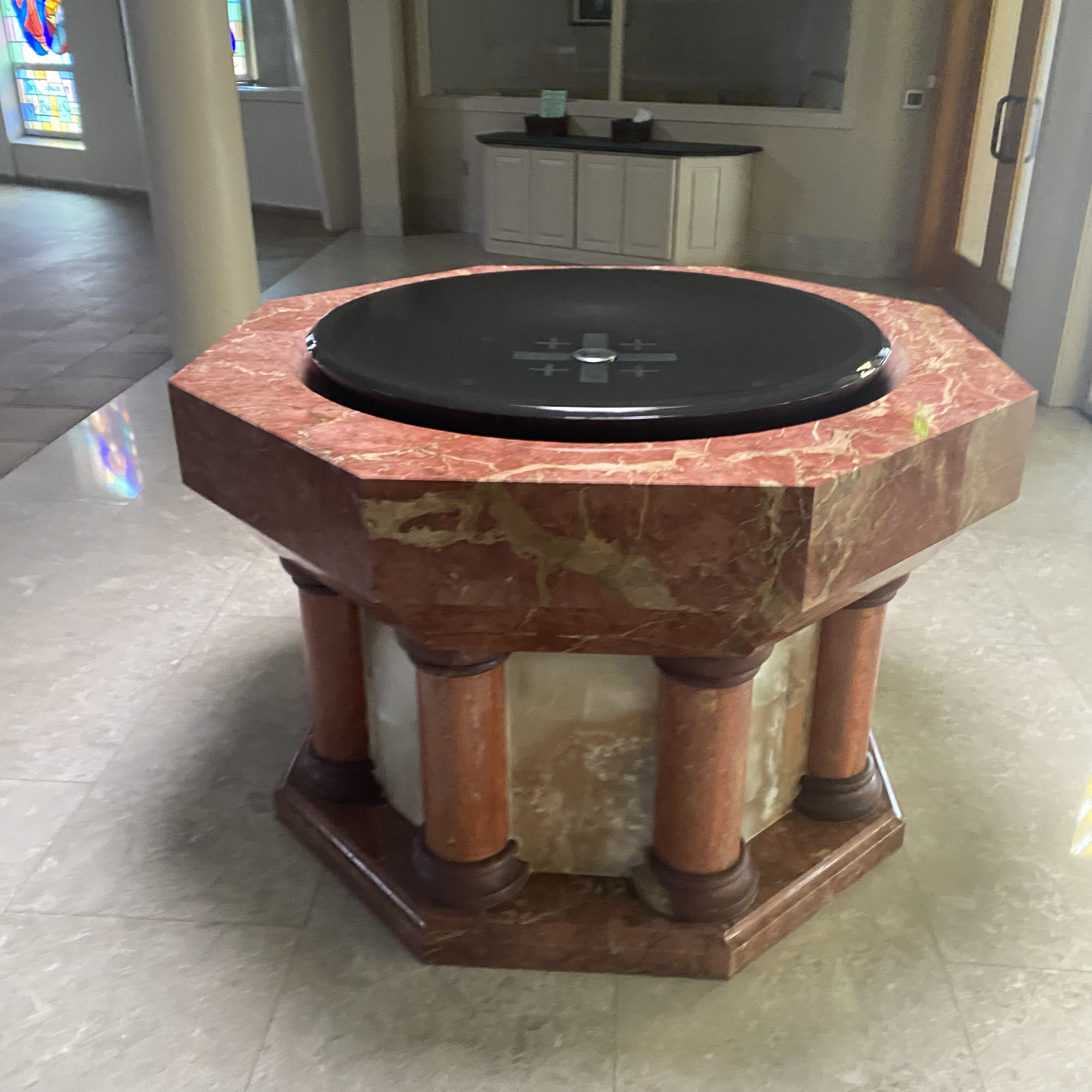
That’s why water is the sign we receive in the Sacrament of Baptism. God tells us that, not only does he support us in life, but God promises support for this world of ours. God will be more present than water, through his Son, Jesus Christ. That’s why our Baptismal fount is such and important part of the church.
We bless ourselves with water when we enter and leave our church. Many people bless themselves with holy water when they enter and leave home. We don’t want to lose a sense of God’s power and presence with us, which can easily happen today. That’s why the feasts of the Epiphany and the Baptism have become more important to the western Christian churches.
Pope Francis said that many of our rivers are “rivers of blood” because of war. He was speaking of the Dneiper and other rivers of the Ukraine. God gives us life. Let’s keep our world life-giving.
Jesus said to the crowds: “To what shall I compare this generation? It is like children who sit in marketplaces and call to one another, ‘We played the flute for you, but you did not dance, we sang a dirge but you did not mourn.’ For John came neither eating nor drinking, and they said, ‘He is possessed by a demon.’ The Son of Man came eating and drinking and they said, ‘Look, he is a glutton and a drunkard, a friend of tax collectors and sinners.’ But wisdom is vindicated by her works.” (Matthew 11:16-19)
Jesus and John the Baptist seem so unlike each other in today’s gospel. They are related, as our readings next week tell us. Son of Zachariah and Elizabeth, John is six months older than Jesus, Luke reckons in his gospel. We wonder how close they were as children growing up.
John is the first to begin a ministry, in the fierce wilderness of the Jordan Valley where he preaches and baptizes pilgrims on their way to Jerusalem. John baptized Jesus in the Jordan River as he begins his ministry in Galilee in the towns along the Sea of Galilee.
Then, they seem to part ways. Even as they do, John offers Jesus two of his own disciples, Peter and Andrew. Their only contact afterwards, however, seems to be through messengers.
Both preach a message of repentance, “Repent, for the kingdom of God is at hand.” (Matthew 3.2; 4,17). Both call for people to change, but Jesus’ message contains a surprising mercy not found in John’s preaching:
“When John speaks of the One who is to come, he is thinking of an executor of divine judgment, not so much of him through whom God’s mercy and love are made visible. He expects the kingdom of God to arrive in a storm of violence, in the immediate future, with the Messiah’s first appearance… From what we know of his preaching, he seems transfixed by the vision of the judgment and finds nothing to say about the salvation the Messiah will bring.” ( Rudolf Schnackenberg Christian Existence in the New Testament, Volume 1, University of Notre Dame 1968, p 39)
“The ax is ready to cut down the tree that bears no fruit,” John says. Repentance dominates his message. I think of him as a drill sergeant readying troops for the coming battle.
Jesus urges repentance too, but with a tenderness and compassion not found in John. “Go tell John what you hear and see…” he says to messengers John sends. The blind see, the lame walk, the deaf hear, the dumb speak, the dead are raised.
Jesus reveals God’s mercy, not only through his many miracles, but also in his teaching. Think of the stories of the prodigal son, the lost sheep, the thief on the Cross– signs of God’s mercy, God’s patient mercy.
You must take a desert road, John says in his preaching. You must take up your cross and follow me, Jesus says, but again, the way’s not hard–his yoke is easy, his burden light.
Jesus doesn’t dismiss John. There’s none born of woman greater that he, Jesus says. John has integrity, he’s not swayed by what other people think or say, not swayed by public opinion or the fear of failure, or sickness, or deprivation, or death. He’s not swayed by winds good or bad. His face is turned to God, his ears hear God’s word, his voice speaks what he hears.
In the easter season the Risen Christ promises signs and sacraments. The Sacrament of the Eucharist is one of his great signs, but let’s not forget the Sacrament of Baptism, another gift we receive from the Risen Lord. He blesses us in water.
Water is a sign of death and of life, says Saint Basil the Great.
“Like a tomb, the water receives the body, symbolizing death; while the Spirit pours in the quickening power, renewing our souls from the deadness of sin into their original life. This then is what it is to be born again of water and of the Spirit, the water bringing the necessary death while the Spirit creates life within us…
“ Through the Holy Spirit comes our restoration to paradise, our ascension into the kingdom of heaven, our return to the status of adopted children our liberty to call God our Father, our being made partakers of the grace of Christ, our being called children of light, our sharing in eternal glory – in a word, our being brought into a state of all fullness of blessing both in this world and in the world to come, of all the good gifts that are in store for us. Through faith we behold the reflection of their grace as though they were already present, but we still have to wait for the full enjoyment of them. If such is the promise, what will the perfection be like? If these are the first fruits, what will be the complete fulfillment?” Basil the Great, On the Holy Spirit
The land where Jesus lived spoke to him and inspired so many of his parables. The sea did too.
Jesus went out along the sea. All the crowd came to him and he taught them. As he passed by, he saw Levi, son of Alphaeus, sitting at the customs post. Jesus said to him, “Follow me.” And he got up and followed Jesus. (Mark 2:13)
From the Jordan where he heard his Father’s voice and the Spirit rested on him, Jesus went to Capernaum on the Sea of Galilee where he taught crowds and called disciples.
I remember looking quietly on the waters of the Sea of Galilee years ago on a visit.. At night a stillness centuries old takes over. The waters of the Jordan flow into it on their way to the Dead Sea. The river winds almost 200 miles from the Golan mountains in the north into the Sea of Galilee, then on to the Dead Sea in the south, a direct distance of about 60 miles. The river falls almost 3,000 feet on its way to the Dead Sea,.
.Jesus’ ministry began in the Jordan River. The waters spoke to him more strongly than they do to us today. The Jordan was sacred to the Jews from the time they miraculously crossed it on their way to the Promised Land. The great Jewish prophet Elijah came from a town near the river’s banks. Later he sought safety from his enemies there.
Elijah’s successor, the Prophet Elisha, also came from the Jordan. He told the Syrian general Namann to bathe in the river to be cured of his leprosy, and he was cured. Ancient hot springs near Tiberias on the Sea of Galilee still witness to the river’s curative powers.
At the time of Jesus, the river’s fresh flowing waters were the life-blood of the land, making the Sea of Galilee teem with fish and the plains along its banks fertile for agriculture. Pilgrims from Galilee followed the Jordan on their way to Jericho and then to Jerusalem and its temple. The river always spoke of life.
The Jordan Today
The river is still life to the region. It’s the primary source of its drinking water and crucial for its agriculture. Its water is a major point of controversy today between Israel and its Arab neighbors.
Nourishing Prophets
The Jordan nourished prophets. Somewhere near Jericho John the Baptist preached to and baptized pilgrims going to the Holy City. The place– hardly a desert as we may think of it– offered enough food for survival, like the “ grass-hoppers and wild honey” John ate. It was also an uncultivated place that taught you to depend on what God provided.
Jesus taught this too. “I tell you do not worry about your life, what you will eat, or drink, or about your body, what you will wear… Your heavenly Father knows that you need them all.” (Mt 6, 25 ff) The desert was a place for learning to put worry aside and trust in the goodness of God.
Water is a sign of life. When Jesus entered the waters of the Jordan, he acknowledged his heavenly Father as the ultimate Source of Life, the creator of all things. Like the prophets Elijah and John the Baptist, Jesus remained in this wilderness near the water for forty days before his divine mission. He also baptized and taught there with his first disciples. He readied himself there to depend on God for everything.
The Jordan after Jesus
Later, when the Roman empire accepted Christianity in the 4th century, Christians came to the Jordan River in great numbers on Easter and on the Feast of the Epiphany to remember the One baptized there. They bathed in the sacred waters, and many took some of it home in small containers.
Early Christian pilgrims like Egeria, a nun from Gaul who came to the Holy Land around the year 415 AD, left an account of her visit to the Jordan where Jesus was baptized. Monks who settled near the river knew a place called Salim, near Jericho. The town, associated with the priest Melchisedech, was surrounded by fertile land with a revered spring that flowed into the Jordan close by. Here’s Egeria’s description:
“We came to a very beautiful fruit orchard, in the center of which the priest showed us a spring of the very purest and best water, which gives rise to a real stream. In front of the spring there is a sort of pool where it seems that St. John the Baptist administered baptism. Then the saintly priest said to us: ‘To this day this garden is known as the garden of St. John.’ There are many other brothers, holy monks coming from various places, who come to wash in that spring.
“The saintly priest also told us that even today all those who are to be baptized in this village, that is in the church of Melchisedech, are always baptized in this very spring at Easter; they return very early by candlelight with the clergy and the monks, singing psalms and antiphons; and all who have been baptized are led back early from the spring to the church of Melchisedech.”
A 19th Century Pilgrim at the Jordan
Christians in great numbers visited the Jordan River. Towards the end of the 19th century, an English vicar, Cunningham Geikie, described Christian pilgrims following the venerable tradition of visiting its waters.
“Holy water is traditionally carried away by ship masters visiting the river as pilgrims to sprinkle their ships before a voyage; and we are told that all pilgrims alike went into the water wearing a linen garment, which they sacredly preserved as a winding sheet to be wrapped around them at their death.
“The scene of the yearly bathing of pilgrims now is near the ford, about two miles above the Dead Sea, each sect having its own particular spot, which it fondly believes to be exactly where our Savior was baptized…
“Each Easter Monday thousands of pilgrims start, in a great caravan, from Jerusalem, under the protection of the Turkish government; a white flag and loud music going before them, while Turkish soldiers, with the green standard of the prophet, close the long procession. On the Greek Easter Monday, the same spectacle is repeated, four or five thousand pilgrims joining in the second caravan. Formerly the numbers going to the Jordan each year was much greater, from fifteen to twenty thousand….”(Cunningham Geikie, The Holy Land and the Bible,Vol 2, New York, 1890 pp 404-405)
The Jordan and Christian Baptism
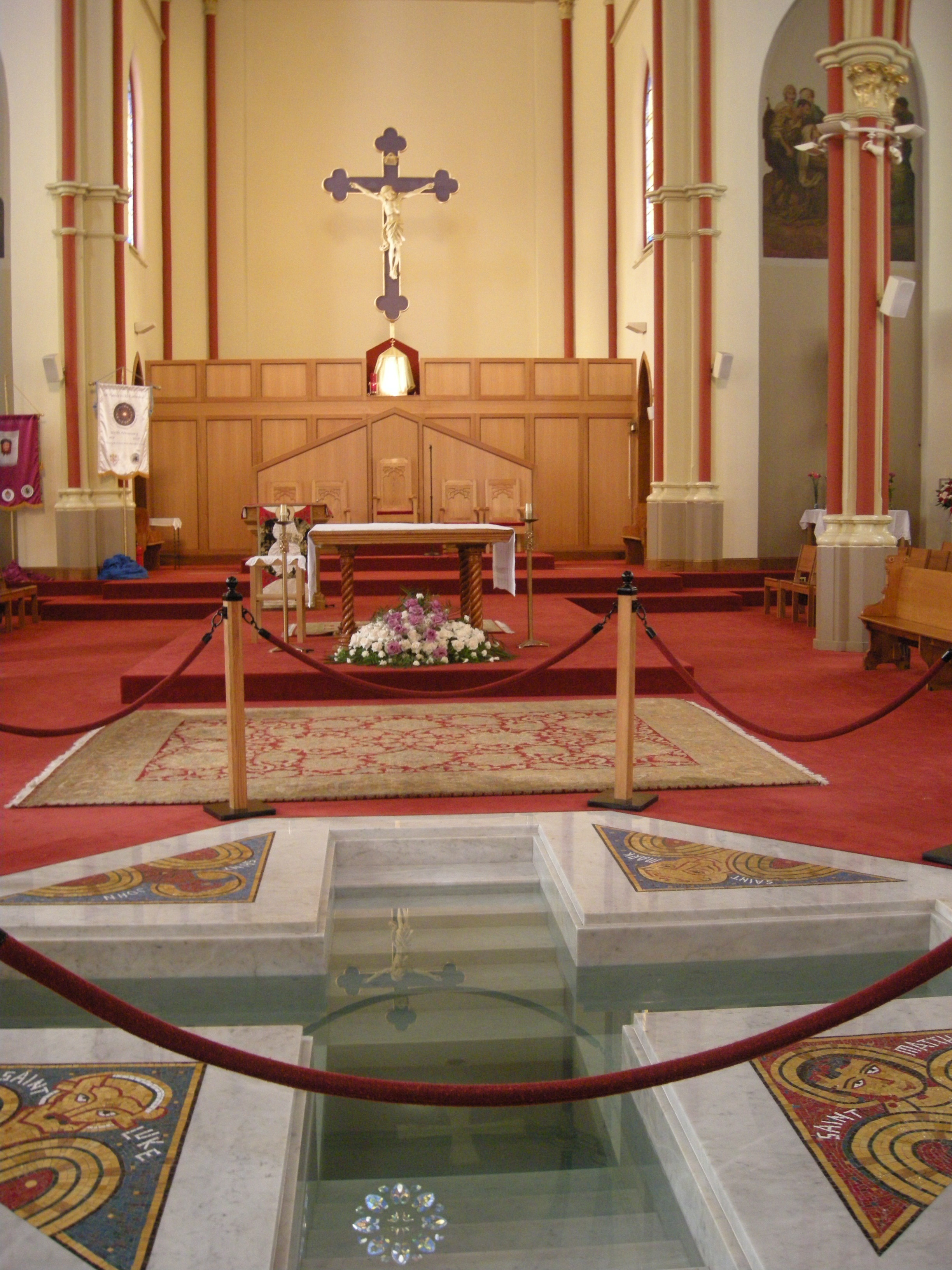
Today, every Catholic parish church has its baptistery where the mystery of the baptism of Jesus is celebrated for new believers. Some eastern Christian churches call their baptisteries simply “the Jordan.”
Today the site of Jesus’ Baptism, according to archeologists, is in Jordanian territory at el-Maghtas, where a large church and pilgrim center has been built following excavations begun in 1996 by Jordanian archeologists. It is probably the “Bethany beyond the Jordan” mentioned in the New Testament where Jesus was baptized and John the Baptist preached.
The Jordan River offers its own commentary on the mystery of death and resurrection of Jesus, expressed in his baptism. At one end of the river is the Sea of Galilee brimming with life, and at the other end is the Dead Sea a symbol of death. The river holds these two realities together, and if we reverse its course we can see the gift God gives us through Jesus Christ.
Like him, we pass through the waters of baptism from death to life.
This week we’re coming to the end of the Easter season and the time devoted especially to Mystagogic Catechesis. Mystagogic Catechesis is an old term inspired by the time that Jesus after his resurrection began to wean his followers away from knowing him physically to knowing him through signs, like water, bread and wine, like gathering together to remember him in the scriptures, like seeing him in the poor and suffering who are wounded like him, also seeing his plan in the signs of the times they were living in. Mystagogic Catechesis is a catechesis for recognizing Jesus Christ in signs.
Even though “they rejoiced at the sight of the Lord” the disciples of Jesus found this new way hard to understand. They saw Jesus physically less and less. We see their uneasiness, their questioning, in the gospel narratives read in the Easter season. He taught the patiently, but still they found it hard to see him in another way, through signs.
The Old Testament scriptures were important signs Jesus offered his disciples after rising from the dead. (Luke24L13-27) During the Easter season the scriptures are important signs offered to us. The resurrection appearances of Jesus from the four gospels, especially from the Gospel of John, are gospels we read in the early weeks of Easter. The meeting of Jesus with Nicodemus, the miracle of the loaves and fish, and the Last Supper Discourse of Jesus– all from John’s Gospel– are read on the following weeks. The Acts of the Apostles, describing the surprising growth of the church after the resurrection, is read all through the Easter season.
Those who follow Jesus share the experience of his disciples as they face the mystery of his death and resurrection.
In their catechetical sermons after easter, saints like Ambrose and Cyril of Jerusalem saw the unease in the newly baptized they taught. “Is this it?” St. Ambrose begins one his catechetical sermons to newly baptized Christians. “Is this it? You’re saying to yourself.” The Christian life is not Paradise, the saint reminds them. The Christian life here on earth is not seeing completely or knowing everything clearly. The Christian life is a life of signs, signs that come with the sign of the cross.
Following the Second Vatican Council, the church gives Mystagogic Catechesis a more prominent place in her liturgy. In the past, Mystagogic Catechesis took place in the one week after Easter and was focused on the newly baptized. In the church’s liturgy now Mystagogic Catechesis takes place, not for just one week, but for all the Easter season, and beyond the Easter season to every Sunday celebration. It is meant, not just for the newly baptized, but for the whole Christian community.
Mystagogic Catechesis is not limited to the seven sacraments, but is sacramental in the broad sense the early church understood the term. For example, it sees the church as a sacrament. That’s why we read the Acts of the Apostles all through the Easter season, to understand the mystery of the church.
The church’s promotion of Mystagogic Catechesis also brings a shift in catechesis and preaching. Mystagogic Catechesis is based on the scriptures, rites and prayers of the liturgy, not the catechism. It moves us into another way of teaching and praying. Not a new way, but a way found in the early church and in the church up to the Council of Trent.
Mystagogic Catechesis puts an emphasis on the liturgy, its prayers, readings and signs, as the preeminent place where we learn and pray. “Christ is always present in His Church, especially in her liturgical celebrations…The liturgy is the summit toward which the activity of the Church is directed; at the same time it is the font from which all her power flows. (SC 7, 10)
In John’s readings from the Last Supper today and tomorrow, Jesus’ disciples , Thomas and Philip, appear unsure of the way and the power of Jesus himself. An important question raised in mystagogic catechesis.
St. Ambrose in the 4th century met the same uncertainty of signs as he spoke to the newly baptized of his time. They signify so much, but we find them hard to accept. “Is this it?” he hears them say as they approach the waters of baptism and the table of the Eucharist.
Encountering God through sacraments in weakened further today by a lack of a symbolic sense, Pope Francis writes in his letter Desiderio Desideravi . Now, more than ever, human beings, like Thomas and Philip, want to see. We want immediate experience.
Ambrose calls on stories of the Old Testament. The Israelites were saved as they flee from Egypt through the waters of the Red Sea, the cloud that guides them on their way–foreshadowing the Holy Spirit, the wood that makes the bitter waters of Marah sweet–the mystery of the Cross.
“You must not trust, then, wholly to your bodily eyes. What is not seen is in reality seen more clearly; for what we see with our eyes is temporal whereas what is eternal (and invisible to the eye) is discerned by the mind and spirit.” (On the mysteries)
The Assyrian general, Naaman, doubted as he stood before the healing waters of the Jordan, Ambrose reminds his hearers. There’s more here than you see or think.
So we’re invited into an unseen world. Still, we’re like those whom the gospel describes and the saint addresses. Is this it? Moreso now, schooled as we are in the ways of science and fact, we look for proof from what our eyes see. We live in a world that tells us what we see is all there is.
Faith is a search for what we don’t see. God desires to approach us through signs. Will he not help us approach him that way? Believe in me, Jesus says.
I often find myself these days praying the Apostles’ Creed and dwelling especially on that first statement: “I believe in God the Father Almighty, creator of heaven and earth.” I need to strengthen my belief that God created our world, sustains it in being and guides it to glory.
Two different versions of the creed have come down through the centuries. The Apostles’ Creed is the oldest, still in use today. It’s a summary of faith given to men and women who were being baptized in the early church to help them remember Christian belief. It summarized a faith taught by the apostles.
I like that creed because it’s so simple. In the Catholic church it can be used in the liturgy during Lent and at other times in place of the Nicene Creed. It’s traditionally said at the beginning of the rosary. Prayer books recommend we say it at the beginning of prayer. Good idea.
In a sermon preached in 4th century to prepare people for baptism, St. Cyril of Jerusalem said the creed is related to the scriptures and the rest of the things in church.
“Although not everyone is able to read the Scriptures, some because they have never learned to read, others because their daily activities keep them from such study, still so that their souls will not be lost through ignorance, we have gathered together the whole of the faith in a few concise articles…
“So for the present be content to listen to the simple words of the creed and to memorize them; at some suitable time you can find the proof of each article in the Scriptures. This summary of the faith was not composed at man’s whim, the most important sections were chosen from the whole Scripture to constitute and complete a comprehensive statement of the faith.
“Just as the mustard seed contains in a small grain many branches, so this brief statement of the faith keeps in its heart, as it were, all the religious truth to be found in Old and New Testament alike. That is why, my sisters and brothers, you must consider and preserve the traditions you are now receiving. Inscribe them in your heart.”
The creed sums up all our belief; like a searchlight it gives power to see so much more, it leads us into the most profound mysteries, and at the same time in its simplicity it helps us find our way through an often bewildering world. The creed is something we can fall back on to go forward.
Here’s the Apostles’ Creed:
I believe in God, the Father almighty,
creator of heaven and earth.
and in Jesus Christ, his only Son, our Lord.
who was conceived by
the Holy Spirit,
born of the Virgin Mary,
suffered under Pontius Pilate,
was crucified, died and was buried;
he descended into hell;
on the third day he rose again
from the dead.
He ascended into heaven
and is seat at the right hand
of God the Father almighty;
from there he will come to judge
the living and the dead.
I believe in the Holy Spirit,
the holy, catholic Church,
the communion of saints,
the forgiveness of sins,
the resurrection of the body
and life everlasting. Amen
John the Baptist is a voice that passes away, according to St. Augustine: “John is the voice, but the Lord is the Word who was in the beginning. John is the voice that lasts for a time; from the beginning Christ is the Word who lives for ever.”
John’s “voice” passes away. He no longer baptizes at the Jordan River. He cedes to the Word, and so should we. Our voice passes away; something of ourselves has to go– some of the things we hold dear, the friends who surround us, the institutions that have upheld us. Our way must give way to God’s way.
We think so little of this.
Listen again to Augustine: “What does prepare the way mean, if not be humble in your thoughts? We should take our lesson from John the Baptist. He is thought to be the Christ; he declares he is not what they think. He does not take advantage of their mistake to further his own glory.
“If he had said, “I am the Christ,” you can imagine how readily he would have been believed, since they believed he was the Christ even before he spoke. But he did not say it; he acknowledged what he was. He pointed out clearly who he was; he humbled himself.
“He saw where his salvation lay. He understood that he was a lamp, and his fear was that it might be blown out by the wind of pride.”





 The Victor's Place
