Tag Archives: Advent

CHRISTMAS Eve

The Advent season closes today December 24th. The Christmas season begins with the vigil Mass this evening. 

Advent is a season rich in the scriptures. Isaiah speaks strongly throughout the season, calling Jewish exiles and all nations to the holy mountain and God’s banquet with his people and all creation. “Swords will be turned into plowshares and spears will be turned into pruning hooks and they will not train for war again.” 

John the Baptist and his parents Zachariah and Elizabeth have important roles in the coming of the Child born of Mary.  Of course, Mary and Joseph are key figures responding to the messengers of God. 

Faith and hope do not come easily, the Advent season tells us. Political unbelief appears in Ahaz who “will not tempt the Lord.” Zachariah, a priest, is struck dumb for his unbelief. John the Baptist asks if Jesus is really “the one who is to come.” Mary wonders “how can this be?”

The gospel reading today, Zachariah’s song of belief, seems to promise faith and hope conquers in the end. 

“Blessed be the Lord God of Israel, he has come to his people and set them free.

Christmas carols, more than the scriptures seem to dominate the Christmas season. They bring the shepherds from the dark hills and magi from the east  to the Child. They also speak of those who not believe, like Herod who goes in search of the Child. But people of faith, like Simeon and Anna, welcome the Child in the temple and take him into their arms. 

Advent and Christmas are seasons rich in the wisdom of faith. A faith that leads to great truths, as the feast of John the Apostle reminds us. A faith one should  die for, as we are reminded by the feasts of the Holy Innocents and Stephen the first of many martyrs.  

MERRY CHRISTMAS

THE ADVENT WREATH

The Advent wreath and its four candles, for the four Advent weeks, is a traditional devotion for this season. It originated in the folk practices of the pre-Christian Germanic peoples who gathered wreaths of evergreen and lit fires during the cold December darkness as a sign of hope for spring and new light.

Christians kept these popular traditions. By the 16th century Catholics and Protestants throughout Germany used these symbols to celebrate their Advent hope in Christ, the everlasting Light. From there, the Advent wreath spread to other parts of the Christian world.

Traditionally, the wreath consists of four candles in a circle of evergreens. Each day at home, the candles are lighted, perhaps before the evening meal– one candle the first week, and then another each succeeding week until December 25th. A short prayer may accompany the lighting.

Prayers for an Advent Wreath

The day the wreath is lit the leader may say:

Our nights grow longer and our days grow shorter.
We look at this candle and green branches–
and remember God’s promise to our world:
Christ, our Light and our Hope, will come.

Here are the words of Isaiah the prophet:

The people that walked in darkness have seen a great light;
on those who lived in a land as dark as death
a light has dawned.
You have increased their joy and given them gladness;
We rejoice in your presence.

Let us pray:

O God, we rejoice as we remember the promise of your Son,

Jesus Christ,

His light shines on us,

brightening our way, guiding us by his truth.

May Christ our Savior bring light into the darkness of our world, 

and to us who wait for his coming.

We ask this through Christ our Lord. Amen.

1st Week

O Emmanuel, Jesus Christ,

Desire of all nations.

Savior of all peoples,

Come and dwell with us. Amen.

2nd Week

O King of all nations, Jesus Christ,

Joy of every heart,

Come and save your people. Amen.

3rd Week

O Key of David, Jesus Christ,

Open heaven’s gates,

Come and let your people enter. Amen.

4th Week

O Wisdom, Word of God, Jesus Christ,

You know all things,

Come and show us the way to salvation. Amen.

Saints of Advent

In the church calendar revised after the Second Vatican Council saints’ feast days were reduced in seasons like Advent and Lent in order to concentrate on the mysteries of Christ. There are still celebrations of the saints in Advent, for example, St. Francis Xavier (Dec 3), St. John Damascene (Dec 4), St. Nicholas (Dec 6), St. Ambrose (Dec 7) and the Feast of the Immaculate Conception of Mary (Dec 8).

Saints are signs of holiness, and holiness is not found only in biblical times, but in every age. They reveal God’s plan unfolding in time. Expressing the mystery of Christ in their time and place, saints ask us to do the same in our time and place.

St. Francis Xavier (December 3) in his time fulfilled a message powerfully  proclaimed in Advent, especially by the Prophet Isaiah– God wills his saving message be brought to all nations. Francis says to us “Portuguese merchants and officials brought me to the Indies in the 16th century. How are you bringing the gospel to all nations today?”

St. John Damascene (December 4) is an 8th century saint of the Eastern church whom the Roman church included in its calendar as a doctor of the church in 1890 during the pontificate of Leo XIII. By recognizing him and his teaching, the Roman church recognized the holiness and teaching of the Orthodox churches. John Damascene is a sign that God works, not just through one church, but through other churches as well. He asks us now: “How do you recognize God’s teaching in churches other than your own?”

John Damascene defended the use of images against those who saw them as impediments to knowing a transcendent God. He validated the work of Michelangelo and Bach and generations of Christian artists. We might not have Christmas creches today without him.

There’s probably not a saint more closely connected to Christmas in the popular mind than St. Nicholas, Santa Claus (December 6). The delightful story of Nicholas throwing pieces of gold into a house where three poor girls are threatened with slavery is a story that mirrors the story of the Incarnation. Jesus, the Word made flesh, a gift of God’s mercy, comes hidden as an infant into our poor world and quietly gives us eternal life, humbly asking nothing in return. 

Nicholas, Santa Claus, asks us to give quietly, humbly, in our time, as Jesus did.

St. Ambrose (December 7) was born in the 4th century into a Christian family and became a lawyer and high official of the Roman government in northern Italy. He was called by popular acclaim to be bishop, though not yet baptized! Eight days after his baptism he was ordained bishop and became one of the great Christian bishops of our church

He immersed himself in the scriptures and preached God’s word. He wrote once to another bishop: “Drink from Christ, so that your voice may be heard…He who reads much and understands much, is filled. He who is full refreshes others.”

One of those Ambrose refreshed with his preaching was St. Augustine, whom he awakened to the beauty of God’s word. He baptized Augustine and his friends and was an example to them. His voice was heard, the voice of Christ.

Mary, the mother of Jesus, is remembered in a number of feasts in Advent and she has an important role in Luke’s Gospel which we read towards the end of Advent. She helps us understand so much about the coming of Jesus Christ. That’s the reason to celebrate her in Advent and Christmas.

Saints are signs of Christ, yesterday, today and forever. They tell us to be signs of Christ in our time.

Advent Weekday Readings: 1st Week

The Old Testament readings for the 1st week of Advent– all from Isaiah–  are a message of universal salvation. Isaiah 2:1-5 (Monday) is the prophet’s classic announcement that all nations will stream to God’s mountain and listen for God’s instruction. “They will beat their swords into plowshares and their spears into pruning hooks.” Wars are over; the fragmentation destroying humanity comes to an end.  

For Isaiah, the mountain of the Lord– site of the Jewish temple in Jerusalem– has a central place in God’s promise. All nations will come there; they will be fed a rich banquet (Wednesday), there the poor will triumph (Thursday), the blind will see (Friday); it’s the rock where people dwell in safety, where children play around the cobra’s den, and the lion and the lamb lie down together (Tuesday). The prophet’s poetic imagery in the readings for the 1st week of Advent is strikingly beautiful. 

The gospels in the 1st week point to the Isaian prophecies fulfilled in Jesus Christ. The Roman centurion humbly approaching Jesus in Capernaum represents all the nations coming to him. Jesus feeds a multitude on the mountain. He gives sight to blind humanity, he affirms that his kingdom will be built on rock. He praises the childlike, who will enter the kingdom of heaven.

Matthew’s gospel, source of many of our Advent readings, portrays Jesus teaching on a mountain (Isaiah’s favorite symbol) and working great miracles there that benefit all who come.  He is also the new temple, the new Presence of God, Emmanuel, God with us.

The World Waits for Mary’s Reply

The world waited for Mary's reply, St. Bernard says:
The price of our salvation is offered to you. We shall be set free at once if you consent. In the eternal Word of God we all came to be, and behold, we die. In your brief response we are to be remade in order to be recalled to life.
Tearful Adam with his sorrowing family begs this of you, O loving Virgin, in their exile from Paradise. Abraham begs it, David begs it. All the other holy patriarchs, your ancestors, ask it of you, as they dwell in the country of the shadow of death. This is what the whole earth waits for, prostrate at your feet. It is right in doing so, for on your word depends comfort for the wretched, ransom for the captive, freedom for the condemned, indeed, salvation for all the sons of Adam, the whole of your race.
Answer quickly, O Virgin. Reply in haste to the angel, or rather through the angel to the Lord. Answer with a word, receive the Word of God. Speak your own word, conceive the divine Word. Breathe a passing word, embrace the eternal Word…
And Mary says, ‘I am the handmaid of the Lord. Be it done to me according to your word.'”

Friday, 3rd Week of Advent


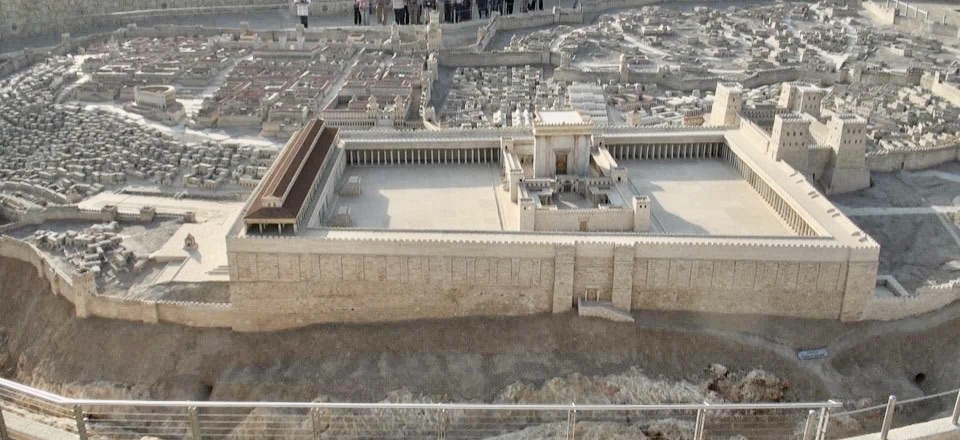
Prophets like Isaiah promised that all nations would come to Jerusalem, to the house of the Lord. And so the temple in Jerusalem provided a Court of the Gentiles, an extensive place surrounding the Holy of Holies (above) where foreigners as well as Jews could come to hear the word of God,

Them I will bring to my holy mountain
and make joyful in my house of prayer;
Their burnt offerings and sacrifices
will be acceptable on my altar,
For my house shall be called
a house of prayer for all peoples.
Thus says the Lord GOD,
who gathers the dispersed of Israel:
Others will I gather to him
besides those already gathered. (Isaiah 56)

It’s significant that Jesus in a symbolic act when he arrives in Jerusalem at the end of his public life cleanses the temple as a sign that that time had come. The Gentiles are called; he calls them to himself. In John’s gospel, read today, Jesus speaks from the temple, most likely from the Court of the Gentiles. He’s the One whom John the Baptist has pointed out and his mission will be confirmed by his Father who will glorify him in his Kingdom.

The Advent and Christmas seasons are not only celebrations for believers, confined to a church or the homes of believers. They take place in the “Court of the Gentiles”, they bring light to the world beyond Christianity. We may not realize it, but the world listens and sees, however dimly that may be. The light of our celebrations shine in a dark world that needs hope.

In the Advent and Christmas seasons, Jesus speaks in the “Court of the Gentiles”.

Readings here.

Friday, 2nd Week of Advent

Too strict, not strict enough. That’s the judgment in public opinion Jesus and disciples faced in their day, today’s Advent reading from Matthews’ gospel seems to say. That’s often the way our church is looked on in the marketplace today. 

Public opinion then– Jesus likens it to “children in the marketplace”– saw him and his disciples in two derogatory ways. For some, Jesus and his followers were not strict enough. Jesus ate too many meals with the wrong kind of people, among other things.  Others saw this movement as too strict. Like John the Baptist, they were crazy eccentrics, out of step with the real world, the world of the marketplace.

Too strict, not strict enough. We would like to answer that criticism of our church with a better public relations campaign and all that goes with it –better catechesis, better homilies, better media, but those responses don’t seem to be on the horizon. 

But listen to the promise our Old Testament readings offer:

“Those who follow you will have the light of life, O Lord.”

Thus says the LORD, your redeemer, the Holy One of Israel:
I, the LORD, your God, teach you what is for your good,
and lead you on the way you should go. If you would hearken to my commandments, your prosperity would be like a river,
and your vindication like the waves of the sea. (Isaiah 48:17-19) 

Mary’s Mother

by Howard Hain

durer

Albrecht Durer, “Virgin and Child with Saint Anne”, ca. 1519 (The Met)

Christmas is a time for grandmothers.

They bake and cook and decorate. Their homes become mini North Poles, diplomatic outposts of Santa’s Castle.

At its core, Christmas is of course all about Jesus. All about Jesus, Mary, and Joseph. All about the Holy Family.

The Holy Family is an extended family though. And it doesn’t stop at grandmothers and grandfathers, aunts and uncles, or even cousins and distant cousins.

Just ask Saints Joachim and Anne, Zechariah and Elizabeth, or John the Baptist—not to mention all the unknown relatives whom the child Jesus surely encountered throughout His Galilean days. Ask any one of them about the far-reaching ripple effects of family grace.

Those touched by Jesus have a tendency to appear bigger than life.

Look at Santa Claus.

Most of us are aware that he is really Saint Nick.

But do we stop to wonder who Mrs. Claus really is?

I think she’s Saint Anne.

After all, Mrs. Claus is seen as everyone’s grandmother, especially when it comes to holiday cheer. But when it comes to truly celebrating the birth of Jesus, it is through Saint Anne that we approach the gates of Christ’s Nativity.

Mary’s Mother holds a special key. She is first among grandmas, first among those who pinch chubby cheeks, who pass along one more extra sugary treat.

———

Saint Anne help us. Speak to us. Show us how to be grand parents to all those around us, especially the little ones. Stir up the spirit of Advent. Bake away the holiday blues. Cook up a dish of Christmas love that only your hearth can serve.

———

Come one, come all, to the home of Saint Anne. Come with me to Grandma’s house for a holiday visit. Taste and see. Enter her kitchen, where the hot chocolate can always fit a little more whipped cream, where you hear the constant refrain: “eat…eat…eat…”

At Grandma’s your plate is never empty.

Her table is continually set.

She always sees Jesus as having just been born.

She is always wrapping Him up tightly in swaddling clothes.

It is simply grand.

To Grandma, Jesus is always an innocent child.

And she can’t help but see Him deep within both you and me.


(Dec/21/2017)

Howard Hain is a contemplative layman, husband, and father. He blogs at http://www.howardhain.com


Web Link: Metropolitan Museum of Art. Albrecht Durer, “Virgin and Child with Saint Anne”, ca. 1519


The Yet Empty Stable

by Howard Hain

There’s a little stable not too far from here.

It sits in a church that has seen better days.

The parish is poor and the people seem to disappear.

But a few persistent peasants won’t stay away.

I love it there.

The priest is wonderfully uncertain.

He is afraid of God.

He instinctively bows his head at the mention of the name.

He knows how little he is in front of the great star.

I imagine he was involved in setting the stable.

It is a good size, on the relative little-stable scale.

It is surrounded by ever-green branches.

Probably snipped from the few Douglas Firs placed around the altar and yet to be trimmed.

The stable itself is composed of wood.

A little wooden railing crosses half the front.

A single string of clear lights threads through the branches laid upon the miniature roof.

They are yet to be lit.

I love it there.

I kneel before the empty scene.

For as of yet, not a creature or prop is present.

Not an ox or a goat, not a piece of hay or plank of fencing.

Not even a feeding trough that is to be turned into a crib.

No visible sign of Joseph and Mary, nor a distant “hee-haw” of a very tired donkey.

I wonder if I could get involved.

Perhaps I could slip into the scene.

There’s a darkened corner on the lower left.

In the back, against the wall.

I could hide myself within the stable.

Before anyone else arrives.

I don’t think they would mind.

I’d only be there to adore.

To pay homage to the new born king.

I might even help keep the animals in line.

Yes, a stagehand, that’s what I can be!

I know there’s no curtain to pull.

That’s to be torn in a much later scene.

But to watch the Incarnation unfold from within!

That’s what I dream.

To see each player take his and her place.

To see the great light locate the babe.

To watch the kings and shepherds stumble onto the scene.

Hark! To hear the herald angels sing!

O the joy of being a simple farmhand.

Of being in the right place at always the right time.

Of course though I wouldn’t be alone.

In that darkened corner, also awaiting the entire affair, there are many others.

Most I don’t know by name.

Too many in fact to even count.

But a few I know for sure.

For certain, present are those few persistent peasants who won’t stay away.

And of course there’s that wonderful anonymous parish priest.

The one who helped set into place this yet empty but very expectant stable.

The one whose fear of God is so clearly the beginning of wisdom.


(Dec/16/2016)

Howard Hain is a contemplative layman, husband, and father. He blogs at http://www.howardhain.com

Feast of St. Nicholas

You would do a little friend, or child, or relative of yours a favor if you would introduce him or her to the real Santa Claus, St. Nicholas, whose feastday is today. My good friend, Mauro DeTrizio, whose family comes from Bari, Italy, has had a lifelong devotion to St. Nicholas. He’s also a good videographer and his dream has been to produce a video on St. Nicholas, our Santa Claus.

So we teamed up to produce a couple of them as part of our campaign for saving Santa Claus. Santa’s more than a salesman; he’s a saint, and his gift for quiet giving is in the spirit of our coming season of Advent and Christmas. He mirrors God’s love shown in Jesus Christ.

Telling his story is one of the ways to save him from being captured by Macys and Walmart. Previously, we offered a version for little children. Now here’s another modest contribution for bigger children– like us:

http://www.youtube.com/watch?v=ADevygB9jNs