Tag Archives: Adam

Stars and Saints

Hubble Ultra Deep Field
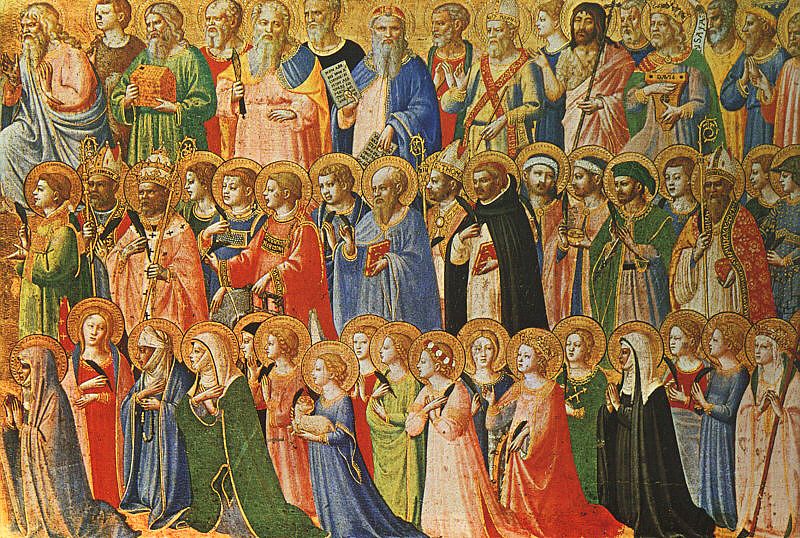
Fra Angelico, The Forerunners of Christ with Saints and Martyrs

By Gloria M. Chang

From eternity the Lord God designed humanity and the cosmos in his image, envisioning the constellation of saints bursting with Christic Light in the heavens. Formed from the dust of the earth, Adam evolves through the eons to completion in Jesus Christ, his descendant and Lord—the Potter’s masterpiece (Isaiah 64:8). 

Kindling the treasure of Christ’s flame in “jars of clay,” we grow day by day into the image of the Blessed Trinity as one Mystical Body (1 Corinthians 15:41). The dazzling kaleidoscope of saints, reflecting the unity and diversity of the Father, Son, and Holy Spirit radiates the infinite rays of divinity. Each saint refined in God’s furnace of Love emerges as an original from the hands of the Divine Artist, for “star differs from star in glory” (1 Corinthians 15:41).

Form me with your hands, Lord, day by day.
You are the Potter; I am the clay.
From soil you shaped sparkling saints like stars, 
Blazing your glory from earthen jars.

Just as we have borne the image of the man of dust, we shall also bear the image of the man of heaven.

1 Corinthians 15:49


This content by Gloria M. Chang was originally published online at Shalom Snail: Journey to Wholeness

World of Vapor

“World of Vapor”
A reflection on Ecclesiastes 1:1-11
©️2024 Gloria M. Chang

The words of the Preacher, the son of David, king in Jerusalem.
Vanity of vanities, says the Preacher,
vanity of vanities! All is vanity.

What does man gain by all the toil
at which he toils under the sun?

A generation goes, and a generation comes,
but the earth remains forever.

The sun rises, and the sun goes down,
and hastens to the place where it rises.

The wind blows to the south
and goes around to the north;
around and around goes the wind,
and on its circuits the wind returns.

All streams run to the sea,
but the sea is not full;
to the place where the streams flow,
there they flow again.

All things are full of weariness;
a man cannot utter it;
the eye is not satisfied with seeing,
nor the ear filled with hearing.

What has been is what will be,
and what has been done is what will be done,
and there is nothing new under the sun.

Is there a thing of which it is said,
“See, this is new”?
It has been already
in the ages before us.

There is no remembrance of former things,
nor will there be any remembrance
of later things yet to be
among those who come after.

Ecclesiastes 1:1-8 (ESV)

What is the Meaning of Life?

Qoheleth, the “Preacher,” writing in the name of Solomon, the son of David, wrestles with the absolute in the book of Ecclesiastes. The Hebrew word Qoheleth (from qahal, a root that means “assembly” or “congregation”) is Ekklesiastes in Greek, which names the book. Early traditions attribute the book’s authorship to Solomon, but philological evidence dates the book to no earlier than the mid-fifth century B.C., a half-millennium after Solomon’s reign. Thus, Qoheleth, a Hebrew sage, critiques the world through the eyes of King Solomon, the wisest, wealthiest, and most powerful man in the world. He investigates the patterns of nature and human striving, hoping to discover an ultimate purpose behind it all.  

World of Vapor

Qoheleth begins by lamenting that all is “vanity” (in Hebrew hebel, “vapor, breath”), which he pronounces five times in a single utterance (1:2). Finding no ultimate profit in the drudgery of human toil, he rhetorically asks, “What does man gain by all the toil at which he toils under the sun?”

Ephemeral phenomena and superficial impressions shift and slide incessantly “under the sun,” where nothing is constant. The rising and setting of the sun, and the circuitous currents of wind go “round and round” ceaselessly in a futile loop. The sea, too, like human ambition and appetite, never finds fulfillment despite continuous filling: “All streams run to the sea, but the sea is not full” (1:7). Jaded by familiarity, Qoheleth deplores the predictable motions of the earth.

“All things are full of weariness,” he despairs, “a man cannot utter it.” “The eye is not satisfied with seeing, nor the ear filled with hearing” (1:8). Ever restless, human desire insatiably consumes the panorama of sight and sound—representative of all sensory and intellectual stimuli. All impressions eventually evaporate like steam (hebel).

Nothing New Under the Sun

What has been is what will be,
and what has been done is what will be done,
and there is nothing new under the sun.

Is there a thing of which it is said,
“See, this is new”?
It has been already
in the ages before us.

Ecclesiastes 1:9-10 (ESV)

Ecclesiastes affirms the truism that “history repeats itself.” As civilizations rise and fall, human nature remains the same. War and peace, joy and sorrow, strength and weakness, freedom and slavery, profit and loss—the same old human affairs cycle round and round, generation after generation, world without end. A keen observer of human nature and historical recurrence, Qoheleth bleakly concludes, “There is nothing new under the sun.”

Puff of the Past

There is no remembrance of former things,
nor will there be any remembrance
of later things yet to be
among those who come after.

Ecclesiastes 1:11 (ESV)

As the sands of time fade away, so does human “remembrance of former things.” Stars and galaxies, fossils, and artifacts provide clues to the mystery of the 13.8 billion-year-old universe and human evolution. Yet billions of ancestors lie buried in the ground, forgotten by their descendants. Apart from cave paintings, oral traditions, scrolls, books, annals, chronicles, and even modern audiovisual media, which capture only fragments from limited perspectives, the past vanishes like vapor “under the sun.” Can fragmentary memories preserve an unbroken, unified recollection of the past? Can mortals achieve immortality in the minds of posterity? 

The Value of Struggle

Ecclesiastes challenges the assembly of wisdom seekers to find ultimate purpose and profit “under the sun.” Like Job, Qoheleth embraces disputation and wrestling with elemental questions. Sometimes described as “unorthodox,” these books goad the pious to “struggle with God,” the meaning of Israel’s name (Genesis 32:28). Questions do not threaten religion but expand its horizons. 

Without being an atheist, Qoheleth journeys to the edge of human striving to discover its peaks and valleys apart from God. His experiment confirms Paul’s observation that, on account of Adam’s departure from God’s will, “the creation was subjected to futility” (Romans 8:20; Genesis 3:17). The Greek word for futility, mataiotés (“vanity,” “emptiness”), translates the Hebrew word hebel (“vapor,” “breath”) in the Septuagint. Ecclesiastes allows every seeker of meaning to feel the emptiness of a life and vision that never rises above the sun. 

I have seen all things that are done under the sun, and behold, all is vanity and a chase after wind.

Ecclesiastes 1:14 (NABRE)

All is vanity, a chase after wind.
Series and cycles—these I examined.
Under the sun, seasons whirl like vapor.
What do humans gain by all their labor?


This content by Gloria M. Chang was originally published online at Shalom Snail: Journey to Wholeness.

Friday Thoughts: The Best Coinage The World Has Ever Known

.

You can run but you can’t hide. An apple a day keeps the doctor away.

What a world it would be if we only spoke in clichés.

Is it the kind of world you and I live in?

Do we retreat into beaten-down meadows, like deer who lay where others have already flattened the grass?

There’s less work I suppose. And the grass may still be warm.

But it’s also kind of like Goldilocks and the Three Bears.

You can enter a home that isn’t yours, you can search for a bed that fits just right, but at the end of the day your cover will be blown.

You can run but you can’t hide.

After all, you’ve made your bed, now lie in it.

Perhaps it is such lying that is really the apple.

For picking fruit from someone else’s tree has never been a good idea.

Those kind of apples certainly keep the good doctor away.

But I guess we also have to be careful to not overcorrect.

We must not out of pride be unwilling to enter where others have already been.

No, that is wisdom. We should go where others have gone before. It just depends on who they were and where they went.

And no matter what, we shouldn’t hide within those spaces, pretend that they are our own, and perhaps worst of all, act as if we are the first to ever have entered—delusion of this kind leads us to the belief that we create anything at all.

We don’t.

Think of Adam in the Garden. God is busy whipping up the entire universe from out of nothing. Creating and sculpting, adding and adapting, breathing life into His new world. And Adam, well, he’s one of the building blocks. Yes, certainly a favorite. A favorite that God does not want to be alone.

And something spectacular takes place:

The LORD God said: It is not good for the man to be alone. I will make a helper suited to him. So the LORD God formed out of the ground all the wild animals and all the birds of the air, and he brought them to the man to see what he would call them; whatever the man called each living creature was then its name. The man gave names to all the tame animals, all the birds of the air, and all the wild animals… (Genesis 18-20)

God created, Adam named.

It is simply amazing. And humbling.

What an honor. And what a clear indicator of who is truly in charge.

We create nothing. That’s the bad news for those who want to be God.

We do though participate in the ongoing unfolding of God’s perfect and eternal world. We even seem to share the leading role. That’s the Good News for those who believe.

For our work is not to create. We simply cant. Only God can. And even if we “build” with what is already in existence, if we seemingly “create” something “new” with the building blocks we find already laying around, that “pseudo-creation” still isn’t our primary job.

Then what is?

Well, the original disciples of Jesus had a similar wonder:

So they said to him, “What can we do to accomplish the works of God?” Jesus answered and said to them, “This is the work of God, that you believe in the one he sent.” (John 6:28-29)

And there’s the crux of it, if you will.

Adam, we must remember, when in the supremely honorable position of naming God’s creatures was still naked, and he felt “no shame.” He hadn’t yet eaten what wasn’t his. He was not yet hiding “among the trees of the garden.” He still believed in the One Who Sends.

Adam was faithful. Adam was original. Adam knew he was God’s creation. And Adam was free to roam.

But Adam used his freedom to choose to become a slave.

Adam’s fall was a fall into self. A fall into creation, the creation of a great lie, that man creates on the same level as God.

It was a great fall. So steep was the cliff off which he went that no other story could ever bring more meaning to the most hackneyed line: “Once upon a time…”

Adam’s fall is a fall into denomination.

A fall into the church of self.

A fall into complete and utter cliché.

And it brought death to the great privilege of cooperating with God, of naming and stewarding on His behalf His created world.

But thanks be to God.

For someone truly original, and creative, finally came round.

He put the apple back up upon the tree and told the snake to take a hike.

His name is Jesus.

He is also called The Son of Man.

But of course we are free to just call Him God.

For about Jesus, nothing is cliché.

It is very clear, there’s absolutely no running or hiding when it comes to the Cross.

And when it comes to His love for us, there’s no apple that can keep the Divine Physician away.


.

—Howard Hain

.

The Synod on the Family

Here’s how Pope Francis began his homily this Sunday opening the Synod on the Famlly in Rome:
“Adam lived in the Garden of Eden. He named all the other creatures as a sign of his dominion, his clear and undisputed power, over all of them. Nonetheless, he felt alone, because “there was not found a helper fit for him” (Gen 2:20). He was lonely.

The drama of solitude is experienced by countless men and women in our own day. I think of the elderly, abandoned even by their loved ones and children; widows and widowers; the many men and women left by their spouses; all those who feel alone, misunderstood and unheard; migrants and refugees fleeing from war and persecution; and those many young people who are victims of the culture of consumerism, the culture of waste, the throwaway culture.

Today we experience the paradox of a globalized world filled with luxurious mansions and skyscrapers, but a lessening of the warmth of homes and families; many ambitious plans and projects, but little time to enjoy them; many sophisticated means of entertainment, but a deep and growing interior emptiness; many pleasures, but few loves; many liberties, but little freedom… The number of people who feel lonely keeps growing, as does the number of those who are caught up in selfishness, gloominess, destructive violence and slavery to pleasure and money.

Our experience today is, in some way, like that of Adam: so much power and at the same time so much loneliness and vulnerability. The image of this is the family. People are less and less serious about building a solid and fruitful relationship of love: in sickness and in health, for better and for worse, in good times and in bad. Love which is lasting, faithful, conscientious, stable and fruitful is increasingly looked down upon, viewed as a quaint relic of the past. It would seem that the most advanced societies are the very ones which have the lowest birth-rates and the highest percentages of abortion, divorce, suicide, and social and environmental pollution.”