April 25th is the Feast of St. Mark, author of one of the gospels. We may forget that real people wrote the gospels, but the medieval portrait above shows the evangelist real enough as he adjusts his spectacles and pours over a book, surely his gospel. A lion looks up at him, the powerful voice of God.
He’s an old man, his eyes are going, He has to be old if he’s a disciple of Peter, as tradition claims. (cf. 1 Peter 5:14) Mark’s gospel appears shortly before or after the destruction of the Jewish temple in Jerusalem by the Romans in 70 AD. If he’s the author of the gospel, as it’s said, he’s in his 70s at least.
He may have written his account in Rome, where he came with Peter, who calls Mark in his 1st Letter “my son.” In 64 AD, Roman Christians experienced a vicious persecution at the hands of the Emperor Nero. Peter and Paul died in that persecution. For years afterwards, Christian survivors were still asking themselves, no doubt, why it happened.
They say Mark wrote his gospel in answer to that dreadful experience. He would have heard Peter’s witness to Jesus many times; he knows his story.
Yet Mark was not just a stenographer repeating Peter’s eyewitness account; he’s adapted the apostle’s story, adding material and insights he had gathered on his own. For a long time Mark’s gospel was neglected by the church, thought to be simply a synopsis of Matthew’s gospel. Today scholars admire it for its simplicity and masterful story telling. It’s the first gospel written and Matthew and Luke derive much of their material from it.
I like the wonderful commentary: The Gospel of Mark, in the Sacra Pagina series from Liturgical Press, by John Donohue,SJ and Daniel Harrington, SJ (Collegeville, Min. 2002). A great guide to this gospel and its rich message. We read Mark in the lectionary from the Feast of Baptism of Jesus up to Ash Wednesday, the beginning of Lent.
Mark’s Gospel offers a unique wisdom. It does not flinch before the mystery of suffering and does not try to explain it away. There’s a darkness about this gospel that makes it applicable to times like ours. We’re disciples of Jesus who must follow him, no matter what.
Our gospel for the feast is the final commission Jesus gives to his disciples, according to Mark. “Go into the whole world and proclaim the Gospel to every creature. Whoever believes and is baptized will be saved; whoever does not believe will be condemned. These signs will accompany those who believe: in my name they will drive out demons, they will speak new languages. They will pick up serpents with their hands, and if they drink any deadly thing, it will not harm them. They will lay hands on the sick, and they will recover.”
Like Jesus, his disciples will drive out demons and speak new languages. They’ll pick up serpents and drink poison, yet be unharmed. They will even believe, without understanding everything. In answer to Jesus’ command, tradition says Mark went to Egypt and founded the church in Alexandria.
Father, You gave St. Mark the privilege of proclaiming your gospel. May we profit by his wisdom and follow Christ more faithfully. Grant this, through Christ, your Son.
Today is Earth Day. As Christians we see the earth through eyes of faith. The earth is God’s creation
God created and cares for more than the human family. You are the “hope of all the earth and of far distant isles”, Psalm 65 says. “You uphold the mountains with your strength, you still the roaring of the seas…The ends of the earth stand in awe at the sight of your wonders. The lands of sunrise and sunset you fill with your joy.
“You care for the earth, give it water, you fill it with riches. Your river in heaven brims over to provide its grain. And thus you provide for the earth; you drench its furrows; you level it, soften it with showers; you bless its growth. You crown the year with your goodness. Abundance flows in your steps, in the pastures of the wilderness it flows. The hills are girded with joy, the meadows covered with flocks, the valleys are decked with wheat. They shout for joy, yes they sing.” (Psalm 65, Tuesday. Morning Prayer, week 2)
Along with the human family, the earth praises God, its creator,. The natural world, as a vital part of God’s creation, shouts for joy and sings. There’s even surprise in the psalms that God, the Almighty, creator of heaven and earth, could have a special care for the human family. “When I see the heavens, the work of your hands, the moon and the stars which you arranged, what is man that you should keep him in mind, mortal man that you care for him?” ( Psalm 8, Saturday Morning, week 2, 4 )
The view of God’s close engagement with the natural world proclaimed by the psalms and the scriptures fell into disfavor when science became the primary way of looking at the natural world with the age of the Enlightenment. Science became our guide and the human world became the center that controls everything. God’s engagement with the natural world and the human world came into question. The scriptural accounts were just poetry.
But poetry can also be true.
As we hear the Risen Jesus in the Easter season using the great images of bread from heaven, the shepherd, the vine, we shouldn’t miss their cosmic import. Images point out many things. Certainly “bread from heaven” points to the sacrament of the Eucharist; the shepherd and vine point to the life of the church and the intimacy we enjoy as branches grafted into the vine that is Jesus Christ.
But let’s not forget God’s rule over the whole world. We know so much more about it now. We also know how endangered it has become because of human neglect. More than ever, we need to acknowledge its dignity before God, who still covers the meadows with flocks, “the valleys are decked with wheat.” The natural world shouts for joy and sings during the Easter season. Its Shepherd guides it; it receives daily bread. It shares in the promise of the Risen Christ.
This week’s readings from the Acts of the Apostles describe the growth of the church in the Gentile world. Peter journeys to Joppa, the seaport Jonah embarked from on his mission to Nineveh. On his way he raises up a paralyzed man at Lydda and in Joppa he raise a young girl, Tabitha, from the dead–signs similar to those Jesus worked.(Saturday, 3rd Week of Easter)
Some, however, question Peter for baptizing the Roman soldier Cornelius and eating at table with him. (Monday) “God has given life-giving repentance to the Gentiles too,” Peter responds, initiating a new phase in the church’s growth. His response is based, not on human judgment, but because he has seen signs from the Spirit.
The readings from Acts from Wednesday to Saturday describe Barnabas and Saul’s opening campaign into the Gentile world. Let’s not ignore, though, the reading from Tuesday which recalls the unknown survivors of the persecution of Stephen who, driven into the Gentile world, “speak to the Greeks, proclaiming the Lord Jesus to them. The hand of the Lord was with them and a great number turned to the Lord.” Clearly, others besides those we know brought the gospel to the Gentiles.
We are all involved, not just a chosen few, in bringing the gospel to the world.
In the Gospel readings from John (Monday-Wednesday) Jesus continues to speak of himself as the Good Shepherd. As Risen Lord, he goes before us, guiding his flock to final pasture. We hear his voice, not the voice of a stranger. His voice is the same as the Father’s voice.
On Thursday, the readings from John bring us back to the supper room. For the remaining days of the Easter season, we will listen to Jesus’ words of encouragement and love for his own who are in this world.
Some years ago Anglican Bishop N. T. Wright, a highly regarded New Testament scholar, addressed the Catholic Bishops of Italy on the resurrection of Jesus Christ. His thoughts on the resurrection were particularly interesting. The theme of the Italian bishops’ conference was “Jesus, our Contemporary.”
He began with this challenging picture of the Risen Christ.
“ On the one hand, it is precisely because Jesus is risen from the dead that he is alive in a new, unique way; that he is able to be with us as a living presence, which we know in prayer and silence, in reading scripture and in the sacraments, and (not least) in the service of the poor.
“Jesus is truly our contemporary. But at the same time in his resurrection Jesus stands over against us. He is different. He is the first fruits; we are the harvest that still awaits. He has gone on ahead while we wait behind.
“What is more, the meaning of his resurrection cannot be reduced to anything so comfortable as simple regarding him as ‘contemporary’ in the sense of a friend beside us, a smiling and comforting presence. Because he is raised from the dead, he is Lord of the world, sovereign over the whole cosmos, the one before whom we bow the knee, believing that in the end every creature will come to do so as well.
“It’s not enough that Jesus intervenes at the moment of our death. He is the Lord of creation.”
According to Wright our belief in Jesus as Lord of creation has been undermined by the thinking of the Enlightenment, which placed God (if God exists) beyond our world. We are the lords of creation. This life and all in it is in our hands to shape and control as we think best.
Our belief in the Risen Christ is influenced by this thinking, Wright believes. The only role we give to the Risen Lord is to save us from death and bring us to heaven. But he is Lord of Creation, present here and now. We must live in him today and continue his work, not in a heavy-handed way, but humbly as Jesus called for in his teaching on the beatitudes.
“This is how Jesus wants to run the world: by calling people to be peacemakers, gentle, lowly, hungry for justice. When God wants to change the world, he doesn’t send in the tanks; he sends in the meek, the pure in heart, those who weep for the world’s sorrows and ache for its wrongs. And by the time the power-brokers notice what’s going on, Jesus’ followers have set up schools and hospitals, they have fed the hungry and cared for the orphans and the widows. That’s what the early church was known for, and it’s why they turned the world upside down. In the early centuries the main thing that emperors knew about bishops was that they were always taking the side of the poor. Wouldn’t it be good if it were the same today.”
The 6th chapter of Luke’s Acts of the Apostles which we started to read on Saturday of the 2nd week of Easter begins with a social problem we shouldn’t overlook. Some new converts to Christianity are being treated unfairly. “As the number of disciples continued to grow, the Hellenists complained against the Hebrews because their widows were being neglected in the daily distribution.”( Acts 6:1. Saturday, 2nd week of Easter)
If we substitute “Immigrants” for “Hellenists” in that text a more familiar situation emerges. New-comers are plainly not treated fairly, especially the poorer among them and they’re looking for something more.
The “Hebrews” are the first followers of Jesus, mostly Jews from Galilee. They’re Jewish Christians at home in the Jewish world, who fit into the religious and political Judaism of their time in spite of the friction that came from following Jesus of Nazareth.
They’re the establishment.
In every age immigrants, once they gain a footing in their new home, learn to speak out for their needs. The Hellenists, led by Stephen, began to speak out. Stephen’s fiery words seem to be only about religious matters, but he’s also criticizing the closed world of Judaism. Should we add the closed world of early Jewish Christianity as well?
Stephen’s criticism cost him his life and initiated the Jewish reaction that led to the expulsion of the Hellenists. They become immigrants again but, as Luke notes, they bring the gospel to new peoples.
It’s a misconception to believe, as some do, that Christianity spread easily without problems and sufferings early on. It’s also a misconception to believe that it spread solely due to the genius of Paul the Apostle. Paul was a great figure in the spread of Christianity, but the Acts of the Apostles read this week reminds us there were others, like the deacon Philip, who brought the gospel to Samaria. (Wednesday)
We wonder, too, about the Ethiopian official Philip baptizes. He surely brought the gospel to Africa. (Thursday) There were many others, not just apostles, not solely Paul, but immigrants like Stephen, who fulfilled a divine plan they hardly understood.
Luke concentrates of Paul’s mission and pays scant attention to the other missionaries who brought the gospel to world around them. Nor does Luke recognize social factors, like immigration, that led the spread of Christianity. He doesn’t tell the whole story.
We are in the midst of an age of massive immigration, due to wars, climate change, religious discrimination and other issues. We tend to see these issues only in social or political terms.
This week’s readings from Luke remind us there’s more. God’s plan is also being fulfilled.
On the Feast of the Glorious Wounds of Jesus Christ, which the Passionists celebrate in the Easter Season, St. Bonaventure looks to the flowers of the field, brightening the world in spring, to describe the love of Jesus in his Passion. Each wound in his hands, his feet and his side is a red rose revealing God’s love for us. It is an ardent and intense love.
Jesus is the flower of heaven which, once closed by the chilling night of Adam’s sin, opens like a rose in the rising sun of God’ great mercy.
“This flower of heaven, warmed by the rays of ardent love, opens wounds in every part of his body… See his entire body: Is there a place where the rose is not found? See one hand, then the other; see one foot, then the other. Can you not see the rose? See the wound in his side, for the rose is there too, although it is of a paler red because of the admixture of water, for there came out blood and water. Yes, this is he who came in water and in blood, Christ Jesus all-good.
Lord and Savior of all, good Jesus, how can I thank you, who from the dawn of your life to your cruel death yes, even after it, have shed so much of your blood for me? How can I thank you who revealed a surpassing love by shedding your blood? How full this rose with its many petals! Who can count them all?
The first reading at Mass for this feast looks into heaven where the heavenly hosts praise the Lamb who was slain: “With your blood you purchased for God men of every race and tongue, of every people and nation. You made of the a kingdom and priests to serve our God and they shall reign on the earth.” ( Revelations 5:5-12)
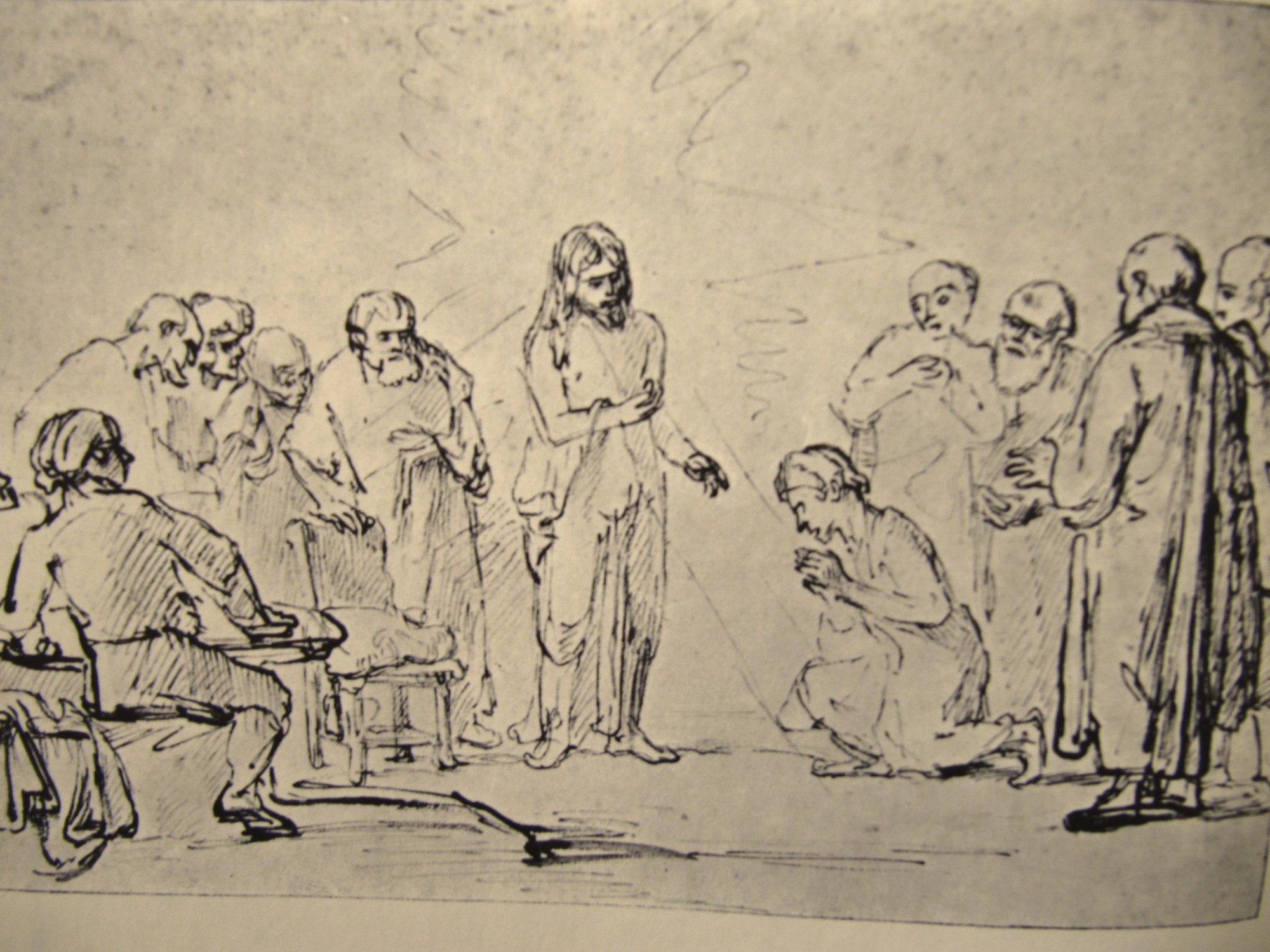
John’s Gospel recalls the night Jesus revealed his wounds to Thomas, who refused to believe. “My Lord and my God,” the disciple said, worshipping him. (John 20:24-29)
“You will draw water joyfully from the springs of salvation.” Our responsory psalm says.
The Passionists celebrate the Feast of the Glorious Wounds of Jesus on Friday of the second week of Easter. The four gospels tell the great story of the passion of Jesus, each in its own way. More than the others, John’s gospel focuses on his wounds, unlikely signs revealing the mystery of the Word made flesh.
On Calvary a small symbolic group stands beneath the cross of “the King of the Jews”– Mary, the mother of Jesus, the disciple whom he loved, and a few others. A gentile soldier joins them.
This group represents the “new Jerusalem,” “the inhabitants of Jerusalem who look on the one whom they have pierced…and mourn for him, as one mourns for an only child.” (Zechariah 11, 10 )
They receive a precious gift. “It is finished!” Jesus declares, and bowing his head, he pours out his spirit on them. A Roman soldier thrusts a spear into Jesus’ side. “Immediately blood and water flowed out.” (John 19, 34)
Blood, a sign of his life, flows on those standing beneath his cross. Water, signifying the Spirit within him, is poured out on the world they represent. Far from ending his life, his death is the moment Jesus shares his life.“This is the one who came by water and blood, Jesus Christ.” (I John 5,6)
Artists afterwards picture the wounds of Christ as cosmic signs. They place the grave of Adam beneath the cross — generations wait for the new life Jesus brings. Creation, symbolized by the sun and moon, looks on expectantly, for Calvary is where creation too is redeemed. Angels collect the blood and water from Jesus’ wounds in cups representing the mystery of the Eucharist. All days are found in this one day. On Calvary, the glory of the Lord is revealed in his wounds.
St. Paul of the Cross in his letters often wished the one to whom he’s writing to be placed in the “wounds of Christ” or the “holy Side of Jesus” or his “Sacred Heart.” “I am in a hurry and leave you in the holy Side of Jesus, where I ask rich blessings for you.”
These expressions may seem pious phrases until we read the story of Thomas from John’s gospel. Jesus shows the doubting disciple the wounds in his hands and side, and Thomas believes.
Belief is not something we come to by ourselves. God gives this gift through Jesus Christ. We all stand beneath the life-giving Cross of Jesus. May his life give new hope to us and our world.





 The Victor's Place