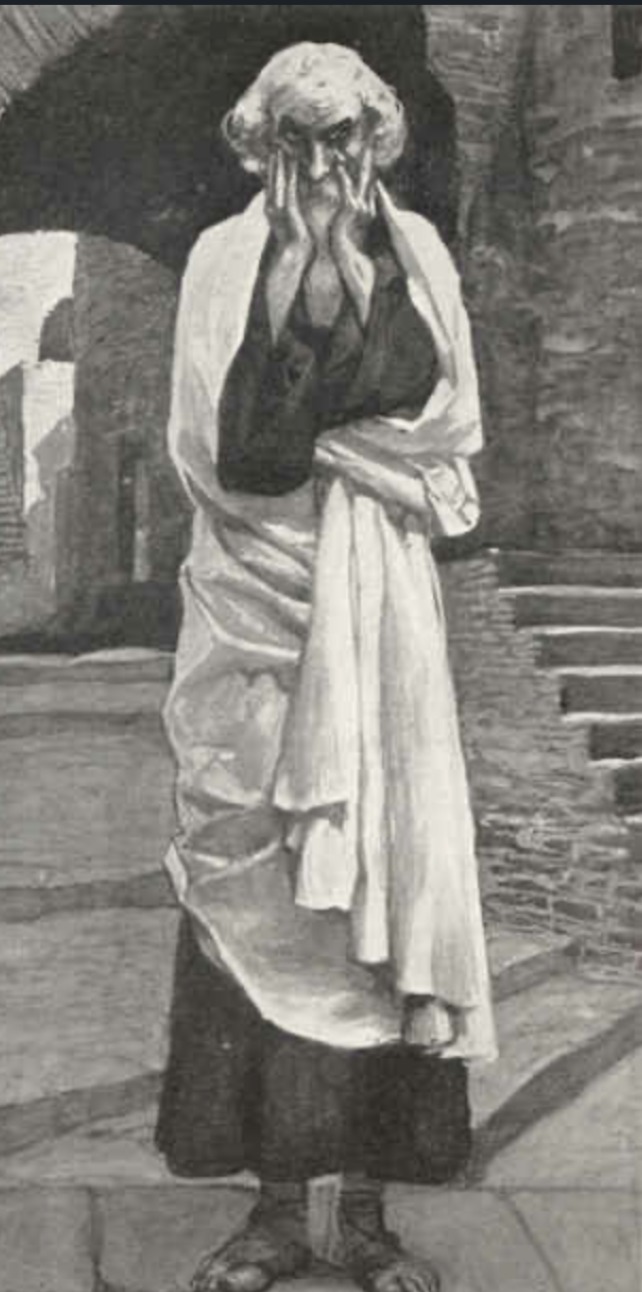
The Prophet Micah

Micah. James Tissot

We’re reading in our lectionary from the prophet Micah, a contemporary of Isaiah, during the 16th week of the year. Micah lived in the southern kingdom of Judea in the 8th century when Assyrian armies destroyed the northern kingdom of Israel and began deporting many of its people to Assyria. 

Archeologists and historians think a good number of people from the northern kingdom immigrated south to Judea at this time and eventually they contributed to its growth. But first, they needed land and houses to live in.  Micah warns Judea’s wealthy class against treating the new immigrants badly. 

Woe to those who plan iniquity…
They covet fields, and seize them;
houses, and they take them;
They cheat an owner of his house,
a man of his inheritance. (Micah 2, 1-6)

The same people whom God led out of Egypt and gave land to freely are gouging the poor immigrants:

O my people, what have I done to you,
or how have I wearied you? Answer me!
For I brought you up from the land of Egypt,
from the place of slavery I released you;

Prophets like Micah called for social justice. They raised up issues that don’t go out of date. We need prophetic voices to raise them up today in a society increasingly anti-immigrant. Housing, immigration, unfair real estate practices?

You have been told what’s good, what the LORD requires of you: Only do justice and love goodness and walk humbly with your God.  (Micah 8:8)

“But you, Bethlehem-Ephrathah,least among the clans of Judah, from you shall come forth for me one who is to be ruler in Israel, whose origin is from of old, from ancient times.”Micah 5: 1-2.

Matthew’s Gospel (2: 5-6) reports that the chief priests and scribes cite this passage from Micah as a promise that a messiah in the line of David will be born in Bethlehem. The reading is also the first reading for the Feast of the Birth of Mary, September 8, and one of the readings for the common of feasts of Mary.

16th Sunday b: Rest Awhile

For this week’s homily please watch the video below.

“Come by yourselves to an out-of-the-way place and rest awhile.”

Last Sunday in Mark’s gospel Jesus sent out his disciples two by two to proclaim his message and cure the sick. Today’s reading describes their return; they’re enthused by what they’ve experienced. It looks like they have done very well, and they’re ready to go out again.

But Jesus tells them, “Come by yourselves and rest awhile.” Now, if you tend to think of Jesus as a hard boss, a relentless driver, remember this gospel. Instead of sending his disciples out again, he tells them to rest awhile–probably the last thing they want to hear, but what they need to do. 

 “Come apart, and rest awhile.” That’s a call for balance in life, a balance of doing and resting, of work and leisure. A hard balance to keep, especially today, I think.

Our world never seems to sleep, our cell phones and computers and video games never stop, our businesses, our work go on day and night, seven days a week. We’re a driven society; we seem to have lost the rhythm of sleep, of meals, of quiet reflection, of prayer, of resting awhile. Even the way we play seems to be over organized and frenetic. We don’t seem to be able to rest awhile. 

Sometimes the business world creates this imbalance. Some people have jobs that are too demanding, non-stop.  Sometimes we ourselves create the imbalance. We want too much, we want to do too much. We don’t want to stop and rest awhile. But we’re not machines; we’re human beings and human beings need to rest awhile. 

We need to remember God’s presence, guiding and sustaining us. We need to hope in God. 

There’s a beautiful poem by the French poet Charles Peguy called “Sleep.” In the poem God talks to someone like us. “Do you think I can’t handle things without you,” God says. Go to sleep. Get some rest.

Here’s some of the poem:

“Human wisdom says  “Don’t put off until tomorrow 
What can be done the very same day.”
But I tell you that he who knows how to put off until tomorrow
Is the most agreeable to God
He who sleeps like a child
Is also he who sleeps like my darling Hope.
And I tell you: Put off until tomorrow
Those worries and those troubles which are gnawing at you 
today
Put off until tomorrow those sobs that choke you
When you see today’s unhappiness.
Those sobs which rise up and strangle you.
Put off until tomorrow those tears which fill your eyes and
your head,
Flooding you, rolling down your cheeks, those tears which
stream down your cheeks.
Because between now and tomorrow, maybe I, your  God, will have
passed by your way.
Human wisdom says: Woe to the one who puts off what he
has to do until tomorrow.
And I say Blessed, blessed is the one who puts off what he
has to do until tomorrow.
Blessed is the one who puts off. That is to say, blessed is the one who 
hopes. And who sleeps.”

The poem’s not advocating procrastination, of course, it’s not saying don’t face reality. No. It’s saying believe that God’s with you, guiding and sustaining you. You don’t have to do it all yourself. 

Going back to our reading for today. The disciples are going to have to go back to work again. Crowds descend on them in a deserted place. “What are we going to do?” they say. Our gospel next Sunday tells us what God does. He feeds the multitudes. They hardly have to do a thing. 

O Lord,I Shall Not Die: Isaiah 38

Life beyond this? In our reading today from Isaiah, Hezekiah, king of Judea, has no high hopes when he’s suddenly told he’s going to die, even as he’s engaged in crucial negotiations for his people with the Assyrians.

His thoughts are placed in the responsorial psalm of today’s liturgy:

“Once I said,
In the noontime of life I must depart!
To the gates of the nether world I shall be consigned
for the rest of my years.” 

I said, “I shall see the LORD no more
in the land of the living.
No longer shall I behold my fellow men
among those who dwell in the world.”

My dwelling, like a shepherd’s tent,
is struck down and borne away from me;
You have folded up my life, like a weaver
who severs the last thread.”

It’s not just death he mourns, as he turns to a dark wall, it’s the time of death, as he’s involved in a crucial work for his people. Death also brings him to a place where he will “see the Lord no more in the land of the living.” His experience of God in this life is taken away, and finally, he will lose those people around him who mean so much. “I shall no longer behold my fellow men among those who dwell in the world.” Life is gone.

“O Lord; I shall not die“. God is the one who gives life, our responsory says. God promises, not just life that stretches out a little while longer, but eternal life. Eternal life is not life that removes us from the work we are engaged in here on earth. It is not life that separates us from those we know and love now. It certainly is not life that takes us away from the presence of God.

You saved my life, O Lord; I shall not die.

In our reading from Isaiah yesterday, the prophet promises more than a dark pit after death. He hears humanity in the voice of Hezekiah crying out in God’s presence like “a woman about to give birth, writhing and crying out in her pains… We conceived and writhed in pain, giving birth to the wind; salvation we have not achieved for the earth, the inhabitants of the world cannot bring it forth.” Our dreams of life are shattered.

Isaiah follows that stark description of human efforts– a woman in labor, giving birth to the wind– with these words:

“But your dead shall live, their corpses shall rise;
awake and sing, you who lie in the dust.
For your dew is a dew of light,
and the land of shades gives birth.” (Isaiah 26, 16-19)

Isaiah is more than a prophet who calls for social justice and a just society. His vision of God inspires him to promise his people life beyond this.

Isaiah 38 is an important reading in the prayers of the church. It’s found in morning prayer, Holy Saturday, in morning prayer of the Office of the Dead, and morning prayer, Tuesday, week 2 of. the Liturgy of the Hours.

We remember the death and resurrection of Jesus today, Friday.

“Woe, Chorazin! Woe, Bethsaida! Matthew 11:20-24

Ruins of Capernaum

In both readings today in our liturgy, from Isaiah and Matthew, kingdoms, cities, towns are brought down. Though powerful, permanent and blessed by God  they fall into the dust. Isaiah describes the fall of Jerusalem. Matthew’s Gospel describes the fall of towns along the Sea of Galilee, like Capernaum and Corazin, where Jesus taught and worked wonders, yet they abandon  him.

Jerusalem was destroyed by the Romans in 70 AD.  Galilee, where Jesus lived most of his life and years of ministry,  became the center of Pharasaic Judaism; exiles from Judea displaced  Jewish Christians from the towns and synagogues of Galilee. Jesus was considered an enemy there. The towns where he taught and worked wonders no longer welcomed him. .

We look for lasting cities, but our readings today remind us earthly cities are not lasting, They change and sometimes disappear. “He came to his own and his own received him not”, St. John says.  Paul writes extensively in the 9th Chapter of Romans about the mystery of rejection Jesus faced from his own people. Look to the mercy of God, he says. 

We wonder about his rejection in our own towns and places.  We wonder about the future of Christianity in our part of the world. Will it disappear?

The psalms in the liturgy offer God’s message to our readings, as Psalm 48  does today: 

“God upholds his city forever. Great is the LORD and wholly to be praised
in the city of our God.
His holy mountain, fairest of heights, is the joy of all the earth.
Mount Zion…is the city of the great King.
God is with her castles; renowned is he as a stronghold.”

The times we live in have their storms like those that destroyed the ships of Tarshish, but time is like a woman in labor. Sometime new is being born and we don’t see it yet.  

The Book of Isaiah: 15th Week

Isaiah

This week, the 15th week of the year, we’re reading from the Prophet Isaiah at Mass, an important Old Testament book, the most frequently referenced Old Testament source in the New Testament, after the psalms. We read it extensively during Advent, Lent and Easter, and in the daily prayers of the hours.

The book is not the work of just one man, Isaiah, writing in his own lifetime. Over two centuries, from 742-500 BC, other writers quoted, added to and expanded the prophet’s words, with their own interests and time in mind. It’s a book compiled over time as one generation after another found God speaking to them in this great prophet. 

In those centuries three crucial periods in Israel’s history occurred: the emergence of the kingdom of Judea after the destruction of the northern kingdom of Israel in 722 BC, the destruction of Jerusalem and the exile of its people ( 587-539 BC), and the call to renewed hope for the exiled community ( 537-500 BC). So, the Book of Isaiah teaches us, first of all,  that God is not found in just one time or place.

Fr. Carroll Stuhlmueller, CP, offers a helpful summary of the Book of Isaiah in the Catholic Study Bible. Isaiah means “God saves.” Isaiah found a saving God in the messy political maneuvering of his day. Those following him afterwards brought “innovative insights into older traditions as they saw God’s saving presence in their time.” Can we learn from Isaiah to see a saving God in our time too?

“First Isaiah (1-39 ) is absorbed in the role of Jerusalem and especially the Davidic dynasty. Second Isaiah (40-55) ignores the Davidic dynasty, except for 55:3, which mentions the temple only once in a disputed passage (44:28), and considers Jerusalem as principally a religious symbol. Third Isaiah (56-66 ) completely ignores the dynasty, and contemplates a new messianic kingdom.”  (Catholic Study Bible RG 288)

Human hands, human interests, human history, human weakness are at work in the Book of Isaiah at every stage of its compilation. They’re always at work. They always get our attention. 

But the book begins with an experience that’s key to it all. Isaiah experiences a vision of God in the temple which initiates his ministry (Isaiah 6): 

”The vision of the Lord enthroned in glory stamps an indelible character on Isaiah’s ministry and provides a key to the understanding of his message. The majesty, holiness and glory of the Lord took possession of his spirit and, at the same time, he gained a new awareness of human pettiness and sinfulness. The enormous abyss between God’s sovereign holiness and human sinfulness overwhelmed the prophet. Only the purifying coal of the seraphim could cleanse his lips and prepare him for acceptance of the call: “Here I am, send me!” ( Isaiah, Introduction, New American Bible)

Is the most important lesson to draw from this book this: go before God, a merciful God who saves, and be constantly refreshed by his presence? In the presence of God we learn what it means to be merciful and turn to create a merciful society in our time.  

15th Sunday b: Get your Walking Stick

For this week’s homily, please watch the video below.

A Harvest Nearby: Matthew 9:38

In our readings this 14th week of the year from Matthew’s Gospel, Jesus calls for laborers for a harvest: “The harvest is abundant but the laborers are few; so ask the master of the harvest to send out laborers for his harvest.” He gathers twelve disciples following that call. When we think of laborers in the vineyard we think of priests and religious. They are certainly needed for the harvest in our own church.

But they’re not the only laborers needed for God’s great harvest. What about laborers for places where priests or religious will never be? And what about the harvest itself, where does that happen?

I’m sure at one time or another you have overheard people at a restaurant or on a bus or at some gathering discussing religion. “What do you think of the pope?” “Do you think there’s life after death?” “Do you think Jesus is really God?” Often the questions go unanswered or wrongly answered because there’s no laborer there to speak the truth.

The harvest is waiting in a lot of places..

Jesus spoke about the laborers for the harvest as he moved from town to town in Galilee and saw  “troubled and abandoned” crowds, Matthew’s gospel says. We need to ask for laborers among crowds like those of today. Maybe we need to recognize there’s a harvest not far from where we are, “troubled and abandoned,” at a table nearby.

Hosea 11: The Bands of Love

Thus says the LORD: When Israel was a child I loved him,  out of Egypt I called my son. The more I called them, the farther they went from me,Sacrificing to the Baalsand burning incense to idols.

Yet it was I who taught Ephraim to walk, who took them in my arms; I drew them with human cords, with bands of love; I fostered them like onewho raises an infant to his cheeks; Yet, though I stooped to feed my child, they did not know that I was their healer.

My heart is overwhelmed, my pity is stirred. I will not give vent to my blazing anger, I will not destroy Ephraim again; For I am God and not man, the Holy One present among you; I will not let the flames consume you. Hosea 11:1-4,8-9

Today’s reading from Hosea reminds us why we read the Old Testament prophets. In an extraordinary way they capture the image of God in simple human terms, whether it’s the love of man and woman or parents for a child.

“When Israel was a child I loved him.” And God’s love is no abstract love. “I taught him to walk, I took him into my arms. I raised him to my cheeks, I stooped to feed him.”

The prophet describes God’s love through the simple “human cords and bands of love” a parent has in raising a child. How easily we forget those  “bands of love” by which we were brought up. We forget them, and we also forget the myriad ways God has been with us.

We may forget, but God does not forget. God’s love is like a mother and father who cannot forget, the prophet says:

“ My heart is overwhelmed, my pity is stirred. I will not give vent to my blazing anger,I will not destroy Ephraim again; For I am God and not man, the Holy One present among you; I will not let the flames consume you.”

Hosea: “I will allure her.”

Hosea and Gomer , from the Bible Historiale, Wikipedia Commons

Commentators say the Book of Hosea, the 8th century Jewish prophet we’re reading at Mass in the 14th week of the year, is one of the most difficult books of the bible to understand. Its language and its references are often obscure. But one part of Hosea’s story you can recognize in any television soap opera or romantic novel today: It’s a story of marital infidelity, a broken marriage.

Hosea had trouble with his wife, whose name is Gomer. He was very much in love with her; they married and had some children. But Gomer’s not satisfied with Hosea and her family and she leaves them. She wants something else– romance, freedom, new things to see and to do, a new life. Who knows what?

So Hosea is heartbroken and crushed when she leaves him. He doesn’t understand why it’s happened, he’s bewildered and angry and feeling rejected.

Yet he still loves her and tries to win her back. He wants to renew the love they had for each other. Eventually, Gomer comes back, but we’re not really sure if she will stay. What we do know is that Hosea wants to have her back and have their love renewed.

Hosea’s story is an example of God’s relationship to humanity. God loves the world and its people. Yet, we can be unfaithful.  But God’s relationship is like the marital relationship, or as we also see in the Book of Hosea, the relationship of a father or mother to their children. God always wants us back.

You can hear the yearning of Hosea for his wife and the love of God for his people in Monday’s  reading:

Thus says the LORD:

I will allure her;
I will lead her into the desert
and speak to her heart.
She shall respond there as in the days of her youth,
when she came up from the land of Egypt.

On that day, says the LORD,
She shall call me “My husband,”
and never again “My baal.”

I will espouse you to me forever:
I will espouse you in right and in justice,
in love and in mercy;
I will espouse you in fidelity,
and you shall know the LORD.

(Hosea 2:6, 17-18,21-22)

Hosea is a wonderful prophet paired with Jesus’ call for preachers for the harvest, which also read from Matthew’s Gospel this week. God always wants us back.