The Humble Flowers and Plants

St. Augustine, commenting on the feast of St. Lawrence which we celebrated the other day, says you don’t have to be a martyr to follow Jesus Christ. You can be who you are, where you are, by following him in his humanity. We all have our place, like the many flowers and plants in a garden.

The garden of the Lord includes – yes, it truly includes – not only the roses of martyrs but also the lilies of virgins, and the ivy of married people, and the violets of widows. There is absolutely no kind of human beings who need to despair of their call; Christ suffered for all. It was very truly written about him: who wishes all  to be saved, and to come to the acknowledgement of the truth.

  So let us understand how Christians ought to follow Christ, short of the shedding of blood, short of the danger of suffering death. The Apostle says, speaking of the Lord Christ, Who, though he was in the form of God, did not think it robbery to be equal to God. What incomparable greatness! But he emptied himself, taking the form of a servant, and being made in the likeness of men, and found in condition as a man. What unequalled humility! (Augustine, On the Feast of St.Lawrence)

I notice in our garden these days some little plants and flowers I don’t know. There they are springing up unannounced and unnoticed. I don’t know their names or what they’re good for, but they bring their own beauty and completeness to our garden.

St. Francis de Sales used this same analogy to describe the various ways of holiness. So let’s notice and let’s learn from the humble flowers and plants in our garden. Not crabgrass, though. I don’t think it’s humble.

Faith, a Ticket to Success? Jeremiah 26:1-9

You can’t listen to the story of the Prophet Jeremiah, our first reading these days,  without thinking about the passion of Jesus.  In fact, readings from the Book of Jeremiah are common readings for Holy Week. We see Jesus in Jeremiah.

God tells Jeremiah to “hold nothing back,” but speak the truth to those in power and the false prophets of the day, no matter how unpopular it is.  Jesus did the same.

Like Jeremiah, Jesus was innocent, but was framed by the powerful as guilty. They questioned his authority, but he would not deny his mission.

Only a few voices seem to stand up for Jeremiah and only a few stood up for Jesus. Neither had many faithful followers at their time of trial. Yet both were carried along by God’s power and their names vindicated.

Jeremiah, like Jesus and  John the Baptist who suffered a lonely death at the hands of Herod Antipas belonged to a brave company.

Some would have us see our faith as a ticket to success, an inoculation against failure or suffering.  Believe and nothing bad will happen to you. Yet, as you look at Jesus, the prophets and the saints, you see a more realistic profile of faith. We’re promised victory, yes, but only by accepting the mystery of the cross.

Keep an eye on Jeremiah and John. Keep an eye on the passion of Jesus. Follow them.

Don’t Look Down on Yourself?

July 30th is the feast of St. Peter Chrysologus, a bishop of Ravenna in Italy, who died around 450 AD. The prayer for his feast describes him as “an outstanding preacher of your Incarnate Word.”  You can see why in this excerpt from one of his sermons:

“Why do you look down on yourself who are so precious to God? Why think so little of yourself when you are so honored by him? Why do you ask how you were created, and don’t want to know why you were made?

“This entire visible universe is yours to dwell in.  It was for you that the light dispelled the overshadowing gloom; for you the night was regulated and the day was measured: for you the heavens were brightened with the brilliance of the sun, the moon and the stars. The earth was adorned with flowers, trees and fruit; lovely living things were created in the air, the fields, and the seas for you, lest you lose the joy of God’s creation in sad loneliness.

“And the Creator is still devising things that can add to your glory. He has made you in his image that you might make the invisible Creator present on earth; he has made you his legate, so that the vast empire of the world might have the Lord’s representative.

“Then in his mercy God assumed what he made in you; he wanted now to be truly manifest in men and women, to be revealed in them as in an image. Now he would be in reality what he was in symbol.”

The Struggles of Jeremiah: 14:17-24

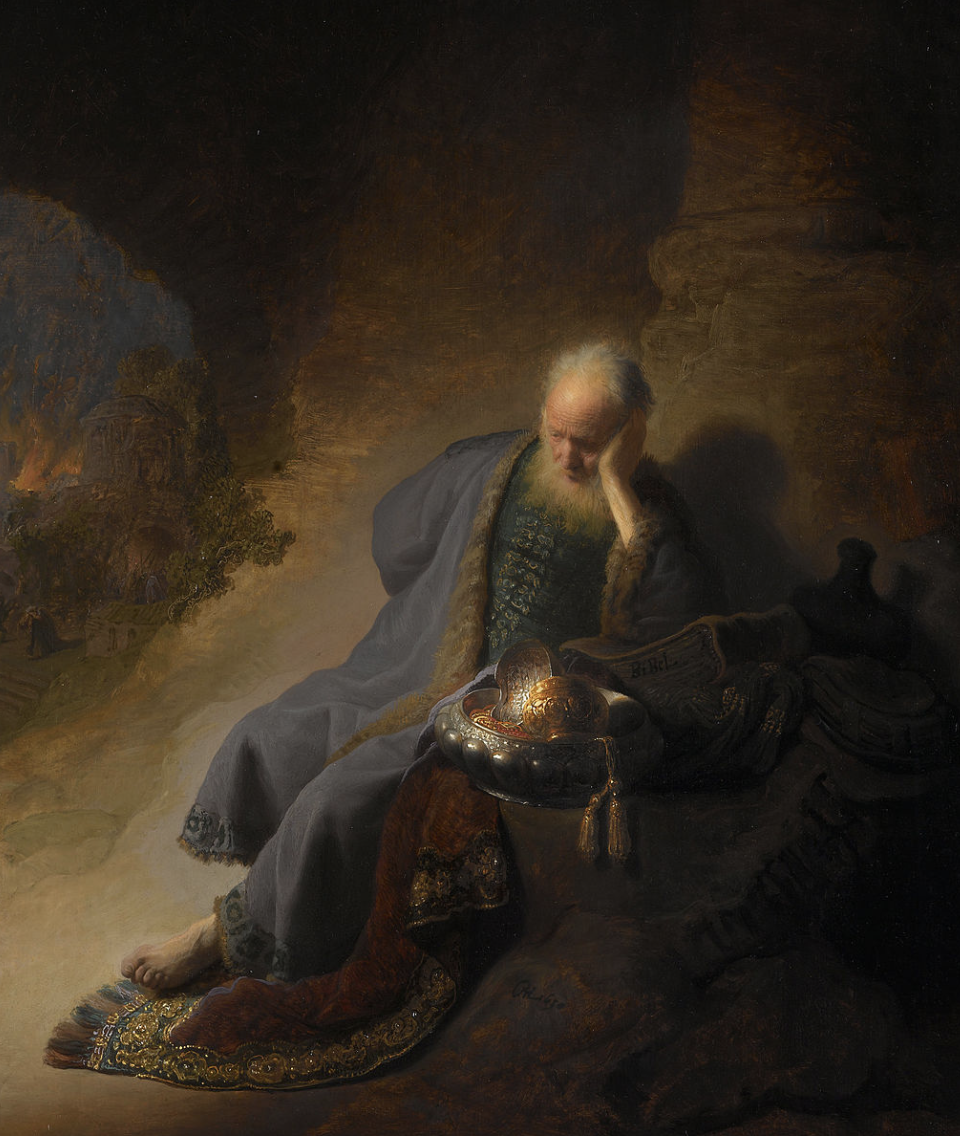
Rembrandt, Jeremiah Lamenting Jerusalem

Let my eyes stream with tears day and night, without rest, Over the great destruction which overwhelms the virgin daughter of my people,over her incurable wound.

If I walk out into the field, look! those slain by the sword; If I enter the city,look! those consumed by hunger. Even the prophet and the priestforage in a land they know not. (Jeremiah 14:17-24

Today’s first reading from our lectionary is a classic picture of the destruction of Jerusalem by the Babylonians in 598 BC, from the Prophet Jeremiah. The dead still wait to be buried, people are starving for food, prophets and priests wander about bewildered by what’s happened. 

Just as important as the description of the devastated city is Jeremiah’s reaction to it. He’s no distant onlooker, he’s there, part of it all, and his eyes are filled with tears, day and night.

That’s Jeremiah. It’s his city and his people that have been struck “a blow that cannot be healed.” Instead of the Babylonians or the Judean leaders whom he had warned, Jeremiah addresses God. “You alone have done all these things.”

Does Jeremiah have something to say about our situation today?

“Nowhere else in the Old Testament does the eternal, invisible God become so involved in human experience and communicate within it as in the person of Jeremiah,” Fr. Carroll Stuhlmueller, CP, writes in his commentary on Jeremiah in the Catholic Study Bible.

Jeremiah  struggles with God. He “paradoxically combines exceptional obedience to God with vigorous argumentation against God, he struggles with doubt and anger, and at times succumbs to them, only to be purified and transformed (Jer. 9:1; 15:19).”

There are no quick answers for him, Fr. Carroll writes: “The biblical message comes  not simply as a finished polished discourse, but as an intuition, or to use Jeremiah’s words , as ‘fire burning in my heart, imprisoned in my bones’ ( Jeremiah 20:10). Jeremiah frequently provides us with a message on its way to becoming the final word of God, struggling to come to birth and seeming lost in the dark birth canal. “(Jeremiah, 20:17) (Reading Guide 304-305)

As we look at our own world in the grip of a devastating wars, climate change, global pandemics, what about Jeremiah’s words to God: “You alone have done all these things.” 

I think we struggle like him. 

17th Sunday b: Bread for our Hunger

For this week’s homily, please watch the video below.

The Prophet Jeremiah

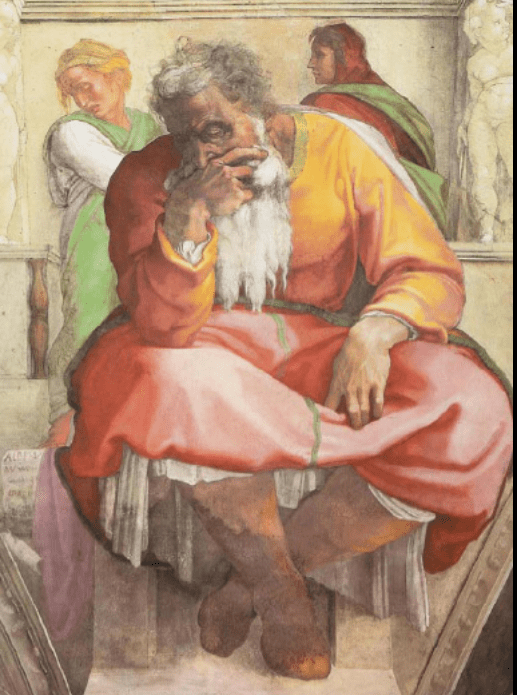
Jeremiah the Prophet, Michelangelo, Sistine Chapel

For the next week or so, we’re reading the Prophet Jeremiah from our lectionary. Born about 650 BC, Jeremiah spoke to a nation in its final days of crisis before the Babylonians captured Jerusalem and took away its leading citizens into exile in Babylon in 598 BC.

Jeremiah wasn’t accepted during his lifetime, for the most part. Discredited, arrested and imprisoned by his enemies, he urged religious reform and wise political alliances to Judea’s kings and leaders. His influence grew only after his death as the exiled Jewish community in Babylon reflected on his words and actions. 

Jeremiah influenced the prophets Ezekiel, Daniel, Isaiah 40-66, and some of the psalms. He remained in Jerusalem after its destruction and later was forced into exile in Egypt where he died, but there is no information about his death.

Our reading for Thursday from Jeremiah is a beautiful summary of his message:

You were “as a bride following me in the desert.” I brought you to a “garden land” which you defiled, the Lord says to the people of Jerusalem. “Two evils have my people done: they have forsaken me, the source of living waters. They have dug themselves cisterns, broken cisterns, that hold no water. “  (Jeremiah 2:1-3, 7-8, 12-13)

A “garden land”, symbol for Jeremiah and others of God’s promises, comes from the garden from the Book of Genesis, where God first gave humanity life. Now it’s offered again, but the “garden land” can be refused. 

“Living waters” also is a favorite symbol of the prophets. The person who is just is like a tree planted by living waters, Psalm 1 says.  A just people grow by God’s living waters. The cisterns we dig dry up and break. 

“With you is the fountain of life, O Lord”, our responsorial psalm says today. 

Jeremiah is mentioned in Matthew’s gospel in Peter’s answer to Jesus’ question “Who do people say I am?”  They say you are Jeremiah or one of the prophets, Peter responds.  (Matthew 16:14) Selections from Jeremiah are read in the lectionary in the 16th to the 18th weeks of the church year, year 2, to accompany the readings from Matthew which describe Jesus facing opposition as he begins his ministry in Galilee. In lent and Holy Week Jeremiah is read as Jesus faces betrayal and death at the hands of his enemies. 

Readings from Jeremiah occur in the Sunday readings, usually in the same context. He’s found in the church’s morning prayers: Jeremiah weeps over a desolate land after Jerusalem’s destruction by the Babylonians.  ( Jeremiah 3 10-14, Friday Morning, 3) The prophet proclaims God’s promise of a “garden land” . (Jeremiah 14 17-21, Thursday Morning 1)

Seed on Tough Ground: Matthew 13:1-9

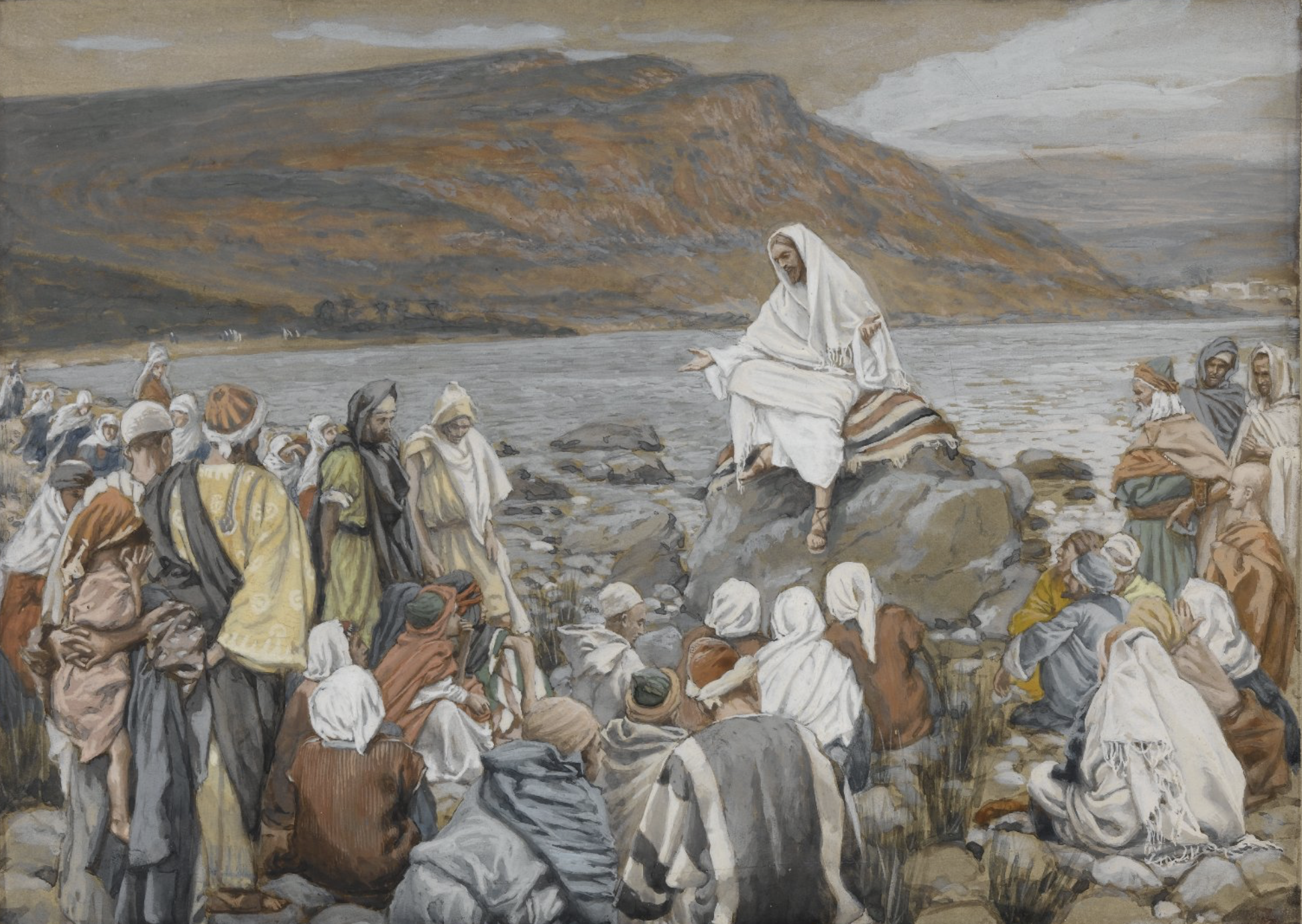
Teaching by the Sea. James Tissot

“A sower went out to sow. some seed fell on the path, and birds came and ate it up. Some fell on rocky ground, where it had little soil. It sprang up at once because the soil was not deep, and when the sun rose it was scorched, and it withered for lack of roots.Some seed fell among thorns, and the thorns grew up and choked it.” ( Matthew 13:1-9)

Jesus tells the crowd at the lakeside the parable of the sower after the Pharisees, the towns where he taught and worked wonders and his own family from Nazareth oppose him. (Matthew 11-12) Previously, Jesus sent his own disciples out to proclaim his life-giving message but he tells them:   “Do not go into pagan territory or enter a Samaritan town. Go rather to the lost sheep of the house of Israel. As you go, make this proclamation: ‘The Kingdom of heaven is at hand.’” (Matthew 10:

When they proclaimed his message to the lost sheep of Israel the seed fell on tough ground. They found the same opposition that Jesus did, more than they expected. .

Our reading today is an example of how an evangelist like Matthew used what Jesus experienced as an example for the church of his time. Matthew’s gospel was written around 90 AD with an eye on the religious conditions then in Galilee. The area had changed since the time of Jesus. After the Romans destroyed Jerusalem in 70 AD, many Jews influenced by the Pharisees moved into Galilee seeking to rebuild Judaism. They strongly opposed the followers of Jesus of Nazareth.

Matthew’s gospel reflects the increasing tension between Christians and Jews in his day. The parable Jesus originally taught throws light on this new situation. The ground is hard, rocky, with little soil. Still, the seed must be sown, however it’s received. Don’t give up on the tough ground, don’t judge it hopeless, Matthew’s gospel insists: Some seed falls on good ground.

A lesson for us today? Seems so. The soil was unwelcoming then, Matthew’s gospel says. Our soil seems unwelcoming now… Still!