“The prayer continues: Thy kingdom come. We ask that the kingdom of God may appear to us, just as we ask that his name may be sanctified in us…We are praying that our kingdom, which has been promised to us by God, may come, the kingdom that was acquired by the blood and passion of Christ; and that we who started off as his subjects in this world may hereafter reign with Christ when he reigns, as he himself promised when he said: Come, you whom my Father has blessed, take up the kingdom which has been prepared for you from the beginning of the world.
We add: Thy will be done, on earth as it is in heaven. This is not that God should do what he wills, but so that we may be able to do what God wills. For who could resist God in such a way as to prevent him doing what he wills? But since the devil hinders us from obeying, by thought and by deed, God’s will in all things, we pray and ask that God’s will may be done in us. For this to happen, we need God’s good will – that is, his help and protection, since no-one is strong in and of himself but is kept safe by the grace and mercy of God. Moreover, the Lord, showing the weakness of the humanity which he bore, said Father, if it is possible, let this cup pass from me, and showing his disciples an example, that they should do not their own will but God’s, he went on to say nevertheless, let it not be my will, but yours.” St. Cyprian
Jesus says in today’s gospel : “In praying, do not babble like the pagans, who think that they will be heard because of their many words. Do not be like them.Your Father knows what you need before you ask him.” (Matthew 6, 8)
Gerhard Lohfink in his book “The Our Father” notes that ancient Near Eastern prayers began with a long address to the god who was approached. An Akkadian prayer, for example, begins: “God of heaven and earth, firstborn of Anu, Dispenser of kingship, Chief Executive of the Assembly of the gods, Father of gods and men, Granter of agriculture, Lord of the air”.
“One senses that the forms of address had to be precise; otherwise the god would not listen. It’s not a simple matter to speak to him without making a mistake. Correct language and competence in praying are required. Above all, one must know the deity’s proper name.
Nothing of the kind in the Our Father! ‘Abba’ that’s the only address. It’s familial.”
The creed and other Christian prayers keep that address first. “I believe in God, the Father Almighty, creator of heaven and earth.” The Creator is our Father. The creed tells us what we as God’s children have received from our Father and what we are promised.
“We would not dare claim such a name in prayer, unless God himself had given us permission to pray this. And so, we should remember that when we call God our Father, we must live as children of God, so that whatever pleasure we take in having God for our Father, he may take the same pleasure in us.” (St. Cyprian, Commentary on the Our Father}
God doesn’t need many words from us; he hears us when we call “Father.”
How are liturgical prayer – the Mass, the sacraments, the liturgy of the hours– and devotional prayers like the rosary, the stations of the cross, and other spiritual practices related ? As we hear the teaching of Jesus on prayer this week, we need to consider this important question for understanding the prayer of our church today and how we should pray.
According to a 2001 church study on prayer liturgical prayer after the Council of Trent “entered a static period of substantial uniformity while popular piety entered a period of extraordinary development.” Devotional prayers like the rosary and spiritual exercises like novenas, parish missions and retreats “were seen as an important means of defending the Catholic faith and of nourishing the piety of the faithful…they still continue to nourish the faith and religious experience of the faithful.” At the approach of the Second Vatican Council ordinary Catholics, particularly in the western world, were deeply attached to the Catholic devotional tradition.
In pastoral practice, devotional prayers and the spiritual exercises that marked devotional Catholicism “were sometimes more important than the Liturgy and accentuated a detachment from Sacred Scripture and lacked a sufficient emphasis on the centrality of the Paschal mystery of Christ, foundation and summit of all Christian worship, and its privileged expression in Sunday.” (Directory on Popular Piety and Liturgy, Rome, 2001, 41)
The Second Vatican Council sought to restore and renew the prayer of the church in its constitution, Sacrosanctum Concilium. It envisioned the church’s liturgical prayer renewing the faith of its people and aiding the church’s outreach to the world and to separated believers. (SC 1) It also saw it more important than devotional prayer.
In the council’s program for reforming the church’s prayer, the transition from a church strongly attached to devotional tradition to a church praying through the liturgy received little attention, however. The council acknowledged popular devotions in one short paragraph: “Such devotions should be so drawn up that they harmonize with the sacred seasons, accord with the sacred liturgy, and are in some way derived from it, and lead the people to it, since in fact the liturgy is by its nature far superior to any of them.” (SC 13)
At the time of the council many believed the harmonization of the liturgical and devotional traditions would occur easily, but in fact that harmonization is still going on and will likely take time.
Some examples? The reformed liturgy, while emphasizing “its privileged expression in Sunday”, also emphasized daily prayer, the liturgy of the hours, a prayer rooted in the scriptures and flowing from the sacraments, especially the Eucharist. How many have made some form of the liturgy of the hours their daily prayer?
Our present church calendar offers a rich selection of the mysteries of Mary in feasts throughout the year corresponding to her mysteries recalled in the rosary and the church’s devotional tradition. I’m not sure we appreciate this treasury of prayer in our church calendar as much as we do the rosary.
Popular saints from the devotional tradition are also celebrated in the liturgy. Our church calendar is a wonderful way to study the saints. Do we use it?
The seasons of advent, lent and easter are times for deepening our understanding of the mysteries of Christ each year. Have they become ways for us to enter the mysteries of our Savior?
In the church’s liturgy, the ordinary Fridays of the year are days for recalling the Passion of Jesus, the ordinary Saturdays are days to keep Mary, the Mother of Jesus, in mind. The liturgical prayers and readings for these days have been chosen to recall their meaning. Have these days become holy for us?
Liturgical prayer roots devotions, devotional practices and prayers more deeply in the scriptures and in the spiritual experience of the church. The liturgical celebrations of Mary in our calendar reveal her place in the mysteries of Christ through the scriptures. The liturgical celebrations of the saints place them in the context of saintly companions who reveal other patterns of holiness from other times and places.
The liturgy brings us beyond the writings and revelations of mystics and visionaries and the devotions they made recommend. In calling for the spiritual restoration of Friday and Saturday, for example, our liturgy made every Friday and Saturday a First Friday or First Saturday, as it situates them in the light of the scriptures and the larger spirituality of the church.
So, say the Rosary, pray the Stations of the Cross, keep your other devotions? Keep our devotional tradition, the church says, but harmonize it with the liturgy and enter the prayer of the church.
We never finish the work of prayer and learning to pray. The Lord teaches us.
We’re reading the 2nd Book of Kings in our lectionary this 11th week of the year. Easy to dismiss these readings about wicked kings and prophets with strange sounding names and skip over to Matthew and the words of Jesus or some devotional prayers.
The 2nd Book of Kings is the last part of what commentators call “Deuteronomistic History.” It tells the story of the settlement of the land by the Jews under Joshua until the downfall of the kingdoms of Israel and Judah and their eventual exile.
Overall, both 1 and 2 Kings paint a discouraging picture of Jewish kings and the political side of the time. In Monday’s reading, King Ahab and his wife Jezebel murder Naboth to grab the vineyard he owns, an example of the flagrant abuse of political power that took place then. Further readings from 1 and 2 Kings indicate it didn’t end there.
How about now ? Deuteronomistic History is Sacred History–it happens again. Take a look around.
The Prophet Elijah confronts Ahab and Jezebel in Tuesday’s reading. He’s a lonely voice for God’s judgment, other prophets are not brave enough to speak out. Yet, even as Elijah condemns, we see signs of God’s mercy when Ahab repents. We may think the political world today is insulated from God’s grace, but is that true? We have to pray for those in government and in the political world; God speaks to them too.
In Wednesday’s reading there’s another lesson from Sacred History. Elisha takes on the mantle of Elijah. Another prophet appears in the land and is given power over kings and a voice to speak to the time. Lonely prophets–or is it prophetic movements?– are always there. God sends his prophets.
Ultimately, time is in God’s hand. All time. History evolves according to God’s plan. Where are the lonely prophets or prophetic movements today? Take a look around.
Moses led the people out of the camp to meet God, and they stationed themselves at the foot of the mountain. Mount Sinai was all wrapped in smoke, for the LORD came down upon it in fire. The smoke rose from it as though from a furnace, and the whole mountain trembled violently. The trumpet blast grew louder and louder, while Moses was speaking and God answering him with thunder. Exodus 19: 9-20
From a mountain aflame and loud with thundering trumpetsGod renewed his covenant with his people after they left Egypt and made their grumbling way through the desert. It was the covenant God made with Abraham and their descendants after him.
Later, Elijah on the run came to this mountain.
“At the mountain of God, Horeb, Elijah came to a cave, where he took shelter. But the word of the LORD came to him, “Go outside and stand on the mountain before the LORD.” (1 Kings 19, 11-16)
Some 60 years ago, as a younger man I climbed that mountain, Sinai, on a memorable pilgrimage with Fr. Donald Senior. We rose about 2 AM to begin the climb in the dark, guided up the rocky winding path by a guide with a flashlight. Bedouins offered a camel ride for anyone who couldn’t make it, almost 7,000 feet up.
We arrived at the barren top at sunrise. I remember the silence of the place, the bare rock, the absence of plants or trees or any sign of life. No thundering sounds like those our reading describes today. The guide pointed to a speck of green down aways, “Elijah’s cave,” he said. We left before the sun was high; too hot to stay there long.
Elijah was told to “stand outside on the mountain before the Lord,” and he experienced a strong wind, an earthquake, fire, but God was not in any of these. Then, in the silence, he heard a “tiny whispering sound” and he hid his face before God.
“A tiny whispering sound.” That’s the way God spoke to Elijah and that’s the way God most often speaks to us. Elijah pours out his woes to God. A fugitive, fighting for his life, with no chance against Ahab and Jezebel.
But God whispers to Elijah. Go down the mountain and go north again. Your enemies won’t stop you. There’s a mission I have for you; I’ll be with you. In the silence Elijah heard God.
In the silence of the Eucharist today, God also whispers. “This is the chalice of my blood, of the new covenant.”
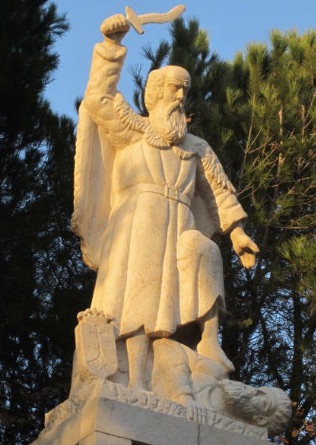
The powerful sculpture of the Prophet Elijah with sword in hand stands on Mount Carmel in northern Israel, where he defeated the false prophets of Ahab –today’s reading, (1 Kings 18:20-39) We will be reading about him this week.
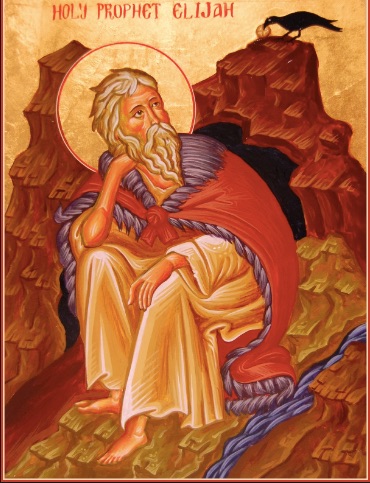
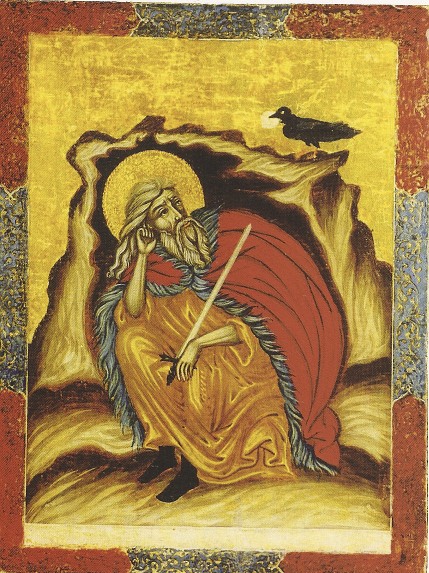
I must confess I like better his picture below where Elijah is huddled in his cloak facing death while a raven behind him offers God’s food. He’s a prophet on a lonely journey. Yes, the powerful prophet forbade the rain to fall and raised the dead, but according to the Book of Kings he spent most of his time on the run, hiding in caves and wadis, depending on someone like a poor widow for food and shelter. He had no support from other religious or political leaders. He was a lonely prophet.
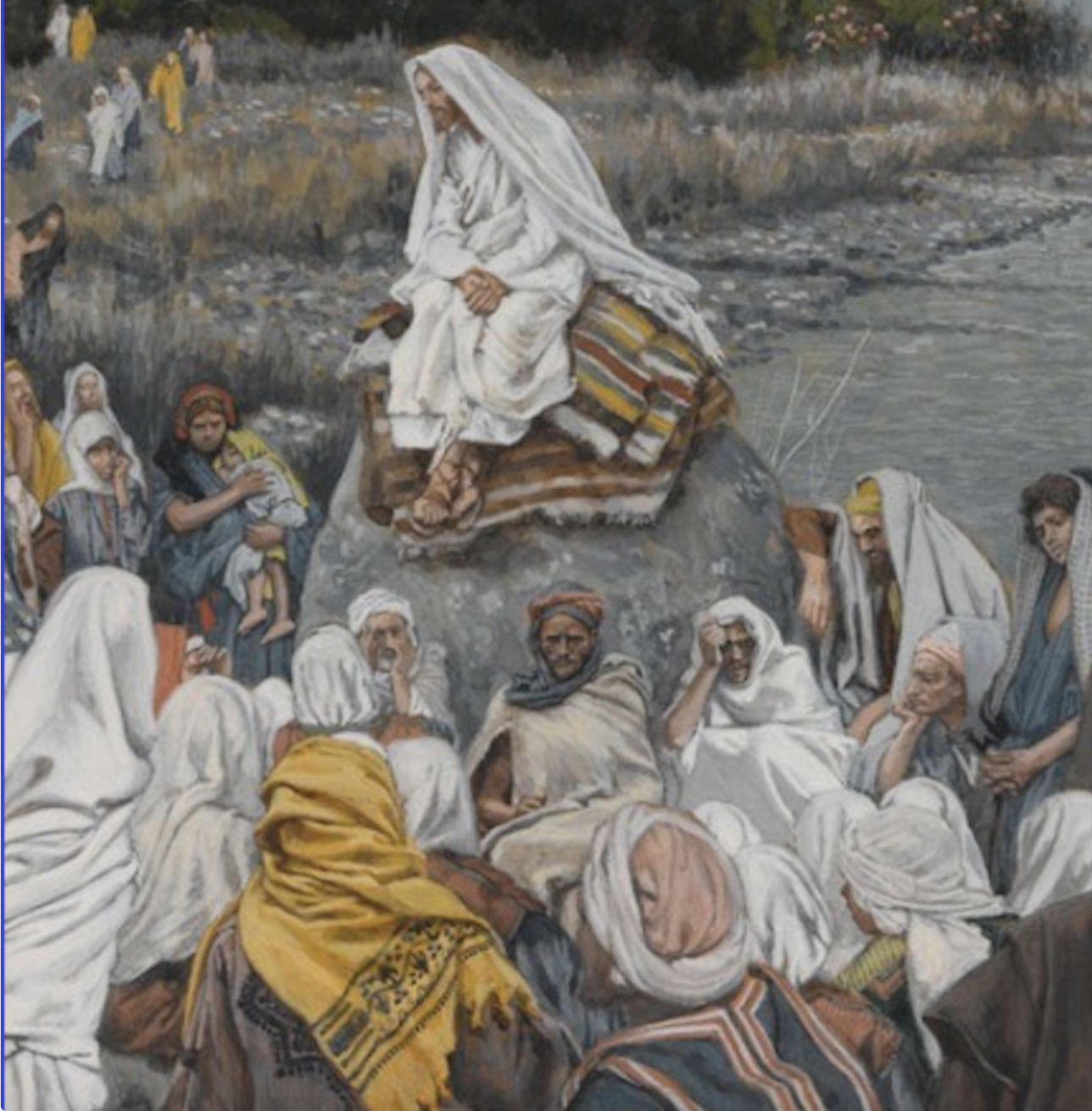
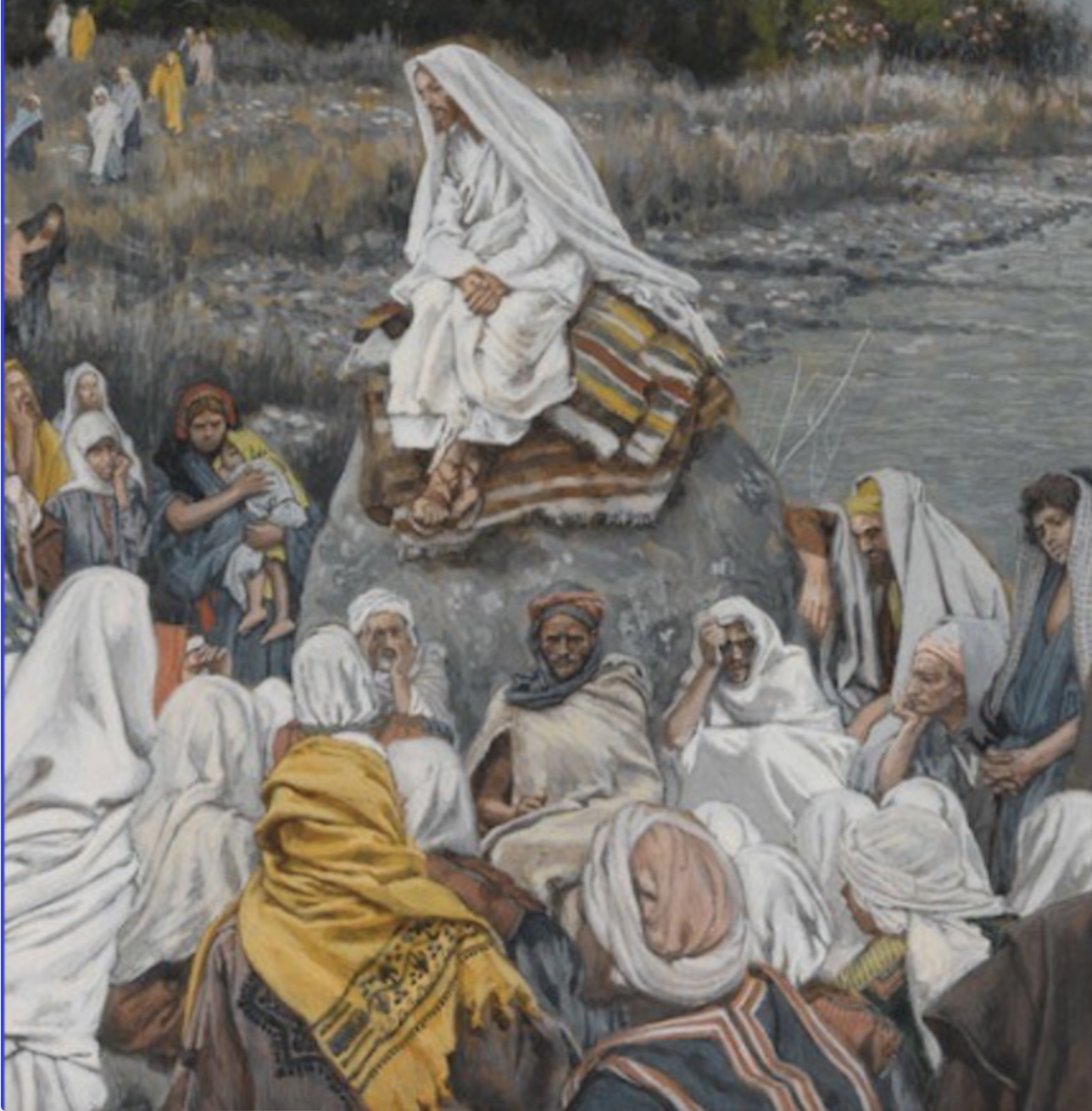
The compilers of our lectionary knew what they were doing when they pared his story with the readings from Matthew’s Sermon on the Mount, also read this week. Some of Jesus’ listeners saw him as Elijah returned. He too had little support from the religious and political leaders of his day.
The Passionist community celebrates today Blessed Lorenzo Salvi, a Passionist priest who lived at the time of the Napoleonic Suppression of the church in 18th century Europe, when most of the religious communities in Italy where disbanded and their places taken over by the government. Lorenzo took part in rebuilding the church in Rome by his constant preaching. I think of him as a lonely prophet and I also see him as an example for the Passionists today. We have a role in rebuilding our church. You can read the story of Lorenzo Salvi here.
Elijah, the lonely prophet, makes me also think of a man who visited us from China about 40 years ago. He had been a seminarian in our seminary in China in the late 1940’s when the communists came to power and began the Cultural Revolution. John was sent for three years to a hard labor camp for “reeducation” because he was a Christian. But when they learned he knew English, government officials made him an English teacher in a Chinese high school.
I asked John what he taught. English literature, he told me. He taught Pearl Buck’s “The Good Earth” because the Chinese loved Pearl Buck. He also taught bible stories, particularly the Old Testament stories about Moses leading the Israelites out of Egypt and Elijah confronting the evil king Ahab and his wife Jezebel.
Bible stories I asked? Didn’t the officials question him? You can’t understand English literature without knowing the stories of the bible, he told them.
Whenever I hear the story of the lonely prophet Elijah in a country completely controlled by a powerful regime, yet still faithfully proclaiming the truth, I think of John. I also think of Lorenzo Salvi. Our society, held strongly now in the grip of a deaf secularism, needs lonely prophets to speak.
We’re reading at Mass this week about the prophet Elijah. He was the lone prophet to confront King Ahab and his notorious wife Jezebel, rulers of the northern kingdom of Israel who promoted the worship of Baal, the god of rain and healing. Elijah as the “disturber of Israel” spent much of his time eluding the king’s forces and fleeing from place to place. Like Moses fleeing from Pharaoh, Elijah sought refuge in mountains, like Horeb and Carmel, places of God’s strength and protection.
Our readings from the lectionary this week offer a few key stories of his life. On Monday, Elijah proclaims to Ahab a drought in Israel because of its infidelity. No rain will fall, he says, and then he flees to a small watering hole east of the Jordan where he’s fed by ravens. (above)
That watering hole dries up, and Elijah flees to Zarephath of Sidon where a widow cares for him (Tuesday).
After three years, Elijah returns to confront Ahab and Jezebel. In Wednesday’s reading he calls for a dramatic test between Baal and the God of Israel. Who can bring rain, Baal or the God of Israel? All the people along with the priests of Baal gather on Mount Carmel, where Elijah resoundingly defeats the priests of Baal and their god of rain and healing.
Elijah announces to Ahab in the name of God that rain is coming. (Thursday) As he waits in prayer on Mount Carmel, poor Elijah, ”crouched down to the earth, his head between his knees,” and wonders if rain really will come. Seven times he asks his servant if there is any sign. “Nothing.” Then there’s a cloud as small as a man’s hand rising from the sea. A little cloud is all he sees. All around the land is parched and lifeless. Hard to see any promise in a small far-off cloud.
A picture for today, isn’t it? Elijah is us all waiting for the promises of God to be accomplished, while we only see tiny distant clouds in a menacing world.
The rains came, in abundance, but then Elijah must face the wrath of Jezebel who orders his death. And so, in our readings for Friday, Elijah flees to Mount Horeb, the same mountain where Moses experienced God in thunder and lightning. Elijah experiences God, not in thunder and lightning, but in a tiny whisper. He pours out his complaints to God and in answer, God sends him on a new mission to the north. He is to appoint a king and also a successor for himself.
Some saw Jesus as Elijah returned, and so Elijah often appears in the New Testament, particularly in the account of Jesus’ transfiguration on the mountain where his glory and mission are revealed. Like Elijah, Jesus had no official backing either, no army, no political base. Powerful people sought his life, though his kingdom was not of this world. Yet, God’s surprising power was on his side. Elijah has influenced prophets and mystics ever since. We can learn from him.



 The Victor's Place