The Lord’s Supper: 1 Corinthians 11:17-26

The Word of God we read in the scriptures at Mass prepares us for the Word of God we receive at communion. That’s particularly true of our readings today. In our first reading St. Paul tells the Corinthians that the Lord’s supper, the Eucharist, has become a time for them to get together with their friends to have a good time. In fact, they don’t want anyone there who’s not one of their friends. That isn’t the Lord’s supper.

Paul then reminds them what the Lord’s supper is:

“For I received from the Lord what I also handed on to you, that the Lord Jesus, on the night he was handed over, took bread and, after he had given thanks, broke it and said, “This is my Body that is for you. Do this in remembrance of me.”In the same way also the cup, after supper, saying,”This cup is the new covenant in my Blood. Do this, as often as you drink it, in remembrance of me.” For as often as you eat this bread and drink the cup, you proclaim the death of the Lord until he comes.” (1 Corinthians 11:17-26)

In today’s gospel from Luke another reading prepares us to receive the Lord Jesus himself. A Roman centurion, probably head of the garrison there, sends the Jewish elders to ask Jesus to come and cure his servant, who is close to him. 

As Jesus goes to cure his servant, the centurion sent his friends to tell him “Lord, do not trouble yourself, for I am not worthy to have you enter under my roof. Therefore, I did not consider myself worthy to come to you; but say the word and let my servant be healed.”

He knows the power of Jesus. He also knows his own unworthiness. 

We says the centurion’s words before we receive communion at Mass. “Lord, I am not worthy that you should enter under my roof, but only say the word and my soul shall be healed.”

24th Sunday b: Who is Jesus Christ?

For this week’s homily please watch the video below.

Luke 6:12-19:

Jesus departed to the mountain to pray,
and he spent the night in prayer to God.
When day came, he called his disciples to himself,
and from them he chose Twelve, whom he also named Apostles:
Simon, whom he named Peter, and his brother Andrew,
James, John, Philip, Bartholomew,
Matthew, Thomas, James the son of Alphaeus,
Simon who was called a Zealot,
and Judas the son of James,
and Judas Iscariot, who became a traitor.

Luke’s Gospel is a gospel of prayer. He often presents Jesus at prayer at important points in his ministry: at his baptism (Lk 3:21); at the choice of the Twelve (Luke 6:12); before Peter’s confession (Lk 9:18); at the transfiguration (Lk 9:28; when he teaches his disciples to pray (Lk 11:1; at the Last Supper (Lk 22:32); on the Mount of Olives (Lk22:41); on the cross (Lk 23:46).

After praying the night in prayer Jesus calls twelve apostles who will accompany him and bear witness to his mission. Why does he pray before important times like this? Why should we pray before important times?

Yes, we need wisdom and strength for what we have to do, but prayer should be,, most of all, an acknowledgement of God’s plan and God’s will. “Your will be done,” was an essential part of the prayer of Jesus. It should be essential to our prayer too.

We pray for many things, but most of all, we pray that God’s will, infinitely wiser and infinitely better than our own, be done.

Today’s readings

A Day with the Saints

I am the presenter for  a day of reflection on saints at Thomas Berry Place this Wednesday. Last week the film Cabrini, the story of Saint Francis Xavier Cabrini, was shown at the retreat house, so the day offers a good opportunity to discuss the film. I’m hoping some who come for the day may have seen it.

I’m interested in saints. Wednesday I’m going to reflect on our church calendar of saints for September. We ask saints to intercede for us, but they also are our teachers of faith. St. Peter Claver, the Jesuit who ministered to African slaves in Columbia, South America, in the 17th century, is remembered in all the churches of the United States on September 9. Like Mother Cabrini God called him to face the question of immigration, forced immigration in his case. With Mother Cabrini he faced the challenge of seeing Christ in the stranger.

I will be talking about other saints of September, like St. Gregory the Great, an early pope, St. Helena, who is associated with the Feast of the Exaltation of the Cross, September 14, Saints Cornelius and Cyprian, who struggled with the issue of forgiveness in the church, St. Matthew, author of a gospel.

The saints are a school of teachers to learn from. 

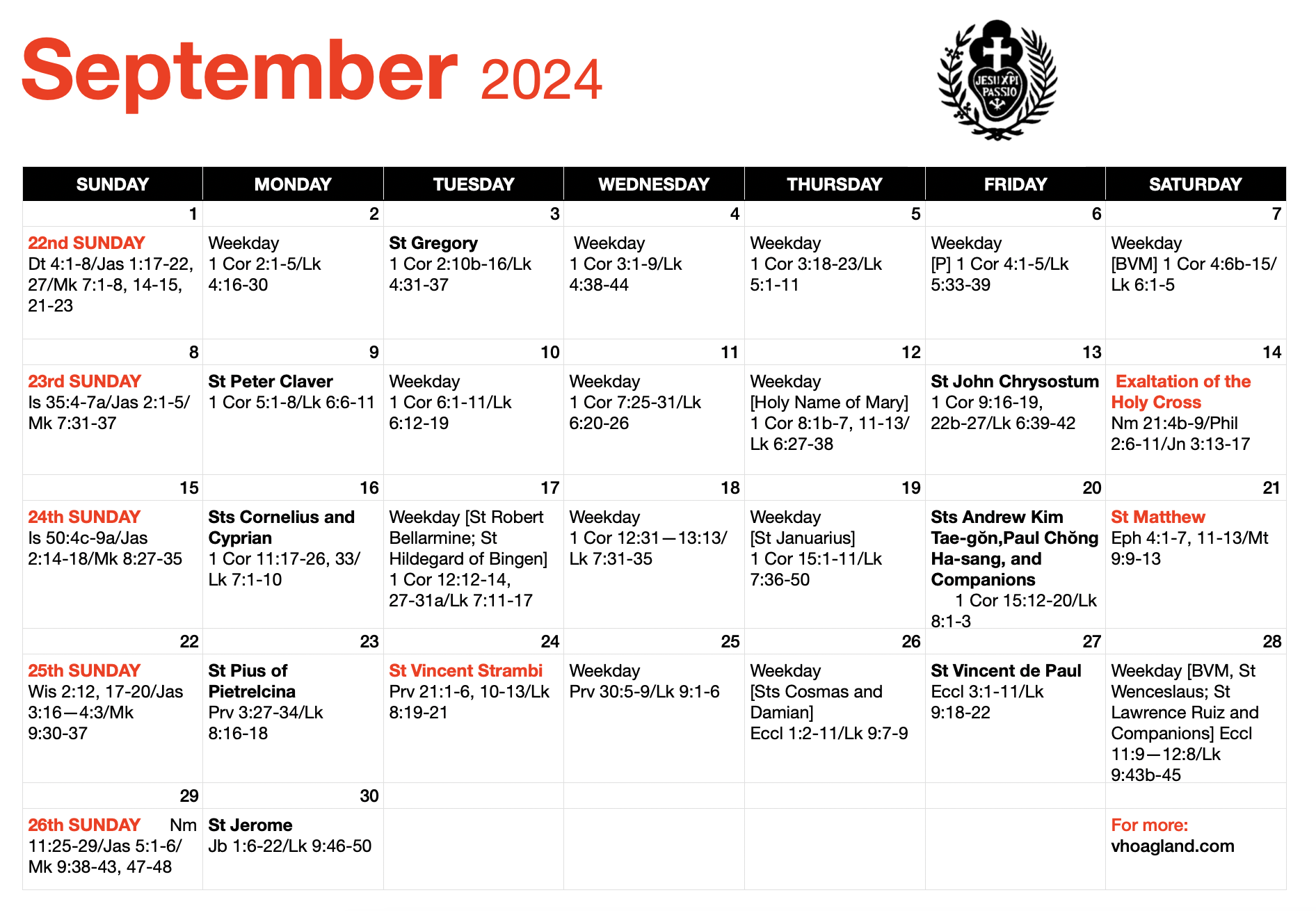
Our church calendar was revised in 1975 and like the lectionary of scripture readings, it’s the basic catechism we need to study from year to year.

You’re welcome to come Wednesday  to Thomas Berry Place in Jamaica, NY, from 9:30 am to 2pm, if you like. Just sign up at 929 357 6700.

Fr. Victor Hoagland

Reading First Corinthians

We’re reading from the 1st Letter of Paul to the Corinthians for almost the next three weeks at weekday Mass. A long stretch for one of Paul’s letters in our lectionary. It’s an important letter because it gives us a view of what an early 1st century Christian community was like better than any other book of the New Testament. We may learn from it how to look at our churches and communities today.

The first thing you notice– this isn’t a perfect church. It has strengths and weaknesses, but its weaknesses seem more obvious than its strengths. That’s because Paul’s letter is written to correct abuses and answer questions that were troubling members of this church. What’s the first thing we might learn? Our churches will never be perfect.

But Paul does not begin the letter enumerating abuses, he speaks of the faithfulness of God, who is always at work purifying and strengthening his church.

Corinth was one of the great port cities of the Roman world, a melting pot for people and cultures of every kind. It had a reputation for moral depravity. Paul went there in the year 51, after visiting Athens where he tried with all his skill to bring the gospel to the Athenians. Evidently, his visit was disappointing. Moving on to Corinth, he went first to the Jews to announce the gospel, as he customarily did, but they turned him away. Then, gentile hearers mostly from the poorer elements of the city embraced the faith.

The situation caused Paul to reflect on what he has experienced. The church is a mystery of God. You can’t judge it by human wisdom or explain it in human terms. It’s God’s church, God’s community, and the Spirit of God is at work. It grows according to God’s plan, not human planning. His task, Paul realizes, is to discern what God wills as the work unfolds.

In Ist Corinthians we have Paul’s humble acknowledgment that, though he is founder of this church, he is a servant among many servants. Other teachers, Apollos and perhaps Peter, have labored in this church and factions have gathered around them. There’s a danger when human teachers take the place of God, Paul writes.

I planted, Apollos watered, but God caused the growth.Therefore, neither the one who plants nor the one who waters is anything, but only God, who causes the growth. He who plants and he who waters are one, and each will receive wages in proportion to his labor. For we are God’s co-workers; you are God’s field, God’s building. (1 Corinthians 3, 6-9)

We’re God’s field, God’s building. What’s God planting? What’s God building? Questions for us to ask.

The Gospel of Luke and First Corinthians Go Together

We’re reading Paul’s 1st Letter to the Corinthians and the Gospel of Luke together these days at Mass. The two may be more closely connected than we suspect. Luke wrote some years later than Paul, but his audience would be much like those found in the church of Corinth.

Theophilus, to whom Luke dedicates his gospel, could easily be one of Corinth’s better-off Christians, who surely  would recognize  the lack of concern for the poor that Jesus condemns in Luke’s gospel as present in his own community as well. That unconcern appeared at table, in the celebration of the Eucharist in the Corinthian church, and Paul condemns it. (1 Corinthians 11, 17-22) Luke presents Jesus, over and over, at table, condemning the same unconcern for the poor as well.

Luke begins Jesus’ ministry in Galilee with his visit to Nazareth (Luke 4, 16-30) where he’s not recognized by his own who know him too well and are ready to throw him to his death over the hill.

The Corinthians–how many we are unsure– fail to recognize the humble Savior whom Paul preaches. “I did not come with sublimity of words or of wisdom. For I resolved to know nothing while I was with you except Jesus Christ, and him crucified.” (1 Corinthians 2, 1-5)

In Luke’s gospel, Jesus is the teacher and Lord bringing God’s word to the towns of Galilee. He brings God’s word to Corinth as well, but the Corinthians are attracted to the various disciples of Jesus, causing “jealousy and rivalry among you…Whenever someone says, ‘I belong to Paul,’ and another,’I belong to Apollos,’ are you not merely men? What is Apollos, after all, and what is Paul? Ministers through whom you became believers, just as the Lord assigned each one.”

God plants and waters the growth of his church; the disciples are disciples, only disciples, who must have “the mind of Christ.” (1 Corinthians, 3, 1-9)

Luke has a church like Corinth in mind when he writes his gospel. How about our church too, as we take  sides. “I belong to…” Good to read these two readings together now.

Readings.

The Season of Creation: September 1-October 4                                                                                                                                                                                            

The Season of Creation begins September 1 with an opening day of ecumenical prayer and ends on the Feast of St. Francis of Assisi, October 4. In 1989 the Ecumenical Patriarch Dimitrios I proclaimed 1 September, start of the Orthodox Church year, a day for the Orthodox Church to pray for creation. The Orthodox church year begins on that day, with a reading from the Book of Genesis.

Later, the World Council of Churches recommended extending the celebration for a season, from September 1 until October 4, the Feast of St. Francis of Assisi.

 Pope Francis included the Roman Catholic Church in the celebration in 2015.

Christians throughout the world come together to renew their relationship with our Creator and all creation in this season through prayer, reflection and action.

We need to take action to care for creation, but as Pope Francis reminds us we need to begin by looking at creation in a deeper way:

“The best antidote against the misuse of our common home, creation, is contemplation. If someone has not learned to stop and admire something beautiful, we should not be surprised if he or she treats everything as an object to be used and abused without scruple Creation is not a mere ‘resource’. Creatures have a value in and of themselves and each one reflects in its own way a ray of God’s infinite wisdom and goodness. Its value and ray of divine light must be discovered and to discover it, we need to be silent, we need to listen, and we need to contemplate. Contemplation heals the soul.” 

In our chapel we have a small Mary Garden the mirrors creation. Soil, rocks, a fern recalling the beginning of plant life 400 million years ago, an herb, Basil, and a flowering plant recalling the plant life that made possible the appearance of humans.

A statue of Mary with her Son holding in his hand a globe of the world stands in the midst of creation. The statue is from Kenya, a gift from Father Gilbert Omolo, CP.

Join the Passionists in celebrating the Season of Creation at https://www.passionistsolidaritynetwork.org