God’s Word, the Tree of Life

“God’s Word, the Tree of Life”
A reflection on Proverbs 30:5-9 and Luke 9:1-6
Wednesday of the Twenty-Fifth Week in Ordinary Time (Year II)
©️2024 Gloria M. Chang

Putting God First

Every word of God is tested;
he is a shield to those who take refuge in him.
Add nothing to his words,
lest he reprove you, and you will be exposed as a deceiver.

Two things I ask of you,
deny them not to me before I die:
Put falsehood and lying far from me,
give me neither poverty nor riches;
provide me only with the food I need;
Lest, being full, I deny you,
saying, “Who is the LORD?”
Or, being in want, I steal,
and profane the name of my God.

Proverbs 30:5-9

“Every word of God is pure (tested, refined),” like fruit from a tree of life. “He is a shield to those who take refuge in him.” Comparing divine wisdom to a tree of life (Proverbs 3:18), the Book of Proverbs guides us toward healing our broken relationship with God that occurred in the Garden of Eden. God created us for abundant life, which we reap by hearing and heeding his word. 

Ordering life around God, the sage asks for a truthful heart and for “neither poverty nor riches.” Luxury may tempt him to deny the Lord, while penury may incite him to steal and dishonor the name of God. Our heavenly Father, who knows what we need, will give us our “daily bread.” When making choices, the sage seeks the honor and glory of God above all.

Neither poverty nor riches, seek I,
But to honor God and him glorify.

God Provides


Jesus summoned the Twelve and gave them power and authority over all demons and to cure diseases, and he sent them to proclaim the kingdom of God and to heal the sick. He said to them, “Take nothing for the journey, neither walking stick, nor sack, nor food, nor money, and let no one take a second tunic. Whatever house you enter, stay there and leave from there. And as for those who do not welcome you, when you leave that town, shake the dust from your feet in testimony against them.” Then they set out and went from village to village proclaiming the good news and curing diseases everywhere.

Luke 9:1-6

Jesus sends his twelve apostles to proclaim the kingdom of God, the fulfillment of his word. The word of the Lord (dabar YHWH), which led the Israelites from Sinai to Jerusalem, has become flesh with divine authority to heal and cast out demons. Jesus, whose Father provides for his children, enjoins the Twelve to “take nothing for the journey.” 

The apostle, like the sage of the Book of Proverbs, lives on and through the Word of God, who is a “shield” and refining fire. Christ, the Word of God and Tree of Life, feeds us with himself in the sanctifying Eucharist.

Your word, O Lord, is a lamp for my feet.

Psalm 119:105 (Responsory)

God’s Word protects and purifies
Apostles who evangelize.


This content by Gloria M. Chang was originally published online at Shalom Snail: Journey to Wholeness

The United Nations: Channeled Waters in God’s Hand

UN. General Assembly

The United Nation’s General Assembly begins this week in New York City. World leaders are here at the UN and already there’s talk that nothing good will come of it. It’s easy to blame leaders, and we do it all the time. Some are easy targets.

“Like a stream is the king’s heart in the hand of the LORD;
wherever it pleases him, he directs it.” (Proverbs 21,1)

Interesting that we hear that reading from the Book of Proverbs as the UN meeting, ” The stream is called “channeled water” , a water for fertilizing arid land. ” It takes great skill to direct water, whether water to fertilize fields or cosmic floods harnessed at creation, for water is powerful and seems to have a mind of its own. It also requires great skill to direct the heart of a king, for it is inscrutable and beyond ordinary human control.” (Commentary NAB)

So God is there directing the “channeled water” of the nations and their rulers, seemingly with a mind of their own, but in God’s firm hand.

St. Augustine in our liturgy recently had a sermon on the Good Shepherd in which he warns church leaders not to lead the sheep astray but to be like Jesus.  When they are like him they are “like the one Shepherd, and in that sense they are not many but one. When they feed the sheep it is Christ who is doing the feeding.”

Pray for good leaders for our church, Augustine continues:  “May it never happen that we truly lack good shepherds! May it never happen to us! May God’s loving kindness never fail to provide them!”

But the saint goes on . We must do something more than pray, we ourselves must be “good sheep,”  because “if there are good sheep then it follows there will be good shepherds, since a good sheep will naturally make a good shepherd.”

Is that something that applies to us as citizens of the world and of the United States? Are our leaders mirrors of ourselves? Are we getting the leaders we deserve? So add to a prayer for good leaders, then, a prayer for good citizens. God make us good citizens, and good leaders will come.

“A king’s heart is channeled water in the hand of the LORD;

God directs it where he pleases. (Proverbs 21,1)

Luke’s Gospel: Chapter 8

This week’s lectionary readings from Luke’s Gospel, chapter 8, focus on the formation of disciples. Luke repeats the parable of the Sower from Mark and Matthew, but instead of the mystery of the rejection of the Seed of Truth, Luke concentrates on the formation of “those who have heard the word, embrace it with a generous and good heart, and bear fruit through perseverance.” ( 8:15)

“Lamps on a lampstand; those who see them must see light. They need to take care how they hear.” (Luke 8: 16-18)

Who are the disciples who must care how they hear?  The Twelve or the 72 disciples sent out to preach are not the only ones. Jesus preaches the good news of the Kingdom of God through Judea accompanied also by “ the Twelve and some women…” ( Luke 7:51) And there are others too.

In the Acts of the Apostles, Luke’s church is a community of disciples who “devoted themselves to the teaching of the apostles, the communal life, to the breaking of the bread and to the prayers.” (Acts 2:42) 

In this week’s readings Luke recalls Mary and some family members coming from Nazareth to see Jesus. ( Luke 8:18-19) Early in his gospel, Luke reports that the angel called Mary “blessed among women”. From the beginning she kept “all these things in her heart” . She would “hear the word of God and keep it.”  ( Luke 2:51) 

This week he compilers of the lectionary have paired Luke’s readings describing the formation of Jesus’ disciples with Proverbs and Ecclesiastes, important readings the Jewish people used for forming disciples. 

The Kingly Child and Flower

“The Kingly Child and Flower”
Mark 9:30-37, Matthew 6:28-29, Luke 12:27 in a couplet
Sunday of the Twenty-Fifth Week in Ordinary Time (Year B)
©️2021 Gloria M. Chang

They left from there and began a journey through Galilee, but he did not wish anyone to know about it. He was teaching his disciples and telling them, “The Son of Man is to be handed over to men and they will kill him, and three days after his death he will rise.” But they did not understand the saying, and they were afraid to question him.

They came to Capernaum and, once inside the house, he began to ask them, “What were you arguing about on the way?” But they remained silent. They had been discussing among themselves on the way who was the greatest. Then he sat down, called the Twelve, and said to them, “If anyone wishes to be first, he shall be the last of all and the servant of all.” Taking a child he placed it in their midst, and putting his arms around it he said to them, “Whoever receives one child such as this in my name, receives me; and whoever receives me, receives not me but the One who sent me.”

Mark 9:30-37

Who is the Greatest?

Walking through Galilee, Jesus’ thoughts and that of his disciples diametrically clashed. A brooding Judas heard his master’s prediction of his betrayal and death. Did the omen disquiet the lone treasurer? Each man heard Jesus uniquely and darkly. The matter of his rising after three days sounded meaningless and opaque. 

Filtering out ideas that conflicted with their image of an earthly Messianic kingdom, the Twelve heatedly argued about their relative positions of power. When questioned by Jesus, no one dared answer. Their squabble, in his presence, vanished as vain and arrogant chatter.

Sitting down to teach in the rabbinic manner, Jesus settled their debate: the greatest of all will be the least of all, like a little child. “If anyone wishes to be first, he shall be the last of all and the servant of all.” Jesus’ whole life from his birth in a manger, wrapped in swaddling clothes, to his burial in a tomb, wrapped in grave clothes, bespoke a complete stripping of earthly pride and power. 

Jesus felt more at home among the lilies of the field than in the palaces of kings. Like the lowly child, the colorful, fragile flowers in the wild express the splendor of God, the true King of Israel. 

Learn from the way the wild flowers grow. They do not work or spin. But I tell you that not even Solomon in all his splendor was clothed like one of them.

Matthew 6:28-29; cf. Luke 12:27

As the Cross loomed, the Twelve vied for power.
Jesus bent down to the child and flower.


This content by Gloria M. Chang was originally published online at Shalom Snail: Journey to Wholeness

25th Sunday b: Thinking Like Human Beings

For this week’s homily please watch the video below.

Matthew, the tax collector: September 21


Jews  usually turned away as they passed the customs place where Matthew, the tax-collector, was sitting. But look at our gospel for today:

“As Jesus passed by, he saw a man named Matthew sitting at the customs post. He said to him, “Follow me.” And he got up and followed him.”

To celebrate their new friendship, Matthew invited Jesus to a banquet at his house with his friends – tax collectors like himself – and Jesus came with some of his disciples. They were criticized immediately for breaking one of Capernaum’s social codes. “Why does your teacher eat with tax collectors and sinners?”

Jesus’ answer was quick: “Those who are well do not need a physician, but the sick do. Go and learn the meaning of the words `I desire mercy, not sacrifice.’ I did not come to call the righteous, but sinners.”

Hardly anything is known of Matthew’s part in Jesus’ later ministry, yet surely the tradition must be correct that says he recorded much of what Jesus said and did. Tax collectors were good at keeping books. Was Matthew’s task to keep memories? Did he remember some things that were especially related to his world?

The gospels say that wherever Jesus went he was welcomed by tax collectors. When he entered Jericho, Zachaeus, the chief tax collector of the city, climbed a tree to see him pass, since the crowds were so great. Did Matthew point out the man in the tree to Jesus, a tax collector like himself, who brought them all to his house, where Jesus left his blessing of salvation? And did tax collectors in other towns come to Jesus because they recognized one of their own among his companions?

Probably so. Jesus always looked kindly on outsiders like Matthew who were targets of suspicion and resentment. True, they belonged to a compromised profession tainted by greed, dishonesty and bribery. Their dealings were not always according to the fine line of right or wrong.

But they were children of God and, like lost sheep, Jesus would not let them be lost.

Pope Francis said he got his vocation to be a priest on the Feast of St. Matthew, when he went to confession and heard God’s call, a call of mercy.

Matthew’s Gospel?

The gospels themselves recall little about Matthew, an apostle of Jesus. We have his name, his occupation and a brief story of a banquet that took place with Jesus and some of his friends after his call.  ( Mt 9: 9-13; Mk 2:3-12; Lk5:18-26) As it is, the gospels concentrate on the ministry and teaching of Jesus. 

In the early centuries, those who knew Jesus told his story and brought his message to the world. As they died, writings about him gradually appeared, but there are only scarce references to who wrote them. St. Justin Martyr in the early 2nd century speaks of the “memoirs of the apostles”, without indicating any author by name. Later in that century, St. Irenaeus, bishop of Lyons, writing against the Gnostics who claim a superior knowledge of Jesus Christ attributes the gospels to Matthew, Mark, Luke and John. They are eyewitnesses who really know Jesus firsthand; they have given us their “memoirs.” 

Scholars today are less likely to credit Matthew’s Gospel to the tax-collector from Capernaum whom Jesus called. Some of his memoirs perhaps may be there– after all he came from a profession good at accounting for things. But too many indications point to other sources. Why would Matthew, if he is an eyewitness, depend on Mark’s Gospel as he does? Language, the structure of the gospel, the circumstances it addresses, point to a Jewish-Christian area beyond Palestine as its source, probably Antioch in Syria, probably written around the year 8o, after the Gospel of Mark.

Traditions says that Matthew preached in Ethiopia and Persia, but they have no historical basis.

He is remembered as a martyr who died for the faith, but again there is no historical basis. 

Better to see Matthew as the gospel and the prayer at Mass sees him: one of the first outsiders whom Jesus called. And he would not be the last..

O God, who with untold mercy
were pleased to choose as an Apostle
Saint Matthew, the tax collector,
grant that, sustained by his example and intercession,
we may merit to hold firm in following you.
Through our Lord Jesus Christ, your Son,
who lives and reigns with you in the unity of the Holy Spirit,
God, for ever and ever.
Amen.

PassionistsPray. Org

Thanks to some talented friends, we have a new online site for our websites and blogs: PassionistsPray.org . The name captures the ministry of my community, the Passionists – to teach and support prayer. We hope you find resources here that bring you closer to God. Bookmark the site. PassionistsPray.org .Here’s a snapshot of the opening page:

1 Corithians 15: Like Seed We Shall Rise

Mary Garden, Passionist Monastery, Jamaica New York

On Thursday we begin reading in our lectionary from Chapter 15 of the 1st Letter to the Corinthians, an important source about the resurrection of the body. “I believe in the resurrection of the body and life everlasting.”

Some Corinthians denied the resurrection, and so In response Paul quotes a basic summary of Christian teaching that he and others received regarding the death and resurrection of Jesus. “For I handed on to you as of first importance what I also received: that Christ died for our sins in accordance with the Scriptures; that he was buried; that he was raised on the third day in accordance with the Scriptures.”  ( 1 Corinthians 15, )

Our preaching is empty, meaningless if there is no resurrection, Paul continues. To deny it means  “ those who have fallen asleep in Christ have perished…If for this life only we have hoped in Christ, we are the most pitiable people of all.”

It’s going into fall in the Northeast USA now. Flowers are beginning to shrivel into dark balls, losing their beauty and going to seed. Flowers in our Mary Garden are falling to the ground and dying. But their seed says “We’ll live again.” 

Good to spend awhile in a garden now, because seed is the analogy Paul uses in speaking of the resurrection of the body. Like the flower, we have our time, then we die. But we will live again. 

We’re children of Adam, from dust, returning to dust. Yet, we’re members of Jesus Christ, who  through the mystery of his death and resurrection gives us life, Paul says. 

We’re children of the flowers too, let’s not forget. We came after they evolved 140 million years ago. Without the food, medicine and beauty they provide we cannot live.  Is that why, I wonder, we call on them in times of death and celebrations of life? Maybe too, in times of uncertainty, like now, they give us wisdom.

Paul used them as a teacher, reminding the Corinthians that what “ is sown corruptible is raised incorruptible; what is sown dishonorable is raised glorious; what is sown weak is raised powerful;  what is sown a natural body is raised a spiritual body. There is a natural body, there is also a spiritual one.”

Not only will we rise, but creation itself will rise again.

Feasts are for Reflection

Ryrson cross

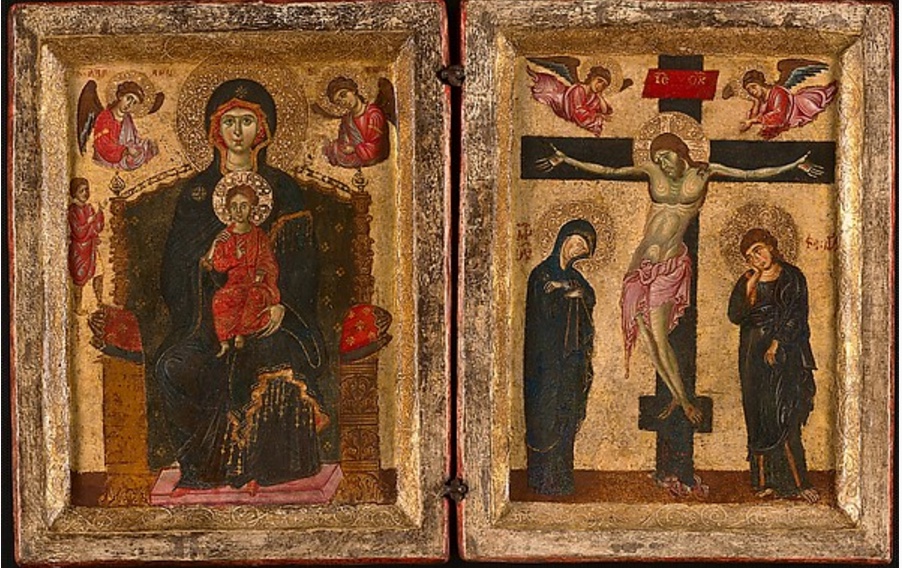
A 13th century European pilgrim to the Holy Land brought this icon home as a reminder of his pilgrimage. What places did that pilgrim visit? Surely, Bethlehem where Jesus was born, and Jerusalem where he was crucified and rose  from the dead. In both places , Mary was there with her Son.

In the picture on the left Mary is a joyful mother holding her Son, a divine Son whom the angels praise.  She is a daughter of Abraham, Isaac and Jacob, a daughter of the human family whom she represents. She never loses that joy, which she invites us to share.

In the picture on the right, Mary stands with John, an image of the church, beneath the cross of Jesus. Angels are astonished at the sight. Jesus seems to enfold his mother and the disciple whom he loves in his arms..

The gospel reading from St. John for the feast of Mary’s Sorrows says simply that Mary stood by the cross of Jesus. She’s a brave woman, not afraid to come close to the fearful place where Jesus was put to death. The Book of Judith, ordinarily the 1st reading for the feast, praises Judith, the brave and wise Jewish woman who’s not afraid to stand with her people at a dangerous moment in their history. Two women of courage face suffering and the challenge it brings.

The prayers, traditions and art of this feast take up the theme of Mary standing by the cross. She’s remembered  in poetry, music and art. “Stabat Mater” Here’s an example in Gregorian Chant and Pergolesi’s magnificent baroque setting.

At the cross her station keeping
Stood the mournful mother keeping
Close to Jesus to the last.

Women mystics, like St.Bridgid of Sweden, a mother herself and an important pilgrim to the Holy Land, saw the life of Jesus, particularly his passion, through a mother’s eyes. Wouldn’t Mary draw close to her Son’s cross and then hold him in her arms as they brought him down. The gospels do not mention it, but women like Bridgid were sure it was  so.

Women mystics like Bridgid gave us the Pieta.

A study of the Pieta in art in early medieval France shows the various ways this scene was pictured in art before Michaelangelo’s Pieta became an overpowering icon surpassing others. “Often she is viewed as caught up in the horror of the moment, but she is also shown praying or even gazing into the distance, as if contemplating comforting memories or the reunion to come. Her demeanor ranges from youthful innocence—the Purity that Time cannot age—to careworn maturity—Our Lady of Sorrows.”

Sorrow. like joy, has a range of faces. Mary shows us them all.

Luke 7: A Summary of Lucan Theology

Raising the Widow’s Son. James Tissot

Commentators say that the 7th chapter of Luke’s Gospel, our lectionary reading this week, is where you can see Luke’s  theology best expressed. He is not following  Mark or Matthew in his presentation of Jesus. His arrangement of stories about Jesus and his teaching is entirely his own.  In fact, Luke adds a story in this chapter found nowhere else in the gospels– Jesus raises a widow’s son to life.

It happens at Naim, not Capernaum or the other towns around the Sea of Galilee where Jesus ministered. Not Nazareth, his hometown. Not Bethany, where Jesus responded to friends like Martha and Mary when their brother Lazarus died. We are not sure where Niam was. 

 The woman has no name, no influential friends or family connected to Jesus; she is a widow with no resources. She is a nobody. Yet Jesus performs this great miracle for her. He raises her only son from death and gives him to her.

In yesterday’s reading we read the account of the centurion, whose beloved servant was cured by Jesus and whose faith amazed him. The story emphasizes Jesus call of the gentiles.

On Thursday we will read of the sinful woman who anoints his feet weeping and dries his feet with her hair in the house of a pharisee. Again, Luke presents Jesus reaching with mercy to someone, a woman, whom his society rejects. 

Jesus prefers  the poor and welcomes all in Luke’s Gospel.  Surely, Luke wrote his gospel for a community like 1 Corinthians, which we’re reading now with Luke’s Gospel, where the poor seem excluded and only the well-off are welcome at the Table of the Lord. 

On Friday Luke again mentions women as he describes Jesus evangelizing one town after another in Judea. (Luke 8:1-3) He’s  accompanied by the Twelve, but also some women. They’re obviously not women like the poor widow, but women with resources and talents. One of them is even connected to the court of Herod. They are vital to the mission, Luke insists. They stay with Jesus through his passion and are witnesses of his resurrection.