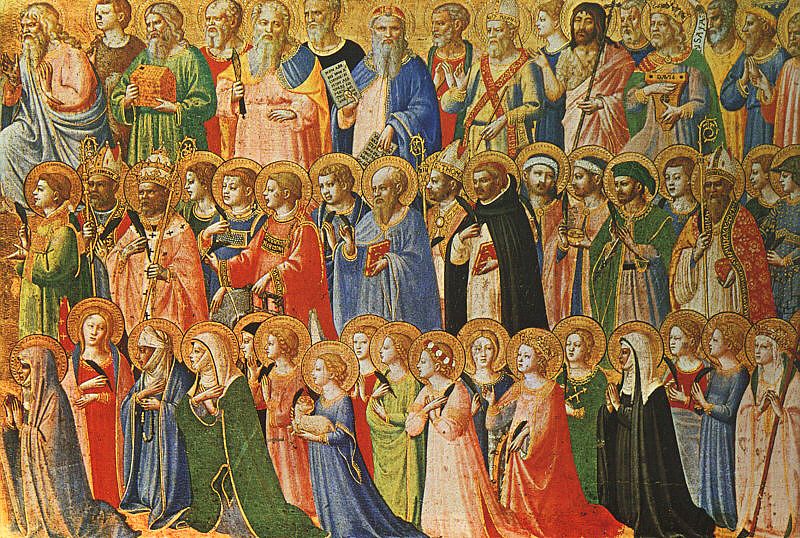
Citizens of Heaven

It’s good to be reminded in these days following our contentious election on Tuesday that “ our citizenship is in heaven.” Paul tells that to the Philippians in today’s reading, but we should hear it too. 

But our citizenship is in heaven, 
and from it we also await a savior, the Lord Jesus Christ.
He will change our lowly body
to conform with his glorified Body 
by the power that enables him also 
to bring all things into subjection to himself.

Therefore, my brothers and sisters,
whom I love and long for, my joy and crown, 
in this way stand firm in the Lord, beloved.  

We ‘re citizens of heaven; we belong somewhere else. We’re temporary, not permanent  residents here. In that place “ the Lord Jesus Christ will change our lowly bodies to conform to his glorified Body by the power that enables him also to bring all things  into subjection to himself.” (Philippians 3:17-4:1)

The responsorial psalm today tells us that even now we’re standing within the gates of a heavenly Jerusalem, the destiny of the tribes of the Lord. Our destiny.

St. Augustine wrote “The City of God” as barbarian armies sacked Rome and were invading North Africa. The world is coming to an end, some were saying, and they blamed Christianity for the critical times. But God is at work beyond human time and events, Augustine wrote. 

Go rejoicing to the city of God and the house of the Lord, we hear today. There is something beyond the politics of today at work. 

“Stand firm in the Lord, beloved. “ 

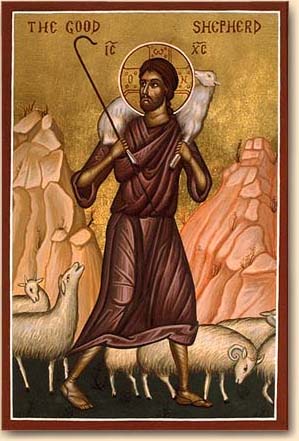
The Little Lost Sheep

Luke 15:1-7

An Excerpt From Pope Francis, General Audience, Saint Peter’s Square
Wednesday, 4 May 2016 

We are all familiar with the image of the Good Shepherd with the little lost lamb on his shoulders. This icon has always been an expression of Jesus’ care for sinners and of the mercy of God who never resigns himself to the loss of anyone. The parable is told by Jesus to make us understand that his closeness to sinners should not scandalize us, but on the contrary it should call us all to serious reflection on how we live our faith. The narrative sees, on the one hand, the sinners who approach Jesus in order to listen to him and, on the other, the suspicious doctors of the law and scribes who move away from him because of his behavior. They move away because Jesus approaches the sinners. These men were proud, arrogant, believed themselves to be just.

The lesson that Jesus wants us to learn is… that not a single one of us can be lost. God’s action is that of one who goes out seeking his lost children and then rejoices and celebrates with everyone at their recovery.

We are all warned: mercy to sinners is the style with which God acts and to this mercy he is absolutely faithful: nothing and no one can distract him from his saving will. God does not share our current throw-away culture… God throws no one away; God loves everyone, looks for everyone: one by one! He doesn’t know what “throwing people away” means, because he is entirely love, entirely mercy.

While he is looking for the lost sheep, he challenges the ninety-nine to participate in the reunification of the flock. Then, not only the lamb on his shoulders, but the whole flock will follow the shepherd to his home to celebrate with “friends and neighbors.”

We should reflect on this parable often, for in the Christian community there is always someone who is missing and if that person is gone, a place is left empty. Sometimes this is daunting and leads us to believe that a loss is inevitable, like an incurable disease. 

In Jesus’ vision there are no sheep that are definitively lost, but only sheep that must be found again. We need to understand this well: to God no one is definitively lost. Never! To the last moment, God is searching for us. Think of the good thief; only in the eyes of Jesus no one is definitively lost. For his perspective is entirely dynamic, open, challenging and creative. It urges us to go forth in search of a path to brotherhood. No distance can keep the shepherd away; and no flock can renounce a brother. To find the one who is lost is the joy of the shepherd and of God, but it is also the joy of the flock as a whole! We are all sheep who have been retrieved and brought back by the mercy of the Lord, and we are called to gather the whole flock to the Lord!

Click here to read the full address by Pope Francis.

May They All Be One

About 6 years ago, Pope Francis met with representatives of the American Bible Society at the Vatican. It was more than a courtesy visit. The American Bible Society  had conducted a study on how Americans connect with the Bible,  and American Catholics were part of the study. 

The study’s results are on the American Bible Society website. Though it’s 6 years old,  I don’t think the study’s results have changed much. Let me summarize two things it said about American Catholics. About 50 percent of American Catholics saw themselves engaged in the Bible which they hear at Mass or read privately or online. They saw the scriptures having an impact on their thinking and the way they lived. 

Another 50 percent saw themselves not engaged at all in the scriptures; they had no impact on their thinking and the way they lived. 

When you consider that the Second Vatican Council set the Catholic Church on a course of greater involvement in the scriptures, you see the catechetical challenge those statistics present. The council directed that the treasures of scripture have an increasing role in our liturgy, our Mass and our sacraments. They should be at the heart of our catechesis and have a more important place in our devotional life. “To be ignorant of the scriptures is to be ignorant of Christ”, the council document on revelation said, quoting St. Jerome. 

How do we bring the scriptures to so many Catholics who don’t see them as important? How can we help them engage in the scriptures and see them influencing the way they think and the way they live?

The American Bible Society has promoted the bible and bible study for many years. in the ecumenical climate that developed after Vatican II its relationship to the Catholic Church has grown closer, and so the society now distributes bibles carrying church approval;  its resources and catechetical tools try reach a Catholic audience. It recognizes, for example, a lectionary-based reading of the scriptures and liturgical feasts and seasons as one way to pray the Bible. ( cf. Reading Guide 2024

What I like especially about the American Bible Society is its emphasis on helping people to use and pray the scriptures on their own. Though the society provides reflective material on the scriptures, it encourages each person to find in the scriptures what God is speaking to them. You don’t find that personal approach emphasized enough, in my opinion. We may wait too much for “experts” to tell us what the scriptures mean.

One encouraging note from the study of the American Bible Society: Catholics expressed an interest in the scriptures. The scriptures have become a promising meeting ground for the various Christian churches for whom Jesus prayed, “May they all be one.”

Immaculate Heart of Mary, Pray for Us!

Immaculate Conception Church in Jamaica, NY on U.S. Flag

By Gloria M. Chang

On this Election Day, let us entrust the nation to Our Lady of the Immaculate Conception, the patroness of the United States of America. On May 13, 1846, the Catholic bishops of the United States unanimously proclaimed the Blessed Virgin Mary, under her title of the “Immaculate Conception,” patroness of the United States. Pope Pius IX formally ratified this decision on February 7, 1847, seven years before he officially defined the Immaculate Conception as a formal dogma of the Church. 

Prayer to the Immaculate Heart of Mary

O Immaculate Heart of Mary, Mother of our country, Heavenly beauty and splendor of the Father, we consecrate ourselves to You, our nation, and our leaders, asking for Your guidance, protection, and intercession. Amen.

Philippians: Have the Mind of Christ

Our first reading at Mass this week is taken mostly from Paul’s Letter to the Philippians. St. Luke describes Paul’s mission to Philippi, ” a leading city in the district of Macedonia and a Roman colony”, in the 16th chapter of the Acts of the Apostles. “We spent some time in that city” , Luke says, indicating he’s describing something he knows firsthand. It was a dramatic and fruitful stay.

Paul encounters Lydia, “a dealer in purple” at the place along the river where women prayed. She listened to his message and asked for baptism for herself and her household. She also convinced Paul and his companion to stay at her house, which became a house church. Women play a major role in the spread of the gospel.

Paul also encountered persecution in Philippi when he was accused of causing businesses to fail because of a cure he worked. ” The magistrates had them stripped and ordered them to be beaten with rods. After inflicting many blows on them, they threw them into prison and instructed the jailer to guard them securely. When he received these instructions, he put them in the innermost cell and secured their feet to a stake. ( Acts 16:22-24)

An earthquake broke the walls of the prison and the jailor, fearing the prisoners had escaped, was ready to kill himself. The earthquake led to his conversion along with his household – another house church in Philippi. It also led to Paul’s exoneration by the fearful magistrates of Philippi.

Commentators describe Paul’s warm relationship with the Philippians. It looks like a lot of important people there were on his side, or at least very respectful of his mission. They say he wrote this letter– to Lydia’s house and the jailor’s household– from prison, either in Rome, Ephesus or Caesaria.

Paul had his share of prisons during his ministry. That experience and others like it convinced him to see his life in the light of the suffering Christ. He told the Philippians they were granted “for the sake of Christ, not only to believe in him but also to suffer for him. Yours is the same struggle as you saw in me and now hear about me.”  (Philippians 1, 29-39)

Have the mind of Christ, Paul tells them– and us– in this important passage, probably from an early Christian hymn:

Have among yourselves the same attitude 
that is also yours in Christ Jesus,
Who, though he was in the form of God,
did not regard equality with God
something to be grasped.
Rather, he emptied himself,
taking the form of a slave,
coming in human likeness;
and, found human in appearance,
he humbled himself,
becoming obedient to death,
even death on a cross.
Because of this, God greatly exalted him
and bestowed on him the name
that is above every name,
that at the name of Jesus
every knee should bend,
of those in heaven and on earth and under the earth,
and every tongue confess that
Jesus Christ is Lord,
to the glory of God the Father.” (Philippians 2, 6-10)

This passage occurs often in the church’s  prayer tradition. On Palm Sunday, it’s read as Jesus enters Jerusalem to suffer and die on the cross. In the Liturgy of the Hours, the Church’s daily prayer, it’s read each Saturday evening. The passage even appears before Christmas, a reminder that from the beginning Jesus accepted the weakness of “human likeness.” Unlike Adam who grasped for equality with God, Jesus humbled himself. 

We follow Jesus from birth to death and then to resurrection. It’s not a grim unhappy journey. Commentators on the Letter to the Philippians call it a “Letter of Joy.” Having the mind of Christ make life a journey to glory. 
31st Sunday b: Love God; Love your Neighbor

For this week’s homily please watch the video below.

Stars and Saints

Hubble Ultra Deep Field
Fra Angelico, The Forerunners of Christ with Saints and Martyrs

By Gloria M. Chang

From eternity the Lord God designed humanity and the cosmos in his image, envisioning the constellation of saints bursting with Christic Light in the heavens. Formed from the dust of the earth, Adam evolves through the eons to completion in Jesus Christ, his descendant and Lord—the Potter’s masterpiece (Isaiah 64:8). 

Kindling the treasure of Christ’s flame in “jars of clay,” we grow day by day into the image of the Blessed Trinity as one Mystical Body (1 Corinthians 15:41). The dazzling kaleidoscope of saints, reflecting the unity and diversity of the Father, Son, and Holy Spirit radiates the infinite rays of divinity. Each saint refined in God’s furnace of Love emerges as an original from the hands of the Divine Artist, for “star differs from star in glory” (1 Corinthians 15:41).

Form me with your hands, Lord, day by day.
You are the Potter; I am the clay.
From soil you shaped sparkling saints like stars, 
Blazing your glory from earthen jars.

Just as we have borne the image of the man of dust, we shall also bear the image of the man of heaven.

1 Corinthians 15:49


This content by Gloria M. Chang was originally published online at Shalom Snail: Journey to Wholeness

An Ambassador in Chains: Ephesians 6: 10-20

We’re reading today from Paul’s Letter to the Ephesians 6:10-20 (Thursday Wk. 30) He’s writing as an ambassador of the gospel, but an “ambassador in chains” asking for prayers that “speech may be given me to open my mouth, to make known with boldness the mystery of the Gospel.”

“Draw your strength from the Lord and from his mighty power,” Paul writes to the Ephesians and possible to the church at large. But he’s also asking for himself,  for the strength of a warrior, for the “armor of God”. “faith as a shield”, “the helmet of salvation”, “the sword of the Spirit.” Battle language, for sure.

No ordinary battle either. HIs enemies are not flesh and blood, but principalities and powers, world rulers of this present darkness, evil spirits in the heavens. 

I’m not a scripture scholar, but this sounds like the persecution of Nero that startled the Christians in Rome after the fire that burned much of the city down in 64 AD and sent an unknown number of them, including Peter and Paul, to a cruel death. It was an absurd persecution that went beyond what flesh and blood could conjure up. 

I’m adding a video on that persecution, told by way of an old Roman church, the traditional storyteller of Christian history. It’s the church of St. Peter in Chains. 

Church of St. Peter in Chains, Rome

St. Christopher, Pray for Us

Christopher

“The Vatican said recently he doesn’t exist,” our guide informed us as we looked up at the imposing statue in Cologne Cathedral in Germany a few years ago, Then, we passed quickly on.

Afterwards, I told him the Vatican didn’t say Christopher never existed, but as of now there is no historical evidence for the popular saint who carries the little child on his shoulders. For one reason or another, no historical evidence exists for a good number of our early saints.

It’s more than finding a Christopher in history, however. If you look at what he’s doing, there have been–and still are– many Christophers. (Bearers of the Christ Child) His holiness can be unrecognized, but very real. He’s there in the women and men who day after day carry children on their shoulders, getting them where they must go and keeping them from the dangers little children face.

Caregivers of all kinds do the same thing. I watch them here at our place, where we have a number of priests and brothers who can’t get around, getting them into wheelchairs and getting them to where they have to go. Not much glamor in that job, but a lot of people need carrying, especially today.

The media seems to thrive on violence today. Gangs taking on gangs, macho heroes blowing up cities, killing thousands.  Non-stop violence. 

Christopher was a sign to generations past that strength is more than swinging a sword.  You’re strong when you serve the weak.

We need you today, St. Christopher. Pray for us. Inspire us.

We follow the Apostles

we are “being built on the foundation of the Apostles and prophets, with Christ Jesus himself as the capstone. Through him the whole structure is held together and grows into a temple sacred in the Lord…” (Ephesians 2: 19-22)

That picture of the church is brought before us every month with a feast of an apostle, We celebrated two apostles yesterday, Simon and Jude. On a feast of the apostles we look back and look forward. We belong to a growing church meant to embrace people from every nation, time and place. It’s a church bound for glory. That’s the church we belong to.

We belong to a church described as a building, not a complete building, but one “being built.” The foundation is the apostles and prophets. Jesus Christ is the cornerstone, holding everything together and ensuring it grows to the “sacred temple of the Lord.”

Yet, in our part of the world, is our church growing? It looks like it’s falling apart. Perhaps we don’t see how big our church is. It’s bigger than we think. Some weeks ago Pope Francis was in Southeast Asia and commented on the growing church he saw there. A youthful, enthusiastic church, he said. We see only a part of the church.

The apostles brought their message to all the earth. They do not just report their memories of Jesus; they brought their message to others, to the ends of the earth. Accounts of their missionary journeys may not all be historically true, but their conviction of a universal mission was certainly true. They call us to this same mission;  a great church is being built and we are part of it.

“We have inherited heaven along with the apostles,” our morning prayer says. “On the foundations stones of the heavenly Jerusalem, the names of the twelve apostles of the Lamb are written,” we read in morning prayer. That’s where we are headed. We see only so much..