Here’s a sermon from, St. Leo the Great about prayer, fasting and almsgiving, the three usual recommendations for our lenten season.. Leo guided the Roman church early in the 5th century in troubled times, maybe like ours.
Barbarian tribes poured through Rome’s defenses along the Rhine River on its northern frontier, threatening the Italian peninsula. Many of Rome’s elite left for the safety of Constantinople, the empire’s new center. Rome was left with an army incapable of defending the city. The Romans barricaded themselves in their homes with everything they had, convinced the world was ending.
Leo’s sermon focuses on the most important lenten recommendation for his time – almsgiving. As governments today give up a role of support for the needy and turn to builiding their armies and their economy, Leo”s word might well be directed to us today. He puts it in more elegant language than mine, but he tells his people “Stick together.”
“There is no more profitable practice as a companion to holy and spiritual fasting than that of almsgiving. The works of mercy are innumerable. Their very variety brings this advantage to those who are true Christians. In the matter of almsgiving not only the rich and affluent but also those of average means and the poor are able to play their part. Those who are unequal in their capacity to give can be equal in the love within their hearts.”
“The works of mercy are innumerable.” Rich or poor can show mercy, according to what you can do. . Forget yourself and think of someone else and do something, Leo says. “The works of mercy are innumerable.” Love makes them all equal.
Pope Francis talks like that too. What can we do for others?
As Jesus was setting out on a journey, a man ran up, knelt down before him, and asked him, “Good teacher, what must I do to inherit eternal life?” Jesus answered him, “Why do you call me good? No one is good but God alone. You know the commandments: You shall not kill; you shall not commit adultery; you shall not steal; you shall not bear false witness; you shall not defraud; honor your father and your mother.” He replied and said to him, “Teacher, all of these I have observed from my youth.” Jesus, looking at him, loved him and said to him, “You are lacking in one thing. Go, sell what you have, and give to the poor and you will have treasure in heaven; then come, follow me.” At that statement, his face fell, and he went away sad, for he had many possessions.
Jesus looked around and said to his disciples, “How hard it is for those who have wealth to enter the Kingdom of God!” The disciples were amazed at his words. So Jesus again said to them in reply, “Children, how hard it is to enter the Kingdom of God! It is easier for a camel to pass through the eye of a needle than for one who is rich to enter the Kingdom of God.” They were exceedingly astonished and said among themselves, “Then who can be saved?” Jesus looked at them and said, “For men it is impossible, but not for God. All things are possible for God.”
For this week’s homily please watch the video below.
On weekdays this year we’ve been reading from the Book of Sirach at Mass, and today, the 8th Sunday C, we read it along with the Gospel of Luke.
The early church used the Book of Sirach for teaching people, especially young people, about the Christian faith. The Book of Sirach was once called the Book of Ecclesiastes, a book for the church. I think Sirach is a Jewish contribution to the church’s catechesis.
Who was Sirach? He was probably a devout Jewish father or grandfather who lived in Jerusalem about 200 years before Jesus, and was writing for younger people, his son or grandson likely among them.
They were facing changing times. Alexander the Great had conquered the Middle East and Jerusalem. Their world was not going to be the same as their fathers’ and grandfathers’. A different world.
What does Sirach tell them, this new generation? He doesn’t say “You’re on your own. Brush your teeth, stay healthy and I hope you get a good job.” He has more important advice.
“Fear of the Lord,” he says over and over. He’s not telling them to be afraid of God, No. He tells them to keep God, all powerful and wise, before them always. Don’t get lost in yourself or a slave to the times you live in.
God is present everywhere. God’s wisdom is in the world you will live in and in your experience of daily life. Learn from your life.
Fear of the Lord is like fear of the sea. We may gain new knowledge and build larger vessels to go on its waters, but we still must fear the sea. It has its own laws. We must accept them, if we don’t want to drown.
God’s not only God of the past, God’s with us always, Sirach says. Follow the Creator’s laws. Don’t forget your religious tradition and its heroes. They can help you. God’s with you on your journey into the future, leading you on.
Always know who you are, Sirach says to the young in today’s reading. Listen to what you say and how you think “one’s speech discloses the bent of one’s mind.” Listen to yourself and watch yourself; you’re responsible for your own life.
“As the test of what the potter molds is in the furnace, so in tribulation is the test of the just.” Sirach also knows life can be hard and doesn’t always play out the way we’d like. How we meet disappointments and suffering is one of life’s greatest tests. You’re going to be challenged and mocked and made fun of. Hold on to your faith, Sirach says. Don’t give up. God is with you.
Sirach’s teaching resembles the teaching of Jesus in today’s gospel.
Keep an eye on yourself. If you only pay attention to others and criticize everyone else. Blind, you will fall into a pit.
A rotten tree doesn’t bear good fruit. Listen to what you say and how you think. That will tell you what your heart is like. What you’re like.
We need this kind of wisdom today, don’t we? The wisdom of Sirach and of Jesus. A wisdom to be passed on from one generation to the next.
It’ s a long way from the creation of the world to sitting on the porch in the morning. How many years before did God, the Creator of all things, bring light and water paving the way for a host of new things, non-living and living. Then, we humans enter the picture. A complex, changing world I belong to, sitting on the porch in the morning, looking eastward at the world before me.
.
Jessica Powers, a Carmelite nun and poet, wrote about our experience of that world– “Song At Daybreak”
This morning on the way,
that yawns with light across the eastern sky
and lifts its bright arms high –
It may bring hours disconsolate or gay,
I do not know, but this much I can say:
It will be unlike any other day.
God lives in his surprise and variation.
No leaf is matched, no star is shaped to star.
No soul is like my soul in all creation
though I may search afar.
There is something -anquish or elation-
that is peculiar to this day alone.
I rise from sleep and say: Hail to the morning!
Come down to me, my beautiful unknown.
“My Beautiful unknown”. Our world is beautiful, but unknown, surprising, with variations that bring “anguish or elation.” People of faith know this, since they believe in God who lives “in his surprise and variation”, but unfortunately we can make God too small. We “think like humans do.”
The Genesis account, which we just finished reading recently and the rest of the Bible, deserve a search for their wisdom. I know there’s a new story that science tells, but the scriptures were there first. We should listen to their special wisdom..
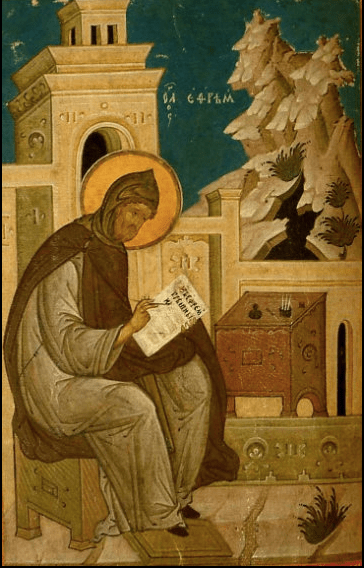
St. Ephem the Syrian, an important teacher of the eastern Christian churches, was made a doctor of the Catholic Church in 1920 by Pope …Scholars today are growing in appreciation of his poetic understanding of the sacraments and his understanding of the church. A gem from St. Ephrem the Syrian, whose feast is June 9th.
Do we have enough wisdom to make our way in life? St. Ephrem says we have more than enough. Christ, the Wisdom and Power of God, has come.
The trouble is that often we want more wisdom than we need or can take in. We want to know it all. Drawing on God’s wisdom, St. Ephrem says, is like drinking from a great spring of water. You can only drink one mouthful at a time. The spring is never exhausted, but you can’t drink it all. That’s not the way we’re built.
But we want to know it all, and so we become dissatisfied with the wisdom we have at the moment, or we think there is nothing more to draw on.
This is not just a problem for us as individuals; we see it in our world today with all of its needs and challenges. One temptation is to throw in the towel and say we can do nothing; another is to think we can solve our problems with one sweeping action.
Keep drinking from the spring, “What you could not take at one time because of your weakness, you will be able to take in at another if only you persevere. So do not foolishly try to drain in one draught what cannot be consumed all at once, and do not cease out of faintheartedness from what you will be able to absorb as time goes on.”
It takes time to believe. The disciples of Jesus needed time to believe in him and understand the meaning of his life, death and resurrection. So did the man in today’s gospel from Mark who asks help in his unbelief. So do we.
As Jesus came down from the mountain with Peter, James, John and approached the other disciples, they saw a large crowd around them and scribes arguing with them. Immediately on seeing him, the whole crowd was utterly amazed. They ran up to him and greeted him. He asked them, “What are you arguing about with them?” Someone from the crowd answered him, “Teacher, I have brought to you my son possessed by a mute spirit. Wherever it seizes him, it throws him down; he foams at the mouth, grinds his teeth, and becomes rigid. I asked your disciples to drive it out, but they were unable to do so.” He said to them in reply, “O faithless generation, how long will I be with you? How long will I endure you? Bring him to me.” They brought the boy to him. And when he saw him, the spirit immediately threw the boy into convulsions. As he fell to the ground, he began to roll around and foam at the mouth. Then he questioned his father, “How long has this been happening to him?” He replied, “Since childhood. It has often thrown him into fire and into water to kill him. But if you can do anything, have compassion on us and help us.” Jesus said to him, “‘If you can!’ Everything is possible to one who has faith.” Then the boy’s father cried out, “I do believe, help my unbelief!” Jesus, on seeing a crowd rapidly gathering, rebuked the unclean spirit and said to it, “Mute and deaf spirit, I command you: come out of him and never enter him again!” Shouting and throwing the boy into convulsions, it came out. He became like a corpse, which caused many to say, “He is dead!” But Jesus took him by the hand, raised him, and he stood up. When he entered the house, his disciples asked him in private, “Why could we not drive the spirit out?” He said to them, “This kind can only come out through prayer.” Mark 9:14-29
Where are we now?
Since the Christmas season we have been reading from Mark’s Gospel, which end when Lent begins. Through lent we follow Jesus from Matthew’s Gospel mostly, as he journeys on to Jerusalem where he will die and rise again.
Do his disciples fully understand him? Peter certainly doesn’t. (Mark 8, 27-33) Despite miracles and his inspired teaching, his own family and hometown turn away from him. (Mark 3,1-5; 6, 1-6) Pharisees and scribes from Jerusalem come to Galilee to dismiss and condemn him.( Mark 7,1-15)
Yet, Jesus goes on to Jerusalem, with his disciples and with all of us. The lenten season’s readings and feasts will take us, like his disciples, from Galilee to Jerusalem. Lent will call us, as Jesus does in today’s gospel, to prayer.
Will this lent and Easter turn more people to join him? Maybe. The world we live in is a lot like Galilee and Jerusalem. Still, like the disciples who first followed him there, we’re going up to Jerusalem. There will always be transfigured moments to lead us on.
In today’s gospel listen to a merciful God. “O faithless generation, how long will I be with you?” Jesus says. Yet then he says “Bring him to me.” And he cures the young boy possessed from childhood. He helps the half-believing father.
Is he unique? Isn’t faith itself always half-believing, always marked with the unbelief that comes from who we are, finite human beings who only see so far?
We’re reading from the Book of Sirach weekdays at Mass until Ash Wednesday,. It’s always helpful to look into the background of the books of scripture and ask when, for whom, and why were they written.
The Book of Sirach was written by a Jewish sage in Jerusalem around 200 BC in Hebrew and was translated into Greek sometime later. Sirach was a writer who loved his Jewish tradition and wanted to pass on its wisdom to a generation that might be saying: “We don’t see anything in it for us any more.” Judea had come under the control of Alexander the Great and his generals who introduced their Jewish subjects, sometimes forcibly, to Hellenistic culture. They were succeeded in 64 BC by the Romans.
The Book of Sirach seems to be a grandfather’s attempt to dissuade his grandchildren from abandoning their tradition as they experience the powerful Greco-Roman culture of their time. Sound like today?
Sirach often speaks of the “fear of the Lord.” He’s not saying be afraid of God, but keep God who is all powerful and all wise before you always. Don’t get lost in yourself or your experiences of life.
What does Sirach do? He speaks strongly of the presence of God who’s everywhere, of a wisdom found in the world and the experience of daily life. Learn from your experience of life, he tells his descendants; your religious tradition and its heroes will help you.
Sirach isn’t saying either to be afraid of life. Life’s not easy, but Sirach sends the younger generation out into the world to find wisdom there. Learn from life, he says, as those before you have done. As I have done.
“Trust God and God will help you;
trust God, and God will direct your way;
turn not away lest you fall.
Fear God and grow old therein.
You who fear the LORD, wait for his mercy,
and your reward will not be lost.
You who fear the LORD, trust him,
for lasting joy and mercy.
You who fear the LORD, hope for good things,
You who fear the LORD, love him,
Study the generations long past and understand.”
and your hearts will be enlightened. (Sirach 2, 1-11)
The Crucifix in the Passionist public chapel of Immaculate Conception Monastery, Jamaica, NY, is a gift of the German bishops of Bavaria to Fr. Fabian Flynn, CP, for helping restore a broken Europe, particularly Germany and Hungary, after the 2nd World War. A book describing his work, “The Priest Who Put Europe Back Together”, by Sean Brennan, an historian from the University of Scranton, appeared in 2018.
Father Fabian was ordained a Passionist in Immaculate Conception Monastery in 1931 and served in its retreat center after ordination. He went on to become an editor for The Sign magazine, a Passionist publication.
During the Second World War, Fabian became an army chaplain in 1943. He served in combat with the 1st Infantry Division for 16 months. His service included North Africa, Sicily, France, and Germany. His unit ended up in Nuremberg, Germany, during the Nuremberg war trials. Fabian became chaplain for Allied participants in that trial. He also ministered to Germans in Nuremberg, including those on trial as war criminals.
During the trial, he celebrated Mass every Sunday. The Mass brought Allied personnel and German Catholics together in one of Nuremberg’s war-torn Catholic churches.
After army service, Father Fabian became Director of the newly created Catholic Relief Services in Germany and Hungary from 1946-49. He worked for Catholic Relief until his death in 1973. He helped millions of refugees displaced by wars and other tragedies in Europe and elsewhere.
Catholic Relief Services was established by the American bishops in 1943, as an agency to bring aid to the victims of war overseas. It was distinct from Catholic Charities whose task was to aid those in need in the United States..
At the end of his service in Germany, the Catholic bishops of Bavaria honored Father Fabian. They did not give him a medal or other sign of appreciation. Instead, they gave him a large 16th-century crucifix from their war-ravaged country. It was an appropriate remembrance of his ministry. He fulfilled one of the hardest teachings of Jesus: “Love your enemies, do good to those who persecute you.”
The Crucifix holds a prominent place in the Passionist monastery chapel today. It serves as a fitting expression of the work he did then. It is also a timely reminder of what we need to do today.
After the Second World War, the victorious Allied countries made a thoughtful decision. They avoided the mistake made after the First World War when Germany was left bitter and impoverished in defeat. They decided a peaceful Europe could only come through the development of a stable peacetime economy in Germany and other European countries. America channeled a large part of its relief aid through Catholic Relief Services. Father Fabian was an administrator of that aid.
Historians today recognize the wisdom of that approach, and many warn about abandoning it. How we deal with enemies and rivals is currently a hot political issue..
People of faith, whatever their political affiliation, look to a higher wisdom Jesus teaches. “ Love your enemies, give to those who hate you…Be children of the Most High,for he himself is kind to the ungrateful and the wicked. Be merciful, just as your Father is merciful.” ( Luke 6)
Jesus lived according to this wisdom. “Father, forgive them for they know not what they do,” Jesus said from the cross. The cross expresses his teaching.
The Crucifix in our Jamaica chapel holds the suffering Jesus, truly God and truly human. We profess this mystery over and over whenever we pray and celebrate our sacraments. We have to keep this mystery in mind.
Jesus became one of us. He calls all humanity to his Cross: the poor who hunger and thirst, victims of war and other tragedies, soldiers lost or scared in battle, women and children without a home, the old, the sick, the frail, yes even our enemies and rivals. All are there.




 The Victor's Place