The Easter Triduum

The mysteries we celebrate in the Triduum from Holy Thursday evening till Easter Sunday are not separate from one another.   The Eucharist, the Passion and Death of Jesus, his Resurrection are joined together.  We”re meant to consider them together,  They are the Paschal Mystery. 

We cannot consider, for example,  the Eucharist only as a sacrament in which we adore Jesus Christ, the Son of God. He gives himself to us in this sacrament as a Servant, whose blood is poured out for us. He is the Lamb of God who gives us life for the journey God calls us to make.

Like his people in Egypt, we are to stand ready for the passage we are to make. He will be our food. He will wash our feet to make them clean and strong for the way, He is our Bread, our Manna. Our Companion on the journey.

The Passion of Christ is not only a dramatic story of the sufferings Jesus Christ endured on Good Friday. We see in his sufferings the love that conquers suffering and death. St. John’s gospel, read on Good Friday, reveals glory in him whom they pierced. He brings life to us and our world. 

We cannot celebrate Jesus Christ risen from the dead without seeing the wounds in his hands and his side.   His victory over death was not without cost.  To rise with him we must die with him. “Lord, by your Cross and Resurrection you have set us free.” 

The Easter Triduum celebrates consecutively three mysteries of Jesus Christ that belong together. They are the most important mysteries of our faith. 

Alleluia!         

The Cross in Early Christian Art

cross, 4th Century Sarcophagus, Rome

Cross, 4th Century Sarcophagus, Rome

There are no realistic representations of Christ Crucified and his passion in early Christian art. Realistic portrayals of Christ on the cross and his passion only appear in the early middle ages in the western church. The Crucifixion of Jesus was only portrayed symbolically at first, as in the example above, and early on appears in a variety of ways.

The Anchor Cross
anchor 4

Travelers from one port to another on the Mediterranean Sea at the time of Jesus were never sure of a safe passage until they dropped anchor. The anchor became the symbol of safe arrival, and so ancient seaports on the Mediterranean like Alexandria and Antioch adopted the anchor as a symbol for their city.

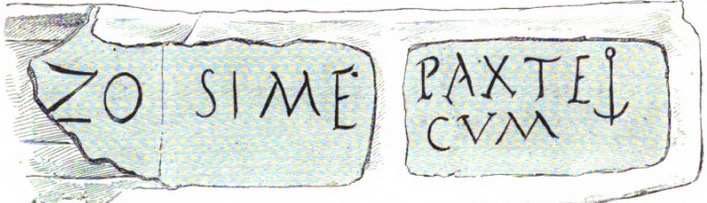
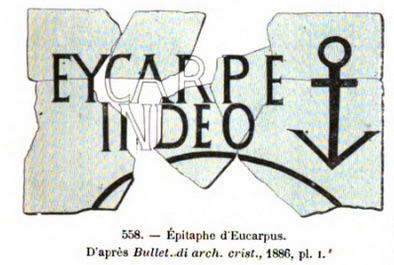
Early Christians used the anchor as a symbol of their hope of reaching a heavenly port, the kingdom of God and they inscribed it on their burial sites  in the catacombs to express their hope in Jesus Christ. The anchor closely resembles a cross and early Christians surely saw the resemblance. It’s the most common and sometimes only mark found on the earliest Christian graves in the ancient Roman catacombs of Priscilla, Domitilla and Callistus.

“Pax tecum,” “Peace be with you” the inscription (above) next to an anchor on one of these gravesites reads; the name of the deceased has been half-destroyed by grave robbers looking for valuables long ago. “Eucarpus is with God” we see in another below.
anchor 3

One reason early Christians hesitated to portray the crucifixion of Christ realistically was because the practice  was still  common in the Roman world until the Emperor Constantine  banned it in the 4th century. With crucifixion still before their eyes, Christians would hardly want it portrayed realistically in art, even if it were the crucifixion of the Savior.
FullSizeRender

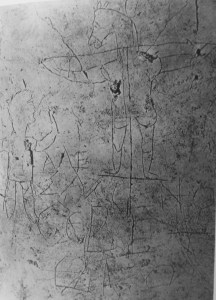
The oldest known portrayal of the crucifixion of Jesus, (left), is a mocking graffiti found on the wall of a barracks on the Palatine Hill in Rome, showing a crucified man with the head of a donkey, and before him a man with hand raised to the image. The Greek inscription from about the year 220 AD reads: “Alexander worships his god.” Undoubtedly, Alexander is a Christian being mocked for belief in Jesus crucified.

The first centuries of Christianity, in  fact, produced little art. For one thing, it inherited a strong iconoclastic tradition from Judaism. The 2nd century writer Justin Martyr also offers another explanation in his Apology disputing Roman claims that Christians were atheists and a danger to society. Justin acknowledges they had no temples, no statues of gods, and did not participate in the rites of Roman prayer.  But Christians were loyal Romans who believed in God, Justin argues. They worship, though, in their own homes and pray there to a God who cannot be imagined or adequately portrayed. (Apology 9,67)

Great Christian churches and shrines were not built till the 4th century, after  emancipation by the Emperor Constantine. Before that, Christian art is found mainly in the catacombs, where Christians buried their dead.

Moses strikes the Rock, Noah saved by the wood. Catacombs

Moses strikes the Rock, Noah saved by the wood.
Catacombs

The art of the catacombs, which are found mostly  around the city of Rome, comes down to us in a fragile state and can be hard to decipher after being underground for centuries. Its simple symbolic style can leave its powerful religious significance unappreciated. Art historians lament its lack of style compared to the sophisticated Roman art of its day.

The writings of Justin Martyr and other early Christian writers may help us better understand its simple, powerful message. In his Dialogue with Trypho the Jew, Justin uses a list of Jewish scriptures that he claims predict the coming of Christ, his life, death and resurrection. The  scriptures were used by other Christian writers of his day–Tertullian, Barnabas, Irenaeus–   to prove that “all the prophets bear witness” to Christ, the promised Messiah. (Acts 10,43)  Before them, Jesus appealed  to Moses and all the prophets to show why it was necessary for the Messiah to suffer. (Luke 24,26-27)

These same Jewish scriptures influenced the formation of the gospels and early Christian baptismal catechesis. They were read in Christian worship and decorated  Christian burial places. The Jewish scriptures are the key to understanding the art of the catacombs.

In his Dialogue with Trypho Justin proposes to his Jewish opponent scriptures such as Psalm 22 and the Servant Songs of Isaiah 53, that indicate God’s plan to send a suffering Messiah who would redeem his people. These same scriptures shaped the accounts of the passion of Jesus in the four gospels.

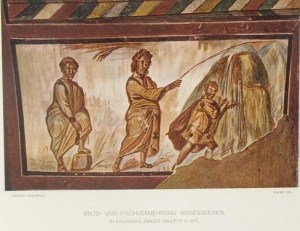
In the 86th chapter of his Dialogue with Trypho, Justin lists other scriptures, beginning with the tree of life planted in paradise, that reveal the saving power of the wood of the cross. That saving wood was prefigured in the wooden rod Moses used to bring water from the rock in the desert and divide the sea for his people to pass over. The cross was prefigured in the ladder Jacob saw mounting to heaven. Abraham saw it in the oak at Mamre and in the wood Isaac carried to his sacrifice. David saw the cross in the tree planted by running waters, mentioned in Psalm 1. The cross was signified in the wood that saved Noah from the flood.
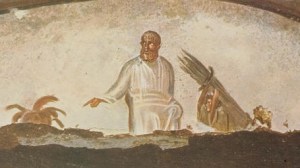
MOSES ROCK *

Isaac carry the wood of sacrifice. Roman catacombs.

Isaac carries the wood of sacrifice.
Roman catacombs.

Many of these Old Testament figures connect wood with water and feature in the early church’s catechesis and rites of initiation. The same catechesis speaks to the dead resting in the catacombs, who  believed in Christ. Through baptism and the sacraments Jesus Christ would bring them, through the mystery of his death and resurrection, to eternal life.

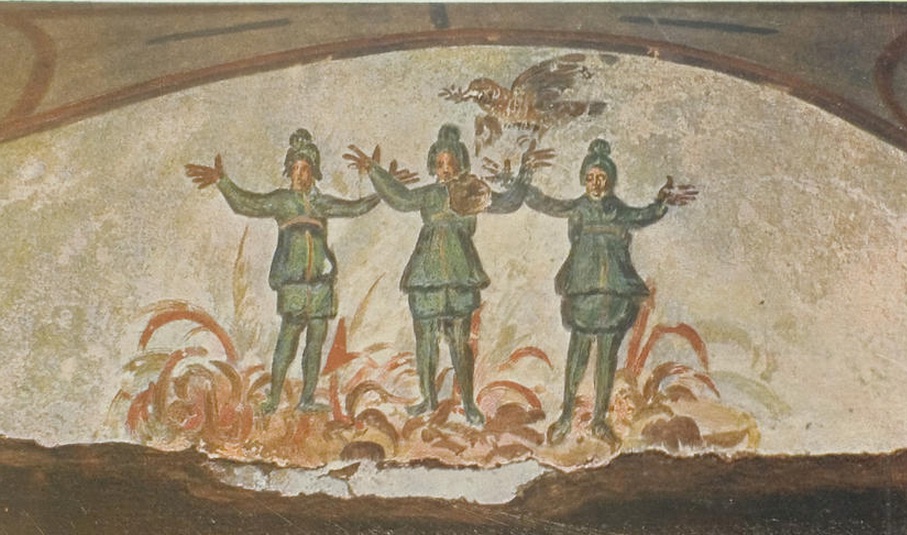
In other parts of the Dialogue, Justin offers the Three Children in the Fiery Furnace, Daniel in the Lion’s Den, and other Old Testament stories as images that speak of the Passion of Jesus. All these “signs” also appear extensively in the art of the catacombs.
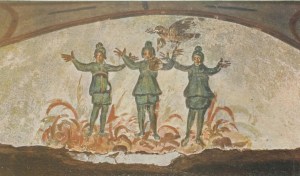
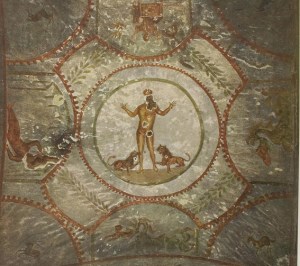
3 children 1

Daniel in the Lion's den. Catacombs

Daniel in the Lion’s den.
Catacombs

In the 55th chapter of his Apology Justin adds signs from nature and human society to expand his argument for Christianity and the mystery of the cross, A ship can’t sail and arrive at its destination without a sail; a field can’t be plowed without a plow. Both of these are in the form of a cross. Human beings themselves are made in the form of a cross, Justin emphasizes. Figures with arms outstretched, Orants, appear everywhere in the catacombs. They imitate Christ who prayed with arms outstretched on the cross, and his prayer was heard. (Tertullian, On Prayer 14)
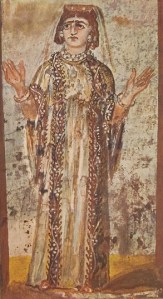
Orans, Catacomb
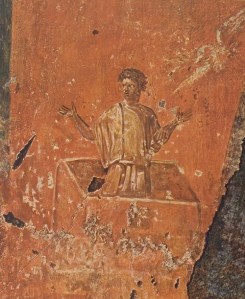
Orans, Catacomb

Noah saved by the wood of the ark. Roman catacombs

Noah saved by the wood of the ark.
Roman catacombs

The art of the catacombs found mostly in the 40 or so catacombs around Rome, offers a rich fascinating look at early Christian belief. Today In the Catholic Church’s prayers for the dying we can still hear the figures portrayed there  invoked once more.

“Welcome your servant, Lord, into the place of salvation…Deliver your servant Lord, as you delivered Noah from the flood, Deliver your servant, Lord, as your delivered Moses from the hand of Pharaoh. Deliver your servant, Lord, as you delivered Daniel from the lions den. Deliver your servant, Lord, as you delivered the three young men from the fiery furnace. Deliver your servant, Lord, as you delivered Job from his sufferings. Deliver your servant, Lord, through Jesus our Savior, who suffered death for us and gave us eternal life.” (Roman Ritual)
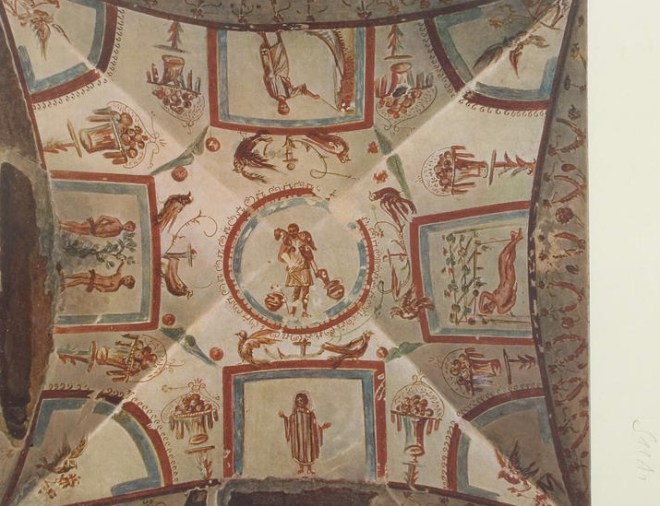
Good Shepherd, Old Testament figures of the Passion. Catacombs
Good Shepherd, Old Testament figures of the Passion. Catacombs

Good Friday: Pope Francis

Good Friday

Through the texts of Sacred Scripture and liturgical prayers we are called to Calvary to commemorate the redemptive Passion and Death of Jesus Christ. 

The Crucifix will be presented to us to adore. Adoring the Cross, we relive the journey of the innocent Lamb sacrificed for our salvation. We carry in our minds and hearts the sufferings of the sick, the poor, the rejected of this world; we will remember the “sacrificed lambs”, the innocent victims of wars, dictatorships, everyday violence, abortions.

 Before the image of the crucified God, we bring, in prayer, the many, the too many who are crucified in our time, who’d receive comfort and meaning in their suffering only from him. And nowadays there are many: do not forget the crucified of our time, who are the image of Jesus Crucified, and Jesus is in them. 

Ever since Jesus took upon himself the wounds of humanity and death itself, God’s love has watered these deserts of ours, he has enlightened our darkness.

 Let us make a list of all the wars that are being fought in this moment; of all the children who die of hunger; of children who have no education; of entire populations destroyed by wars, by terrorism. Of the many, many people who, just to feel a bit better, need drugs, the drug industry that kills… 

He enters into the abyss of suffering, he enters into these calamities to redeem and transform them. to free every one of us from the power of darkness, of pride, of resistance to being loved by God.

 By his wounds we have been healed (cf. 1 Pt 2:24), the apostle Peter says, by his death we have been reborn, all of us. And thanks to him, abandoned on the cross, no one will ever again be alone in the darkness of death. Never. He is always beside us: we need only open our heart and let ourselves be looked upon by him. 

Pope Francis


For today’s homily, please play the video file below:

For a commentary on John’s Passion narrative by Fr.Donald Senior, CP. seehttps://passionofchrist.us/commentary/

Holy Thursday

On the evening of Holy Thursday, as we enter the Easter Triduum, we will relive the Mass in which we commemorate the Last Supper and what happened there. It is the evening when Christ left his disciples the testament of his love in the Eucharist, not as a memento, but as a memorial, as his everlasting presence. 

Every time we celebrate the Eucharist we renew this mystery of redemption. In this Sacrament, Jesus substituted the sacrificial victim — the Paschal lamb — with himself: his Body and Blood grant us salvation from the slavery of sin and death. The salvation from every form of slavery is there.

On this evening, he asks us to love one another by becoming servants to one another, as he did in washing the disciples’ feet, a gesture that anticipates his bloody oblation on the cross. And indeed, the Master and Lord will die on the next day to purify not the feet, but the hearts and the entire life of his disciples. He was a servant to us and by the service of his sacrifice he redeemed us all.

Pope Francis

For today’s homily, please play the video file below:

God of infinite compassion, to love you is to be made holy. Fill our hearts with your love. By the death of your Son you have given us hope, born of faith. By his rising again fulfill this hope in the perfect love of heaven where he lives and reigns with you, and the Holy Spirit, One God, forever and ever. Amen.

The Days of Holy Week

Six days before the Passover, Jesus came to Bethany, the home of Lazarus,  whom he had raised from the dead. The next day the great crowds that had come for the festival heard that Jesus was coming to Jerusalem.  So they took branches from the palm tree and went out to meet him.

John’s gospel says that Jesus came to Bethany, the home of Lazarus whom he raised from the dead. He was honored at a Sabbath banquet there, John’s gospel for Monday tells us. The next day, our Palm Sunday,  crowds that have come to Jerusalem for Passover will honor him by placing palm branches before him as he goes into city. 

We have a picture day by day as we approach the mystery of Jesus’ death and resurrection.

Palm Sunday c: The Passion from St. Luke

For this week’s homily please watch the video below.

Thursday, 4th Week of Lent

Lent 1

Readings

In the final weeks of Lent the readings from John’s Gospel describe Jesus’ various visits to Jerusalem to celebrate different Jewish feasts. In John’s gospel today, Jesus is in Jerusalem celebrating the Jewish feast of Pentecost, which took place 7 weeks after Passover. (John 5, 31-47)  Our Pentecost comes from the Jewish feast.

The Jewish feast of Pentecost goes by different names. It’s called Shavuot, meaning weeks, which originally celebrated the beginning of the barley harvest, but also recalls Moses handing on the law to the Jews as he comes down from Sinai. This year the Jewish feast begins at sundown, June 11. The Christian feast of Pentecost falls on Sunday, June 19th, this year. 

Our first reading today recalls the descent of Moses from Sinai to an unbelieving people.”I see how stiff-necked this people is. Let me alone, then, that my wrath may blaze up against them to consume them.Then I will make of you a great nation,” God says to him. (Exodus 34:7-14)

But Moses pleas for his people, lest Egypt be convinced the God of Israel is cruel. Moses also recalls God’s covenant made to Abraham. Jesus appears as the new Moses on this feast, pleading for forgiveness for his people and promising to open the graves of their dead. 

The miracles and his works of healing testify to him, Jesus says. The scriptures, long searched by the Jews as the way to eternal life also “testify on my behalf,” Jesus says. Above all, his heavenly Father, who through an interior call draws to his Son those who are humble, speaks for him.

Faith in Jesus still comes in these ways. The Jewish scriptures still point him out. On their feast of Shavuot, Jews study the Torah, the law of Moses. One Jewish custom is to stay up all night and read the Torah.

Our heavenly Father draws us to his Son in lent. The voice of the Father says once more: “listen to him.” We listen to him in the scriptures.

We’re reminded by scholars that in these passages from John’s Gospel, “the Jews” who condemned Jesus are not the Jewish people but a powerful group that turned against him at that time. We approach the mystery of God together with our Jewish brothers and sisters..

Prayer

O God
I come to you
who have given so much to me. You know “my inmost being” and “all my thoughts from afar.” I want to listen to you
and be changed by what I hear.

Help us all to be changed by you. Amen.

Bethesda

There was a feast of the Jews, and Jesus went up to Jerusalem.
Now there is in Jerusalem at the Sheep Gate
a pool called in Hebrew Bethesda, with five porticoes.
In these lay a large number of ill, blind, lame, and crippled.
One man was there who had been ill for thirty-eight years.
When Jesus saw him lying there
and knew that he had been ill for a long time, he said to him,
“Do you want to be well?”
The sick man answered him,
“Sir, I have no one to put me into the pool
when the water is stirred up;
while I am on my way, someone else gets down there before me.”
Jesus said to him, “Rise, take up your mat, and walk.”
Immediately the man became well, took up his mat, and walked.

Now that day was a sabbath.
So the Jews said to the man who was cured,
“It is the sabbath, and it is not lawful for you to carry your mat.” 
He answered them, “The man who made me well told me,
‘Take up your mat and walk.'”
They asked him,
“Who is the man who told you, ‘Take it up and walk’?”
The man who was healed did not know who it was,
for Jesus had slipped away, since there was a crowd there.
After this Jesus found him in the temple area and said to him,
“Look, you are well; do not sin any more,
so that nothing worse may happen to you.”
The man went and told the Jews
that Jesus was the one who had made him well.
Therefore, the Jews began to persecute Jesus
because he did this on a sabbath.

The miracle Jesus worked on the paralyzed man on the Sabbath is behind the dialogue he has with the Jews found in our readings for Wednesday and Thursday of this week. “My father is at work until now, so I am at work.”

Like the man born blind,  the paralyzed man does not approach Jesus. Jesus approaches him. The man never enters the healing waters. God’s Healing Water, God’s Son, heals him.

John’s gospel describes the place where the miracle happened in Jerusalem. It is close by the temple. In our first reading today Ezechiel promises life-giving water will flow from the temple. Jesus, the new Temple, offers life and light to a paralyzed world.

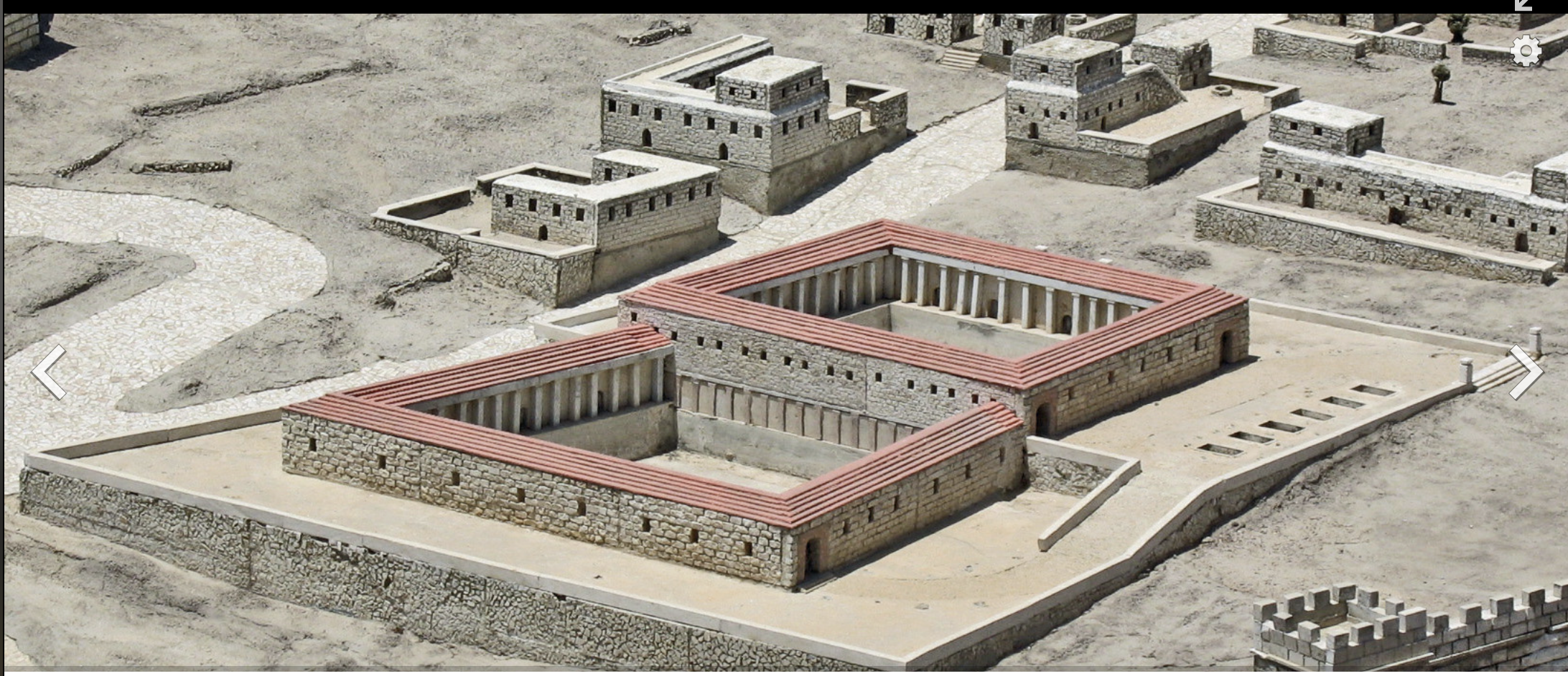
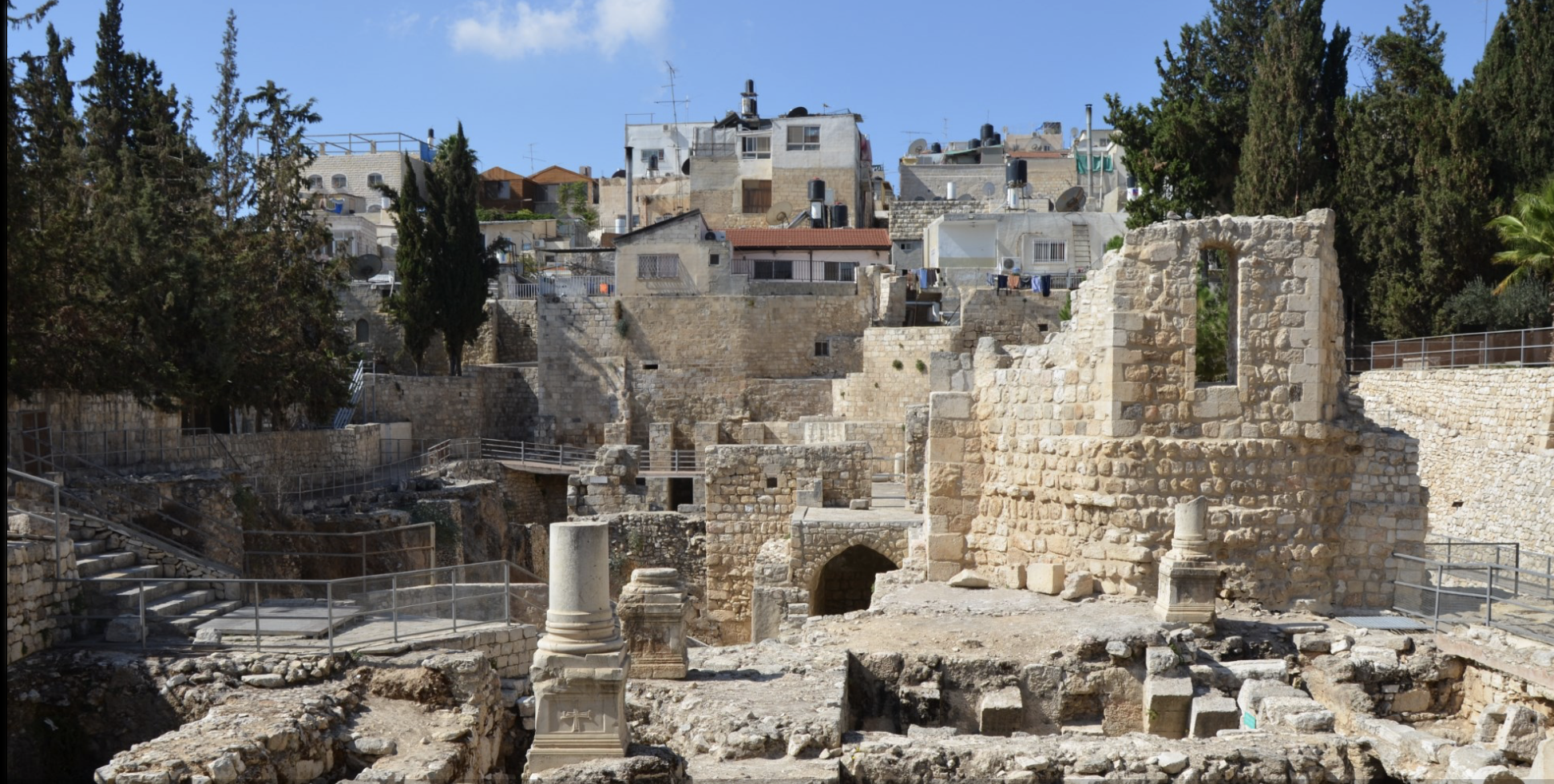
Archeologists have uncovered the place. Here are some pictures:

Jerusalem model, Jewish Museum

Reconstruction of Bethesda, located near the temple and the Fortress Antonia, where the paralyzed man was healed; from the Jerusalem model, Jewish Museum

Wikipedia Commons

Ruins of the healing pool of Bethesda.

Until the 19th century, there was no clear archaeological evidence for the pool but archeologists have uncovered the ruins of the ancient healing place marked by ancient churches since the 5th century. The beautiful 12th century church of St. Ann stands today next to the ruins. Tradition says the birthplace of Mary, the mother of Jesus, is nearby. The site, near St. Stephen’s gate, is a popular pilgrim destination today.

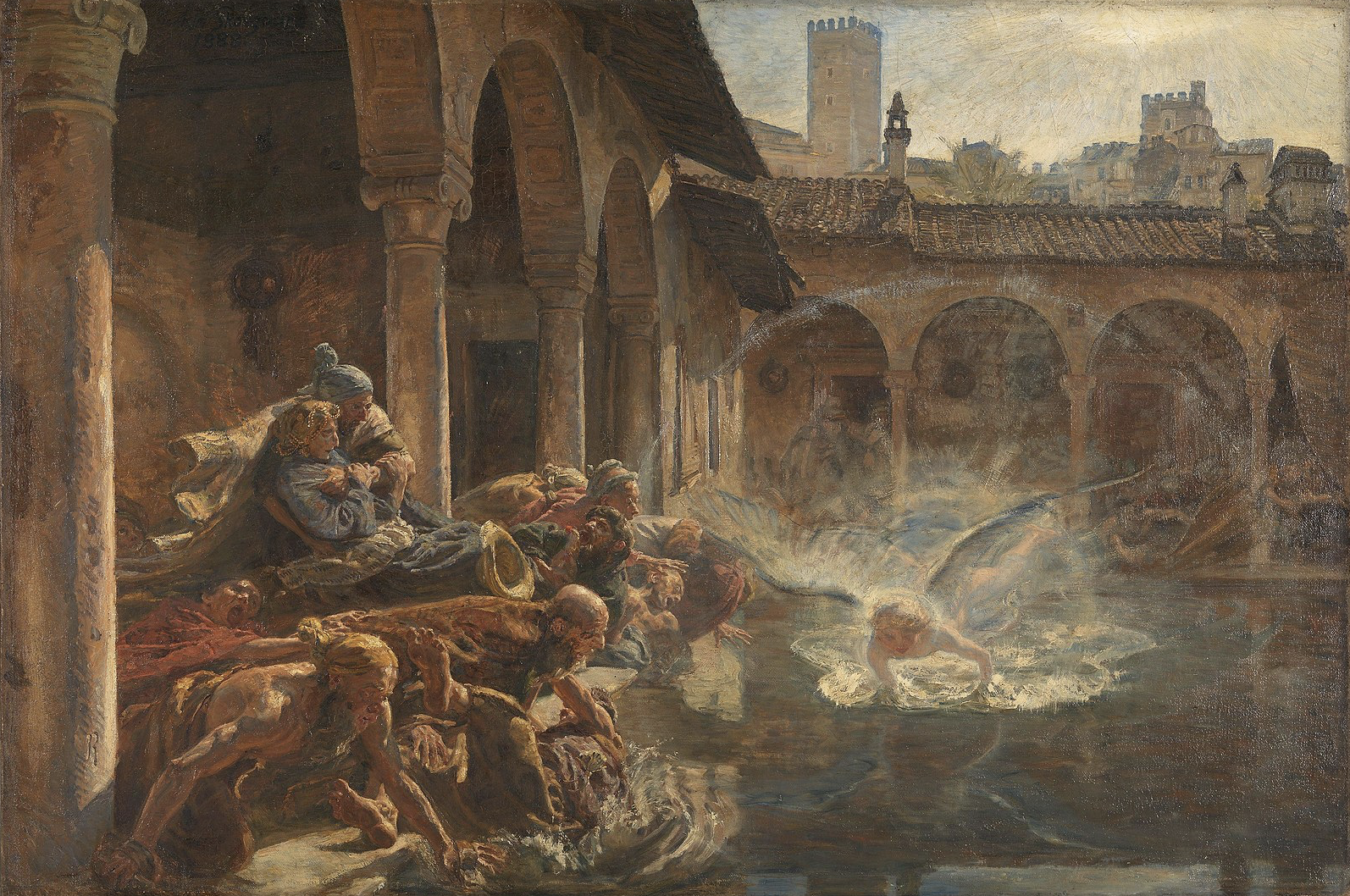
Joakim Slpvgard, Museum of Art, Norway

Artist rendering of the pool. The Fortress Antonia is in the background. Not only the Jews, but also the gentiles were among the ill, the blind, the lame, to be healed in this pool.