St. Athanasius: Creation Speaks of the Word

May 2nd is the feast of St. Athanasius, the 4th century  bishop of Alexandria in Egypt, an important figure in the early Christian disputes about the Trinity. He defended the divinity of Christ against the Arians who claimed that the Word, the Second Person of the Trinity, was created by God the Father and so was not eternal.

The Word was God, eternal, consubstantial, one with the Father and the Holy Spirit, Athanasius taught. Humanity and all creation were brought into being by the Word.  We are made in the image of God, the saint says in his treatise “Against the Arians”; we are made in the image of the Word of God who became flesh.

“Our Lord said: ‘Whoever receives you, receives me.’ The image of the Word through whom the universe was made, the Wisdom that made the sun and the stars– is in us.”

The  saint carries this thought further:

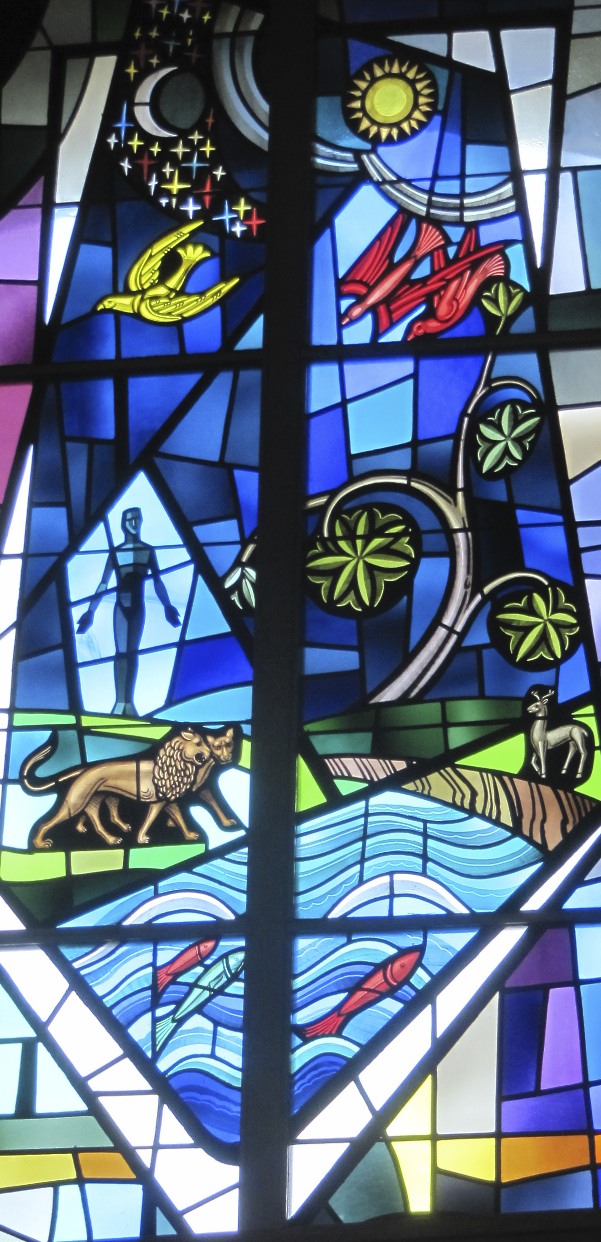
“The likeness of Wisdom has been stamped upon creatures in order that the world may recognize in it the Word who was its maker and through the Word come to know the Father. This is Paul’s teaching: ‘What can be known about God is clear to them, for God has shown it to them. Ever since the creation of the world his invisible nature has been there for the mind to perceive in things that have been made.’”

All creation has been stamped with “the likeness of Wisdom.” The universe can be traced to the Word; and it draws us to the Word. Creation is hardly secular, divorced from God, an entity of its own, or to be seen as worthless. The Word of God, Jesus Christ, came among us that we might discover the divine image not only in ourselves, but in the things that are made. Creation leads us to its Creator, and to Jesus Christ.

We make Jesus Christ too small if we see him only as a human being, the saint argues. We also make creation too small if we see it separate from its Creator. Jesus immersed himself in the waters of the Jordan at his baptism and he was proclaimed God’s only Son in the waters. At the last supper, Jesus took bread and wine, blessed them and gave himself to us through them. He gave himself to us through these signs of creation. Water brings life to creation; bread at Mass is the “fruit of the earth” and the wine “fruit of the vine.”  Creation brings the Word to us; Creation brings Jesus Christ to us.

Pope Francis asked for this same recognition of the dignity of creation in his encyclical “Laudato Si.” Creation brings us to Jesus Christ.

Father, you raised up  St. Athanasius, to be an outstanding teacher of the divinity of your Son.  May we grow to know and love you through his wisdom and through the world made in his image. Amen.

Saint Joseph, the Worker, May 1

IMG_1146


Brother Michael Stromber, CP,  a member of the Passionist community in Queens, New York, produced this sculptor of St. Joseph the Worker some years ago while he was a missionary in Jamaica. Brother Michael is a fine artist as well as a worker who fixes almost anything, cars, toilets, broken light fixtures, chairs. Not much he doesn’t know how to do. He also flew planes in Guyana and Papua New Guinea carrying missionaries to their isolated mission stations.

I pass this sculpture regularly on my way up to my room on the 3rd floor in the monastery. The faces on the statue are blank, you can see, which is the way it is with so many ordinary workers in our society, isn’t it? We hardly notice them. We only see what they do.

In this case, that’s clearly shown in our sculpture. The most defined thing in it is the hammer in Joseph’s hand which he’s sharing with the young boy standing with him. He’s teaching the young boy how to work with it. They are absorbed in what they’re doing.

The people of Nazareth dismiss Jesus when he speaks in their synagogue! “Where did he get this wisdom? Isn’t he the son of Joseph, the carpenter?” The man who fixes things and goes unnoticed..

Our feast encourages us to see Joseph, the Worker, who went unnoticed and unappreciated in Nazareth and at the same time, to see the many like him who also do so much and are unnoticed. It calls us to recognize the dignity of work and so many things associated with it– the right to a just wage, equality of wages for women and men, the right to a job, the right to join other workers to seek good working conditions.

How important to pass on to the young what Joseph is passing on to Jesus. It’s a wisdom the people of Nazareth, unfortunately, don’t see.

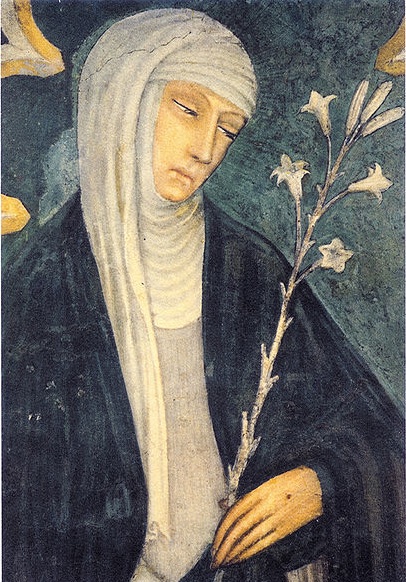
Catherine of Siena, (1347-80)

St. Catherine of Siena is a doctor of the church and Italy’s patron saint along with St. Francis.

The 24th child in a family of 25 children, Catherine was a saintly teacher and church reformer.  As a young girl, she clashed with her father, who worked dying wool, and her mother, a hardy determined housewife, after she told them she wasn’t going to get married, but was giving herself totally to God.

She cut her hair and began to fast and pray.  She joined a group of women who helped the poor in Siena, mostly widows associated with the Dominican order. They  were suspicious of the pious young girl who kept to herself and at odds with her mother and father.

At 21 years old, Catherine went beyond the mission of the women’s group and reached out further to the church and society.  Men and women, priests and laypeople, from Siena and its surroundings gathered around her. They cared for the poor– famine struck Siena in 1370 and a plague in 1374– but also they sought to reform the church and the society of their day.

At the time, Italian cities like Siena, Florence, Pisa and Padua were fighting among themselves as rival families clashed continuously over political power and economic advantages. In 1309 the popes fled the violence and factional riots in Rome for the safety of Avignon in France, where the papacy remained for almost 70 years. They call it “the Babylonian Captivity.”

Catherine and her companions pleaded with the feuding Italian cities for peace and urged the popes to return to Rome to exercise their mission as bishops of the city where Peter and Paul once led the Christian church. Catherine cajoled, warned and scolded the absent popes to do their duty as shepherds of their sheep and get back to where they belonged.

Without any formal education, Catherine learned to read and write only later in life, which made her an unlikely public figure. She was also a woman teaching and preaching– unusual for that day : “Being a woman, I need not tell you, puts many obstacles in my way. The world has no use for women in a work such as that and propriety forbids a woman to mix so freely with men.” (Letter) Despite those obstacles, Catherine traveled to the warring cities of Italy urging peace and to Avignon to plead with the pope to return to Rome.

Catherine had a deep experience of God in prayer, as the “Dialogue,” her mystical exchange with God, attests. God spoke with her and she shared those words. Her prayerfulness drew others to join her in her mission of peace-making and reform.

Jesus was her “Gentle Truth,” her guide and strength.

As a lay-woman in the church, she was not afraid to speak to power, once correcting a bishop for “ordaining little boys instead of mature men… idiots who can scarcely read and say the prayers.  They consider it beneath them to visit the poor, they stand by and let people die of hunger.”

Tell the truth, God told her. Tell the truth because love impels you. “You must love others with the same love with which I love you. But you cannot repay my love. Love other people, loving them without being loved by them. Love them without concern for spiritual and material gain, but only for the glory of my name, because I love them.” ( Dialogue )  Loving God inevitably means loving others.

She died in Rome in 1378 and is buried there in the Dominican church of Santa Maria sopra Minerva. Her heart is in Siena.

“This is a sign that you trust in me and not in yourself: that you have no cowardly fear. Those who trust in themselves are afraid of their own shadow; they think heaven and earth are letting  them down. Fear and a twisted trust in their own small wisdom makes them pitifully concerned about getting and holding on to everything on earth and throwing away everything spiritual…The only ones afraid are those who think they are alone…They are afraid of every little thing because they are alone–without me.” (Dialogue)

Nicodemus

We heard from Thomas, doubting Thomas, on Sunday. The next few days  he’s joined in this week’s readings by Nicodemus, a teacher in Israel, fluent in religious matters, but he comes to Jesus by night. Was it fear, human respect? Yet Jesus meets him at night. (John 3)

Nicodemus has questions but doesn’t understand Jesus’ answers. 

“How can this happen?” 

 So Thomas  isn’t the only skeptic, a lone dissenter. Others are slow to believe too. 

There’s skepticism in us all.

Nicodemus and Joseph of Arimathea– members of the Jewish ruling party – finally come forward at Jesus’ death. 

 Joseph asks Pilate for his body.  Nicodemus brings an abundance of spices for his burial. They finally leave the darkness and follow Jesus into the light. 

Here’s how John’s gospel describes them:

“After this, Joseph of Arimathea, secretly a disciple of Jesus for fear of the authorities, asked Pilate if he could remove the body of Jesus. And Pilate permitted it. So he came and took his body. Nicodemus, the one who had first come to him at night, also came bringing a mixture of myrrh and aloes weighing about one hundred pounds.

They took the body of Jesus and bound it with burial cloths along with the spices, according to the Jewish burial custom.

Now in the place where he had been crucified there was a garden, and in the garden a new tomb, in which no one had yet been buried. So they laid Jesus there because of the Jewish preparation day; for the tomb was close by. “(John 19, 39-42)

John’s Gospel sees the dark time of Jesus’ death bathed in glory.  Nicodemus’ store of spices  makes Jesus’ burial a kingly burial. And the new tomb in a garden suggests something wonderful about to happen.

The seed fallen to the ground will rise, bearing much fruit.  

“For God so loved the world that he gave his only Son, so that everyone who believes in him might not perish but might have eternal life. For God did not send his Son into the world to condemn the world, but that the world might be saved through him.” (John 3,17)

“Everyone who believes in him might have eternal life.” Everyone, even slow believers like Joseph and Nicodemus.

Readings here.

Recognizing the Risen Christ

One of the great French scripture scholars, Xavier Leon Dufour, wrote a book on the accounts of  Jesus’ Resurrection in the four gospels which he began by recalling how he first understood the Resurrection as a child from the stained glass window in his parish church.

Jesus was pictured in shining light coming out of the tomb,  the soldiers with hands up high in fear at the sight. It’s a common portrayal found in many of our churches.

Dufour writes of his surprise that this picture can’t be found anywhere in the gospels. The gospel accounts of the appearances of the Risen Christ are much more complex, which is one reason we read them all through Easter week, the “Long Day” of Easter.

In today’s reading,  the two Emmaus disciples returning to Jerusalem are greeted with cries, “he is risen, he had appeared to Simon.” Then they report how he appeared to them on the road, how he opened the scriptures and how they recognized him in the breaking of bread.

Then Jesus appeared to them. Luke says his appearance causes them “fear and panic”; they think he is a ghost. His appearance seems to be different than that of Lazarus who, when raised from the dead, was the same as before. The Risen Jesus is different. He doesn’t come back from the dead the same as Lazarus did. 

To assure them who is is, Jesus tells them to touch him, to eat with him. Only after he assures them does Jesus recall the scriptures that speak of a Messiah who dies and is raised from the dead. He tells them a message of forgiveness is to be preached in his name. They are witnesses of him. They’re to wait in the city for power from on high to come upon them: “The promise of the Father.”

Then Jesus takes them out to Bethany and ascends into heaven.  This all happens on Easter Sunday, according to Luke’s gospel. He ends his gospel there. After that he begins the second part, Acts of the Apostles, the story of the coming of the Spirit and the spread of the message of Jesus through his. church.

Luke’s gospel would have us recognize the Risen Jesus– we who are on the way —-   especially in the scriptures and the breaking of the bread.

Earth Day and the Long Day of Easter

We celebrate Earth Day, appropriately,  during the Long Day of Easter. 

How slowly do his disciples understand the mystery of the Resurrection of Jesus ! Some at first,  like Thomas, need hard evidence he is alive. For them life ends in death.  Some, like Peter and John,  see at first only the burial cloths in the tomb and wonder if he, like Lazarus, has come back from the dead.  Most of them, like the disappointed disciples on the way to Emmaus, had limited hope in him. They saw him restoring Israel to a place among the nations. A Secular Messiah.

As he appeared to them and ate with them and spoke with them their hopes grew.  He  broke bread with them and explained the scriptures.  Go to Galilee and meet him there, they were told. At the lake, according to John’s gospel, Jesus commanded them to bring his message to a wider world. In Mark’s gospel, he gave his command from a mountain. 

Their understanding of the mystery of the Resurrection grew. “He rose from the dead, according to the scriptures.” He brings the promise of  life to generations before and generations ahead. As Lord of all ages, his message of eternal life goes out to the heavens and the earth.  

 Jesus Christ is not just a solitary man brought back to life. He is, “the image of the invisible God.” In him all things have their being. He brings the promise of life to a broken world. Not just to one, or a few, but all. Not just to one nation, or a few, but all. Not just to the human race, but to all creation.

The opening prayer for Mass today recognizes the mysteries we celebrate this Long Week of Easter as “paschal remedies”, medicine for our weakness, healing for our blindness, hope for our doubt, new understanding. We are meant to grow through them.

How like the first disciples we are in our limited understanding of the mysteries of God. Yet God expands our knowledge. Is God expanding our understanding of the Resurrection now, calling our attention to his creature, our Earth. As we reflect on the death of Pope Francis, we recognize his challenge to care from the poor and the marginalized of our world. But let’s not forget his challenge to care for the earth that he made in his great encyclical “Laudato si’ “

Earth Day belongs in the Long Day of Easter.

Pope Francis

God give him that rest the scriptures promise a servant who had done well.

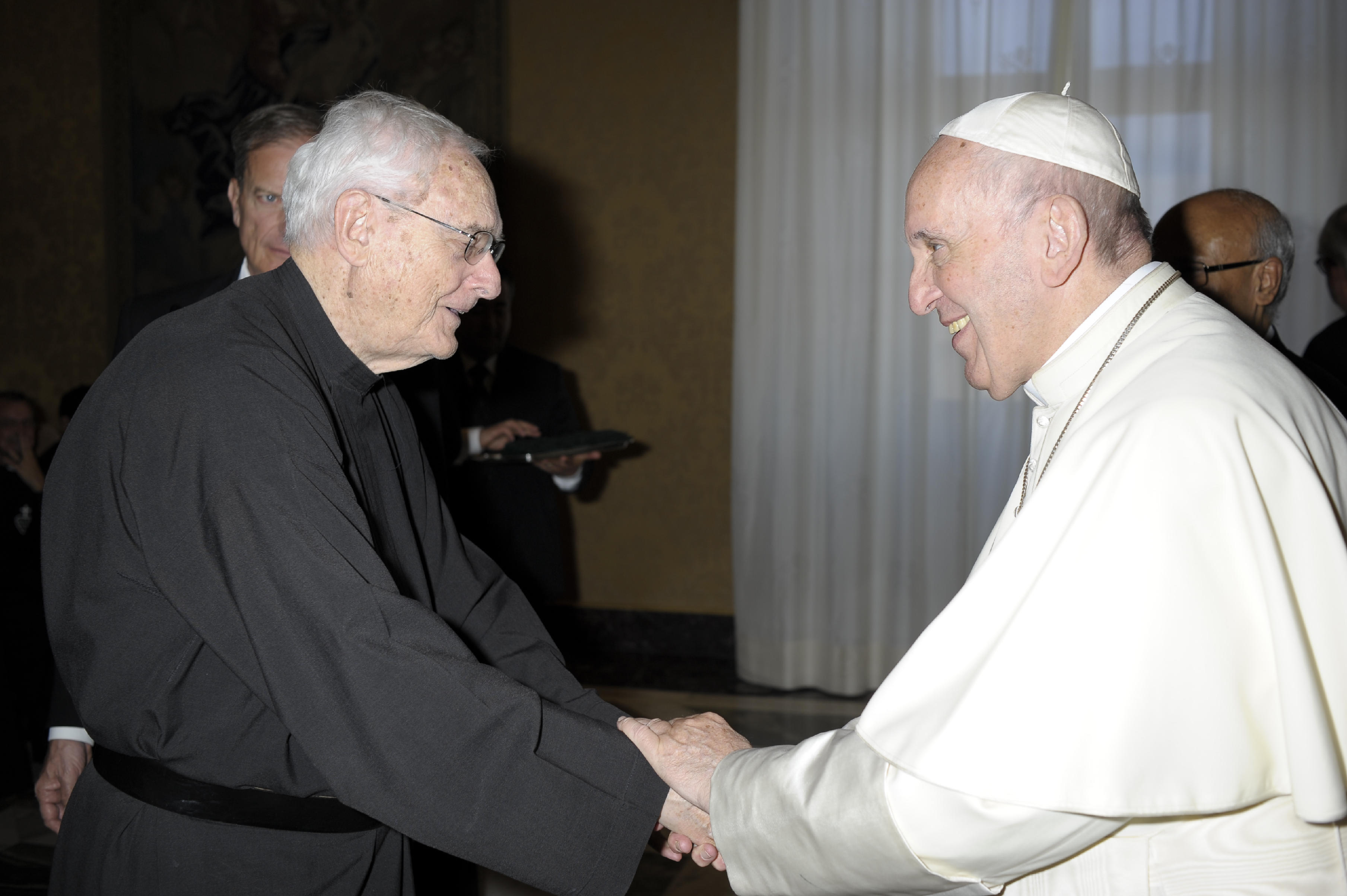
I remember his greeting four years ago, when he met Passionists taking part in their general chapter in Rome. He had come from a busy morning yet instead of going for lunch he spoke to us and greeted each of us.

He greeted about forty of us, each with the same attentiveness that he greeted me. Like Mary Magdalen, I want to cling to him as our leader and pope, but like Jesus he has to “go to the Father.”

He passes on during the long day of Easter.

https://www.vaticannews.va/en/pope/news/2025-04/twelve-years-of-new-paths-processes-and-open-doors.html

Easter Sacraments

Easter Week is an extension of Easter Day. The whole week is considered one day. Risen from the dead, Jesus made us one with him this day. We remember this week the signs of our union with him, baptism, the Eucharist and the other sacraments.  

As he did with the two disciples on the way to Emmaus, Jesus walks with us and breaks bread with us. The Paschal Candle next to the scriptures are a sign his light never fails.  The water blessed for baptism on the side of the altar reminds us we have been reborn of water and the Holy Spirit. 

The water has been blessed by Christ himself, for it comes from his pierced side when the soldier’s spear pierced his heart. It was blessed at the Easter vigil  with the sign of the Cross.

This week the those newly baptized are led into the mysterious world of sacraments and saints This week St. Cyril of Jerusalem and  St. Ambrose of Milan, preaching on the sacraments, often pointed out how insignificant the signs seem to be.  Only faith reveals their power.  

We need to remember newly baptized Christians, for we received the same gift as they have. An early sermon describes the gift given to the newly baptized at Easter: 

“Remember the newly formed: children born from the life-giving font of holy Church… As they emerge from the grace-giving womb of the font, a blaze of candles burns brightly beneath the tree of faith. The Easter festival brings grace from heaven to us. Through the repeated celebration of the sacred mysteries we receive the spiritual nourishment of the sacraments. We worship  the one God, adoring the triple name of his essential holiness, and together with the prophet sing the psalm which belongs to this yearly festival: This is the day the Lord has made; let us rejoice and be glad. 

And what is this day? It is the Lord Jesus Christ himself, the author of light, who brings the sunrise and the beginning of life, saying of himself: I am the light of day; whoever walks in daylight does not stumble. That is to say, whoever follows Christ in all things will come by this path to the throne of eternal light.” (Office of Readings, Wednesday of Easter Week.)