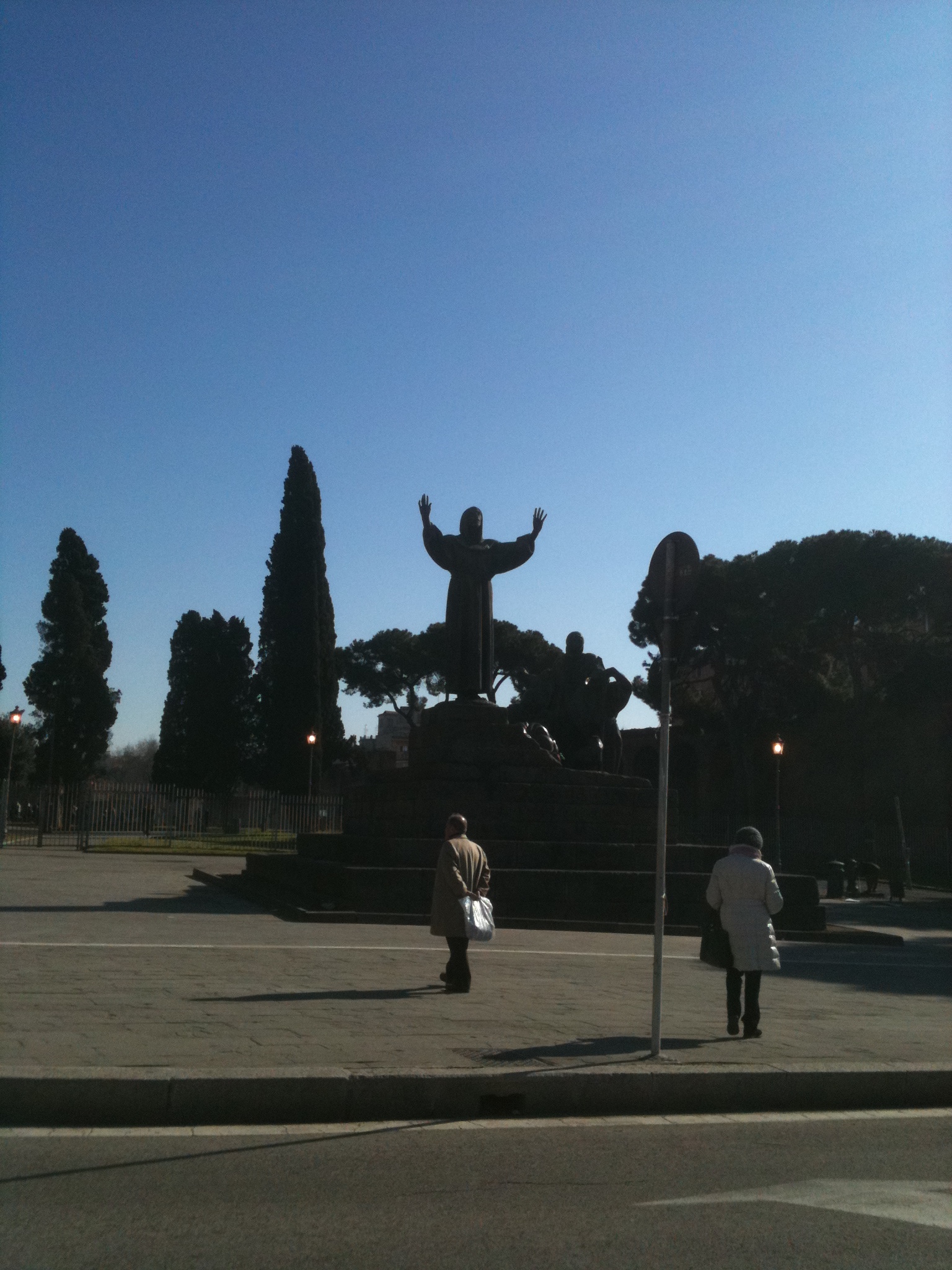
October 4th is the Feast of Francis of Assisi. A large statue of Francis with arms outstretched stands facing the Basilica of St. John Lateran in Rome. If you face the the basilica from behind the statue, you might think the saint was holding up the church in his arms. And that’s what he did: Francis raised up a church that was falling down
We need to see saints in the light of their times as they met the needs of their day. Chesterton called saints “God’s antidotes for the poison of their world”.
What was poisoning Francis’ world? Twelfth century Italy’s economy was booming when Francis was born. His family was among its new rich merchant class. As a young man he had everything money could buy, but then, as now, money could be a poison.
Italy’s cities, often at war, fiercely competed with one another, fighting for power.. It was the time of the crusades and everything was settled through force of arms.
It was a time too when the church had become weak and in need of reform. Before Francis, saints like Bernard of Clairvaux (1090-1153) and popes like Gregory VII (1015-1085) and Innocent III (1160-1216) sought renewal and change. The church was looking for a saint.
And so when Francis of Assisi came with twelve disciples to see the pope in Rome about reforming the church in the summer of 1220, he came at the right time. They say that the pope had a dream the night before that St. John Lateran, the mother church of Christendom, was falling down and a young man resembling the 28 year old Francis came to hold its walls up.
The pope asked Francis what would he do and Francis replied with three verses of scripture. The first was from the gospel of Matthew in which Jesus says to the young man ‘If you wish to be perfect, go, sell your possessions, and give the money to the poor, and you will have treasure in heaven; then come, follow me.’(19,21) The second from Luke’s gospel in which Jesus sends his disciples out saying “Take nothing for your journey, no staff, nor bag, nor bread, nor money—not even an extra tunic.”( 9,3) The third from Matthew: Jesus says, “If anyone wishes to come after me, let him deny himself and take up his cross.” (16,24)
The pope was a good judge of people and, sensing the grace of God in Francis, told him to live those gospel teachings, sending him on his way. Francis and his companions started a movement that spread like fire throughout Europe.
Francis made Jesus’ teachings his own. He embraced poverty, not just renouncing the rich lifestyle that he was born into, but renouncing any way that led to power. For example, he never became a priest or a bishop or a pope, because they were positions of power fought for and sometimes paid for in his day.
He did not want a monastery or a religious order as a base of power. Saints like St. Bernard and St Norbert before him thought monasticism was the way to bring about church reform, but Francis wanted a life style where you had nothing, “no staff, nor bag, nor bread, nor money—not even an extra tunic.” He distanced himself and his movement from the religious institutions of his day, because he feared them becoming places of power.
He took the gospel teachings literally and lived them literally. His renunciation of power became an antidote to the poisonous attraction to power that crippled his world and his church. He imitated the “Son of Man” a poor man who said to his followers the “foxes have dens and birds of the sky have nests, but the Son of Man has nowhere to rest his head.”
Like the Son of Man, who suffered and died on a cross and rose again, Francis experienced the mystery of the cross and was blessed by it.
Remembering him, we might pray: God send us saints to deal with the poison of our time.
“Time present and time past/Are both perhaps present in time future.”
Pooe Leo began an important conference in Rome October1 on the environment with that question posed by Pope Francis ten years ago in his letter Laudao si’.Looks like many of the countries of the world, especially the USA, are turning away from that question. We are absorbed in our wars and political fights.
“ Our Sister Earth cries out, pleading that we take another course. Never have we so hurt and mistreated our common home as we have in the last two hundred years. Yet we are called to be instruments of God our Father, so that our planet might be what he desired when he created it and correspond with his plan for peace, beauty and fullness.
The problem is that we still lack the culture needed to confront this crisis. We lack leadership capable of striking out on new paths and meeting the needs of the present with concern for all and without prejudice towards coming generations. The establishment of a legal framework which can set clear boundaries and ensure the protection of ecosystems has become indispensable; otherwise, the new power structures based on the techno-economic paradigm may overwhelm not only our politics but also freedom and justice.
It is remarkable how weak international political responses have been. The failure of global summits on the environment make it plain that our politics are subject to technology and finance. There are too many special interests, and economic interests easily end up trumping the common good and manipulating information so that their own plans will not be affected. Any genuine attempt by groups within society to introduce change is viewed as a nuisance based on romantic illusions or an obstacle to be circumvented.”
Pope Francis, Laudato SI 54-55
Today at the Vatican Gardens outside Rome evironmental leaders of the world gathered to answer that question: Are we caring for our common home?
One thing to notice about this conference, which involved artists,scientists, politicians, business people, ordinary people. Pope Leo sat among them, not before them, as if to signify their equal task in the care of the environment. They bring an equal wisdom to the challenge of caring for the earth. It’s not just the task of religious people, or a pope. It’s a common task for a common good.
At that time the disciples approached Jesus and said, “Who is the greatest in the kingdom of heaven?” He called a child over, placed it in their midst, and said, “Amen, I say to you, unless you turn and become like children, you will not enter the kingdom of heaven. Whoever humbles himself like this child is the greatest in the kingdom of heaven. And whoever receives one child such as this in my name receives me.
See that you do not despise one of these little ones, for I say to you that their angels in heaven always look upon the face of my heavenly Father.”
Matthew 18:1-5, 10
Guardian Angels Guide Us to the Father
God, the Father Almighty, maker of heaven and earth, of all things visible and invisible, placed Christ at the center of the angelic world. Every child made in the image of the Incarnate Son of God receives a guardian angel at conception to guide them in their journey home to the Father. As “their angels in heaven always look upon the face of my heavenly Father,” they intercede and light the way through Christ in the Spirit to the heart of the Father.
From its beginning until death, human life is surrounded by their watchful care and intercession. “Beside each believer stands an angel as protector and shepherd leading him to life.” Already here on earth the Christian life shares by faith in the blessed company of angels and men united in God.
Catechism of the Catholic Church 336
Prayer to My Guardian Angel
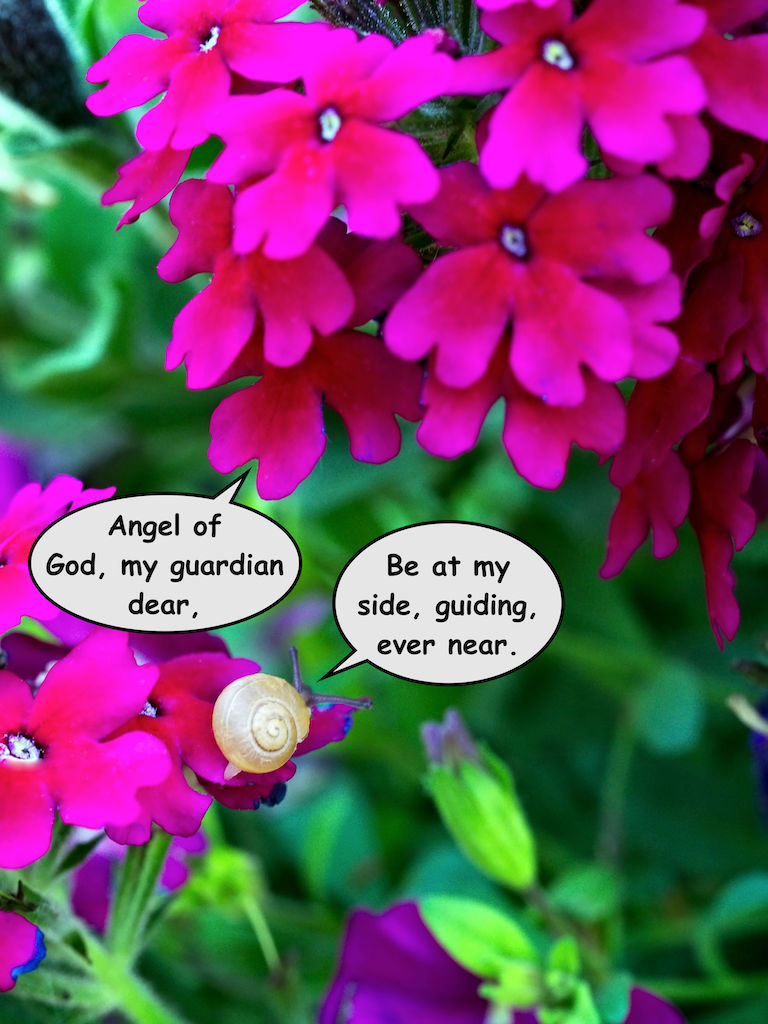
Angel of God, my guardian dear, to whom God’s love commits me here, ever this day be at my side, to light and guard, to rule and guide. Amen.
Angel of God, my guardian dear, Be at my side, guiding, ever near.
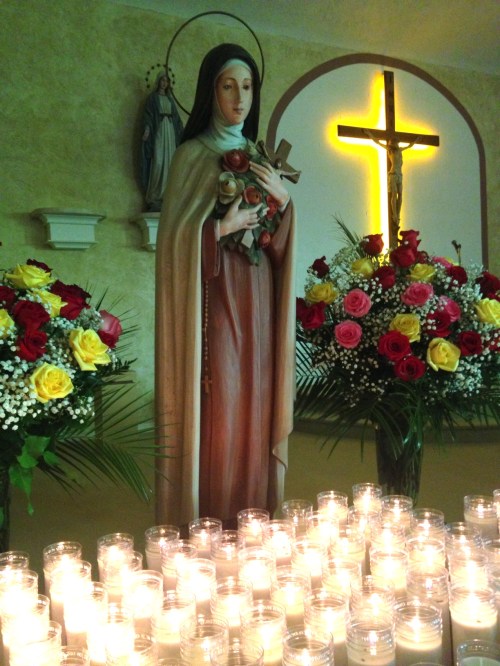
St. Thèrése put two titles to her name after she became a Carmelite nun. She holds those two titles in this photo. One was Thèrése of the Child Jesus, the other was Thèrése of the Holy Face of Jesus. She wished to be known by these two titles: Thèrése of the Child Jesus and the Holy Face.
The titles came from religious experiences she had. The first occurred on Christmas day, 1886, when she was 13 years old. Shorlty afterwards, she had an experience of the Passion of Jesus, which took place one Sunday of the next year, when she was 14. She describes the two experiences in chapter 5 of her autobiography. Her experience of the Passion of Jesus involved a murderer.
“One Sunday, looking at a picture of Our Lord on the Cross, I was struck by the blood flowing from one of the divine hands. I felt great sorrow when thinking this blood was falling to the ground unnoticed. I was resolved to remain in spirit at the foot of the Cross and to receive the divine dew. I understood I was then to pour it out upon souls.
The cry of Jesus on the Cross sounded continually in my heart: “I thirst!” These words ignited within me an unknown and very living fire. I wanted to give my Beloved to drink and I felt myself consumed with a thirst for souls. As yet, it was not the souls of priests that attracted me, but those of great sinners; I burned with the desire to snatch them from the eternal flames.”
At the time a notorious murderer, Pranzini had been condemned to death and refused to see a priest. Thèrése was deeply affected by the sensational story and asked Jesus, “feeling that I myself could do nothing,” to be merciful to him. She had Mass offered for him, she begged God’s mercy.
Afterwards the newspaper reported a priest offered Pranzini a crucifix as he went to his death and he kissed it fervently three times. Thèrése believed her prayers were answered “Then his soul went to receive the merciful sentence of him who declares that in heaven there will be more joy over one sinner who does penance than over ninety-nine just who have no need of repentance!”
For Thèrése the Passion of Jesus was a sign of God’s mercy. His words “I thirst,” were more than an expression of physical thirst, they expressed his desire to show a merciful love to the world.
The teen age girl’s experience reminds us that God’s graces can come to anyone, at any time. The experience left her with a lasting conviction, “I myself can do nothing.” One of her prayerbooks carries a remembrance of her experience.
The proper prayers of the Mass for the feast of a saint often tell us about the saint and the graces we find in them. The prayers for the Feast of St. Therese do just that:
“The Lord led her and taught her
and kept her as the apple of his eye.
Like an eagle spreading its wings
he took her up and bore her on his shoulders.
The Lord alone was her guide.” (Entrance antiphon)
Therese saw herself as loved by God, she was the apple of God’s eye. Jesus alone was her guide. No matter how close she was to her family or her religious community, Jesus was her teacher and guide. In her autobiography she speaks of herself as a little bird hardly able to fly, but she has the desires, the heart of an eagle, and she prays that God give her wings. God gave her what she sought. “Like an eagle spreading its wings, he took her up and bore her on his shoulders.”
In the Collect, the opening prayer of the Mass for her feast, we ask God to “lead us to follow trustingly in the little way of Saint Therese, because God invites those who are humble, little ones, into his kingdom:
“O God, who open your Kingdom
to those who are humble and to little ones,
lead us to follow trustingly in the little way of Saint Thérèse,
so that through her intercession
we may see your eternal glory revealed.
Through our Lord Jesus Christ, your Son,
who lives and reigns with you in the unity of the Holy Spirit,
one God, for ever and ever.”
In the prayer over the offerings we say:
“As we proclaim your wonders in Saint Thérèse, O Lord,
we humbly implore your majesty,
that, as her merits were pleasing to you,
so, too, our dutiful service may find favor in your sight.
Through Christ our Lord.”
Therese insisted as she began writing her autobiography that her life, not her accomplishments, proclaimed the wonders of God. As we bring ourselves to God in the bread and the wine, we proclaim God’s goodness to us in Jesus Christ. We give thanks to the Lord, our God.
After communion we remember what Jesus taught, so that he accomplish his teaching in us:
“Thus says the Lord:
Unless you turn and become like children,
you will not enter the Kingdom of Heaven.”
In the prayer after Communion we pray:
“May the Sacrament we have received, O Lord,
kindle in us the force of that love
with which Saint Thérèse dedicated herself to you
and longed to obtain your mercy for all.”
We know how much this saint loved God. She also reached out in love to the whole world as God’s merciful love does. We ask the Lord to “kindle in us the force of that love”, to love him and love others with his merciful love.
St. Thérèse of Lisieux was born January 2, 1873 in Alençon, France, the youngest of 9 children. She died in 1897, only 24 years old. Her father, Louis Martin, was a watchmaker; her mother Zelie, a talented lace maker. Pope Francis declared them saints on October 18, 2015, praising them as Christian parents who created “ day by day an environment of faith and love which nurtured the vocations of their daughters, among whom was Saint Thèrése of the Child Jesus.”
St. Thérèse is one of three women doctors of the church, along with St. Theresa of Avila and St. Catherine of Siena. A few months before her death September 30, 1897 she said, “I feel that my mission is about to begin, to make God loved as I love him, to teach souls my little way…It is the way of spiritual childhood, the way of trust and absolute surrender.” From the time of her death, Thèrése has been teaching her “little way” to countless numbers here on earth. Her feast is October 1.
We know a lot about her, thanks to her own writings and the witness of those who knew her. Her mother, who died when she was 4, wrote of her intelligence and strong spirit. As a little girl, she climbed onto a swing outside their home and demanded to be pushed ever higher.
Thérèse described herself and her strong desire for life in a simple story from childhood: “One day, Léonie, thinking she was too big to be playing any longer with dolls, came to us with a basket filled with dresses and pretty pieces for making others; her doll was resting on top. ‘Here, my little sisters, take something; I’m giving you all this.’ Céline took a little ball of wool that pleased her. After a moment’s reflection, I stretched out my hand saying: ‘I want it all!’ and I took the basket without further ceremony
Thérèse wanted it all. Her “little way” “the way of spiritual childhood, the way of trust and absolute surrender” let God be the creator of her all, for she knew God wanted her to have more than she could ever dream. God would give her everything.
She called herself the “little flower,” one among many flowers in God’s garden. God was the sun that gave her light and the soil that nourished her. She would grow as God willed.
The Lord led her and taught her,
and kept her as the apple of his eye.
Like an eagle spreading its wings
he took her up and bore her on his shoulders.
The Lord alone was her guide. (Entrance antiphon of her Mass, October 1st)
For us today Thérèse is an important teacher and Doctor the Church. She lived in a world of growing unbelief and a church that was reaching out to worlds unknown. How shall we live in such a world? She offers wisdom.
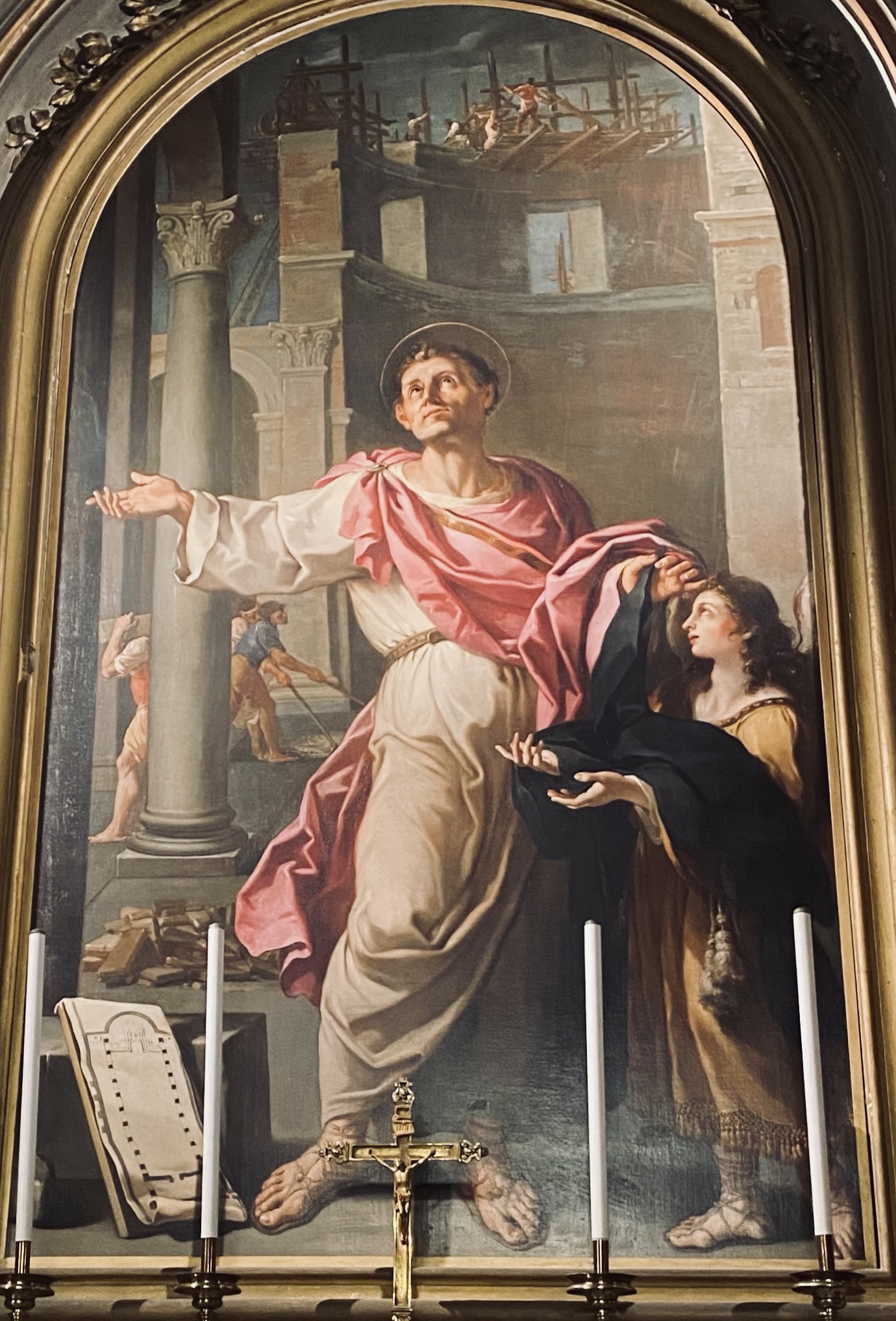
A picture of St. Pammachius (c 409), builder of the Church of Saints John and Paul in Rome, is on the right side of the church towards the altar. He was a friend and patron of St. Jerome (342-420) . Jerome had strong connections with this church and influential Christians like Pammachius, Paula and Fabiola who lived on the Celian Hill.
Before the church was built around 400, Celian Christians met in the house of Pammachius, a Roman senator.The house was owned before him by his father, Byzantus. It was one of the 25 original house churches in Rome. .
Jerome and Pammachius (+c 409 ) studied in Rome together. Pammachius likely introduced Jerome to influential people on the Celian Hill, like Paula and Fabiola and Pope Damasus. Paula and her daughter Eutochium later accompanied and supported Jerome in the Holy Land. Pammachius married another of Paula’s daughters, Paulina. They had no children.
Was Pammachius with his friend Jerome on his visits to the catacombs where Christian martyrs made Jerome question the strength of his own faith? Was he instrumental in bringing his friend to be baptized at St. Peter’s on the Vatican? Jerome recalls renewing his baptism at the fount there after Easter.
Certainly Pammachius shared Jerome’s interest in the scriptures and the religious questions of the day. Jerome later dedicated many of his scriptural commentaries to him. Besides corresponding with Jerome, Pammachius corresponded with Augustine and Paulinus of Nola, important church figures then. He was a leader of the fervent group of prominent Roman Christians, many of them women, who promoted Jerome’s new scriptural translations and commentaries.
After his wife Paulina died in 397 Pammachius began leading a religious life, probably in the style described in the Life of Anthony, written by Athanasius. The bishop of Alexandria and other eastern holy men were visitors to Rome and admired by Christians on the Celian Hill as spiritual teachers.
Anthony heard the scriptures as if they were written for him alone. He gave away all that he had to the poor to follow Jesus. Pammachius pursued a similar path. He and Fabiola, a Christian from the Celian Hill, built a hospice for the poor and the sick near the Tiber River. Pammachius worked vigilantly for the interests of the church. He built the Church of Saints John and Paul.
Why did Pammachius build the Church of Saints John and Paul on the western side of the Celian Hill facing the Palatine Hill and the Roman Forum, center of Roman power? The usual answer it that it honors the relics of the two soldier saints, John and Paul, who were reportedly martyred there.
Certainly that was so, but was his purpose limited to that? Perhaps a monument to his wife Paolina, pictured in the portrait that hangs in the church?
An added suggestion is that Pammachius’ church is an outreach to the hard core of Romans still invested in the traditional Roman religion, whom Augustine also addressed in his work “The City of God”. After Constantine freed Christianity in 312 AD, Christians from the Celian must have been part of an effort to win over to Christianity the powerful Roman majority that remained distant and sometimes resentful of the new faith. The Church of Saints John and Paul must have been part of an effort of Christian evangelization.
Before 312 AD, Christians promoted their faith cautiously; now they presented it boldly, using the Christian scriptures freshly translated by St. Jerome, along with his learned commentaries. The new faith, St. Augustine argued in his City of God, far from causing the empire to fall, offered it a powerful new wisdom it needed. Roman Christians confidently believed they had something to say to their city and made their appeal from splendid new churches, like the Church of Saints John and Paul.
The feast of St. Jerome, the great biblical scholar, is a good time to look at the history of the bible itself. Where does it come from? I happen to be staying today in a place Jerome knew well, the Celian Hill, in Rome.
Our Christian bible comes from two closely related religious traditions: Judaism and Christianity. The first books of any Christian bible come from the Jews, the Jewish scriptures. The rest of the writings found in a Christian bible– gospels, letters– come from Christian writers.
It’s good to remember that before printing was invented in the 15th century, the various writings of the bible were copied on papyri and parchment, materials too limited at first to be bound together in one book. “When you come,” Paul writes to Titus, “bring the cloak I left with Carpus, the papyrus rolls and especially the parchment.” ( Titus 4:13)
Paul does not have a complete bible, but only individual writings. Luke’s Gospel describes Jesus in the synagogue at Nazareth taking a scroll of the Prophet Isaiah to read. Unrolling the scroll, he read a passage from Isaiah, probably in Aramaic or Hebrew, then he rolled back the scroll, handed it an attendant, and began to teach. (Like 4:16-30) Something like this:
Ancient scroll Byzantine Museum Wiki Commons
That’s how the scriptures were read in early Christian liturgies, from papyri and parchment copies of individual Christian gospels and letters and various books from the Jewish scriptures.
The first Christians read the books of the Old and New Testament in Greek, the language of the Mediterranean world. Only in the 2nd century did Latin versions of the scriptures begin to appear in Roman North Africa as people began speaking Latin instead of Greek. Versions in other languages, like Syriac, Coptic and Armenian, also appeared as Christianity spread through the world.. Jerome was responsible for the Latin translation.
Codexes or books of the complete Christian Bible appear only towards the 4th century, as printing methods evolved. Only towards the 9th century did complete copies of the Bible become commonplace in the latin Christian world. These complete “books” of scripture were mainly located in a church; some copies might circulate among the wealthy.
Until the 9th century copies of the scriptures were found in mostly in churches, monasteries, and church libraries of western and eastern Christianity . Complete copies of the scriptures were marked for use in the liturgies and feasts of the church. Often the scriptures appeared in lectionaries specifically designed for use in the liturgy. The ordinary Christian heard the Word of God proclaimed and then commented on in a church.
Gospel of Mark. Vulgate
St. Jerome began his important translation of the scriptures from Greek and Hebrew into latin and wrote his commentaries from 382 till his death in 420. His translations, known as the vulgate, were sponsored by friends in Rome, especially Pope Damasus, who looked for a fresh translation of the various latin versions currently in use in the western church.
The Roman church then was experiencing a spiritual revival, and Roman Christians, especially women from the wealthy families on the Caelian and Aventine hills, found Jerome writings and translations from the original Greek and Hebrew inspiring. Like all languages, latin was a developing language and Jerome produced the scriptures in a language they appreciated. Some of his wealthy friends produced copies of his translations and commentaries, which they circulated among themselves.
The Roman senator, Pammachius, whom Jerome called “ my old fellow-learner, companion and friend”, was one of the advocates of the new translations. Like other Roman Christians, he hoped to convert the followers of Rome’s traditional religion through the wisdom of the scriptures. What better resource to win them over than fresh translations of the Christian scriptures from the original Greek and Hebrew and commentaries of a brilliant scholar like Jerome?
Pammachius built an impressive basilica on the Caelian Hill in sight of the Roman Forum, Saints John and Paul. Until then, no Christian church was built in this area in deference to the sensibilities of Rome’s traditional religion firmly established in the temples and monuments of the forum.
Saints John and Paul was the first Christian church to be built in this sensitive area, according to Richard Krautheimer, an expert on Rome’s early Christian churches. The church not only honored two Roman Christian martyrs but it brought the Christian message to the spiritual heart of Rome, the Roman Forum.
Gutenberg Bible. New York Public Library. Wiki commons
Jerome’s latin translations of the scriptures, the vulgate, remained the scriptures western Christians read until the printing press revolutionized communication in the western world in the 15th century. The Gutenberg Bible, an edition of the latin vulgate printed in the 1450s, ushered in the mass production of bibles. No longer for a few, the bible became available for all.
The Protestant Reformation benefitted especially from new versions of the scriptures quickly produced in the languages of western Europe. The Catholic Church reacted defensively, fearing that the faithful, uninstructed in the scriptures, would question the traditional teachings of faith. Instead of a biblically grounded spirituality fostered by the flow of printed bibles, the church turned to a spirituality nourished by devotions.
Thanks to the work of Catholic biblical scholars in the last century following in the footsteps of St. Jerome, the Catholic Church recognized the importance of the scriptures at the Second Vatican Council (1962-1965 ). In its Constitution on Divine Revelation the church professed her veneration for the scriptures “just as she venerates the body of the Lord, since, especially in the sacred liturgy, she unceasingly receives and offers to the faithful the bread of life from the table both of God’s word and of Christ’s body.”
The scriptures are “together with sacred tradition, the supreme rule of faith… Therefore, like the Christian religion itself, all the preaching of the Church must be nourished and regulated by Sacred Scripture.” They are “the food of the soul, the pure and everlasting source of spiritual life.” (DV 21)
“Easy access to Sacred Scripture should be provided for all the Christian faithful. That is why the Church from the very beginning accepted as her own that very ancient Greek translation of the Old Testament which is called the septuagint; and she has always given a place of honor to other Eastern translations and Latin ones especially the Latin translation known as the vulgate. But since the word of God should be accessible at all times, the Church by her authority and with maternal concern sees to it that suitable and correct translations are made into different languages, especially from the original texts of the sacred books. And should the opportunity arise and the Church authorities approve, if these translations are produced in cooperation with the separated brethren as well, all Christians will be able to use them. “ (DV 22)
The council also decreed that a treasure of scripture be available in the liturgy of the church.
St. Jerome and later scripture scholars were recognized at the Second Vatican Council, but the task of creating a biblical spirituality in the Catholic Church remains to be done. For Jerome it was not an easy task. His letters reveal that in his day critics strongly questioned his scholarly efforts. Even prominent teachers like St. Augustine were not altogether in favor of Jerome’s new translations, but favored versions they were used to.
Fostering a biblical spirituality today is not an easy task. St. Jerome, pray for us.
For a history of the Bible, see the Bible: A Global History, by Bruce Gordon, , Basic Books, New York 2024






 The Victor's Place