The Conversion of St. Paul

January 25th is the Feast of the Conversion of St. Paul. It came in a blinding moment, so different than the call of Jesus’ other apostles.

Caravaggio’s dramatic painting of Paul on the flat of his back, arms outstretched, helplessly blind is a vivid picture of humanity before God.

Conversion is God’s work; God alone gives the gift of faith.

The first reading for his feast tell the dramatic story of his conversion. (Acts 22, 3-16)  In the gospel of Matthew,Jesus announces why he was called – to preach the gospel to all nations.(Matthew 16,15-18)

“May the Spirit fill us with that light of faith.”

For St. John Chrysostom  “Paul, more than anyone else, has shown us what we really are, and in what our nobility consists, and of what virtue a human being is capable. Each day he aimed ever higher; each day he rose up with greater ardour and faced with new eagerness the dangers that threatened him. He summed up his attitude in the words: I forget what is behind me and push on to what lies ahead.

“When he saw death imminent, he bade others share his joy: Rejoice and be glad with me! And when danger, injustice and abuse threatened, he said: I am content with weakness, mistreatment and persecution. These he called the weapons of righteousness, thus telling us that he derived immense profit from them…

The most important thing of all to Paul was that he knew himself to be loved by Christ.”

May God give us that grace .

Today ends the Week of Prayer for Christian Unity.

May God give us all that grace.

Extra Ordinary

by Orlando Hernandez

Since January 14 we have been observing “Ordinary Time” in our Liturgy. Fr. Victor Hoagland has been pointing out how most of our Church year takes place in this Ordinary Time, and how this reflects the reality of our lives. Our hours, months, and years are mostly made up of ordinary things and activities. We eat, sleep, get up, brush our teeth, work, interact with those nearest to us, and live in those challenges and blessings that they bring to us. We drive past the same stores and barely see the same winter trees along the way. We wear and wash the same clothes. We each have our own routines.

Fr. Victor tells us that it is especially in those moments that the Presence of the Beloved can be found. In an almost “Buddhist” way, he advises us to be mindful of all the experiences we have, no matter how simple or common. There is great Beauty and Light there.

I have been trying. I see a new loveliness in those bare trees, reaching up to heaven. I am suddenly struck by the flavor of morning cereal. At home, I have been picking up different objects that I walk past every day. I feel them in my hands and actually discover things about them: the material they are made of, a craft-person’s signature, a chip or break (when did it happen?). I remind myself of why I have kept these objects around in the first place. They each hold a blessed, special memory of someone I regard, or love.

Suddenly, these objects become luminous with feeling and meaning, leading me to realize that there’s even more to life than just what is there in front of me. My faith is stirred. I feel the presence of my Creator and Savior in a surprising, and yet familiar way. I hope that you have all experienced something like this at some point during your day or week. We are so loved by this good, wonderful God.

The simple, insipid water that occupies our earthen vessels can be unexpectedly changed into the finest wine by realizing that the Holy Spirit of our Creator is here within and around us. We believe, and for a moment experience this “life to the fullest” that our Lord desires for all of us. It can be so easy. All we have to do is think and say, “Jesus!”. He is the vehicle to this life of adventure and wonder. He is why this “Ordinary Time” can be so special to me.

Our Gospel readings once again begin to relate His story to us. Each weekday we again hear about the deeds of our Lord in the action-filled Gospel of Mark. On Sundays we also continue with His story. I suppose we could say, “here we go again, the same old stories all over.” It is strange, but I really never get sick of hearing them. I know some of these Gospels nearly word for word, and still I find something new, or even better, I re-discover something I had lost. Like a child, I am hungry to hear the same tale again and again!

I have written before about my seven-year old granddaughter, how my relationship with her has given Our Heavenly Father a chance to teach me how much He loves us, His children. For a few years now she has driven me crazy by having me read to her the same children’s book again and again. I try to convince her to try out a different story, but no way! She insists on this slightly worn book. Children lose many things, but this one is still around. I tell her that she knows how to read now, so she can read it to me. Well, not this book, I have to read it. As I read, she goes through the same actions she would undertake as a toddler, pushing a dot on a page so that it will change color on the next, shaking the book, counting the dots, answering questions.

I realize this is a ritual that she loves to share with me. Suddenly, in the middle of this “ordinary” activity the extra-ordinary happens; the Light of our amazing, loving God shines all around. I get an insight into the reason for my love of the Liturgy of the Mass. I experience such happiness. Why does He love us like this?

I realize why I love to hear the Gospel stories again and again. This is because it is my Heavenly Papa who is holding me in His arms while He reads them to me.

Orlando Hernández

January 21-27


JANUARY 21 Mon Saint Agnes, Virgin and Martyr
Memorial
Heb 5:1-10/Mk 2:18-22 (311)

22 Tue USA: Day of Prayer for the Legal Protection of Unborn Children
Heb 6:10-20/Mk 2:23-28 (312)

23 Wed Weekday
[USA: Saint Vincent, Deacon and Martyr; USA: Saint Marianne Cope, Virgin]
Heb 7:1-3, 15-17/Mk 3:1-6 (313)

24 Thu Saint Francis de Sales, Bishop and Doctor of the Church
Memorial
Heb 7:25—8:6/Mk 3:7-12 (314)

25 Fri The Conversion of Saint Paul the Apostle
Feast
Acts 22:3-16 or 9:1-22/Mk 16:15-18 (519)

26 Sat Saints Timothy and Titus, Bishops
Memorial
2 Tm 1:1-8 or Ti 1:1-5 (520)/Mk 3:20-21 (316)

27 SUN THIRD SUNDAY IN ORDINARY TIME
Neh 8:2-4a, 5-6, 8-10/1 Cor 12:12-30 or 12:12-14, 27/Lk 1:1-4; 4:14-21 (69)
28

An interesting group of saints this week, starting with St. Agnes (January 21) , the brave young girl martyred at the beginning of the 4th century for going against the state. She’s a reminder of the power of women in our church and a wonderful example of the holiness young people can attain.

The Conversion of St. Paul (January 25) and his two disciples, Timothy and Titus (January 26). What would our church be without them? The Church Unity Octave begins today with prayers that God give a converting grace to the Christians churches that they become the one church Jesus prayed for.

St. Francis de Sales was a great communicator when a fractured Europe needed communication. Would he be interested in the internet today?

St Maryanne Cope was a American nun who, after founding two hospitals in upstate New York, served lepers in Hawaii. She reminds us of the heroic service women religious have given to the church in the United States and in the world.

January 22 is a day of prayer for the legal protection of unborn children. A major issue in society today.

Waiting

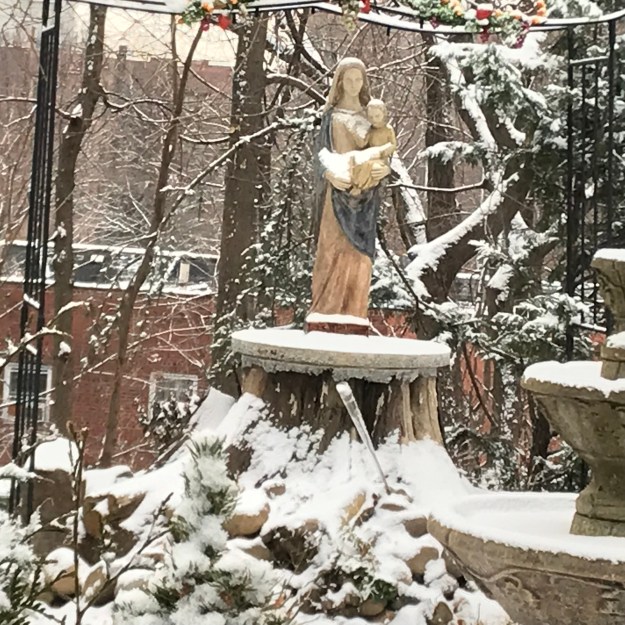
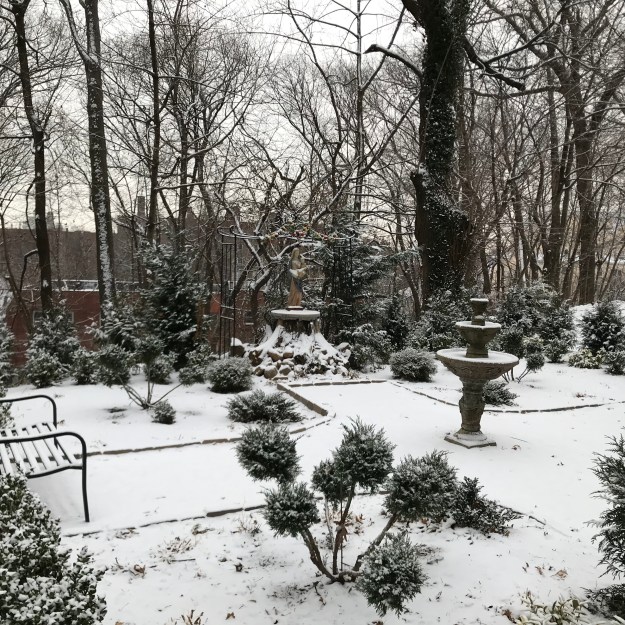
In our Mary Garden this morning, all’s covered with light snow.

Mother and Child share the blanket covering trees and plants and ground.

Somewhere a car horn; someone’s stuck in traffic.


But mostly soft silence here as snow fall quietly.


Waiting.

He Came to Nazareth

The gospel readings this week are not just from one gospel, as they usually are. The readings this week after the Epiphany to the Baptism of the Lord ( January 7-12) are from the four gospels and each tells us that Jesus Christ, the Word Incarnate, manifested himself to all. In Psalm 2 (Monday) God says “I will give you all the nations as an inheritance.” Jesus gives himself to all.

This week each gospel points to the universal mission of Jesus already evident as he ministers to the people of his own time and place. Matthew’s gospel on Monday says he began his ministry in the “Galilee of the Gentiles.” “Great crowds from Galilee, the Decapolis, Jerusalem, and Judea, and from beyond the Jordan followed him.” Gentiles from the Decapolis and beyond the Jordan as well as Jews were already approaching him. Matthew 4,12-17, 24-25)

In the readings from Mark’s Gospel for Tuesday and Wednesday, Jesus multiplies the loaves and the fish on the Jewish side of the Sea of Galilee and then sets out on the sea for the other side, the pagan side, to bring the blessings of these signs to them also. (Mark 6)

On Thursday and Friday, there are excerpts from Luke’s Gospel. On Friday Luke recounts the cure of the leper. The leper’s cure promises that Jesus will reach out to all the abandoned throughout the world.

On Saturday, in the reading from John, John the Baptist recognizes that Jesus “is baptizing and everyone is coming to him.” Jesus will bring the waters of life to all.

Luke’s reading for Thursday, though, is somewhat puzzling. Jesus goes to Nazareth where he was raised and is rejected, but notice Luke’s reading for that day ends before the account of his rejection: “And all spoke highly of him and were amazed at the gracious words that came from his mouth.” (Luke 4, 14-22)

That’s the way we would have liked Nazareth to respond to the presence of Jesus when he first came there, but the town rejected him and Jesus never returned, the gospels say.

Do our readings this week offer the promise that Jesus, as the Risen Christ entrusted with the mission to save all, always returns to the hard places and most resistant people?

That means we’re not to give up on the Nazareths of this world that seem too far gone, too faithless, to ever hear the gospel. “Lord, every nation on earth will adore you,” our psalm says.

Christmas Light and Song


by Orlando Hernandez

In our home we put up this image of Mary and Jesus across from our front door. Over the door there is a window that lets in the low, December sun from the front porch. This Christmas season, on the porch light we set up a big, transparent plastic star, that we light up at night. But in the morning, as the sun’s rays are refracted by the star and enter through the window this wonderful effect is created over the picture of the Mother and Child. People have told us that it is “miraculous”, “ a sign”, “ a gift from God”. It has certainly filled me with delight and gratitude. I took it as an “omen” that this would be the best Christmas ever. It wasn’t quite so.

The artist did not seem to intend for us to smile at this picture. If you look carefully at the expressions of the Mother and Child, they look deadly serious. The Christ Child seems to be a few months old. They were probably living in Egypt at he time, migrants, refugees from the crazy violence of humanity. What do these stern looks tell us?

Around this time, on a typically bleak, rainy December morning, I walked past a car with a recently purchased “natural” Christmas tree on its roof. I was disturbed by the image. It reminded me of a dead deer tied to the roof of a hunter’s car. I thought of this lovely young fir tree, already six feet tall, full of life and potential, suddenly killed by the chain-saw, destined in a few weeks to be cast out on the curb to be picked up by the garbage truck. Then I also imagined it full of decorations and light, Christmas standards playing in the background, brightening up a home, a sign of unity, family, and most of all, a sign of our Lord Jesus Himself, born among us, bathing our lives with the Divine Light of His Message, and then crucified by us, buried in a cave, limp, wet, and lifeless.

Let’s not forget He resurrected, ascended into His Glory, and invites us to share in His Eternal Life.
I guess I was in this mood after reading the
Christmas message from Fr. Rick Frechette CP, who is also a medical doctor and, as far as I am concerned, a mystic. He has been working in Haiti for more than 20 years, starting from nothing and helping courageous Haitian citizens to heal the sick, shelter the orphans, educate the poor, help the people to sustain themselves, and very importantly, bury the dead with dignity and prayer.
Fr. Rick’s letter was titled “Christmas When Darkness Seems Darker.” He starts by quoting the poem “Anthem”, by Leonard Cohen:

Ring the bell that still can ring,
Sing the song that still can sing.
There’s a crack in everything-
That’s how the light gets in.

They have such a bell in their Mission. They rescued it nine years ago from he ruins of a church after the devastating earthquake that killed some 150,000 human beings. Fr. Rick goes on to talk about the political violence that took place at the end of November of last year in the La Saline section of Port au Prince:
“We worked daily in La Saline, with the help of the Sisters of Mother Theresa, to help refugees (mostly young mothers and their children), also to recover and bury the dead, and to rescue the wounded, the old, the disabled that were not able to flee.” Fr. Rick goes on to describe the grief-stricken women rolling up the tin roofs from the ashes of their burned homes, to put them on their heads and carry them to a new home. Where?
Fr. Rick writes:
“By what deep light in their souls, did they rise from their knees to their feet in those ashes?
A light coming through the deepest cracks of broken hearts.
By what soulful music in their hearts, did they take their first steps, weeping loudly,
turning their backs to what was just yesterday their whole life,
to walk toward an unknown tomorrow?
The poem ‘Anthem’ speaks of the mighty spirit of these women,
and of the ancient Christian wisdom that the very place of death is also the very place of rising again.
The bitter place of burial is the very place of resurrection.
The crack in the earth that serves as a tomb, blasts forth the glorious light of Rising eternally.
Yes, there is a crack in everything.
That’s exactly where to be, where to serve, where to wait for the light.
It is worth the wait.”

If you want to learn more about Fr. Rick’s work in Haiti and how the organization that he started has grown so beautifully, you can go to their very elegant website: “St Luke Foundation for Haiti”. Fr. Rick’s letter is there in it’s entirety. If you have any dollars left after all this Christmas spending you certainly can help this good cause. They even offer opportunities for volunteering. Check it out.
The website is full of hope and light. The light that shines through the cracks. The light that breaks into prismatic colors, emanating from the Glory of God.

Orlando Hernandez

The Epiphany Feast Isn’t Over!

Kings Point, New York

Like the Christmas feast, we can pass over the Feast of the Epiphany too easily. It can become a quaint story of no significance.

I spoke about the meaning of the Epiphany on Sunday at the Maritime Academy in Kings Point, New York, where young men and women are being trained for service on the ships that sail our seas and waterways. This feast should mean something to them.

The only gospel that records this story is the Gospel of Matthew, so why is it there?

Matthew’s gospel was written for Jewish Christians in Galilee and Syria some time after the temple in Jerusalem was destroyed by the Romans in the year 70. We can’t imagine how shocked they were by the complete destruction of the temple and the city itself. These were places where God’s promises would be fulfilled, they thought. The Messiah would appear there. This was where Jesus would come again. All nations would stream to Jerusalem, prophets like Isaiah foretold. Now they were gone.

Matthew’s gospel reminds his hearers–and us too–that Jesus must be known by all nations before he comes again. “Go and make disciples of all nations,” Jesus says in his final words in Matthew’s gospel, “baptizing them in the name of the Father and of the Son and of the Holy Spirit, teaching them to observe all that I have commanded you. And behold, I am with you always, until the end of the age.” (Matthew 28, 18-20)

Matthew’s story of the Magi is a reminder that even as Jesus is born, messengers, strangers, wise men from afar, want to know and acknowledge him as their king and God.

Jesus Christ came, our gospel says, not for only one people or nation, but for all. Though his ministry was first to the Jews, Jesus wishes to make the world one. God doesn’t wish to save a few. He wants to save all– all the world.

The Magi came, our story says, from the east. Could that be from Iran or Yemen; two places we hardly view positively today in our country? More and more, as we look at the world only through the lens of politics and economics; we fear the stranger, we reject the immigrant, we create enemies, we reject people not like us. We’re becoming tribal instead of global. We’re falling into individualism. As the old song said, we’re looking for “perfect peace, where joys never cease, and let the rest of the world go by.”

But we can’t let the rest of the world go by and we won’t be safe behind walls. We’re living in a big world that God wants to be one. That’s what the story of the magi tells us. We’re all commissioned on this Feast of the Epiphany, which is followed next Sunday by the Feast of the Baptism of Jesus, to go out into the whole world, “ baptizing them in the name of the Father, and of the Son, and of the Holy Spirit,” teaching them to observe all that Jesus commands. And he will be with us, even to the end of time.

I told the young men and women at Kings Point on Sunday that they’re commissioned as people of the sea. The oceans and waterways are highways uniting this world of ours. They shouldn’t be looked at only through the eyes of economics or politics. They’re meant to connect peoples, they’re bridges that make us one.

As I left the chapel, I met some people who are “furloughed” by the current government shut-down. We don’t have to look far to see how dangerous it is to see the world only through the eyes of politics and economics. We need a brighter star.

Epiphany to the Baptism of Jesus


JANUARY 6 SUNDAY THE EPIPHANY OF THE LORD
Solemnity Is 60:1-6/Eph 3:2-3a, 5-6/Mt 2:1-12 (20)

7 Mon Christmas Weekday
[Saint Raymond of Penyafort, Priest]
1 Jn 3:22—4:6/Mt 4:12-17, 23-25 (212)

8 Tue Christmas Weekday
1 Jn 4:7-10/Mk 6:34-44 (213)

9 Wed Christmas Weekday
1 Jn 4:11-18/Mk 6:45-52 (214)

10 Thu Christmas Weekday
1 Jn 4:19—5:4/Lk 4:14-22a (215)

11 Fri Christmas Weekday
1 Jn 5:5-13/Lk 5:12-16 (216)

12 Sat Christmas Weekday
1 Jn 5:14-21/Jn 3:22-30 (217)

The readings for the week after the Epiphany to the Baptism of the Lord speak of the various manifestation of Jesus as he is Incarnate. He manifests himself to all. “I will give you all the nations as an inheritance.” (Psalm 2, Monday) The gospel readings this week from Matthew, Mark, Luke and John indicate his universal mission was evident even in his ministry to his own people and time. It’s the “Galilee of the Gentiles” where his ministry begins. “Great crowds from Galilee, the Decapolis, Jerusalem, and Judea,and from beyond the Jordan followed him,” according to Matthew. Gentiles as well as Jews were in those crowds. (Monday)

Jesus multiplies the loaves and the fish on both sides of the Sea of Galilee according to Mark’s gospel  Saving signs meant for all. . (Tuesday and Wednesday)

Already in Nazareth, among his own people, he proclaims universal salvation from the Book of Isaiah,  The leper who is cured is a sign of all those everywhere who will be cured. ( Luke, Thursday and Friday)

His baptism, unlike that of John’s, brings the waters of life to all people. (John, Saturday)

We read the First Letter of John throughout the week. Jesus is not the only one who goes out into the world. “False prophets go out into the world” too. Loving one another and a strong commitment to Jesus Christ, human and divine, are what gets us our reward. It’s not by seeing or understanding everything, but by loving one another and believing in him that we remain in the truth. “Those begotten by God conquers the world. And the victory that conquers the world is our faith.” (1 John 3-4)

They Guide Us Still


The calendar of the Roman Catholic church was reformed in 1969 after the Second Vatican Council. One aim of the reform was to ensure that the mysteries of Christ celebrated during the year were not overshadowed by celebrations of the saints, especially during the seasons of Advent Christmas, Lent and Easter. To achieve that goal, the number of saints in the general calendar was reduced, some historically unreliable saints eliminated and celebration of other saints made optional.

Particular calendars for various countries, dioceses and religious communities took on the celebration of saints and feasts that were peculiar to them. In the calendar at present there are solemnities, like Christmas and Easter, feasts, memorials and optional memorials.

The new arrangement doesn’t mean that saints aren’t important any more. They are. The saints are examples of faith in their time and promote a vision of faith in our time. They show that “holiness is not bound by time and place.” It’s not limited to the bible or biblical times. It’s found “always and everywhere.”

Saints are not bound by their own time either, they also reach into our time. What’s said of the apostles in the preface for their Masses can be said of other saints too. “From their place in heaven they guide us still.”

Some of the saints we write about in this blog are found in the general calendar of the Catholic Church, others in the calendar of the church in the United States, others in the Passionist calendar.

Saints like Mary, the Mother of Jesus, the apostles, saintly women and men like Theresa of Avila and Francis of Assisi are patrons and guides of the universal church. Other saints, like Elizabeth Ann Seton, John Neumann and Charles Houben– all celebrated this week–are in the United States calendar or the Passionist calendar.

This week the American bishops are on retreat in Chicago. As we celebrate Elizabeth Ann Seton and John Neumann, important saints for the history of the church in North America, may they guide us still.

Charles Houben, the Passionist saint who cured so many at Mount Argus in Dublin, Ireland, still heals and still helps the Passionists understand their charism today.

A Mere Coincidence?

Vincent J. Rizzuto, M.D., FACP

When you’re an 80-year-old doctor, you think you’ve seen it all.
For two years I served as a specialist in internal medicine in the U.S. Army in Okinawa during the height of the Vietnam War.
I’ve done industrial medicine for a large New York bank.
I taught interns and residents at Mary Immaculate Hospital in Queens, New York.
I supervised the work of other doctors prior to my retirement.
But nothing in all my professional experience prepared me for what happened next.
I developed a severe episode of depression following the sudden death of my younger sister. I was afraid I might take my own life if I were left unattended, so I voluntarily consented to several successive admissions to a major psychiatric/medical center in New York City. The diagnosis was endogenous depression and Parkinson’s disease. In short, I suddenly found myself in Hell and proceeded to abandon all hope!

From a technical viewpoint, I received the finest, most comprehensive, up-to-date psychiatric and medical therapy available today. However, my depression was so deep that eventually I exhausted most of the customary therapeutic modalities, including medications. Consequently, I was forced to resort to some of the older agents. The only remaining procedure was shock therapy, but this was discontinued because of serious adverse effects. I remember telling my doctors that I would rather die than undergo shock therapy. For all practical purposes, as far as I was concerned, modern medicine had come to a standstill.

Finally, after a deeply distressing two-year period, I was discharged in “stable” condition for outpatient follow-up. I contacted a doctor friend who “just happened” to know a home health aide who was “ eminently capable and trustworthy”, who in turn, “just happened” to be available since, unfortunately, her patient expired the week before. As Albert Einstein once said, “Coincidence is God’s way of remaining anonymous!”

The next phase of my life was punctuated by a series of plunges–deeper and deeper into depression. The only clear recollection I have of this period was that I experienced an overwhelming, almost constant nausea which was refractory of all treatment. I awakened each morning “immersed” in nausea which progressively worsened throughout the day.

At this point, another doctor friend introduced me to a 92¬–year–old, but positively brilliant Catholic priest, Father Joseph Guzinski, C.P. Father Joe’s ministry was spiritual direction. I told him my story and he became my personal spiritual advisor. This was the only avenue left to explore, but quite frankly, I did not ascribe much hope to it. How could this 92–year–old man in a wheelchair possibly stop the unrelenting onslaught of the depression/nausea–fueled crises which engulfed me?

Father Joe was quick to grasp how sick I was–he immediately got down to business. He instructed me in the use of the holy oil of Saint Charles, and he provided directions for its administration. He suggested that Vanessa (my home health aide) apply Saint Charles’ oil on my forehead in the form of a cross each morning while we recited a prayer to Saint Charles.

Similar to Jesus’ time, olive oil is still used by the Catholic Church to anoint the sick. It’s a sign of God’s mercy, soothing and healing our wounds. Of course, the Church offers other spiritual measures to help those who are ill, but that subject is beyond the scope of this article.

St. Charles spent most of his life as a priest at the Passionist monastery at Mount Argus in Dublin, Ireland. He was responsible for many miraculous cures. In fact, the doctors surrounding the Passionist monastery wanted St. Charles transferred because his miracles had a negative impact on their income!

One day, my severe depression simply vanished as quickly and dramatically as it began. There was no “fuss or fanfare”. I suddenly felt vigorous and healthy–very peaceful, extremely happy– a great weight had been lifted from my shoulders. This euphoric feeling only lasted about 1-2 minutes. Concomitantly, I knew my depression was cured! I can’t tell you how I knew–I just knew and felt it instinctively. This event took place about 7-10 days after we initiated the prayers to Saint Charles with the application of the holy oil. I can pinpoint the day/time precisely. It was 11:00 a.m. Easter Sunday morning.

Subsequently, I was examined by a professor of neurology at New York Columbia-Presbyterian Weill Cornell Hospital. He concluded that I did not have Parkinson’s disease and he advised me to stop taking the very powerful anti-Parkinsonism drugs.

You might ask, to what do I, as a doctor and a man of science, attribute my cure from depression. As a matter of fact, there is very little doubt in my mind because I have never had any difficulty reconciling science and religion.

Perhaps Shakespeare said it best when Hamlet told Horatio, “There are more things in heaven and earth, Horatio, that are dreamt of in your philosophy.”

Let’s review a few facts and then you can decide for yourselves.

First, depression is a serious, even deadly, disorder in which suicides are not uncommon. My depression had a veritable stranglehold on me. I was so nauseous that I couldn’t think or see properly or even walk a straight line. And it was getting worse! And there was no relief in sight!

Following my cure from depression, I developed a problem holding my head up. This is a rare phenomenon known as the “head drop syndrome.” In my case, it was the direct result of the “stranglehold” related to my depression, a reminder, as it were, of the time when I was more dead than alive.

When we are sick, God expects all of us to avail ourselves of the best possible medical care which He has already provided. He will not help us unless we help ourselves. I did that. But there came a point when it was obvious that modern medicine was no match for my disease. Psychiatry was powerless over the degree of depression. This was when I requested divine intervention thorough the intercession of St. Charles. And you know the result.

I would like to conclude with a word of advice. We must be very cautious when we ask for God’s assistance. Don’t be like the businessman who was looking for a parking spot in New York City. He was already late for an important meeting. At last, he looked up in the direction of heaven and said, “Dear God, let me find a parking spot, and I will do anything you want.” Just then, a small truck pulled out, leaving him more than ample room to park. He looked up and said, “Never mind. I found one.”

Miracles are rare, but when they do occur, they often happen very quickly. If you are not observant you are liable to miss them.

As C.S. Lewis once said, “Miracles are a retelling in small letters of the very same story which is written across the whole world in letters too large for some of us to see.”