6th Sunday c: How Do We Get to Heaven?

For this week’s homily please play the video file below.

Kingdom of the Unworthy

by Orlando Hernandez

The three readings for the 5th Sunday in Ordinary Time deal with unlikely persons recruited by God to aid Him in His work of salvation. Isaiah feels doomed before the sight of God because he is “a man of unclean lips.” (Is 6: 5) Saint Paul says that he is “not fit to be called an apostle.” (1 Cor 15:9) Simon Peter kneels in the boat, full of fish, before Jesus, and says, “Depart from me, Lord, for I am a sinful man.” (Lk 5: 8b)
God will have none of this breast-beating. He touches Isaiah with the burning heat of the Spirit of Love and “asks” him, “Whom shall I send? Who will go for us?” Isaiah cannot help but exclaim, “Here I am….. Send me!” (Is 6: 8) After having personally met Jesus, Paul has to admit that in spite of his former guilt, “ by the grace of God I am what I am, and His grace to me has not been ineffective.”(1 Cor 15: 10) So he toils for the rest of his life as a great apostle of God. Peter does not get a break either. Jesus tells him, “ Do not be afraid; from now on you will be catching men.”
(Lk 5: 10b) No time for feeling guilty, Simon Peter, Andrew, John, and James “left everything and followed Him.” (V: 11b)
This week’s Gospels from Mark also deal with “unworthy” people who are touched by Jesus. People who might be blamed for their illnesses because of their sins are brought by others to the marketplace, “and as many as He touched were healed.” (Mk 6: 56a) Then Jesus defends disciples who “ate their meals with unclean, that is, unwashed hands.” (Mk 7: 5) In spite of the Syrophoenician woman being an “unclean” gentile, “ a dog”, Jesus the Jew is impressed by her loving perseverance and heals her daughter. (Mk 7: 24-30) When He returns to the gentile Decapolis He heals the deaf man, through physical contact and intimacy. (Mk 6: 33-36) It is important for me to notice that just like the people in the marketplace, the deaf man had been “ brought to Him” by people interceding for him, just like the Syrophoenician woman for her daughter. Perhaps Jesus had been recommended to these folks by the Gerasene man who was cured of those cruel demons. Jesus had told him, “Go home to your family and announce to them all that the Lord [our Loving Father] in His pity has done for you.” (Mk 5: 19)
Do we do this? Do we proclaim to all we meet what Jesus has done for us? Or are we too embarrassed ? Do we show it? Do we live as examples of the Gospel? Do we pray for, and touch, and attend to anyone who comes to us in need of God’s help, the way those folks in the Gospel do? I feel pretty sure that most of the people reading this try to live this kind of life, and I rejoice in this. It gives me the strength to try harder.
This weekend I attended a conference titled “Release the Spirit!” This wonderful speaker, Bob, exhorted us to stop beating our breasts and saying “I am not worthy.” Indeed, we are not, but our Lord has died on the Cross so that we may approach His throne in confidence that His Holy Spirit will be poured upon us, to burn within our hearts and heal us. Let’s be renewed by this great Gift, through heartfelt, humble prayer every day, not feeling as much entitled, as feeling so, so grateful for His mercy. But let’s not keep the fire, the grace, the miracle there hiding. Let’s release that Spirit of Love upon the world, especially on those lying prostrate in the marketplaces of our culture, those unclean, unworthy ones, the people in “ the fringes” that Pope Francis talks about. Let us Catholics be open to everyone, welcoming them warmly into our lives, into our churches, like the Evangelicals do. Let us, like our Pope, open our hearts in respect and dialogue with people of all faiths.
Last month in Church we heard passages from the Letter to the Hebrews, my beloved book of the Bible. One of my favorite passages was not included, (Hebrews 13:1-3, 11-16):

“ Let mutual love continue. Do not neglect hospitality, for through it some have unknowingly entertained angels. Be mindful of prisoners as if sharing their imprisonment and of the ill-treated as of yourself, for you also are in the body….. The bodies of the animals whose blood the high priest brings into the sanctuary as a sin offering are burned outside the camp. Therefore, Jesus also suffered outside the gate, to consecrate the people by His own blood. Let us then go to Him outside the camp, bearing the reproach that He bore. For here we have no lasting city, but we seek the one that is to come. Through Him then let us continually offer God a sacrifice of praise, that is, the fruit of lips that confess His name. Do not neglect to do good and to share what you have; God is pleased by sacrifices of that kind.”

Praised be the Name of Jesus!

Orlando Hernández

February 11-17

We’ll be reading from the Book of Genesis for next two weeks. In his letter Laudato si Pope Francis asks that we reflect on the Book of Genesis to deepen our understanding of God’s creation. Good time to do it.

Monday, February 11, we remember Our Lady of Lourdes who appeared to St. Bernadette at Lourdes in France in 1858. We remember her as we read from Genesis, for she’s the new Eve, the mother of all the living.

Readings from the 7th chapter of Mark’s gospel during the week center around the objections of the Pharisees that Jesus and his disciples are not keeping Jewish laws. Jesus not only asks for a more spiritual approach to Jewish observances but he and his disciples head for pagan territory to bring them news of God’s kingdom .
February 14 we remember Cyril and Methodius who brought the news of God’s kingdom to the Slavic peoples.

FEBRUARY 11 Mon Weekday
[Our Lady of Lourdes]
Gn 1:1-19/Mk 6:53-56 (329) Ps 1

12 Tue Weekday
Gn 1:20—2:4a/Mk 7:1-13 (330)

13 Wed Weekday
Gn 2:4b-9, 15-17/Mk 7:14-23 (331)

14 Thu Saints Cyril, Monk, and Methodius, Bishop
Memorial
Gn 2:18-25/Mk 7:24-30 (332)

15 Fri Weekday
Gn 3:1-8/Mk 7:31-37 (333)

16 Sat Weekday
[BVM]
Gn 3:9-24/Mk 8:1-10 (334)

17 SUN SIXTH SUNDAY IN ORDINARY TIME
Jer 17:5-8/1 Cor 15:12, 16-20/Lk 6:17, 20-26 (78)

5th Sunday of the Year c: A Culture of Tolerance

For this week’s homily, please play the video below.

Fixing Our Eyes on Jesus


We’ve been reading the Letter to the Hebrews at Mass for two weeks now. It’s a good example of how time-conditioned our scriptures are. Those who listened to the letter long ago knew more about the temple in Jerusalem and its round of worship than we do today.  They were more familiar with the story of the exodus and they knew “the great cloud of witnesses” better than we do.. We’re far removed from their times.

We’re people of our age, wired to the absorbing images of our time. Hard as we try, the language of the bible can be hard to appreciate.

Still, one image from those times stands fresh and strong.. It’s the image of Jesus on the Cross.  We must “keep our eyes fixed on Jesus, the leader and perfecter of our faith,” the Letter to the Hebrews says. “For the sake of the joy that lay before him, Jesus endured the cross, despising the shame, and has taken his seat at the right of the throne of God. Consider how he endured such opposition from sinners, in order that you may not grow weary and lose heart.”

The passion of Jesus  speaks to every time and place. It’s a book anyone can read, a sign to get the attention of every age, for it makes  a startling claim. The Son of God, through whom all things were made, endured the shame of dying on a cross.  Jesus, wise and powerful, fell into the hands of his enemies. And it was all because of a wondrous love.

Fixing our eyes on him, our faith in God grows, the Letter to the Hebrews says. If we keep this mystery before us we won’t tire or lose heart. Fixing our eyes on Jesus means fixing our eyes on the eternal God.

So utterly simple. Beyond past images and time.


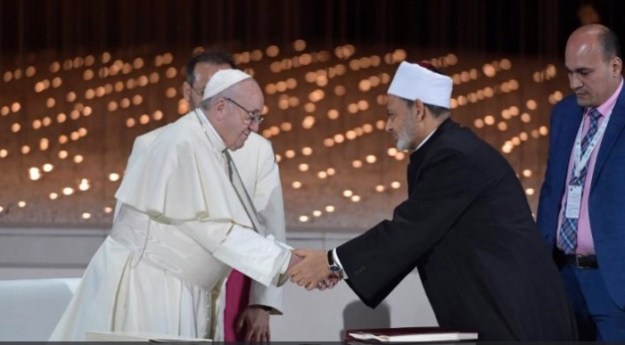
Document on Human Fraternity for World Peace and Living Together


Screen Shot 2019-02-06 at 8.49.53 AM

Pope Francis and the Grand Imama of Al-Azhar, Ahmad el-Tayeb,

“Something is happening.” That’s the way the great reading for our Holy Saturday liturgy, taken from an ancient homily, begins. We don’t see clearly yet, but something is happening.

And that’s the way I felt yesterday watching on YouTube a Mass at Abu Dhabi in the United Arab Emirates where more than one hundred thousand Christian migrant workers in the Middle East celebrated their faith with Pope Francis. Christianity is alive in the Middle East.

In the “Document on Human Fraternity for World Peace and Living Together” signed on Monday afternoon in Abu Dhabi by Pope Francis and the Grand Imama of Al-Azhar, Ahmad el-Tayeb, a path for the two religions and the world itself opened. Something is happening.

The document from leaders of these two great religious traditions, Christian and Muslim, is worth reflecting on.

It begins:
“In the name of God who has created all human beings equal in rights, duties and dignity, and who has called them to live together as brothers and sisters, to fill the earth and make known the values of goodness, love and peace,”

The document speaks for innocent human life, the poor, the destitute and the marginalized, the victims of destruction, calamities and war. It invokes the name of freedom, fraternity, peace and justice, the name of all people everywhere:

“In the name of God and of everything stated thus far; Al-Azhar al-Sharif and the Muslims of the East and West, together with the Catholic Church and the Catholics of the East and West, declare the adoption of a culture of dialogue as the path; mutual cooperation as the code of conduct; reciprocal understanding as the method and standard.”

“We, who believe in God and in the final meeting with Him and His judgment, on the basis of our religious and moral responsibility, and through this Document, call upon ourselves, upon the leaders of the world as well as the architects of international policy and world economy, to work strenuously to spread the culture of tolerance and of living together in peace; to intervene at the earliest opportunity to stop the shedding of innocent blood and bring an end to wars, conflicts, environmental decay and the moral and cultural decline that the world is presently experiencing.”

One commentator Tuesday said a meeting like this takes time for its meaning to be felt. “Something is happening.”

Facing “Unclean Spirits”

Edvard Munch: The Scream


When Jesus and his disciples cross the sea into pagan territory– an important new step in his ministry– they meet a man in the tombs and Jesus drives the unclean spirit out of him. (Today’s reading: Mark 5, 1-20) 

Throughout  his ministry “whenever unclean sprits saw him they would fall down before him and shout, ‘You are the Son of God.’ (Mark 3,11) Unclean spirits were favorite targets for Jesus in his ministry.

What’s an “unclean spirit”?

In their fine commentary on Mark’s gospel John R. Donahue, SJ, and Daniel Harrington, SJ, say “In this context ‘unclean’ (akatharton) primarily connotes not a moral (even less a sexual) fault), but something opposed to the “holy.” In the command of the Old Testament to be holy (Leviticus 11,44) it implies life, wholeness and completeness,( Leviticus 21, 17-21) whereas uncleanness implies something that should not be, something out of place ( e.g. soil in a farmer’s field is productive, while in a house it’s dirt). The opposite of the realm of the holy is the demonic, hence the spirits there are “unclean”. Physical defects or psychological aberrations can make a person “unclean”in a sense of incomplete, imperfect and out of order.”
(The Gospel of Mark, Sacra Pagina, Liturgical Press 2002 page 80.)

Jesus did not focus on the intellectual establishment or the religious establishment in his ministry. He engaged the chaotic world of the “unclean spirits.” He set up a “field hospital” to use a phrase dear to Pope Francis.

That can be a messy, scary world, as we see in Mark’s gospel. Just think of the poor man in the tombs, chained and hurting himself. Who wants to deal with him? But Jesus gives his disciples “authority” over unclean spirits. His followers have the power to take them on.

Jesus commissioned  his apostles for this ministry. He summons “the twelve and began to send them out two by two and gave them authority over unclean spirits.” (Mark 6, 7) We’re not out of place in our chaotic world today.

4th Sunday c: Nazareth

For this week’s homily, please play the video below.

Presentation in the Temple, February 2nd


DSC00129

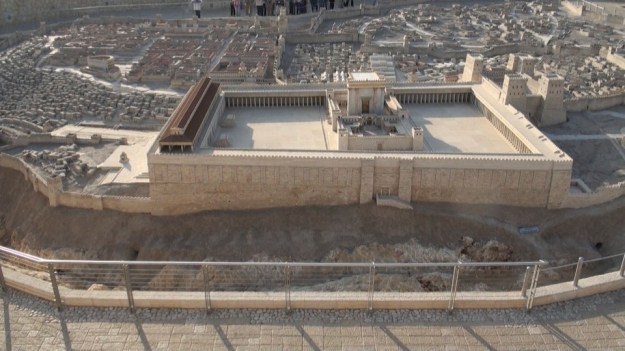
Temple of Jerusalem, 1st century, Israel Museum

The Presentation of Jesus in the temple, forty days after his birth, is a Christmas feast, even though our Christmas decorations are put away. It’s part of Luke’s Infancy Narrative.

The temple of Jerusalem– a reproduction is pictured above– plays a big part in Luke’s Infancy Narrative,  even more important than the stable to which the shepherds came.  The angel announced John’s birth to Zachary in the temple, and there Jesus is presented after his birth. Later, he will come to the temple as a young boy and  impresses its teachers, as he listens to them and asks them questions.

Luke doesn’t dwell on the rituals or appearance of the temple– he may not know much about them–but the temple for him is where God is present, and so it’s the place where Jesus would be recognized. Forty days after his birth, two elderly Jews, Simeon and Anna, recognize him. They’re  faithful believers who  represent the generations waiting for the Messiah.

Old Simeon takes the child in his arms:

“Now, Master, you may let your servant go
in peace, according to your word,
for my eyes have seen your salvation,
which you prepared in the sight of all the peoples:
a light for revelation to the Gentiles,
and glory for your people Israel.”  (Luke  2,22-40)

Afterwards in his gospel Luke describes the rejection of Jesus by his neighbors in the synagogue at Nazareth– neighbors who saw him so frequently but don’t recognize him. Here in the temple two faithful Jews, Simeon and Anna, waiting for years, receive him. The long wai in the temple has not dulled their eyes. In fact, it has made them sharper. They see salvation in this little child, ” a light of revelation to the gentiles, and the glory of  your people Israel.”

Presentation

So true, isn’t it, waiting can dull our eyes? Year by year can diminish what we expect and hope for. Day after day, faith can get tired. Prayers can become rote, sacraments can become routine. A holy place can become just another place.

It wasn’t so for these two elderly Jews. Their steady presence in the temple made them sharper, quicker to recognize the light that came to that place. We bless candles today, to burn in our church this year, and we pray that our church may never be dark but a place where we see the light of Christ and recognize his will for us and for our world.

“Outwardly Jesus was fulfilling the law, but in reality he was coming to meet his believing people. Prompted by the Holy Spirit Simeon and Anna came to the temple. Enlightened by the same Spirit, they recognized the Lord, so let us also gathered by the Holy Spirit, enter the house of the Lord and encounter Christ and recognize him in the breaking of the bread until he comes again, revealed in glory.”  (Feast of the Presentation)


Faith like a Mustard Seed.

We would like a stronger faith, like the apostles, “Increase our faith,” they ask Jesus, faith that understands everything immediately and sees everything clearly–right away! We can hear ourselves asking for faith like that.

In response, Jesus offers a mustard seed. Look at this tiny seed, he says. With faith like this, you can accomplish the most impossible things. What does he mean?

A mustard seed is so small that you hardly can see it in the palm of your hand, Yet once in the ground it grows into a full sized tree, through cold and heat, nights and days, all kinds of weather. But it takes time.

Faith is like that. It grows, but its growth takes place over time, day by day, through the common experiences that come our way. God dwells in the ground of daily life and it’s there we meet him most of all. That’s why the psalm insists: “If today you hear his voice, harden not your hearts.”

Today in countless little things, in unassuming moments, God speaks to us. God acts. And even as the moments slip by, God’s plan unfolds. We need a daily faith, a patient faith, a faith like the mustard seed, to wait until it reaches its completion.

“The vision still has its time, presses on to fulfillment, and will not disappoint. If it delays, wait for it, it will surely come, it will not be late.”
A daily faith that watches God’s plan unfold in the course of things.