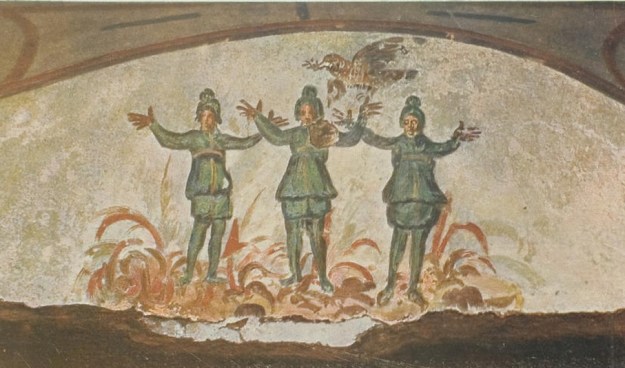
Praying in the Fiery Furnace

In today’s reading from Daniel, three young men are thrown into a fiery furnace by the Babylonian King Nebuchadnezzar because they won’t worship a golden idol. Still, “unfettered and unhurt” they walk freely in the fire, an angel at their side. They’re unharmed, saved by their faith in God.

Here’s Azariah’s prayer:

“Blessed are you, and praiseworthy, O Lord, the God of our ancestors,and glorious forever is your name. For you are just in all you have done;all your deeds are faultless, all your ways right, and all your judgments proper.For we have sinned and transgressed by departing from you,

and we have done every kind of evil. For your name’s sake, do not deliver us up forever, or make void your covenant. Do not take away your mercy from us, for the sake of Abraham, your beloved, Isaac your servant, and Israel your holy one,To whom you promised to multiply their offspring like the stars in heaven.

For we are reduced, O Lord, beyond any other nation, brought low everywhere in the world this day because of our sins. We have in our day no prince, prophet, or leader, no burnt offering, sacrifice, oblation, or incense, no place to offer first fruits, to find favor with you.

But with contrite heart and humble spirit let us be received;As though it were burnt offerings of rams and bulls,or tens of thousands of fat lambs, So let our sacrifice be in your presence today and find favor before you for those who trust in you cannot be put to shame. And now we follow you with our whole heart, we fear you and we seek your face. Do not put us to shame.”

(Daniel 3, 26,27,29,34-41)

The young men in the furnace are from a Jewish community in exile, with no priest, prophet or leader, no temple to offer sacrifice, but they willingly shoulder the world that’s come down from past generations. They also have sins and mistakes of their own.

Their world has become a fiery furnace, but the young men with few spiritual resources of the past still believe in God’s promises: they’ll have offspring like the stars in the sky and the sands of the sea. “We follow you with our whole heart, we fear you and seek your face. Do not put us to shame.”

Is their prayer a good prayer for our church today? Today can seem like a fiery furnace, with diminished resources but hoping in God’s promises, trusting and uncomplaining, we too can walk in the fire, “unfettered and unhurt.”

Readings for March 25-31

On Monday this week we celebrate the Solemnity of the Annunciation of the Lord when, at the invitation of the angel,  Mary consented to become the mother of Jesus Christ. To help us understand the mysteries of faith, the church celebrates them as concretely as possible, and so this mystery of Jesus is celebrated on March 25th, 9 months before Christmas, December 25th, the traditional date of Jesus’ birth. In some ancient church calendars March 25th is also the day Jesus was crucified. All the major Christian churches celebrate this important feast.

The Roman Catholic calendar also suggests reflecting on the scripture readings on the meeting of Jesus with the Samaritan woman, from John’s gospel, some day this week. An important reading in the Lenten catechesis.

March 25 Mon THE ANNUNCIATION OF THE LORD

Solemnity

Is 7:10-14; 8:10/Heb 10:4-10/Lk 1:26-38 (545)

26 Tue Lenten Weekday5 Dn 3:25, 34-43/Mt 18:21-35 (238)

27 Wed Lenten Weekday

Dt 4:1, 5-9/Mt 5:17-19 (239)

28 Thu Lenten Weekday

Jer 7:23-28/Lk 11:14-23 (240)

29 Fri Lenten Weekday

Hos 14:2-10/Mk 12:28-34 (241)

30 Sat Lenten Weekday

Hos 6:1-6/Lk 18:9-14 (242)

Pss Prop 5 

The following readings may be used on any Lenten day this week, especially in Years B and C when the Gospel of the Samaritan Woman is not read on the Third Sunday of Lent: Ex 17:1-7/Jn 4:5-42 (236).

20

31 SUN FOURTH SUNDAY OF LENT violet or rose Jos 5:9a, 10-12/2 Cor 5:17-21/Lk 15:1-3, 11-32 (33)or, from Year A, 1 Sm 16:1b, 6-7, 10-13a/Eph 5:8-14/Jn 9:1-41 or 9:1, 6-9, 13-17, 34-38 (31) Pss IV

3rd Sunday of Lent c: Living by Faith

For this week’s homily please play the video below.

Veronica

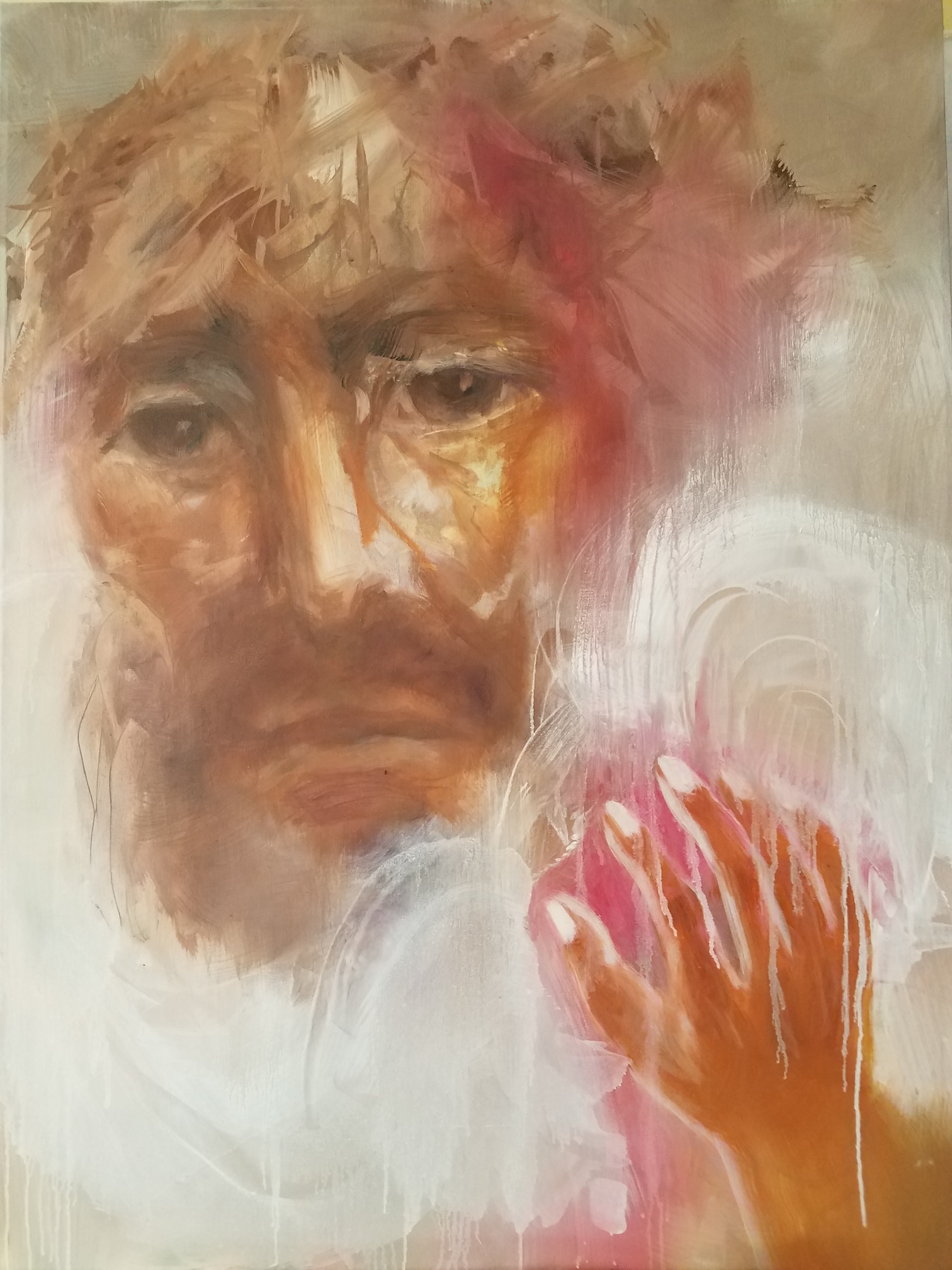
The painting above of Veronica wiping the face of Jesus was done recently by Duk Soon Fwang, an artist whom I have always admired. I asked her the other day what inspired her to paint it.

She told me she liked Veronica, the woman who shoved her way through the crowd, braved the Roman soldiers, took off her head covering and gave it to Jesus to wipe his face, on the way to his death. What courage she had!

Duk Soon wanted to capture the moment when Jesus responded as her hand reached out to him. Some picture his face imprinted on her veil, she said, but she wanted to see his face as he looked at Veronica. 

It’s not important what Jesus looks like, Duk Soon continued, it’s what he did that counts,  but she found she could not paint his face as a white man, as most western artists do. To her his face is the face of a hardworking Mexican immigrant.

She couldn’t paint his eyes, at first, but then she painted them. Jesus sees the woman who wiped his face. “I was in need and you reached out to me.”

Artists have their way of exploring the mysteries of God. 

I’m interested in the gospel accounts of the Passion of Jesus. How did they come about? Some want to see them only as factual accounts of what happened then. Indeed, this isn’t a made up story; Jesus was crucified under Pontius Pilate.

But the story of Veronica, though it didn’t make it into the gospels, is a reminder there were other influences behind the gospels. There were eyewitnesses to the Passion of Jesus; scribes who wrote their stories, apologists who made a point from it, thinkers who saw God’s great designs in it. There were also mystics, artists and ordinary people who saw the human story in the story of Jesus.

 There had to be a Veronica.

The Rich Man and Lazarus

The rich man in St. Luke’s parable today is so absorbed in himself and his “good” life that he sees nothing else, not the poor man at his door nor his own inevitable death. The scriptures, like Psalm 49, often point to the same blindness: “In his riches, man lacks wisdom; he is like the beasts that are destroyed.”

The warning is not just for the rich, however. The same psalm calls for “people both high and low, rich and poor alike” to listen. A small store of talents and gifts can be just as absorbing and make us just as shortsighted as a great store of riches. Whether we have much or little, we have to see the poor at our gate.

We also have to see a life beyond this one as our destiny and what we do and how we live here will count there. There will be a judgment.

But Jesus‘ parable offers another reminder. God has given us a sign in his resurrection from the dead that we have been called to share in his risen life. A great gift has been given, greater than anything we have here.  Yet as the sign of Jonah indicates, some will not believe the sign Jesus Christ, risen from the dead, gives to us. 

May God give us grace to believe in it.

Going Up To Jerusalem

“We” are going up to Jerusalem, Jesus tells his disciples in Matthew’s gospel today and they follow him. They’re weak and human, but together they’ll be  renewed by God’s grace. 

We’re on our way  to Jerusalem too. I may think that Lent is a personal journey I make for 40 days to be renewed in faith, but it’s more than that. Lent is a time we’re renewed by God together. 

The disciples were far from perfect on the journey described in the gospel. Look how weak they are in the story told today. The mother of James and John wanted to get her two sons a good place in the kingdom Jesus promised. “Command that these two sons of mine sit, one at your right and the other at your left, in your kingdom.” She’s looking for power and prestige for her sons and for herself.

Jesus reminds her that his followers are not to be served, but to serve. Serving others won’t make them rich; it will cost them, for “the Son of Man did not come to be served but to serve and to give his life as a ransom for many.” 

The other disciples are indignant when they hear about the mother’s request, but she wont be the last to look for human gain in the gospel. A lot of people think following Jesus brings success.  That’s why Jesus’ words are so important to hear during Lent. Faith doesn’t bring power and success. Following Jesus is about serving others. Serving others is a good part of the  cross we bear.

Make me one who serves,

like you, O Lord.

At the table of life,

let me bend down to wash the feet of others;

help me give life to them.

March 19, 2019


All is well here.

The path is much different than I would have imagined a few months ago.

I am joyfully suprised.

It is a good place to be.

I realize that I had no idea what humility even meant.

It seems that any of my interest in art, literature, writing, words, etc, has evaporated, like the morning dew meeting the rising sun.

It’s almost as if I’m not interested in anything.

I am alive.

And that is beyond interest.

Maybe that’s detachment. Freedom. Liberty. Uninterested love. Love for the sake of love. For the sake of God.

Let’s keep walking. We are never alone. Climb on.


—Howard Hain

3/19/19

Solemnity of Saint Joseph, husband of the Blessed Virgin Mary

Readings: March 18-24


Luke’s Gospel, with its emphasis on the mercy of God and care for the poor, is read on Monday, Thursday and Saturday of this week. Luke’s story of the Prodigal Son is the gospel reading on Saturday.

Matthew’s Gospel for Wednesday reminds us that temptations about power, so obvious in the story of Jesus’ temptations, can also be seen in his disciples, like James and John. 

On March 19, we celebrate the feast of St. Joseph, Spouse of the Blessed Virgin Mary, who cared for Jesus at his birth and early life and was the faithful companion of Mary.

On March 18, St. Cyril of Jerusalem is remembered. The bishop of Jerusalem preached to Christians from all over the world who came to that city to pray at the tomb of Jesus and venerate the place where he died. He was a powerful voice announcing the mystery of the death and resurrection of Jesus.

MARCH 18 Mon Lenten Weekday

[Saint Cyril of Jerusalem, Bishop and Doctor of the Church]

Dn 9:4b-10/Lk 6:36-38 (230) Pss 2

19 Tue SAINT JOSEPH, SPOUSE OF THE BLESSED VIRGIN MARY

Solemnity

2 Sm 7:4-5a, 12-14a, 16/Rom 4:13, 16-18, 22/Mt 1:16, 18-21, 24a or Lk 2:41-51a (543) Pss Prop

20 Wed Lenten Weekday

Jer 18:18-20/Mt 20:17-28 (232)

21 Thu Lenten Weekday

Jer 17:5-10/Lk 16:19-31 (233)

22 Fri Lenten Weekday

Gn 37:3-4, 12-13a, 17b-28a/Mt 21:33-43, 45-46 (234)

23 Sat Lenten Weekday

[Saint Turibius of Mogrovejo, Bishop]

Mi 7:14-15, 18-20/Lk 15:1-3, 11-32 (235)

24 SUN THIRD SUNDAY OF LENT

Ex 3:1-8a, 13-15/1 Cor 10:1-6, 10-12/Lk 13:1-9 (30)

2nd Sunday of Lent: The Transfiguration

For this week’s homily, please play the video below.

Lent Means Looking Again

Our readings this week began with Jesus’ words in Matthew’s Gospel calling us to reach out to “the least”–the stranger, the prisoner, the sick, the naked. Christ reaches out to them, and he says we will find him in them.

But what about those people? Don’t some of them– perhaps many of them– deserve to be in prison or sick or out of a job? That’s what the 1st reading today from the Prophet Ezekiel asks. Why pay attention to them? Let’s take care of the good people.

In Matthew’s Gospel today Jesus takes up the same question, calling his disciples to go beyond the “righteousness” of the scribes and Pharisees, who permitted killing someone as an act of God’s judgment. Jesus returns to the ancient command, “You shall not kill.” Leave someone’s judgment to God.

And he goes further. Avoid any killing judgment against someone by anger or words. They can destroy people too. Leave ultimate judgment to God. 

Does that mean we shouldn’t judge others at all? Jesus never hesitated to judge others, but before judging others he says we have to remove “the splinter in our eye.” That can be anger or arrogance or pride or a lack of self-knowledge or even an ignorance of human nature. It can come from not loving others. Make sure they’re not splinters clouding your judgment, Jesus says. (Matthew 7, 1-5)

When he came among us, some early Christian saints said, Jesus went in search of the lost image of God in every one of his creatures;  he welcomed tax collectors like Matthew and others society condemned. In them he saw “the lost image of God.” He came to call sinners. 

Are we meant to search for the lost image of God in others and to welcome sinners too? But how?

“Respect” is a wonderful word. It describes a wonderful virtue that I’m afraid is more and more ignored in today’s judgmental world. “Respect” comes from a Latin word meaning “to look again”, to look again at someone or some thing to see a value we didn’t see before or denied too quickly.  Respect keeps looking, searching. It’s a permanent way to see others as long as we live, never losing hope of finding the image of God there. 

God’s image is there. We need to see it. Lent means looking again.