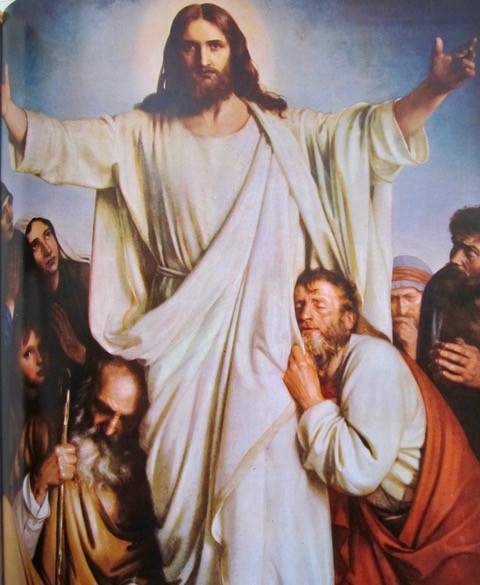
The Journey to Jerusalem

Jesus begins to set out for Jerusalem in today’s reading at Mass from the 10th chapter of Mark’s gospel. Matthew offers a similar account in the 19th and 20th chapters of his gospel.

Jesus doesn’t go to Jerusalem alone, he invites others to go with him. It’s a journey to resurrection and life and more than a couple of days, but as they hear Jesus describe the way to Jerusalem, people react like people do,

You can’t miss human weakness in the journey stories of Mark’s and Matthew’s gospel, beginning with the Pharisees. I suppose they represent human doubt and questioning that’s always there. The disciples rebuked the women bringing their children forJesus’ blessing, and Jesus rebukes them. Be like children to make the journey, Jesus tells them.

The rich young man wants to hold on to what he has, so he goes away sad. Peter says proudly he’ s given up everything to follow Jesus, but we know how inconstant he is. The story of the brothers, James and John, is obviously a story of human ambition.

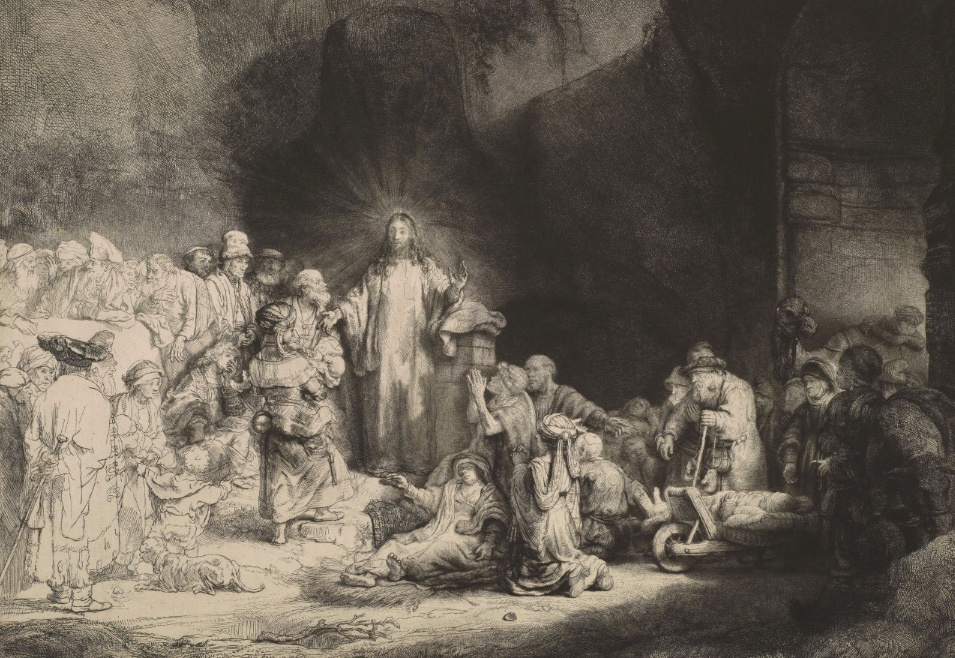
1 Hundred Guilder Print
Rembrandt Hundred Guilder Print

Matthew offers Mark’s stories in chapter 19 and 20 of his gospel. The artist Rembrandt drew a remarkable picture of the 19th and 20th chapter of Matthew called the Hundred Guilder Print.

Jesus stands at the center of Rembrandt’s work, bathed in light, his hands outstretched to the crowds before him.

Peter stands at Jesus right, close by. Other disciples, probably James and John, are next to him. Women and their children, whom the disciples told to go away, are next to them. The rich young man is also there in the crowd. Is he reconsidering?

Some of the enemies of Jesus who plotted against him and argued with him are also there, talking among themselves, but they’re still in the picture. Rembrandt even pictures the camel, back by the city gates.

Jesus sheds his light on them all. His arms are open to them all. Rembrandt has it right. Grace is more powerful than human weakness. It’s everywhere.

8th Sunday c: Advice for the Young

For this week’s homily please play the video below.

February 27–March 3


We’ll be reading from the Book of Sirach at Mass from this Monday till Ash Wednesday, March 6. Sirach is a grandfather’s advice to his grandchildren, filled with encouraging words of faith.

February 27th the Passionists celebrate the Feast of St. Gabriel of the Sorrowful Virgin, a young Italian saint who’s a good example for young people. 

March 1st the Passionists get ready for Lent by celebrating the Solemn Commemoration of the Passion of Jesus Christ. Like the rainbow God chose to promise life and mercy to Noah, the Passion of Jesus is a sign of God’s love for the world. May it be always in our hearts.

FEBRUARY 25 Mon Weekday

Sir 1:1-10/Mk 9:14-29 (341)

26 Tue Weekday

Sir 2:1-11/Mk 9:30-37 (342)

27 Wed St. Gabriel of the Sorrowful Virgin

Gen 12, 1-2,4/Mk 10,17-21

28 Thu Weekday

Sir 5:1-8/Mk 9:41-50 (344)

MARCH 1 Fri Solemn Commemoration of the Passion of Jesus Christ

Gen 22,1-18/Rom 5,12.17-19/Mt 16, 21-27

2 Sat Weekday

Sir 17:1-15/Mk 10:13-16 (346)

MARCH

 3 SUN EIGHTH SUNDAY IN ORDINARY TIME

Sir 27:4-7/1 Cor 15:54-58/Lk 6:39-45 (84)

7th Sunday c: Love Your Enemies

For this week’s homily, please play the video file below.

February 18-24

The readings from the Book of Genesis this week take us out of the Garden of Eden to the world where Adam and Eve begin life anew with their two children, Cain and Abel. A tough world that gets worse as time goes by. Finally, only Noah is left as rain comes down, but God’s promise remains. A rainbow spreads across the sky.

The readings from chapter 8 in Mark’s gospel center on the identity of Jesus. The Pharisees and scribes dispute his claims. His disciples believe he is the Messiah, but Peter in Mark 8, 33 calls him to turn away from his mission to Jerusalem.

The Chair of St. Peter the Apostle is celebrated on February 22nd. The same apostle Jesus calls “Satan” teaches about his mission.
St. Polycarp, the 2nd century bishop of Smyrna, is one of the great martyrs of the early church. An old man who wouldn’t give up his faith and died for it.

FEBRUARY 18 Mon Weekday
Gn 4:1-15, 25/Mk 8:11-13 (335)

19 Tue Weekday
Gn 6:5-8; 7:1-5, 10/Mk 8:14-21 (336)

20 Wed Weekday
Gn 8:6-13, 20-22/Mk 8:22-26 (337)

21 Thu Weekday
[Saint Peter Damian, Bishop and Doctor of the Church]
Gn 9:1-13/Mk 8:27-33 (338)

22 Fri The Chair of Saint Peter the Apostle
Feast
1 Pt 5:1-4/Mt 16:13-19 (535) Pss Prop

23 Sat Saint Polycarp, Bishop and Martyr
Memorial
Heb 11:1-7/Mk 9:2-13 (340)

24 SUN SEVENTH SUNDAY IN ORDINARY TIME
1 Sm 26:2, 7-9, 12-13, 22-23/1 Cor 15:45-49/Lk 6:27-38 (81)

Readings: FEBRUARY 22-28

This week, the first week of Lent, Jesus begins his journey to Jerusalem from the Mount of the Beatitudes to the Mount of Calvary. In Matthew’s Gospel he teaches his disciples to pray ( Tuesday and Thursday, 1st week) and to love their neighbor, the “least”, who are easily overlooked, and even their enemies. (Friday and Saturday, 1st week) He is a teacher and friend to listen to, a companion on the journey of life.

The Gospel of Matthew is the most frequently read of the four gospels in the first three weeks of Lent, beginning with Ash Wednesday. From earliest times it was read as the most important gospel for preparing catechumens for baptism and for renewing belief in those already baptized.

Luke’s Gospel (Wednesday), along with the reading from Jonah, focuses on the end of Jesus’ journey, the mystery of his death and resurrection, which must be preached to all the world. 

Monday the Feast of the Chair of Peter is celebrated.

For the readings and notes on the readings, see www.usccb.org

.

FEBRUARY 22 Mon Chair of St.Peter 1 Pet 5:1-4/Mt 16:13-19

23 Tue Lenten Weekday Is 55:10-11/Mt 6:7-15

24 Wed Lenten Weekday Jon 3:1-10/Lk 11:29-32

25 Thu Lenten Weekday. Est C:12, 14-16, 23-25/Mt 7:7-12

26 Fri Lenten Weekday Ez 18:21-28/Mt 5:20-26

27 Sat Lenten Weekday Dt 26:16-19/Mt 5:43-48

28 SUN SECOND SUNDAY OF LENT

Gn 22:1-2, 9a, 10-13, 15-18/Rom 8:31b-34/Mk 9:2-10

6th Sunday c: How Do We Get to Heaven?

For this week’s homily please play the video file below.

Kingdom of the Unworthy

by Orlando Hernandez

The three readings for the 5th Sunday in Ordinary Time deal with unlikely persons recruited by God to aid Him in His work of salvation. Isaiah feels doomed before the sight of God because he is “a man of unclean lips.” (Is 6: 5) Saint Paul says that he is “not fit to be called an apostle.” (1 Cor 15:9) Simon Peter kneels in the boat, full of fish, before Jesus, and says, “Depart from me, Lord, for I am a sinful man.” (Lk 5: 8b)
God will have none of this breast-beating. He touches Isaiah with the burning heat of the Spirit of Love and “asks” him, “Whom shall I send? Who will go for us?” Isaiah cannot help but exclaim, “Here I am….. Send me!” (Is 6: 8) After having personally met Jesus, Paul has to admit that in spite of his former guilt, “ by the grace of God I am what I am, and His grace to me has not been ineffective.”(1 Cor 15: 10) So he toils for the rest of his life as a great apostle of God. Peter does not get a break either. Jesus tells him, “ Do not be afraid; from now on you will be catching men.”
(Lk 5: 10b) No time for feeling guilty, Simon Peter, Andrew, John, and James “left everything and followed Him.” (V: 11b)
This week’s Gospels from Mark also deal with “unworthy” people who are touched by Jesus. People who might be blamed for their illnesses because of their sins are brought by others to the marketplace, “and as many as He touched were healed.” (Mk 6: 56a) Then Jesus defends disciples who “ate their meals with unclean, that is, unwashed hands.” (Mk 7: 5) In spite of the Syrophoenician woman being an “unclean” gentile, “ a dog”, Jesus the Jew is impressed by her loving perseverance and heals her daughter. (Mk 7: 24-30) When He returns to the gentile Decapolis He heals the deaf man, through physical contact and intimacy. (Mk 6: 33-36) It is important for me to notice that just like the people in the marketplace, the deaf man had been “ brought to Him” by people interceding for him, just like the Syrophoenician woman for her daughter. Perhaps Jesus had been recommended to these folks by the Gerasene man who was cured of those cruel demons. Jesus had told him, “Go home to your family and announce to them all that the Lord [our Loving Father] in His pity has done for you.” (Mk 5: 19)
Do we do this? Do we proclaim to all we meet what Jesus has done for us? Or are we too embarrassed ? Do we show it? Do we live as examples of the Gospel? Do we pray for, and touch, and attend to anyone who comes to us in need of God’s help, the way those folks in the Gospel do? I feel pretty sure that most of the people reading this try to live this kind of life, and I rejoice in this. It gives me the strength to try harder.
This weekend I attended a conference titled “Release the Spirit!” This wonderful speaker, Bob, exhorted us to stop beating our breasts and saying “I am not worthy.” Indeed, we are not, but our Lord has died on the Cross so that we may approach His throne in confidence that His Holy Spirit will be poured upon us, to burn within our hearts and heal us. Let’s be renewed by this great Gift, through heartfelt, humble prayer every day, not feeling as much entitled, as feeling so, so grateful for His mercy. But let’s not keep the fire, the grace, the miracle there hiding. Let’s release that Spirit of Love upon the world, especially on those lying prostrate in the marketplaces of our culture, those unclean, unworthy ones, the people in “ the fringes” that Pope Francis talks about. Let us Catholics be open to everyone, welcoming them warmly into our lives, into our churches, like the Evangelicals do. Let us, like our Pope, open our hearts in respect and dialogue with people of all faiths.
Last month in Church we heard passages from the Letter to the Hebrews, my beloved book of the Bible. One of my favorite passages was not included, (Hebrews 13:1-3, 11-16):

“ Let mutual love continue. Do not neglect hospitality, for through it some have unknowingly entertained angels. Be mindful of prisoners as if sharing their imprisonment and of the ill-treated as of yourself, for you also are in the body….. The bodies of the animals whose blood the high priest brings into the sanctuary as a sin offering are burned outside the camp. Therefore, Jesus also suffered outside the gate, to consecrate the people by His own blood. Let us then go to Him outside the camp, bearing the reproach that He bore. For here we have no lasting city, but we seek the one that is to come. Through Him then let us continually offer God a sacrifice of praise, that is, the fruit of lips that confess His name. Do not neglect to do good and to share what you have; God is pleased by sacrifices of that kind.”

Praised be the Name of Jesus!

Orlando Hernández
February 11-17

We’ll be reading from the Book of Genesis for next two weeks. In his letter Laudato si Pope Francis asks that we reflect on the Book of Genesis to deepen our understanding of God’s creation. Good time to do it.

Monday, February 11, we remember Our Lady of Lourdes who appeared to St. Bernadette at Lourdes in France in 1858. We remember her as we read from Genesis, for she’s the new Eve, the mother of all the living.

Readings from the 7th chapter of Mark’s gospel during the week center around the objections of the Pharisees that Jesus and his disciples are not keeping Jewish laws. Jesus not only asks for a more spiritual approach to Jewish observances but he and his disciples head for pagan territory to bring them news of God’s kingdom .
February 14 we remember Cyril and Methodius who brought the news of God’s kingdom to the Slavic peoples.

FEBRUARY 11 Mon Weekday
[Our Lady of Lourdes]
Gn 1:1-19/Mk 6:53-56 (329) Ps 1

12 Tue Weekday
Gn 1:20—2:4a/Mk 7:1-13 (330)

13 Wed Weekday
Gn 2:4b-9, 15-17/Mk 7:14-23 (331)

14 Thu Saints Cyril, Monk, and Methodius, Bishop
Memorial
Gn 2:18-25/Mk 7:24-30 (332)

15 Fri Weekday
Gn 3:1-8/Mk 7:31-37 (333)

16 Sat Weekday
[BVM]
Gn 3:9-24/Mk 8:1-10 (334)

17 SUN SIXTH SUNDAY IN ORDINARY TIME
Jer 17:5-8/1 Cor 15:12, 16-20/Lk 6:17, 20-26 (78)

5th Sunday of the Year c: A Culture of Tolerance

For this week’s homily, please play the video below.