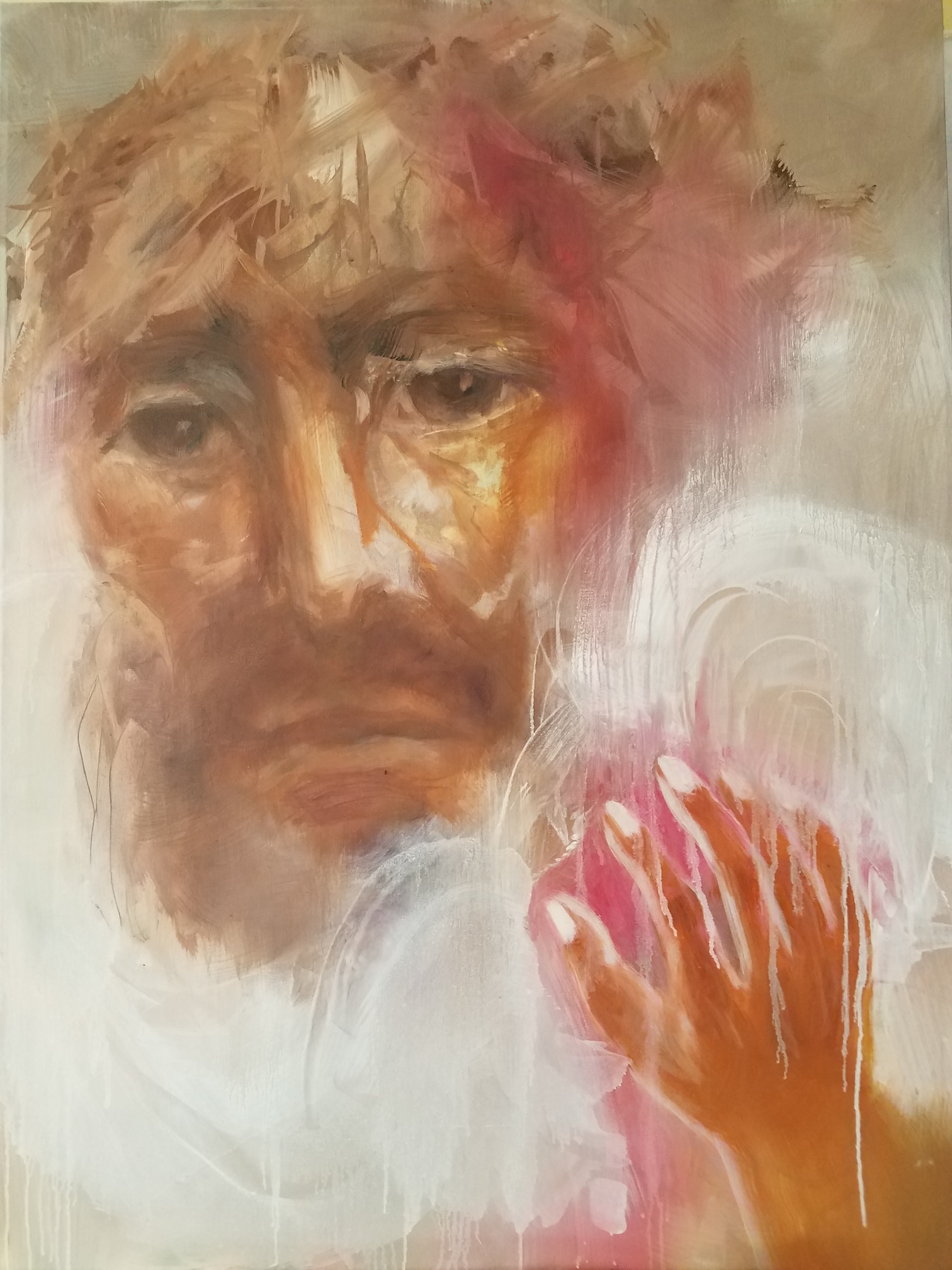
The painting above of Veronica wiping the face of Jesus was done recently by Duk Soon Fwang, an artist whom I have always admired. I asked her the other day what inspired her to paint it.
She told me she liked Veronica, the woman who shoved her way through the crowd, braved the Roman soldiers, took off her head covering and gave it to Jesus to wipe his face, on the way to his death. What courage she had!
Duk Soon wanted to capture the moment when Jesus responded as her hand reached out to him. Some picture his face imprinted on her veil, she said, but she wanted to see his face as he looked at Veronica.
It’s not important what Jesus looks like, Duk Soon continued, it’s what he did that counts, but she found she could not paint his face as a white man, as most western artists do. To her his face is the face of a hardworking Mexican immigrant.
She couldn’t paint his eyes, at first, but then she painted them. Jesus sees the woman who wiped his face. “I was in need and you reached out to me.”
Artists have their way of exploring the mysteries of God.
I’m interested in the gospel accounts of the Passion of Jesus. How did they come about? Some want to see them only as factual accounts of what happened then. Indeed, this isn’t a made up story; Jesus was crucified under Pontius Pilate.
But the story of Veronica, though it didn’t make it into the gospels, is a reminder there were other influences behind the gospels. There were eyewitnesses to the Passion of Jesus; scribes who wrote their stories, apologists who made a point from it, thinkers who saw God’s great designs in it. There were also mystics, artists and ordinary people who saw the human story in the story of Jesus.
The rich man in St. Luke’s parable today is so absorbed in himself and his “good” life that he sees nothing else, not the poor man at his door nor his own inevitable death. The scriptures, like Psalm 49, often point to the same blindness: “In his riches, man lacks wisdom; he is like the beasts that are destroyed.”
The warning is not just for the rich, however. The same psalm calls for “people both high and low, rich and poor alike” to listen. A small store of talents and gifts can be just as absorbing and make us just as shortsighted as a great store of riches. Whether we have much or little, we have to see the poor at our gate.
We also have to see a life beyond this one as our destiny and what we do and how we live here will count there. There will be a judgment.
But Jesus‘ parable offers another reminder. God has given us a sign in his resurrection from the dead that we have been called to share in his risen life. A great gift has been given, greater than anything we have here. Yet as the sign of Jonah indicates, some will not believe the sign Jesus Christ, risen from the dead, gives to us.
“We” are going up to Jerusalem, Jesus tells his disciples in Matthew’s gospel today and they follow him. They’re weak and human, but together they’ll be renewed by God’s grace.
We’re on our way to Jerusalem too. I may think that Lent is a personal journey I make for 40 days to be renewed in faith, but it’s more than that. Lent is a time we’re renewed by God together.
The disciples were far from perfect on the journey described in the gospel. Look how weak they are in the story told today. The mother of James and John wanted to get her two sons a good place in the kingdom Jesus promised. “Command that these two sons of mine sit, one at your right and the other at your left, in your kingdom.” She’s looking for power and prestige for her sons and for herself.
Jesus reminds her that his followers are not to be served, but to serve. Serving others won’t make them rich; it will cost them, for “the Son of Man did not come to be served but to serve and to give his life as a ransom for many.”
The other disciples are indignant when they hear about the mother’s request, but she wont be the last to look for human gain in the gospel. A lot of people think following Jesus brings success. That’s why Jesus’ words are so important to hear during Lent. Faith doesn’t bring power and success. Following Jesus is about serving others. Serving others is a good part of the cross we bear.
Luke’s Gospel, with its emphasis on the mercy of God and care for the poor, is read on Monday, Thursday and Saturday of this week. Luke’s story of the Prodigal Son is the gospel reading on Saturday.
Matthew’s Gospel for Wednesday reminds us that temptations about power, so obvious in the story of Jesus’ temptations, can also be seen in his disciples, like James and John.
On March 19, we celebrate the feast of St. Joseph, Spouse of the Blessed Virgin Mary, who cared for Jesus at his birth and early life and was the faithful companion of Mary.
On March 18, St. Cyril of Jerusalem is remembered. The bishop of Jerusalem preached to Christians from all over the world who came to that city to pray at the tomb of Jesus and venerate the place where he died. He was a powerful voice announcing the mystery of the death and resurrection of Jesus.
MARCH 18 Mon Lenten Weekday
[Saint Cyril of Jerusalem, Bishop and Doctor of the Church]
Dn 9:4b-10/Lk 6:36-38 (230) Pss 2
19 Tue SAINT JOSEPH, SPOUSE OF THE BLESSED VIRGIN MARY
Solemnity
2 Sm 7:4-5a, 12-14a, 16/Rom 4:13, 16-18, 22/Mt 1:16, 18-21, 24a or Lk 2:41-51a (543) Pss Prop
20 Wed Lenten Weekday
Jer 18:18-20/Mt 20:17-28 (232)
21 Thu Lenten Weekday
Jer 17:5-10/Lk 16:19-31 (233)
22 Fri Lenten Weekday
Gn 37:3-4, 12-13a, 17b-28a/Mt 21:33-43, 45-46 (234)
23 Sat Lenten Weekday
[Saint Turibius of Mogrovejo, Bishop]
Mi 7:14-15, 18-20/Lk 15:1-3, 11-32 (235)
24 SUN THIRD SUNDAY OF LENT
Ex 3:1-8a, 13-15/1 Cor 10:1-6, 10-12/Lk 13:1-9 (30)
Our readings this week began with Jesus’ words in Matthew’s Gospel calling us to reach out to “the least”–the stranger, the prisoner, the sick, the naked. Christ reaches out to them, and he says we will find him in them.
But what about those people? Don’t some of them– perhaps many of them– deserve to be in prison or sick or out of a job? That’s what the 1st reading today from the Prophet Ezekiel asks. Why pay attention to them? Let’s take care of the good people.
In Matthew’s Gospel today Jesus takes up the same question, calling his disciples to go beyond the “righteousness” of the scribes and Pharisees, who permitted killing someone as an act of God’s judgment. Jesus returns to the ancient command, “You shall not kill.” Leave someone’s judgment to God.
And he goes further. Avoid any killing judgment against someone by anger or words. They can destroy people too. Leave ultimate judgment to God.
Does that mean we shouldn’t judge others at all? Jesus never hesitated to judge others, but before judging others he says we have to remove “the splinter in our eye.” That can be anger or arrogance or pride or a lack of self-knowledge or even an ignorance of human nature. It can come from not loving others. Make sure they’re not splinters clouding your judgment, Jesus says. (Matthew 7, 1-5)
When he came among us, some early Christian saints said, Jesus went in search of the lost image of God in every one of his creatures; he welcomed tax collectors like Matthew and others society condemned. In them he saw “the lost image of God.” He came to call sinners.
Are we meant to search for the lost image of God in others and to welcome sinners too? But how?
“Respect” is a wonderful word. It describes a wonderful virtue that I’m afraid is more and more ignored in today’s judgmental world. “Respect” comes from a Latin word meaning “to look again”, to look again at someone or some thing to see a value we didn’t see before or denied too quickly. Respect keeps looking, searching. It’s a permanent way to see others as long as we live, never losing hope of finding the image of God there.
God’s image is there. We need to see it. Lent means looking again.
Jonah doesn’t see himself up to what God asks of him, the scripture story says. Frightened, he doesn’t want to preach to the great city of Nineveh. When the sailors threw him from the boat because they thought he cursed their ship, he doesn’t stop them. If the whale didn’t swallow him and vomit him up on the shore at Nineveh he would have ended it all.
But God would not have it. Jonah’s arrival caught the attention of the Ninevites. Who wouldn’t listen to a man come from the belly of a whale? They begged God for forgiveness when he spoke. Someone snatched from the jaws of sure death had to be a sign of life.
Luke’s gospel emphasizes Jonah’s preaching at Nineveh, a big city at earth’s end. Jesus has to be proclaimed to all peoples, everywhere, a theme Luke repeats again and again. But is that possible in a world like ours that’s putting up walls rather than bridges? I don’t know what Jonah said, but God used what poor words came to him, and Nineveh heard his message.
Have we lost confidence in the power of Jesus Christ and his message of death and resurrection to bring hope to the world and bring it together? Are we like Jonah, afraid? Could it be that we are being swallowed up into the belly of the whale for another mission we hardly envision?
Lent is the time to think about the sign of Jonah. The early church thought about him, as this picture from the catacombs attests. He makes you think.
Prayer gives us eyes to see and strength to keep going on the journey of life. On this Tuesday of the 1st week of Lent, Jesus teaches us to pray. On the Mount of the Beatitudes, in Matthew’s gospel, Jesus teaches his disciples– and us– to pray. “Our Father….” (Matthew 5, 7-15) Readings here
We pray as Jesus prays. We approach the One whom Jesus knows intimately as his Father. We pray God’s kingdom come, God’s will be done, on earth, in us, as it is in heaven. We ask for our daily bread, for forgiveness and for strength to live without falling away.
The Lord’s Prayer is our basic Christian prayer. We learn it by heart. It appears everywhere in the church’s life. We treasure it.
Like so many things we treasure, we can take the Lord’s Prayer for granted,. Lent is a time to make it a treasure again.
When Moses approached God on Mount Sinai, a voice said: “Do not come near; put off your shoes from your feet, for the place on which you are standing is holy ground.” Jesus invites us to approach as children the One who gives us everything. Let us pray reverently as we come into God’s presence.
Can we look for graces to pray this Lent? Listen to Isaiah, our 1st reading.
Thus says the Lord: just as from the heavens the rain and son come down and do not return there till they have watered the earth, making it fertile and fruitful, giving seed to the one who sows and bread to the one who eats, so shall my word be that goes forth from my mouth. It shall not return to me void, but shall do my will, achieving the end for which I sent it.
In the Gospel (Lk 9:22-25) for the Thursday after Ash Wednesday, our Lord warns His disciples about His coming Passion, death, and resurrection. This passage in Luke comes after Peter’s confession of Jesus as Messiah. Jesus seems to be telling them that this Messiah must suffer greatly before saving us, and this salvation involves much more than just freedom from Roman oppression. Our Lord is preparing them (and us) for their own Lenten observance on the road to the Passion that is coming:
“If anyone wishes to come after me, he must deny himself and take up his cross daily and follow me. For whoever wishes to save his life will lose it, but whoever loses his life for my sake will save it. What profit is there for one to gain the whole world yet lose or forfeit himself?” (Lk 9:23-25)
This passage is a tremendous challenge for us, a powerful set of instructions for the season of Lent and, actually, for our entire lives if we want to go all the way with Him. Can we deny ourselves of so many pleasures, opinions, angers, resentments, luxuries, and caprices? Can we lose this life of comfort in “the world” for the mysterious promise that He gives us of the bliss to be experienced when we find our true life, our true selves in Him? That’s the goal I seek! But, oh boy, the sacrifices to be made along the way sure seem like the carrying of a heavy, painful cross. I don’t know if I can make it!
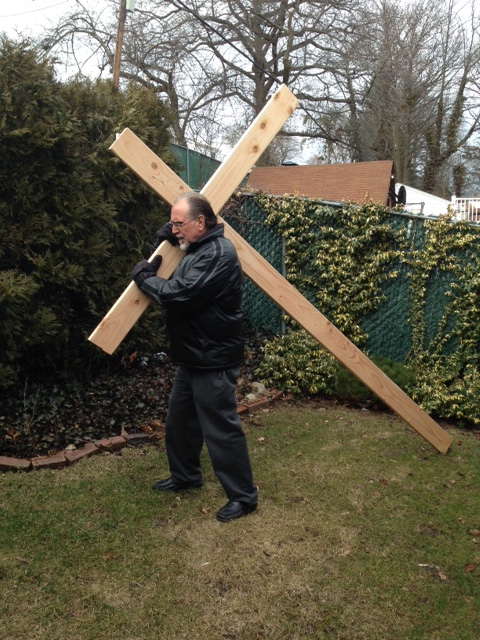
Now, here I am sort of changing the subject in order not to face this inner cross that Jesus asks me to carry. And yet it is related to it. For years now I have had this urge to make a large wooden cross that I can carry during Lent, take it perhaps in front of church buildings after Mass(with the Pastor’s permission!), or through Central Park or Times Square (probably need a police permit!) and just seeing what happens. This year I somehow forced myself to make this cross. It is 10 feet tall but just heavy enough for me, I hope(I attached small wheels to the bottom so it will not drag painfully on the concrete!).
But then I asked God, “Why am I doing this? Is it an empty act? Is it just stubbornness, or the desire to show off ? How can I do some good in Your name?” Finally an idea “came” to me. Why not have Sharpie markers to lend to people so they can write something on the cross? A prayer of love perhaps, since the Cross is the place where God’s great love for us is so powerfully expressed; or just a prayer of gratitude for this incredible Love that gives us life daily. The Cross is also the place of forgiveness. If they want, they can write a prayer of personal contrition, or just write the name of a person they need to forgive! The Cross is the place of healing, where “It was our infirmities that He bore, our sufferings that He endured….. by His stripes we were healed.” (Is 53:4a,5b) Perhaps folks can write the name of a person in need of healing, even themselves. God can inspire them in different, unexpected ways. Maybe young people will be attracted to help me carry it around. Who knows? I will let you readers know how it went.
I am looking forward to this. When I pick up this cross, after I get used to the weight and pain, and realize that my back and knees can take it, I feel a strange peace, a heightened awareness, a sense of God’s presence. I wonder if Simon the Cyrenian (in the Gospel of Luke) felt this way in spite of the horrendous situation that he was forced into as he followed the wounded Jesus to Calvary. I hope this “mission” of mine will touch people’s hearts and that this home-made cross will remind them of God’s unfathomable mercy and love for all of us.
Part of me realizes how unworthy I am to even dare to try this. What keeps me going is the thought of that daily cross that Jesus offers me in the Gospel. This personal, invisible cross is a different sign, which shows me that this Lent is the perfect time to lose a little more of my old, selfish life, to deny myself of things that keep me from the intimacy that God wants to share with me. Jesus offers me this spiritual cross, the place where I die into the loving arms of my God in order to resurrect in His joy.
This cross can be found in every person that we meet, even in my wooden cross. But most of all it can be found in the very center of prayer, where the Lord repeatedly gives us His gentle heart, His easy yoke, and the soothing burden of carrying His Love to the world. Lord, give us the strength and perseverance to seek You in our very hearts, every moment of the day. Orlando Hernández


 The Victor's Place