Friends of God

Pope Leo is dedicating his Wednesday audiences to the Second Vatican Council and its meaning today. An important source for how he sees our church today. Here’s yesterday’s catechesis. I’ll try to follow him every Wednesday: 

Dear brothers and sisters, good morning and welcome!

We have started the cycle of catechesis on Vatican Council II. Today we will begin to look more closely at the Dogmatic Constitution Dei Verbum, on the divine Revelation. It is one of the most beautiful and important of the Council and, to introduce it, it may be helpful to recall the words of Jesus: “No longer do I call you servants, for the servant does not know what his master is doing; but I have called you friends, for all that I have heard from my Father I have made known to you” (Jn 15:15). This is a fundamental point of Christian faith, which Dei Verbum reminds us of: Jesus Christ radically transforms man’s relationship with God, which is henceforth a relationship of friendship. Therefore, the only condition of the new covenant is love.

Saint Augustine, commenting on this passage of the Fourth Gospel, insists on the perspective of grace, which alone can make us friends of God in his Son (Commentary on the Gospel of John, Homily 86). Indeed, an ancient motto stated: “Amicitia aut pares invenit, aut facit”, “friendship is born between equals, or makes them so”. We are not equal to God, but God himself makes us similar to Him in his Son.

For this reason, as we can see in all the Scripture, in the Covenant there is a first moment of distance, in which the pact between God and mankind always remains asymmetrical: God is God and we are creatures. However, with the coming of the Son in human flesh, the Covenant opens up to its final purpose: in Jesus, God makes us sons and daughters, and calls us to become like Him, albeit in our fragile humanity. Our resemblance to God, then, is not reached through transgression and sin, as the serpent suggests to Eve (cf. Gen 3:5), but in our relationship with the Son made man.

The words of the Lord Jesus that we have recalled – “I have called you friends” – are reprised in the Constitution Dei Verbum, which affirms: “Through this revelation, therefore, the invisible God (see Col 1:15; 1 Tim 1:17) out of the abundance of His love speaks to men as friends (see Ex 33:11; Jn 15:14-15) and lives among them (see Bar 3:38), so that He may invite and take them into fellowship with Himself” (no. 2). The God of Genesis already conversed with our first parents, engaging in dialogue with them (cf. Dei Verbum, 3); and when this dialogue was interrupted by sin, the Creator did not cease to seek an encounter with his creatures and to establish a covenant with them. In the Christian Revelation, that is, when God became man in his Son in order to seek us out, the dialogue that had been interrupted is restored in a definitive manner: the Covenant is new and eternal, nothing can separate us from his love. The Revelation of God, then, has the dialogical nature of friendship and, as in the experience of human friendship, it does not tolerate silence, but is nurtured by the exchange of true words.

The Constitution Dei Verbum also reminds us of this: God speaks to us. It is important to recognize the difference between words and chatter: this latter stops at the surface and does not achieve communion between people, whereas in authentic relationships, the word serves not only to exchange information and news, but to reveal who we are. The word possesses a revelatory dimension that creates a relationship with the other. In this way, by speaking to us, God reveals himself to us as an Ally who invites us into friendship with Him.

From this perspective, the first attitude to cultivate is listening, so that the divine Word may penetrate our minds and our hearts; at the same time, we are required to speak with God, not to communicate to him what He already knows, but to reveal ourselves to ourselves.

Hence the need for prayer, in which we are called to live and to cultivate friendship with the Lord. This is achieved first of all in liturgical and community prayer, in which we do not decide what to hear from the Word of God, but it is He Himself who speaks to us through the Church; it is then achieved in personal prayer, which takes place in the interiority of the heart and mind. Time dedicated to prayer, meditation and reflection cannot be lacking in the Christian’s day and week. Only when we speak with God can we also speak about Him.

Our experience tells us that friendships can come to an end through a dramatic gesture of rupture, or because of a series of daily acts of neglect that erode the relationship until it is lost. If Jesus calls us to be friends, let us not leave this call unheeded. Let us welcome it, let us take care of this relationship, and we will discover that friendship with God is our salvation.

The Leper: Mark 1:40-45

The Leper

As Jesus’ exciting first day of ministry in Capernaum ends,  “the whole town was gathered at the door”. The next morning “ very early before dawn, he left and went off to a deserted place, where he prayed,” Mark’s Gospel notes. (Mark 1: 29-39)

Jesus often went by himself to deserted places to pray, but in today’s gospel (Mark 1:40-45) a “deserted place” is where he meets a leper.  Lepers were banished to deserted places then, outside the towns, for fear their disease, their “uncleanness”, might infect others.  “Social distancing” at its extreme. 

Rembrandt (above) has a wonderful sketch of Jesus and the leper. Peter and another follower seem to be hiding behind him, keeping their distance from it all, but Jesus reaches out and touches the leper kneeling before him.

Jesus is keenly aware of human suffering wherever he finds it, in the towns and villages he visits or in deserted places where people hide from it. Like Peter and the others we’re often afraid of people like lepers, people suffering so much we think we’re going to be overwhelmed by their suffering. 

And so we avoid the deserted places where the lepers are. (Maybe too the desert place of prayer where we met God) We hide from the sufferings of the world. “Keep it away,” we say.

But Jesus leads us to the leper. He helps us see suffering and then reach our hands out to it. 

Notice the last line of today’s gospel reading: “He remained outside in deserted places, and people kept coming to him from everywhere. “(Mark 1: 45) Mark says a lot in a few words. Is Mark saying Jesus is always in deserted places; they’re privileged places where we can find him?

A Remarkable Day: Mark 1:21-34

Peter's mother in law
Rembrandt; Jesus Heals Peter’s Mother-in-law

Jesus’ ministry in Galilee begins with a remarkable day, a “paradigmatic day,” a day you can see everything you need to know about Jesus. That’s the day described in Mark’s gospel. A Sabbath day. (Mark 1:21-34)

Just before it, Jesus passed along the Sea of Galilee and called Simon and his brother Andrew, then James and his brother John. “Come after me, and I will make you fishers of men.” They accompany him into that day. .

They enter the synagogue in Capernaum on a Sabbath Day and Jesus begins to teach. The people are amazed; no one has taught like him before. Then, as it happens through his life, evil appears. A man with an unclean spirit cries out, “What have you to do with us, Jesus of Nazareth? Have you come to destroy us? I know who you are—the Holy One of God!”

The man with the unclean spirit is humanity helpless, fragile, beset by fear that it is forever in the hands of Evil.

Jesus rebuked him and said,“’Quiet! Come out of him!’ The man becomes a promise of humanity redeemed. The people who leave the synagogue tell everybody they meet. News spreads quickly in Capernaum, a trading center, and the day is still not over.

From the synagogue Jesus enters Peter and Andrew’s house in Capernaum where Peter’s mother in law is ill. “He grasped her by the hand, and helped her up and the fever left her. Immediately she began to wait on them.”

We shouldn’t dismiss this miracle or Mark’s simple observations: “He grasped her by the hand and helped her up.” In our drawing above, Rembrandt noticed that too. “She began to wait on them.” Now she was back, doing what she wished to do, feeding the others. A woman feeding others. A symbol of humanity restored. The mystery of the incarnation revealed in Judea at Christmas, now revealed in the miracles of healing in Galilee.

Again, the news spreads. “After sunset, as evening drew on, they brought all who were ill and those possessed by demons. Before long, the whole town was gathered outside the door. He cured many who were variously afflicted.” The whole world is represented in that crowd who come to the door to receive the Sabbath grace.

Truth and Life came to that town, and from that town other towns receive the promise: “ I must proclaim the good news to them too,” Jesus says.

Jesus confronts evil of all kind, wherever he goes. It won’t be long before leaders come from Jerusalem to question his authority to cure on the Sabbath. His own disciples and his own family do not understand him either. The towns that welcomed him, reject him. Still, he announces the good news.

To appreciate Mark’s remarkable day in perspective, try reading the gospels of these three days in our lectionary all a once. You can see Mark at his best, describing God’s beloved Son announcing the good news to the towns of Galilee and to the world as well. (Mark 1:16-39)

Saint Hilary of Potiers: January 13

Hilary

Besides  the scriptures, the saints are companions on life’s journey, revealing  the wisdom of God from age to age.  “A cloud of witnesses,” the Letter to the Hebrews calls them.

January 13th we remember St. Hilary of Potiers, who lived in the early 4th century, a crucial time for the church, when the Emperor Constantine and his successors ended years of persecution and welcomed Christians as allies in governing the empire. They were considered subservient allies, however.

Hilary was born in Gaul into a wealthy family, but he wasn’t brought up in a Christian environment. He came to baptism (about the year 345 AD) through personal study of the scriptures. He was married and had a daughter. Then, about ten years after his baptism he was elected by the people of Potiers as their bishop. An unusual path to become a bishop!

A bishop’s role changed after Constantine gave the church freedom in 312 AD. More and more, they became agents of the emperor and his administration, and that brought temptation. Hilary and one of his friends, Martin of Tours, thought a good number of the bishops in Gaul were after worldly power and prestige rather than a spiritual ministry.

Many bishops closely associated with the emperors– both in the eastern and western parts of the empire– were also influenced by Arianism, which was favored by the emperors Constantius ( 350-361) and Valens (364-378). Arianism claimed that Jesus was human and not divine. He was only godlike.

Arianism is Christianity lite; it dismisses the claims of Jesus to be divine and makes him like us, only better and more powerful. Probably the emperors and  bishops sympathetic to the Arian doctrine felt it made Christianity more palatable for unbelievers. A good political option

Hilary strongly upheld the divinity of Jesus, basing his faith on the scriptures  he read and the sacrament of baptism he received. His stand brought him exile in Asia Minor, but he continued to teach and write in defense of orthodoxy and eventually he was restored to his diocese.

Hilary’s counterpart in the eastern church, St. Athanasius, was another big opponent of Arianism and imperial control of the church. Both bishops suffered exile and helped the church hold to the faith professed at the Council of Nicea in 321 AD. St. Jerome expressed the gravity of the situation: “The world groaned, amazed that it had become Arian.”

Hilary in Gaul, Athanasius in Egypt and Basil in Asia Minor argued for Catholic orthodoxy from the scriptures and church tradition. They also strongly encouraged religious life in the church. Athanasius saw the spirituality of the desert, exemplified by St. Anthony ( we remember him later next week) as a remedy for the increasing worldliness of Christians. Hilary was the teacher of Martin of Tours, founder of religious life in Gaul.

The two saints promoted religious life which played an important part in promoting sound faith in the church. Christianity always needs communities of dedicated believers as well as sharp-minded leaders for its journey through time. Say a prayer for our religious communities, including my own. We need them in the church.

And let’s not forget to pray for good bishops too.

The Unclean Spirit:Mark 1:21-28

Jesus Confronting the Unclean Spirit. James Tissot

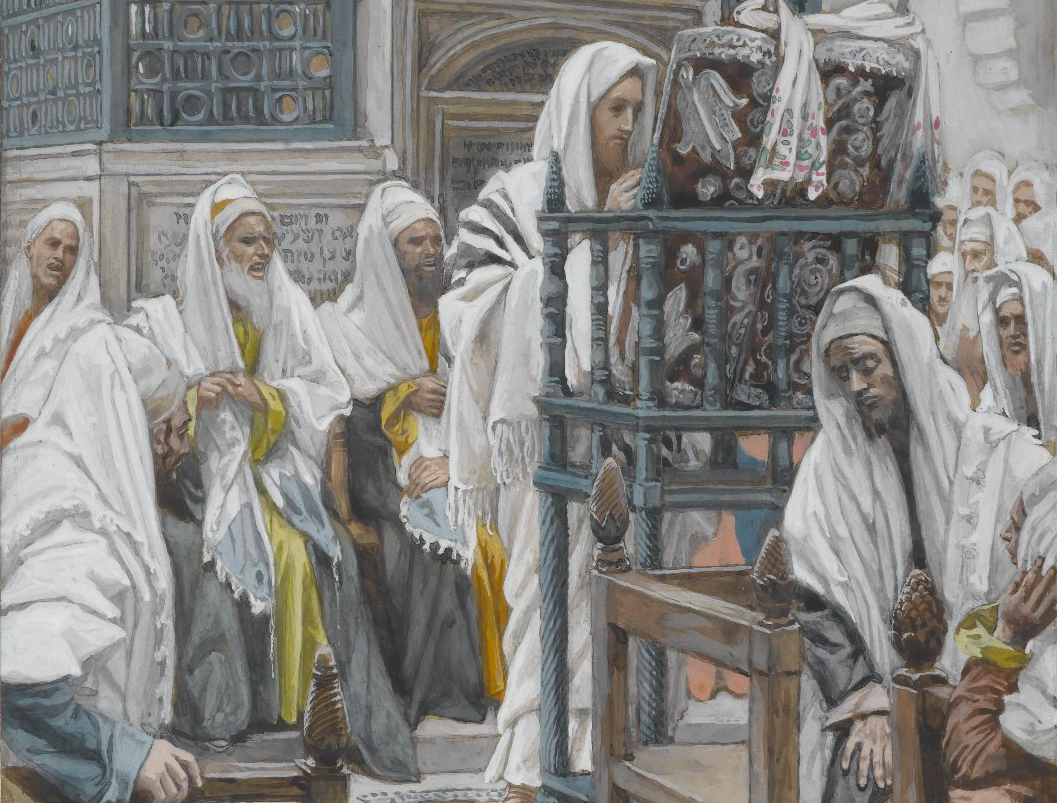
Jesus begins his ministry, according to Mark’s Gospel, in the synagogue at Capernaum facing someone with an “unclean spirit.” You would expect a synagogue to be a quiet, orderly place, but it was a place of shouting and confusion that day. Like the messy world we live in today.

What’s a unclean spirit anyway? Here’s an explanation from a commentary on Mark’s gospel by John R. Donahue, SJ, and Daniel Harrington, SJ.

“In this context ‘unclean’ (akatharton) primarily connotes not a moral (even less a sexual) fault), but something opposed to the “holy.” In the command of the Old Testament to be holy (Leviticus 11,44) it implies life, wholeness and completeness,( Leviticus 21, 17-21) whereas uncleanness implies something that should not be, something out of place ( e.g. soil in a farmer’s field is productive, while in a house it’s dirt). The opposite of the realm of the holy is the demonic, hence the spirits there are “unclean”. Physical defects or psychological aberrations can make a person “unclean”in a sense of incomplete, imperfect and out of order.”(The Gospel of Mark, Sacra Pagina, Liturgical Press 2002 page 80.)

Jesus did not engage primarily the intellectual establishment or the religious establishment when he came. He engaged the chaotic world of the “unclean spirits.” He set up a “field hospital” to use a phrase dear to Pope Francis. That’s the messy, scary world we live in.

Just think of the poor man in the tombs further on in Mark’s gospel, chained and hurting himself. Who wants to deal with him? But Jesus gives his disciples “authority” over unclean spirits. His followers have the power to take them on, to deal with the “messy” world they belong to.

And when they’re done? They’re never done. That’s the world we live in..

Reading Mark’s Gospel

Mark

Mark 1, 7-11-  Mark 8, 14-21

After the Feast of the Baptism of Jesus we read at Mass from the first 8 chapters of the Gospel of Mark until Ash Wednesday.

Mark’s Gospel makes no mention of Jesus’ birth in Bethlehem but begins with his baptism in the Jordan River. Then he describes his miracles and teaching in the towns around the Sea of Galilee– the Jewish towns first, then in the gentile region. Then Jesus goes up to Jerusalem and his death and resurrection.

Until recently, Mark’s Gospel received little attention compared to the gospels of Matthew, John or Luke. It was hardly read in the liturgy. Earlier commentators thought Mark was simply a synopsis of Matthew’s Gospel. Commentators today, however, recognize Mark’s Gospel as the first to be written and appreciate the powerful way it tells the story of Jesus. It’s not just a simple portrayal of historical facts or a synopsis of Matthew. It’s rich in symbolism of its own.

Mark’s Gospel, for example, begins in the waters of the Jordan River, where Jesus is called God’s beloved Son on whom the Spirit rests. Water is a recurring image in Mark’s portrayal of Jesus’ ministry.

John Donahue SJ, a recent commentator on the Gospel of Mark (Liturgical Press, 2002) , points out the symbolic nature of the various events in Jesus’ ministry, beginning with his baptism in the Jordan River and then his ministry around the Sea of Galilee. As the Spirit rested on the waters of the Jordan, so does the Spirit stir the waters in Galilee, drawing more and more to Jesus, God’s Son. Crossing from the western to its eastern side of the Sea – from a side largely Jewish to a side largely gentile – Jesus and his disciples bring the gospel to gentiles as well as Jews. 

The storms Jesus and his disciples face on waters of the Sea of Galilee are more than historic storms; they symbolize the fearful challenge and rejection to be faced in bringing the gospel to others. (Mark 6:45-52)

“As he passed by the Sea of Galilee,” Jesus calls some fishermen, Simon, his brother Andrew, James and his brother John. He makes them “ fishers of men.” (Mark 1, 16-19) Along the sea, Jesus teaches the crowds in parables.

The journeys of Jesus and his disciples to Tyre and Sidon, seaports on the Mediterranean Sea, are also more than historical markers. The Syrophoenician woman and the deaf man, both gentiles healed there, are signs that the gospel must be brought over the seas to the gentiles at ends of the earth. ( Mark 7:24-37) 

Jesus multiplies bread on both sides of the Sea of Galilee in Mark’s Gospel. The gentiles are to be fed and blessed as well as Jews. (Mark 6:31-44; Mark 8:1-10)

The Spirit moves in the waters of the Jordan, the Sea of Galilee and the waters beyond yet, as Mark’s Gospel indicates repeatedly, the Jewish leaders, the pharisees, scribes, Herodians, members of his own family, his disciples, do not understand. Neither do we.

Still, the Spirit works through the waters, softening, cleansing, strengthening, giving new life.

I suspect Mark’s gospel had an important affect on the early community of Roman Christians as they survived the Neronian persecution in the 60s, when Peter and Paul were killed. A common opinion is that Mark, a disciple of Peter, wrote this gospel in Rome in part to support the Roman community after their experience. He reminded them of Peter’s words and example.

Our readings from Mark end on Ash Wednesday.

The Books of Samuel

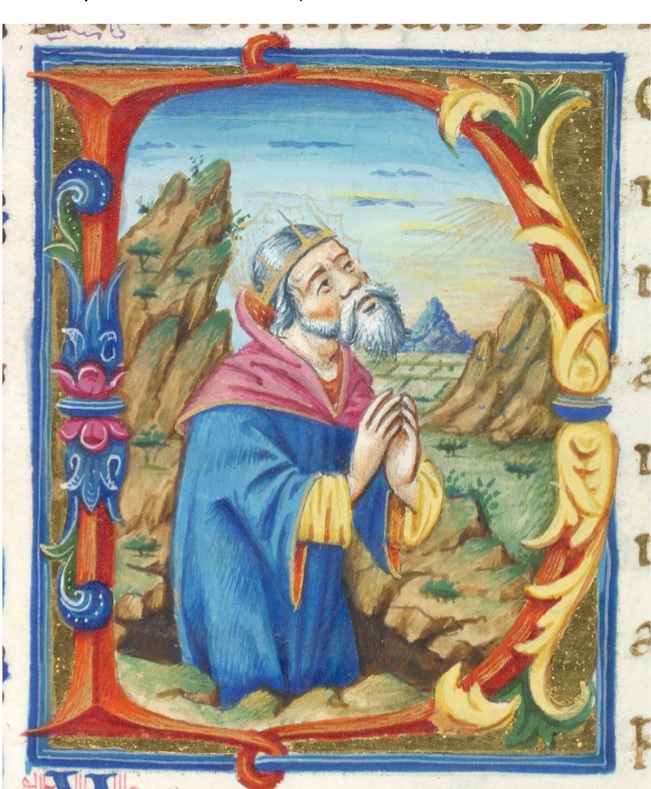
Hannah Praying for a Child. Furmyer Bible Library of Congress

We read for almost three weeks at Mass from the two books of Samuel. They begin with a woman praying for a child. She will become the mother of Samuel who, along with another prophet, Nathan, will deal with the great Jewish kings, Saul and David. The books describe times of intrigue and wars. We read about places and names we can hardly pronounce, but they begin with a woman, Hannah, praying for a child.

Why read old stories from the Jewish scriptures? Why not stick to the gospel and the story of Jesus, maybe adding the Acts of the Apostles and the story of the early church?

We read stories from the Old Testament because they make us aware that God acts in time and God’s plan unfolds in time. They help us understand our own time as well. 

The Books of Samuel recall the change that took place as the Jews moved from a loose association of tribes to a people ruled by kings. The change wasn’t easy; it was messy, slow and typically human. Though the books begin with the birth of a prophet, Samuel, the prophet’s role–and God’s role as well–seems obscured by human history that seems beyond divine control. 

Yet, God’s plan unfolds and the prophet speaks his word. It unfolds in a tension between the human and divine, the political and the spiritual, human slowness and divine patience, sin and grace.  It unfolds as it does in our time, in our world and our church, in ourselves.

Just look around while reading the Books of Samuel

We read the Books of Samuel along with the Gospel of Mark the next few weeks. A study in contrasts. Samuel is slowly recognized as a prophet, beginning with his mother Hannah’s reception in the temple as she prays for a son. His times seem asleep. Totally human.

Jesus, on the other hand, arrives in Caphernaum, like a bolt of lightening. All come to see what he does and listen to what he says.

But then, they turn away. Human slowness.

Calling Disciples:Mark 1:14-20

DSC00036
James Tissot, Calling Disciples

Mark’s account of Jesus’ ministry in Galilee is succinct. John has been arrested and Herod, who rules in Galilee, is ready to behead him. Not a good time, in human thinking, to begin a ministry. Better wait, we say.

But this is God’s time, different from ours. The Good News is God’s message, not ours. God will act according to his plan, not ours. (Mark 1:14-20)

The call of the four fisherman, Peter, Andrew, James and John occurs by the Sea of Galilee in Mark’s gospel. For the Jews the sea, like the wilderness, was a dangerous place; storms unsettled it; unpredictable winds made it fearful. Even an inland body of water twelve miles long and six miles wide was something to be wary of. They made a living on it, but still the sea was a dangerous place.

Mark’s gospel wants us to understand the call of disciples takes place by the sea.

Jesus says simply, “Come after me and I will make you fishers of men.” Mark’s Gospel sees the four fishermen with a lot to learn to be fishers of men. They slowly understand his call. Later on, twelve would be called, (Mark 3,13-19), still later their ministry would be explained. (Mark 6,7-13)

They keep learning, not something you learn in a book, or by yourself. “I will make you fishers of men,” Jesus said. “Come away by yourselves and rest awhile,” he said to his disciples who returned to him with reports of all they had done. (Mark 6,30ff) Every disciple has to learn what the call means for him and for her, and a great deal of it we learn with others. And a great t deal of that learning comes from prayer

photo

Remembering the Baptism of Jesus

On the Mount of Olives in Jerusalem the Russian government in the last century built a high tower  (above) so that Christian pilgrims could see key places associated with the life, death and resurrection of Jesus.

Looking westward is the Church of the Holy Sepulcher where he was crucified and rose from the dead. Just down below is the garden of Gethsemane where Jesus prayed and was arrested. In the distance to the southeast is Bethlehem where he was born. On the eastern side of the Mount of Olives where this picture above was taken is the village of Bethany where Jesus stayed when he came to Jerusalem and where he raised Lazarus from the dead. Further east, about 20 miles down the Jordan Valley is where he was baptized in the Jordan River by John the Baptist.

The tower was built, I understand, because some pilgrims could not get to one of these destinations, a 20 mile trip to the Jordan River.

The tower attests the importance of  pilgrimage to the Jordan River where Jesus was baptized. The Baptism of Jesus is a mystery that includes all the mysteries of Jesus we celebrate as Christians. That’s why we celebrate it as we conclude the mysteries of the Christmas season. In our baptism we are brought to share in his baptism and in his life.

In the Jordan River,  God the Father, “a voice from heaven,” proclaimed him “my beloved Son, with you I am well pleased.” (Mark 1,11) We believe that when we are baptized we become children of God with him..

As we take Holy Water into our hands and bless ourselves, we remember the great gift we have in Jesus Christ. “In the name of the Father, and of the Son and of the Holy Spirit. Amen.”

We celebrate the Feast of the Baptism of Jesus today. This week we begin readings Mark’s Gospel at Mass till Ash Wednesday. Mark is a good follow-up for this feast since it begins with the baptism of Jesus and relies heavily on the symbolism of baptism and water in his narrative.

The Baptism of Jesus

For this week’s homily, please watch the video below.