He Took a Body Like Ours

The Word became flesh, the flesh of Abraham and his descendants, Athanasius writes in his “Treatise on the Incarnation”, one of the great ancient texts on that mystery. It’s the reading for today’s Feast of Mary, the Mother of God. 

“He had to take a body like ours. This explains the fact of Mary’s presence: she provided him with a body of his own, to be offered for our sake. Scripture records her giving birth, and says: She wrapped him in swaddling clothes. Her breasts fed him and were called blessed. Sacrifice was offered because the child was her firstborn. 

Gabriel used careful and prudent language when he announced his birth. He did not speak of “what will be born in you” to avoid the impression that a body would be introduced into her womb from outside; he spoke of “what will be born from you,” so that we might know by faith that her child originated within her and from her.

  By taking our nature and offering it in sacrifice, the Word was to destroy it completely and then invest it with his own nature, and so prompt the Apostle to say: This corruptible body must put on incorruption; this mortal body must put on immortality.

  This was not done in appearance only, as some have imagined. No, our Saviour truly became human, and from this has followed the salvation of humanity as a whole. Our salvation is in no way fictitious, nor does it apply only to the body. The salvation of the human being, soul and body, has really been achieved in the Word himself.

  What was born of Mary was therefore human by nature, in accordance with the inspired Scriptures, and the body of the Lord was a true body: It was a true body because it was the same as ours. Mary, you see, is our sister, for we are all born from Adam.

  The words of St John, the Word was made flesh, bear the same meaning, as we may see from a similar turn of phrase in St Paul: Christ was made a curse for our sake.  Humanity has acquired something great through its communion and union with the Word. From being mortal it has been made immortal; though it was a living body it has become a spiritual one; though it was made from the earth it has passed through the gates of heaven.

  Even when the Word takes a body from Mary, the Trinity remains a Trinity, with neither increase nor decrease. It is for ever perfect. In the Trinity we acknowledge one Godhead, and thus one God, the Father of the Word, is proclaimed in the Church
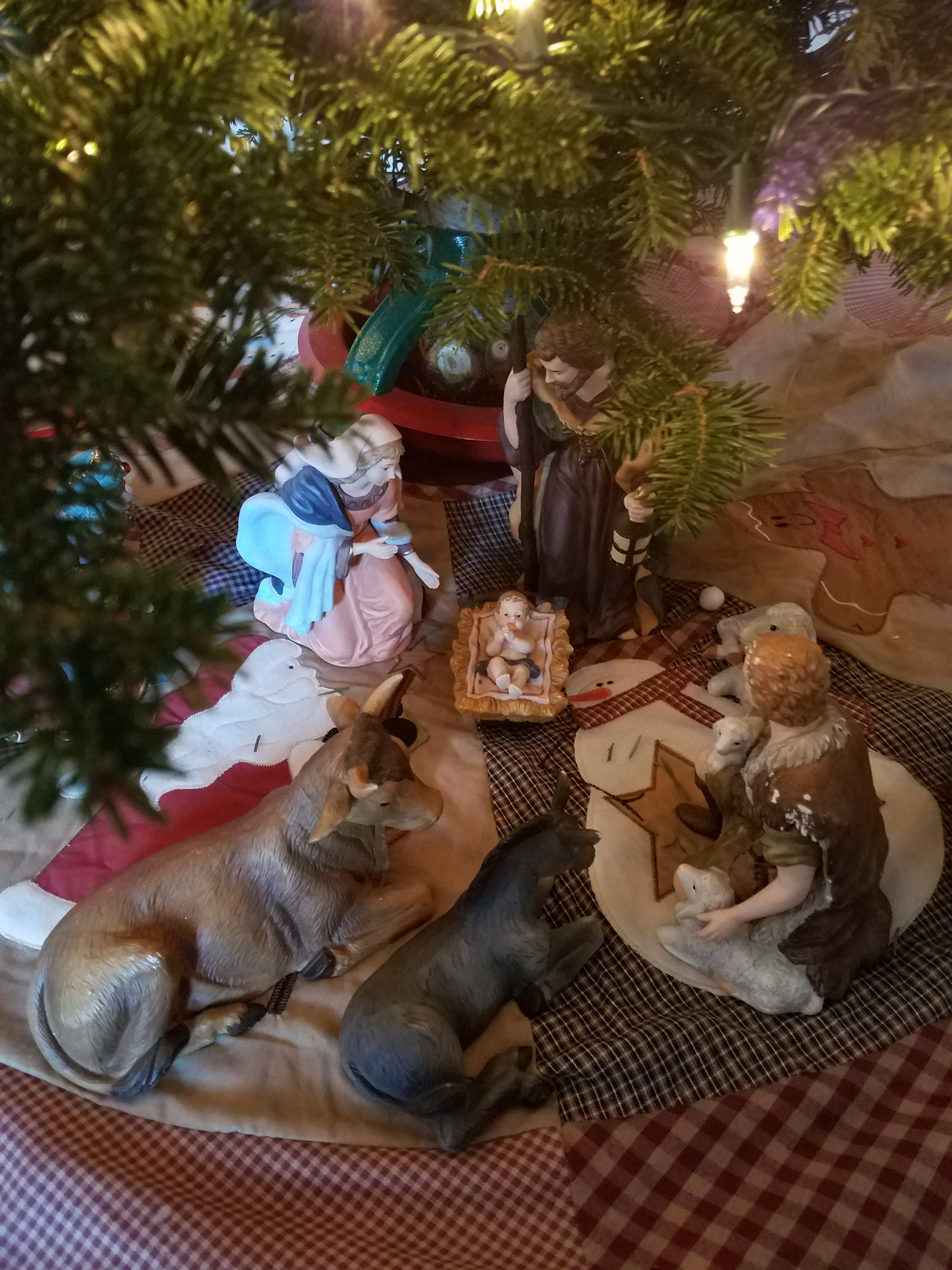
Merry Christmas

20171225_083206


The softest sound that could ever be.

The slightest touch possible.

The simplest gesture known to God and man.

Humility.

Nothing more powerful.

The Word became flesh.

God became man.

God became you and me.

Now the child leads us:


Merry Christmas.

A Blessed New Year.


—Howard and family


Poor in Spirit

Christmas is a time of poverty. The Spirit of Bethlehem is one of smallness, of tiny new beginnings that open our minds to the infinite largeness of Incarnate Wisdom. The Christ Child heals us of our presumption. The New Born shows us that we simply don’t know what God has in store. His impoverished delivery stops us in our tracks. We stand like beasts in a stable, our knowledge, our understanding, our science, our facts, our truths stripped of eternal value. All that remains, whether we’re shepherds or kings or someone in between, is for us to nod along with the tiny beat of the drummer boy offering his seemingly meaningless gift. Let’s welcome Christ Jesus, Innocence itself, by being poor with Him. Let’s let go of preconceived notions of having control. To stand before the Lord in our nothingness is worth more to Him than any amount of gold, frankincense or myrrh. Our humility before the bright light is pure praise and prayer to the One Who offers us everything.

—Howard Hain

December 20- 26: FEASTS AND READINGS

DECEMBER 20 Mon Advent Weekday Is 7:10-14/Lk 1:26-38 

21 Tue Advent Weekday [Saint Peter Canisius, Priest and Doctor of the Church]

Sg 2:8-14 or Zep 3:14-18a/Lk 1:39-45 

22 Wed Advent Weekday 1 Sm 1:24-28/Lk 1:46-56 

23 Thu Advent Weekday [Saint John of Kanty, Priest] Mal 3:1-4, 23-24/Lk 1:57-66 

24 Fri Advent Weekday  2 Sm 7:1-5, 8b-12, 14a, 16/Lk 1:67-79 

25 Sat THE NATIVITY OF THE LORD (Christmas) Solemnity 

Vigil: Is 62:1-5/Acts 13:16-17, 22-25/Mt 1:1-25 or 1:18-25 (13) Night: Is 9:1-6/Ti 2:11-14/Lk 2:1-14 

Dawn: Is 62:11-12/Ti 3:4-7/Lk 2:15-20 

Day: Is 52:7-10/Heb 1:1-6/Jn 1:1-18 or 1:1-5, 9-14 

26 SUN THE HOLY FAMILY OF JESUS, MARY AND JOSEPH

Sir 3:2-6, 12-14/Col 3:12-21 or 3:12-17/Lk 2:41-52

or, in Year C, 1 Sm 1:20-22, 24-28/1 Jn 3:1-2, 21-24/Lk 2:41-52

We begin reading St. Luke’s Infancy Account this week in our liturgy. I added a reflection on Luke’s account of Zechariah in the temple, which our Sunday readings displaced this year. Be sure to read the Old Testament readings that accompany Luke’s account. They provide the background for Luke’s story; without them we tend to read it too literally.

By neglecting the Old Testament readings we miss understanding New Testament sources like Luke.

I’m reading again Pope Benedict’s “Jesus of Nazareth: the Infancy Narratives” (Image Books 2012), a wonderful commentary on our readings for this week. Benedict engages Luke using the best of modern scripture scholarship (mostly German) and beautifully presents the meaning of Luke’s narrative. 

I remember the headlines when his book appeared: “Pope says the ox and the donkey weren’t around the manger at Christ’s birth.” Far from denying the facts of the Infancy Narrative, Pope Benedict makes them more understandable. The manger of Jesus is the Lord’s first throne, the humble temple where he comes to feed the poorest of the world.

“So the manger has in some sense become the Ark of the Covenant, in which God is mysteriously hidden among men, and before which the time has come for ‘ox and ass’–humanity made up of Jews and Gentiles–to acknowledge God.”

Until now, many of our Advent readings were taken from Matthew’s Gospel, which portrays Jesus teaching on a mountain (Isaiah’s favorite symbol) and working great miracles that benefit all who come. Jesus is the new temple, the new Presence of God, Emmanuel, God with us.  

This week Luke is the primary source for the our gospel readings.        

.

4th Sunday of Advent c: Faithful Women

For this week’s homily, please watch the video below.

Where Do You Come From?

Whenever we read Matthew’s gospel of the genealogy of Jesus, filled with so many unfamiliar names, many hard to pronounce, I am reminded of my mother.  She had a remarkable memory for relationships, whether her own family relations or how other people were related. Honestly, I often tuned out as she probed family trees with delight. After she died I realized I had lost connection with countless relatives and people she had firmly stored in her mind.

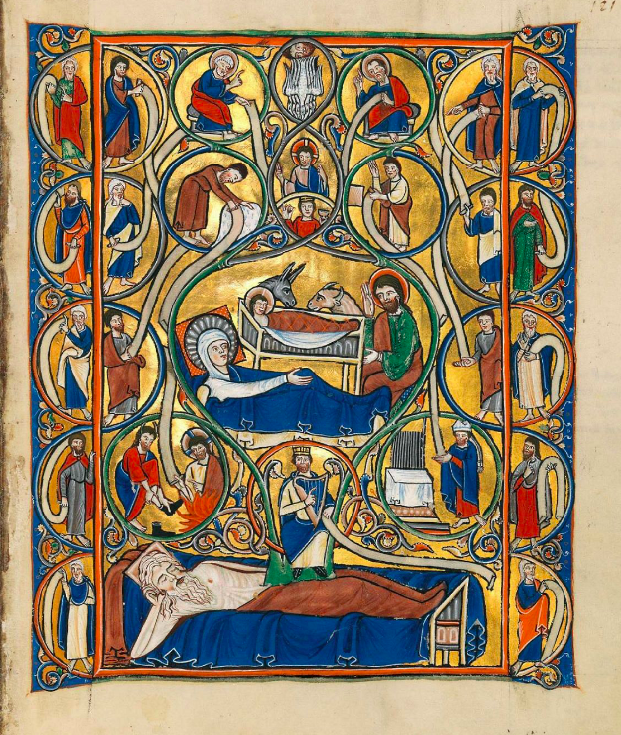
She wasn’t a professional genealogist, but she would be at home with the study of Jesus’ ancestry in the gospels of Matthew and Luke. She would want to know how all those people in the 13th century picture above were related.

The gospel genealogies are not mere formalities, official records proving Jesus’ human identity. Mary and Joseph would have made Jesus aware of these relationships as he grew up among the tight family units of Nazareth. The people of Nazareth knew where they came from.

Jesus would hardly be a protected child, kept safely away from others till his day would come. Jesus knew from the beginning he was part of the human family. His family tree was not just an army of saints, sinners were there for sure. They’re all part of the mystery of his Incarnation.

We will hear about some of his immediate family in the next few days of Advent– Mary, Joseph, Elizabeth and Zachariah, John their son. There were others too we will hear of when he begins his ministry. We shouldn’t be surprised that some of his first disciples were related to him.

Jesus was not an isolated individual, but the Word made flesh, firmly part of the human family he came to save.

Mary’s Mother

by Howard Hain

durer

Albrecht Durer, “Virgin and Child with Saint Anne”, ca. 1519 (The Met)

Christmas is a time for grandmothers.

They bake and cook and decorate. Their homes become mini North Poles, diplomatic outposts of Santa’s Castle.

At its core, Christmas is of course all about Jesus. All about Jesus, Mary, and Joseph. All about the Holy Family.

The Holy Family is an extended family though. And it doesn’t stop at grandmothers and grandfathers, aunts and uncles, or even cousins and distant cousins.

Just ask Saints Joachim and Anne, Zechariah and Elizabeth, or John the Baptist—not to mention all the unknown relatives whom the child Jesus surely encountered throughout His Galilean days. Ask any one of them about the far-reaching ripple effects of family grace.

Those touched by Jesus have a tendency to appear bigger than life.

Look at Santa Claus.

Most of us are aware that he is really Saint Nick.

But do we stop to wonder who Mrs. Claus really is?

I think she’s Saint Anne.

After all, Mrs. Claus is seen as everyone’s grandmother, especially when it comes to holiday cheer. But when it comes to truly celebrating the birth of Jesus, it is through Saint Anne that we approach the gates of Christ’s Nativity.

Mary’s Mother holds a special key. She is first among grandmas, first among those who pinch chubby cheeks, who pass along one more extra sugary treat.

———

Saint Anne help us. Speak to us. Show us how to be grand parents to all those around us, especially the little ones. Stir up the spirit of Advent. Bake away the holiday blues. Cook up a dish of Christmas love that only your hearth can serve.

———

Come one, come all, to the home of Saint Anne. Come with me to Grandma’s house for a holiday visit. Taste and see. Enter her kitchen, where the hot chocolate can always fit a little more whipped cream, where you hear the constant refrain: “eat…eat…eat…”

At Grandma’s your plate is never empty.

Her table is continually set.

She always sees Jesus as having just been born.

She is always wrapping Him up tightly in swaddling clothes.

It is simply grand.

To Grandma, Jesus is always an innocent child.

And she can’t help but see Him deep within both you and me.


(Dec/21/2017)

Howard Hain is a contemplative layman, husband, and father. He blogs at http://www.howardhain.com


Web Link: Metropolitan Museum of Art. Albrecht Durer, “Virgin and Child with Saint Anne”, ca. 1519


Morning Thoughts: Little Drummer Boys and Girls

by Howard Hain

Yesterday I witnessed a “dress” rehearsal for a live nativity. The cast was made up of first and second graders, and the audience was mostly composed of residents of a retirement home for religious sisters, Franciscans. It was spectacular.

Last week I was at Radio City Music Hall to watch the Rockettes in their “Christmas Spectacular”. It was quite a production.

Sitting in the dark this morning I cannot help but contrast the two.

I also cannot help but relate to the seven-year old who played the part of The Little Drummer Boy.

As that child walked so slowly toward the foot of the altar, where the rehearsal was being staged, I saw my vocation in an entirely different light.

The children were all singing their hearts out, and many of the eighty and ninety year-old sisters were mouthing the words. The boy with the drum didn’t utter a sound. He just kept walking, slowly, extremely slowly toward the altar, every once in a while ever so slightly pretending to tap two tiny sticks upon a toy drum. He was beautifully awkward.

There was no greater spectacle on earth at that very moment. Shall I dare to say, no greater event that heaven or earth has ever known?

For a child was born. We were all being born.


Come they told me, pa rum pum pum pum
A new born King to see, pa rum pum pum pum
Our finest gifts we bring, pa rum pum pum pum
To lay before the King, pa rum pum pum pum,
rum pum pum pum, rum pum pum pum,

So to honor Him, pa rum pum pum pum,
When we come.

Little Baby, pa rum pum pum pum
I am a poor boy too, pa rum pum pum pum
I have no gift to bring, pa rum pum pum pum
That’s fit to give the King, pa rum pum pum pum,
rum pum pum pum, rum pum pum pum,

Shall I play for you, pa rum pum pum pum,
On my drum?

Mary nodded, pa rum pum pum pum
The ox and lamb kept time, pa rum pum pum pum
I played my drum for Him, pa rum pum pum pum
I played my best for Him, pa rum pum pum pum,
rum pum pum pum, rum pum pum pum,

Then He smiled at me, pa rum pum pum pum
Me and my drum.*


.

.*(Little Drummer Boy was composed by Katherine K. Davis, Henry Onorati and Harry Simeone in 1958.)


The Lowliness of Human Flesh

Our Advent Preface says the Son of God assumed “the lowliness of human flesh” when he came among us, and so fulfilled the divine plan formed long ago.

How long ago? God plans are from all eternity, we believe. Our lowly “human flesh” finds it hard to discover God’s plan in time. 

In today’s gospel John the Baptist asks Jesus through his emissaries: “Are you he who is to come, or are we to look for another?” John was not altogether sure, some say. Jesus appeals to the Prophet Isaiah: “Go and tell John what you have seen and heard: the blind regain their sight, the lame walk, lepers are cleansed, the deaf hear, the dead are raised, the poor have the good news proclaimed to them.  And blessed is the one who takes no offense at me.” (Luke 7:18-23)

In yesterday’s gospel the chief priests and leaders of the people are certainly not sure about Jesus and his authority. They hesitate about John too, but they’re afraid of the people. (Matthew 21: 23- 27) Before them, Ahaz, King of Judea, was not persuaded by the Prophet Isaiah and will not ask for a sign.

“Human flesh” finds it hard to discover God’s plan in time, our readings this week of Advent say.

The Advent liturgy proclaims the coming of Jesus Christ in the fullness of time. It measures time from the prophets and the history of Israel, which traces its beginnings to the Book of Genesis. The genealogy of Jesus will be proclaimed in our liturgy this Friday. 

Until recent times, the biblical timetable was the accepted norm in the western world for measuring geological history, even science accepted it. Now we have “Deep Time.” Science sees the world evolving over billions of years. 

It seems to me we have a task before us reconciling biblical time and “Deep Time.” Lowly human flesh finds it hard to discover God’s plan in time.

Broken Baby Jesus

by Howard Hain

(Note: This post was originally published on December 24, 2011.)

broken-baby-christ-2-1


We have not put up a tree in years.

For nearly a decade we have been moving—no longer than two years in any one house and no less than ten different not-so-humble abodes. Between and during the moves we were very much engaged with the world. A seemingly endless movable beast.

This December marks one year in our current house. I am happy to say it is our home. The Lord has blessed us with great peace. And with that peace comes a tree. A simple, well-shaped tree. Fittingly, a dear friend offered it to us as a gift.

Francesca could not be more ready to be initiated into the act of trimming. Before the tree arrived, her two-year-old fingers pointed out every tree, artificial or real, that graced the pages of a holiday flyer or the commercial floor of a Rite Aid or Dollar Store.

Up the stairs came the evergreen, into the old stand that has been in storage since my father last used it several decades ago. I cut off the mesh and out popped the branches.

We hung the lights and old glass ornaments that my mother-in-law washed a few days before.

The main attraction for Francesca was the Nativity.

Not since St. Francis of Assisi assembled the first Nativity in Greccio in 1223, has there been such admiration for each and every witness who Our Lord assembled to adore His Son that first Christmas two millennia ago. Francesca kissed and hugged every shepherd, sheep, donkey, angel, and king. Most of all she adored the Holy family, calling Mary and Joseph, Ma-ma and Da-da, respectively. And Jesus, He was simply called: “ba-be.”

She carried them around the apartment. I did not want to ruin her fun, but they are ceramic. I explained a few times to be very careful.

“Gentle, Francesca…gentle…”, I harked a host of times.

Boom. To the wood floor went the shepherd. Amazing, grace held him intact. I took that as a great sign to put an end to her carrying the animals, angels and representatives of mankind.

I was fixing my coffee when I turned to see Francesca with Baby Jesus in her tiny hands. But He is so small, so tiny, what harm could come from holding Him? So I let her get away with carrying the Savior.

As I stirred my spoon Christ crashed to the floor, the tile floor. Francesca immediately looked at me, as if expecting all hell to break loose. I think I sighed but that was about all. It is Christmas, right? And it is, after all, only a ceramic figure purchased at Target.

After assuring Francesca not to worry and guiding her toward a few coloring books in the living room, I bent down to retrieve the broken Christ.

———

St. Francis was told by a Crucifix in an old abandoned chapel: “Restore my Church.”

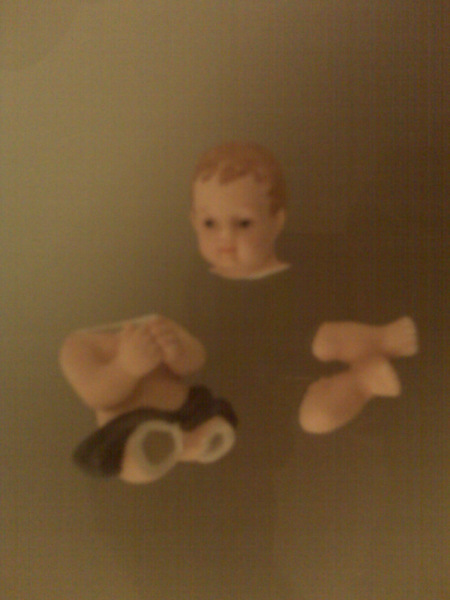
In my small one-bedroom apartment, I found Baby Christ, broken into exactly three: The Head, the Torso, and the Crossed Legs.

“Restore the Trinity,” was spoken to me.

———

For half of my forty years I can honestly say I have tried to pursue Truth, wherever it lie. In philosophy, in scripture, in literature, in art, in nature, in history…

Now, the entire Gospel of Christ lie naked on my kitchen floor.

We separate, we distinguish, we categorize, we breakdown. The Fall of Adam was a fall into denomination.

Christ’s body is One. His Church cannot be broken. Only mere men can get things so wrong.

I think of the great “Angelic Doctor” of the Church, St. Thomas Aquinas, who after spending a lifetime in unparalleled pursuit of human understanding, said after glimpsing a vision of what Our Lord has in store for those who love God:

“All that I have written seems like straw compared to what has now been revealed to me.”

Yes… “straw”…my brother Thomas…merely straw. Straw that lines the manger within which Our Savior is laid bare.

———

It is tradition to leave the crib empty until Christmas morning. Only then do we place the figurative baby Jesus into the scene, after all until that moment he was not yet brought forth from Mother Mary’s womb.

This Christmas morning I will glue together a Broken Baby Christ. The Head, the Torso, and the Crossed Legs will again be One.

Like the world after the birth of Christ, I will never be the same.

For what has now been revealed to me, no fall can break apart.


Howard Hain is a contemplative layman, husband, and father. He blogs at http://www.howardhain.com