Category Archives: Travel

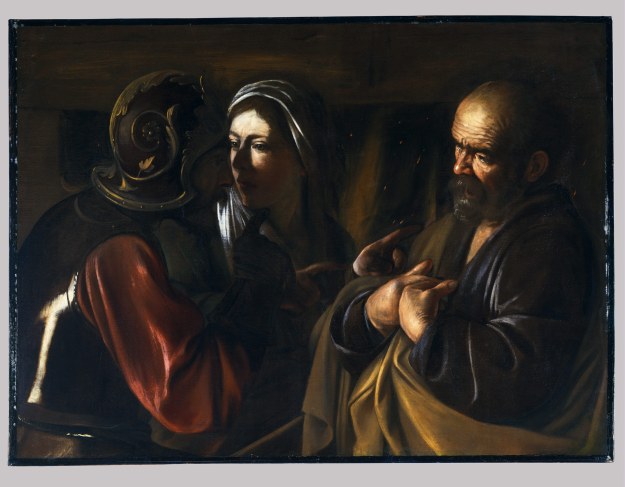
Morning Thoughts: Don’t Look At Me


caravaggio-the-denial-of-saint-peter-ca-1610-the-met

“The Denial of Saint Peter”, ca 1610, Caravaggio (Michelangelo Merisi) (Italian, Milan or Caravaggio 1571-1610 Porto Ercole) (The Met)

.

Never look to a man for answers.

Look to Christ who is the answer.

If you insist on looking to a man, then choose one who points to Christ.

For the best teacher is Christ Himself…and His best assistants are those who clearly say: “Don’t look at me.”


.

—Howard Hain

.

http://www.metmuseum.org/art/collection/search/437986

.

Morning Thoughts: The Prayer of Milk and Honey


.

Then the LORD brought us out of Egypt with a strong hand and outstretched arm, with terrifying power, with signs and wonders, and brought us to this place, and gave us this land, a land flowing with milk and honey.

—Deuteronomy 26:8-9


.

Last fall we went apple picking. We were a small party, composed of immediate family. It was a beautiful crisp day, just the kind you would order for such an excursion.

On our rounds we passed an old wood wagon, behind it and off a bit in the distance lay the remains of an abandoned stone farmhouse—roofless, hollowed out, its fireplaces and chimneys still the main draw. But is was a tiny hand-painted sign on the wagon right before me that most caught my attention:

“Honey is the only food that includes all the substances necessary to sustain life, including enzymes, vitamins, minerals, and water.”

I don’t know if it’s true or not, and I’m not going to spend much time investigating. I like the thought. That’s what matters. So I’m going to keep it, well not keep it, but steward it. Yes, ‘steward’ is a much better word:

Thus should one regard us: as servants of Christ and stewards of the mysteries of God.

(1 Corinthians 4:1)

So often an internet search can do quite the opposite. It can make us into investigators, examiners, maybe even mean-spirited inquisitors. It can turn us into lots of things, other than stewards.

Such an investigative approach also often opens the door to outright skepticism. It may even lead us into intellectual scrupulosity. And all scrupulosity, no matter its form or make up, steals joy. And that we just cannot allow.

On the other hand, we also have to be responsible. We can’t just “believe everything we hear and read”, right?

So what is one to do with such a pickle?

Well, a good steward should look to his master for advice, after all it’s his property we are called to steward on his behalf:

Now it is of course required of stewards that they be found trustworthy.

(1 Corinthians 4:2)

So there we have it. We must be stewards of God’s mysteries, and as stewards we must be found trustworthy.

Sounds straight forward enough. Tough to do though.

Perhaps this can help.

Let’s go step by step, at our Savior’s command:

———

First, let us become more aware of the very mystery that is put into our care:

Our Father, who art in heaven…

Let us next adore what we do not understand:

hallowed be thy name;

Let us then accept the great gift of responsibility, handed over to each one of us daily:

thy kingdom come,

thy will be done

on earth as it is in heaven.

What happens next seems logical enough, we have to ask for help:

Give us this day our daily bread,

And with that, we address the inevitable—for even if we possess only a morsel of humility—we all know that disobedience on our part is bound to occur:

and forgive us our trespasses,

as we forgive those who trespass against us;

Now, having about all we need to proceed, it’s a very good idea to remind ourselves of an eternal reality: That the master is ultimately in control and oversees us closely—rooting us on to accomplish what he wills for us to achieve, all in his very name:

and lead us not into temptation,

But just in case we fail to avoid the snares and traps hidden in plain and disordered sight—especially from falling into the false belief that the “possessions” placed into our care are actually our own—we plead with great desperation, like Saint Peter and all true disciples who think they’ve become lost, that we don’t completely sink into the waters of darkness when our faith begins to falter:

but deliver us from evil.

And together we say:

Yes. I accept. I believe. I agree.

So be it.

(or in other words:)

AMEN.

.

Now, if I can only find some raw milk for breakfast…


.

Look down, then, from heaven, your holy abode, and bless your people Israel and the fields you have given us, as you promised on oath to our ancestors, a land flowing with milk and honey.

—Deuteronomy 26:15


.

—Howard Hain

.
Morning Thoughts: Love Your Proud Papa

Today, This Moment, The Year of Your Lord

My Child,

I thought I should write you this morning. To put down a few words. To speak into creation my ongoing love for you.

There are times when I watch you, somewhat at a distance. I leave that space so that my watching doesn’t impede your playing. But there is really no space at all. Because by not being “right with you” I get to see you as you truly are. My “distance” allows me to see you within the full scope of your existence. And never forget, my child, not for a second, I create your existence. It is not an event of the past. I am active. Always. I am always creating you, and I am always enjoying my creation. That is why I watch.

I watch you unfold. I watch frowns and frustrations unfold into smirks and full-blown smiles. I watch you evolve and grow. I watch you transform. I watch you fight then make up. I watch you get hurt then heal. I watch you hoard then share. Of course there are many times, my dear child, always in fact, that I want to jump in and save the day, to stop the fight, the hurt, the misunderstanding before it evens begins. But I love you too much to always deny you such good food and such nutritious drink.

I will your existence moment by moment, and my will is love. I know exactly how much you need to digest in order to provide for your perfect growth. I also know when too much of one nutrient or the denial of another is not part of my overall plan.

Perhaps that is the hardest thing about being a father, knowing that your maximum freedom within the ever-expanding bounds of my love is what you most need. Such liberty leads you into the divine individuality that I ultimately will to be achieved. And it’s also what makes you most valuable to our one, united, and very common family.

True liberty is what makes you most like me.

Please enjoy my gift this new day.

That’s what I will.

Enjoy my love. Enjoy your freedom. Enjoy the play of keeping it all within bounds. For you should also know, your freedom without my love is a very dangerous game. A game that as much as it grieves me to see any of my children play, I must allow, if the freedom I gift to you is to be of any value at all.

I am always with you. And know this—and know it for sure—if at any one moment, you choose to use your liberty to call out my name, I will scoop you up before you can even utter “the smallest letter or the smallest part of a letter” of my most hallowed name.

For the distance between us isn’t real at all.

It’s love. It’s everywhere. And it lasts for eternity.

I seal this with a kiss. I place it upon the palm of my hand.

I hold it out and gently blow it your way.

I love you…my dear child.


Always smiling at you,

.

Your Proud Papa

.


.

.

—Howard Hain

.

Sunday Vespers: A Chip off the Old Block

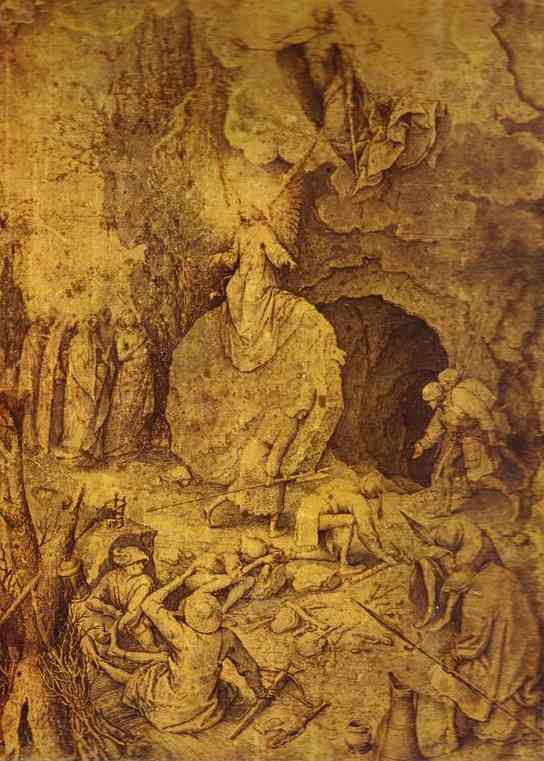
pieter-bruegel-the-resurrection-of-christ-ca-1562


You are my rock

Upon the rock You built Your Church

At Your death the rock was split in two

They laid You lifeless in the rocky tomb

And rolled the rock to seal the light of day

I am Your rock

Upon me You build Your Church

At Your death I split in two

You lay lifeless in my lifeless tomb

My rocky heart seals the light of day

In secret to Father we do pray

Our stillness knows that He is God

No longer statues we arise

And throw aside what we once wore

Total darkness and yet we see

Clearly only one way to go

Your promise lights the way

To restore what You foretold

Same as in the beginning

God and in His image

His creation

His masterpiece

His Son and His brother

The One known as The Word and the one called man

We both enter the garden

As the rock is rolled away


.

—Howard Hain

.

* Pieter Bruegel the Elder, “The Resurrection of Christ”, ca. 1562

.

The Epiphany

We’re into the New Year and automatically we wonder about the future. We can’t avoid it. We’re wondering what this year is going to bring. What’s coming?

Living in a secular age as we do, we see things mainly with eyes for the here and now, which often boils down to politics and economics. What’s the country going to be like under President Trump? What’s the economy going to be like? Unfortunately when we look at things only like that, we can end up being small minded. We can think that what we see and hear and touch now is all there is. We lose a larger vision of life.

We need the spark, the light, of revelation.

Can we see that light in the mystery of the Epiphany we celebrate today? It begins with a star, guiding some travelers on their way. Can this mystery lift up our secular minds and point out something more? Is our world being guided by a Star?

To start, let’s not see the story of the Magi as a cute story of some people riding on camels coming to see Jesus. More than that, it’s a revelation of God’ divine plan which carries news for us and our world, and it’s as important now as it was then.

The Magi story is only found in the Gospel of Matthew, who was writing for Jewish Christians in Galilee and the Syria about the end of the first century. The temple of Jerusalem was recently destroyed and Jewish Christians like other Jews were facing an unknown, disturbing future. When Jesus came to them, he began his mission saying to the Canaanite woman, who pleaded for a cure for her daughter, “I was sent only to the lost sheep of the house of Israel.” (Mt 15;24)  “Go nowhere among the Gentiles, and enter no town of the Samaritans, but go rather to the lost sheep of the house of Israel,” Jesus first told the twelve whom he sent out to preach. (Mt 10, 5) It looked as though the promises of God were for the Jews and them alone.

But that made the promises of God too small.

Matthew’s story of the Magi was a reminder that the gospel was meant for others besides. Jesus came for all, though his ministry was first to the Jews. God wants the world to be one family and he wishes his gifts and graces be given to many peoples and places. God doesn’t save a few.

The Magi may have come from present day Iran or Yemen; two places we hardly view positively today. We tend to see ourselves a privileged people and our own country a promised land. God is on our side. Better to leave the rest of the world to its wars, its earthquakes, its immigrants, its divisions, its problems. As the old song once said, let’s find “perfect peace, where joys never cease, and let the rest of the world go by.”

We can’t let the rest of the world go by. The story of the Magi reminds us we live in a big world that God means to be one. The story of the Magi is not a sweet story about people on camels who looked and dressed and spoke differently than us. They’re symbols of the world beyond ours that’s called by God to share in his promises.

And the newcomers come with gifts.

The Holy Family


Luke 2,41-52

For most people, Christmas is over– the music’s stopped; Santa Claus is gone from the malls. The decorations are down and put away. It’s over.

But in church Christmas isn’t over. We’re still singing  carols and continue to celebrate as we think  about what it means when we say “our God was made visible.”

Today’s the feast of the Holy Family. The Word was made flesh, and as the child of Mary and Joseph Jesus was part of a family in the small town of Nazareth in  hills of  Galilee.

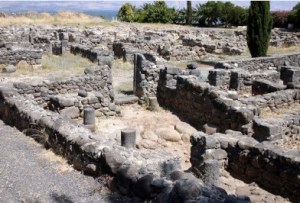
For one thing, families then were extended families or clans, living close together and working side by side. Archeological excavations in Nazareth and Capernaum (pictures below) make that clear. Families worked together in the fields or in  business, they ate together and moved together, as they still do in parts of the Middle East and elsewhere today.

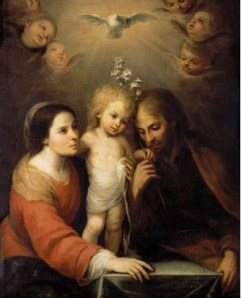
holy familyCapernaumruinsDSC00062

It’s safe to say that nuclear families didn’t exist then. A nuclear family– mother, father and children– is a modern form of family life. Mary, Joseph and the Child Jesus were not all by themselves in a small house in Nazareth. Rather, Jesus was raised in an extended family where  grandfathers and grandmothers, uncles, aunts and cousins lived together and were involved in bringing him up.

That doesn’t take away the part Mary and Joseph played in his upbringing, of course. They weren’t props, standing by while angels brought him up. Some of the apocryphal gospels – early stories about Jesus which the church rejected  – seem to say that.  One  story describes the Child Jesus forming  the figure of a bird from clay, then breathing on it, and instantly it becomes a living bird and flies away. Stories like that presented him exercising  miraculous powers as a child.

The church rejected those stories because they gave a  false picture of Jesus growing up. He “was subject” to Mary and Joseph, the gospel of Luke says. He grew up in their care as an ordinary child would.

Like mothers and fathers everywhere, they saw to his needs, they held him in their arms,  fed him, clothed him,  stayed up at night when he was sick. They taught him his first words,  guided his first steps,  nudged him along this way and that.

They  brought him to church–the synagogue, the temple–as we see in today’s gospel from Luke. They instructed him in his tradition. They taught him to pray,  interpreted events for him,  listened to his questions,  encouraged him over and over. They had their misunderstandings, as today’s gospel  indicates. In fact, they  influenced his life.

Yes, angels were there, but at a distance.  Mary and Joseph and that larger family and village around him raised the Child.

Today’s  feast of the Holy Family takes in the years of Jesus’ childhood and early adult life called his “Hidden Life.” His  years in that nondescript town among those ordinary people were truly hidden, yet were they less important than his Public Life, the few years he taught and did great miracles,  suffered and died and rose from the dead? In those hidden years “he humbled himself.”  A hidden life is important; it’s what mostly characterizes life in a family.

We need to think about family life today, because it’s in trouble.  For one thing, the nuclear family– father, mother, children– is  in trouble. I read some disturbing statistics recently. In every state in our country, families where children have two parents have declined significantly in the last 10 years. One of three children live in a home without a father. Almost 5 million children live in a home without a mother. A single mother may have an income of $24,000. Two parents are likely to have an income significantly greater.

What can we do? How can we help? Feasts  like the Holy Family focus our attention on important things.  They remind us what’s important in God’s eyes. The feast of the Holy Family focuses on the family. It’s important, it says.  At the same time, it tells us God’s grace will be ours when we work to make families go and when we support them all we can.  God points to family life today. It’s vitally important in our world.

Friday Thoughts: Just Up At Dawn


utagawa-hiroshige-titmouse-and-camellias-right-sparrow-and-wild-roses-center-and-black-naped-oriole-and-cherry-blossoms-left-ca-1833

Utagawa Hiroshige, “Titmouse and Camellias (right), Sparrow and Wild Roses (center), and Black-naped Oriole and Cherry Blossoms (left)”, ca. 1833


Lord, You are good.

Truly Good.

You are a great promise.

You are as good as Your Word.

You set free and You restore.

You truly make all things new.

I have seen great deeds.

Only Your hand can accomplish.

Within spaces.

So big and so small.

I have seen you in the sky and in the bird.

I have heard You cry and felt You shake.

I feel Your smile.

This very moment.

Good morning, Father.

You are so very good.

You are God.

And You alone.

Thank You for teaching me.

For showing me how to be free.

By asking only one thing.

Each and every moment.

What is Your will?

I need know nothing more.

I need not see, nor hear, nor feel, nor sense anything else.

I need not understand, nor remember, nor plan.

I need not desire nor will more than Your will itself.

I am.

Here.

To know.

To love.

To serve.

You.

And You alone.

That is Your will.

Your will is You.

One and the same.

Father, Son, Holy Spirit.

Holy Mother Church.

Holy Angels.

Holy Saints.

Cloud of Witnesses.

Help me, Lord God.

Maker of Heaven and Earth.

To love You more and more each day.

In all Your creation.

Every bit of Your handiwork.

All for Your sake.

Simple. Clear. Honest. Pure.

A sparrow just up at dawn.

Tweet…tweet…tweet…

I hear Your will knocking at my door.


.

—Howard Hain

.

http://www.metmuseum.org/art/collection/search/56918

.

Fidel

fidel

Dear Lord,

     The death of Fidel Castro, Cuban dictator, brought joy to many and sadness to others. In Miami there were celebrations in the streets of Little Havana. In Cuba there were nine days of mourning. Many of my friends ask how I feel about the death of Fidel. I’m neither happy nor sad. As a Christian I don’t rejoice in someone’s death. What I do is put them in Your capable hands, my Lord. I’m no one to judge!

     I’ve been praying for Fidel’s soul. Unfortunately I can’t forget that because of his political views and cruel policies generations lost their country and way of life. Torture, executions, imprisonment, all took place if you dared to disagree with any of his policies. Freedom no longer existed. Indoctrination began! Your churches, Lord, were closed. Prayer and religion were no longer necessary, we now had Fidel.

     My mother decided that she needed to leave Cuba for my sake and her own. In 1962 we became refugees. Thanks to the U.S., which opened its arms to us, we began a new life. It wasn’t easy, my God. Here we were penniless in a new land facing a new language and new obstacles. But with the help of family, the U.S. government, and the Catholic Church hope began to spring up and we survived.

     We left Cuba, my God, afraid and without much hope. We left Cuba because one man lost his way and the need for power overwhelmed his ideals. Fidel did have wonderful ideals, but the dark side won, in his case.

     I’ve been in the U.S. now for over fifty years. I’m in love with You, my Lord Jesus and I have to admit that happened here in the U.S.. Good things happened to most Cuban refugees. Most of us survived. We progressed. We lived full lives. But we never will know what could have been. The Cuba of today is nothing like the Cuba of yesterday. For some it’s very sad, for others it’s life. For me it is Your will, my God! May You, our Lord and Savior have the mercy on Fidel that he neglected to have for many of his people.

Berta Alvarez-Hernández

33rd Sunday C: Visiting Churches

Audio homily here: 

Whenever I can, I invite visitors to our monastery in Jamaica, Long Island, to take the subway to downtown Manhattan for a ride on the Staten Island Ferry and then visit Battery Park, the Museum of the American Indian, and some of the old churches and shrines among the city’s famous skyline. I try to tell the story of our country and the Catholic church in America by walking through those places. It’s a good opportunity to talk about the care we need to give creation as we look at the waters of the harbor, the question of immigration as we visit Castle Clinton in the Battery, and the church as we visit the area’s churches. Looking at the past helps you to understand the present.

Our walk usually ends at St. Peter’s church, the oldest Catholic church in New York City, on the corner of Church and Barclay Streets, a block away from the World Trade Center. The church was dedicated November 4, 1786, three years after British troops evacuated the city at the end of the Revolutionary War and it’s been there as an active parish every since.

Previously, New York City was under Dutch and British rule for almost 150 years. During that time the city was strongly anti-Catholic, with laws calling for any Catholic priest who came there to be jailed. Catholic worship was forbidden; there were no Catholic churches.

Even after the Revolutionary War, despite their support for the American cause, Catholics were looked down upon in New York City. There were only a few hundred in a population of almost 20,000. Being a Catholic didn’t get you far in New York in those days.

So how did that church get built? Well, there were some foreign diplomats from France and Spain and Portugal in the city then. New York was the nation’s capital at that time. (1785-1790)

There were a couple of well-to-do Catholic businessmen, but most of the Catholics that formed St. Peter’s were poor Irish and German immigrants and French refugees and slaves from the recent revolution in Haiti.

Not a good mix of people to form a parish, you might think. This new congregation, besides facing the anti-Catholic attitude of New Yorkers, was poor and getting poorer as new Catholic immigrants poured into New York from Europe. Its priests weren’t the best either. They seemed to be always squabbling among themselves. There were some scandals among them. The laypeople were also divided among themselves. There were factions that wanted to run the parish their way or no way. There wasn’t a bishop in the country at the time to straighten things out.

So what kept it going? The other day we celebrated the Feast for the Dedication of the Church of St. John Lateran in Rome. The liturgy for that feast offers some wonderful insights into what a church and a parish should be. “My house is a house of prayer,” Jesus says. This church is not a social hall; it’s a place where we meet God and God meets us. It’s a place where we are welcomed on our way through life by a living water that restores us and helps us grow. ( Ezekiel 47.1-12) It’s is a place where we remember our mission in this world: we’re builders of the City of God, living stones that together form the temple of God. ( 1 Corinthians 3, 9-17) It’s is a place of communion, where we commune with God and God with us.

The readings for the feast say a church is a place of welcome. It’s where the lost sheep find their way home. It’s where people like Zacchaeus, the tax collector mentioned in St. Luke’s gospel, find new hope for their lives. It’s is a place of sacraments, where infants are blessed, where marriages begin, where we put our dead in the hands of God who promises eternal life.

What keeps a church and a parish going is its spiritual life, its life of prayer, its life of ministry.

Whenever I go to St. Peter’s Church on Barley Street I point out two markers at its entrance. One says that St. Elizabeth Seton, the first native born American saint, was received into the Catholic Church here in 1806. She had been a member of a prominent Anglican church just down the street, Trinity Church, but came to St. Peter’s drawn by her faith in the Mass and the Blessed Sacrament. Socially, it was step down for her. Spiritually, she found a home here in this struggling, messy parish of poor immigrants.

The other marker recalls Pierre Toussaint, a Haitian slave who was also a member of this church in colonial times. He became a famous New York hair-dresser and was welcomed into the homes of elite members of New York society for over 50 years. For 50 years he came to Mass every morning at St. Peter’s. He’s buried in the crypt at St. Patrick’s Cathedral and in being proposed for canonization today.

The church is not a place of brick and stone. It’s a place for people, holy people, to meet God and one another.  They make the church.

Remembering World Youth Day

img_3385

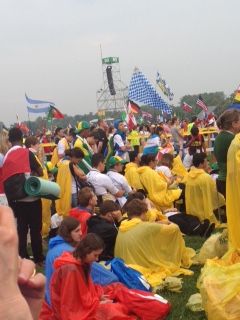
During the summer of 2016, I had the opportunity to travel to Krakow, Poland, to attend World Youth Day. I began my journey with five other people from my parish, Holy Family Church in Fresh Meadows. along with the 500 people from the Diocese of Brooklyn. I had no expectations for what was to come my way.

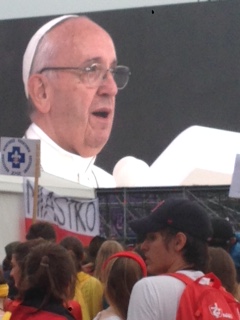
I had so many incredible experiences when I realized that there were approximately 3 million Catholics who came from across the world to be united in Poland because of their love and passion for Jesus. There were an overwhelming amount of opportunities to experience the year of mercy throughout the different activities in Poland. I attended the catechesis sessions in Krakow, walked through the concentration camp in Auschwitz, visited the chapel in the shrine of the Black Madonna in Czestochowa, and attended the festival in Blonia Park where Pope Francis visited the anxiously awaiting pilgrims.

img_3363

The incredible overnight experience in Krakow was so joyful as I walked along a five mile route with the rest of the young people from Brooklyn and Queens. We camped out in an open field and joined millions of youth in a peaceful environment. The year’s World Youth Day was focused upon the lives of Saint Pope John Paul II, Saint Faustina and Saint img_3367Maximilian Kolbe, especially during the catechesis sessions.

World Youth Day in Krakow changed my view of Catholicism because I was used to attending church on Sundays and occasionally a meeting with my youth group. I never would believe that there were so many young Catholics that are truly seeking Jesus and eager to spread his mission. I truly believe that my Catholic faith has been transformed spiritually and I am very grateful for that experience.

I hope to attend World Youth Day in Panama in 2019!


Raquel Goncalves