Category Archives: spirituality

Friday Thoughts: Pure Extra Virgin

by Howard Hain
william-dyce-the-garden-of-gethsemane-1860

William Dyce, “The Garden of Gethsemane”, 1860*


To your eyes a thousand years are like yesterday, come and gone, no more than a watch in the night.

—Psalm 90:4


.One good olive.

There are so many factors.

The altitude. The light. The soil. The temperature. The rainfall. The wind. The dew point and humidity. The age of the tree.

Then there are those factors that we can control: pruning, watering, fertilizing, fanning, netting, and wrapping chilly trees with burlap or fleece.

And of course there are those other factors, those that fall somewhere in-between, between our control and our complete lack thereof: most of these relate to the sneaky work of numerous little thieves—animals, birds, insects, and perhaps even fellow farmers or other hungry travelers who just happen to pass by.

But when all is said and done—when all the factors are poured into the olive equation, mixed-up well, and left to unify or settle out—the fruit that’s produced by the world’s most nostalgic, symbolic, and romantic of trees means very little (at least in digestive terms) if it’s simply left to shrivel up and fall to the ground.

———

Picking an olive is perhaps the highest part of the art.

———

When to do so? And toward what end?

If too early, great potential is squandered.

If too late, great taste is lost.

If indecisive, we might as well let nature enjoy it for the time being—for one way or another—God’s process will eventually return it to the earth.

———

And yet, we’re still not done, for even if the olive is picked at just the right time, from just the right tree—the one that has grown in all the right circumstances—when it comes to the culmination of olive production, all is moot if the precious fruit of the womb is never squeezed.

For no matter how good the olive, without applied pressure, there’s nothing left to be labeled “pure extra virgin”.


.But when the fullness of time had come, God sent his Son, born of a women…

—Galatians 4:4


* Gethsemane is the name of a garden on the Mount of Olives in Jerusalem. It appears in the Greek of the Gospel of Matthew and the Gospel of Mark as Γεθσημανή (Gethsēmanē). The name is derived from the Aramaic ܓܕܣܡܢ (Gaḏ-Šmānê), meaning “oil press”.


(Dec/23/2016)


Thoughts Upon The Cross: Doxa. Doxa. Doxa.

by Howard Hain

.

And we have seen his glory,

the glory of an only Son coming from the Father,

filled with enduring love.

—John 1:14


.

The power of God.

A tiny leaf caught between two worlds

Suspended by invisible threads

Dancing to the still small voice.

Deeper and deeper

Into the person

The Son of Man

Who is God.

Glory.

And Might.

Power.

And Majesty.

Fully Alive.

Beautifully Human.

Walking Wisdom.

The Lightness of Fullness.

The Heaviness of Simplicity.

Doxa. Doxa. Doxa.

Honor.

Adoration.

And Praise.

Doxa. Doxa. Doxa.

Beyond praise.

The Power of One.

He Is.

We’re not.

He stands.

We fall down.

He dies.

We live.

Doxa to the Father.

Doxa to the Son.

Doxa to the Holy Spirit.

Doxa. Doxa. Doxa.

Between two worlds.

Is a man.

Who says “I AM”.

A tiny leaf suspended.

He is Lord.

He is God.

Invisible threads.

He Is.

And so now are we.

Dancing.

Still.

Small.

Voice.

The Word.

The Depth.

Beyond the signs.

To the Person Himself.

The Person of Jesus.

Deeper.

And deeper.

Into His flesh.

Into His Glory.

Doxa is Thy Name.

Dwelling among us.

Abiding within us.

Still small leaves caught between two worlds.

Suspended by invisible threads.

Dancing to the breath of God.

From deep to deep.

Depth to depth.

It never ends.

Doxa. Doxa. Doxa.

Doxa in the highest.


.

(May 6, 2017)

St. Paul of the Cross

OLYMPUS DIGITAL CAMERA

October 20th, we celebrate the feast of  St. Paul of the Cross in the United States.

A saint leaves a legacy, a blessing for the church and especially for members of communities he founded or inspired. What legacy did the saintly founder of the Passionists leave?

Paul of the Cross died October 18, 1775, a year before our American Revolution and fourteen years before the French Revolution. Twenty three years after his death, the French revolution spilled over into neighboring Italy and the Papal States. Napoleon imprisoned the pope, Pope Pius VI, religious houses and church resources were taken over by French forces; the Catholic Church in Italy, like the Catholic Church in France, was seemingly crushed by the French general and his powerful army.

In May of 1810 the situation got worse. Napoleon declared an end to the Papal States and ordered the new pope Pius VII to be imprisoned in Savona, Italy. His police led thousands of religious from their religious houses back to their homes and told to start another life. Among them were 242 Passionists, the community Paul of the Cross founded in the previous century.

The old church was dead, the emperor said. He would replace it by a new one of his own. In that thinking, the Passionists too were dead; they would hardly have a role in Napoleon’s church. Of course, the church didn’t die and neither did the Passionists.

Historians usually credit the brilliant diplomacy of Cardinal Consalvi, the pope’s secretary of state, for keeping the church alive and getting it on its feet again after Napoleon’s defeat in 1814. But diplomats weren’t the only ones responsible for the church’s restoration. Most of the credit belonged to ordinary believers who kept the faith and remained loyal.

The same was true for the Passionists. We certainly gave the church an inspirational figure at the time, St. Vincent Strambi, the Passionist bishop and first biographer of Paul of the Cross. Before Napoleon’s troops invaded Rome in 1798 Pius VI asked Vincent to preach in the city’s four major basilicas to strengthen the Roman people. After Napoleon’s defeat, Pius VII called Strambi to Rome again to preach a 9 day retreat of reconciliation–not everybody stood up to the French invaders.

But besides Strambi, what kept the Passionists alive were certainly those ordinary religious who were driven from their monasteries and came back to continue the work that St. Paul of the Cross envisioned a century before. They were the faithful ones, faithful to what they learned from him.

Paul of the Cross not only preached the mystery of the Passion of Jesus; he lived it. He held on to his dreams through hard times. Humanly speaking, the Passionists, the community he founded, should have gone out of existence many times, from its tenuous beginnings to the years it waited for acceptance by the church. The mystery of the Cross was present in its birth, its growth and its life.

Now as then, the Passion of Jesus brings life, not death.

“Wait for One Another”

In today’s reading at Mass from 1 Corinthians ( 11, 17-26.33) we have the earliest written account of the institution of the Last Supper in the New Testament:
“For I received from the Lord what I also handed on to you,
that the Lord Jesus, on the night he was handed over,
took bread and, after he had given thanks,
broke it and said, “This is my Body that is for you.
Do this in remembrance of me.”
In the same way also the cup, after supper, saying,
“This cup is the new covenant in my Blood.
Do this, as often as you drink it, in remembrance of me.
For as often as you eat this bread and drink the cup,
you proclaim the death of the Lord until he comes.”

The simple account stresses that Jesus, taking bread and wine, gave himself, Body and Blood, “for you.” He gave himself for all. When we do this “in remembrance of me” we are called to be like him, to give ourselves for all.

Paul warns the Corinthians that by what he hears of their divisions and factions they’re failing to do what the Lord commands. Instead of imitating what Jesus d, they’re driving others away in their celebrations and thus bringing judgment on themselves.

Therefore, my brothers and sisters,
when you come together to eat, wait for one another.

A beautiful phrase Paul uses, “wait for one another.” A phrase that comes from the family meal in Paul’s time, when someone might miss the meal if the family did not wait for them. “We have to wait for them.”

So we wait for the grace Jesus offers at the Eucharist, to see all at the table of the Lord, loved by God who loves all.

Hurricane Florence is Coming

We not preparing for the disasters brought by climate change, an article in USAToday by Rick Hampson says. “Will repeated exposures to vivid scenes of natural disaster–Western wildfires, a global heat wave, Hawaiian volcano eruptions, the 2017’s hurricane’s anniversary and a suddenly active 2018 season” prepare us to do something? “Experience counsels skepticism. So does human nature.”

“Experts say people aren’t really motivated by disaster until it come to, or through, their door.” Hampson writes.

We forget that “America, the Beautiful” is vulnerable to climate change as other parts of the world are, and our political system doesn’t help us face the change either. The earth doesn’t get to vote.

“Democracies are creatures of the present, because the public focuses on the here and now, not some future hypothetical problem… Our political system makes us vulnerable to distant crises, because we don’t try to anticipate or diffuse them.” (Robert J. Samuelson)

In a previous blog Pope Francis asks us to hear in the changing climate cries of “Our  Sister, the earth” groaning from the abandonment and mistreatment received at our hands. Is Hurricane Florence a cry of creation?

“Save us, Lord, from becoming simply ‘creatures of the present.’ looking after ourselves. Let us hear our earth and sky and sea when they cry out from our abuse and lack of care. We ourselves are dust from the earth, we breathe her air and are refreshed by her waters. May we hear the cries of our Sister, the earth,  and care for her.”


Speak, Lord, Your Servants are Listening

In times like this we should listen to the voice of the mystics in our church. They speak in troubled times.

Among the mystics I count the writers of scripture, Luke and Paul, who speak in our readings at Mass these days and see things from a higher perspective than we do. Be careful of human wisdom, Paul says today to the Corinthians enmeshed in the politics and personalities of their church:

“So let no one boast about human beings, for everything belongs to you,
Paul or Apollos or Cephas,
or the world or life or death,
or the present or the future:
all belong to you, and you to Christ, and Christ to God.”

Luke’s gospel today (Luke 5, 1-11) describes the fishermen on the lake, Cephas among them, who have come from fishing all night and caught nothing. The One from Nazareth, no fisherman at all, tells them to cast their nets for a catch.

Wisely, they defer to him and their human wisdom is replaced by the power of God.

I think too of Bridget of Sweden and Catherine of Siena, mystics of their day, whose vivid perception of the powerful presence of God in their meditations and prayers reminded the leaders and people of their church to listen to their Lord.

Prayer and listening to God’s word are not small gestures today. We’re like the Corinthians and the fishermen by the lake. We need to listen to the Lord who speaks to us. We get so caught up in the wisdom of the day.

Why I Am A Catholic

by Orlando Hernandez

The Gospel readings for this week are full of harsh, ominous sayings by our Lord Jesus. They are filled with characters worthy of rejection by God: the scribes and Pharisees, the careless servants, the foolish virgins, all headed for damnation, punishments, gnashing teeth, Gehenna! I actually could relate to all these unfortunate souls. In many ways I feel as guilty as them. It was very hard for me to choose a Gospel reading to write about.

Careful re-reading and prayer came to the rescue once again. Incredibly, the threatening reading for Monday (Mt 23:13-22) began to show me a way out of Gehenna. Jesus starts proclaiming the “woes” against the scribes and Pharisees. They “lock the Kingdom of heaven before men” (Don’t I in my mind, do this for so many that I judge as hopeless, cruel people?). Jesus goes on to say:

“ Woe to you, blind guides, who say, ‘If one swears by the temple, it means nothing, but if one swears by the gold of the temple, one is obligated.’ Blind fools, which is greater, the gold, or the temple that made the gold sacred? And you say, ‘If one swears by the altar, it means nothing, but if one swears by the gift on the altar, one is obligated.’ You blind ones, which is greater, the gift, or the altar that makes the gift sacred?”

I do not wish to comment on the historical background for this writing, the bitter conflicts between Pharisaic Judaism and the Church of Matthew at the time, which might have influenced Matthew’s writing. What I need to do is to express what Jesus tells me when I read His attacks on the Pharisees and scribes.

We are not supposed to “swear”, but an oath can be a kind of pledge, a commitment that leads to a way of life. Why are so many people committed to follow the Catholic Church? Is it the “gold,” the grandeur , the power of the institution that calls to us, and gives us some sense of security? When we walk into a church building are we simply mesmerized by the splendor all around, the vastness of the place, the large crowd, the ritual, the gold, the place of leadership, respect, and wisdom that we give to our priests and bishops? Is it because we need to belong to something greater than ourselves? What is this “something” that is so great?

This week, Pope Francis is ministering to an Irish Church that has been greatly diminished. Almost 50% of Irish Catholics have left. New civil laws scoff at the precepts of the Church. Fr. Martin Coffey CP once talked to us Passionist Associates about the incredible wealth and dominance that the Church had over Irish culture and government. Yet the power led to hubris, abuse, and corruption. Many Ministers of God went the way of the pharisees in the Gospel. They forgot to act with “judgement and mercy and fidelity”. The Church was like those cups and graves that were shiny on the outside and dirty on the inside. With the news of recent weeks, we wonder if this process of diminishment has also been accelerated in our own Church in the USA.

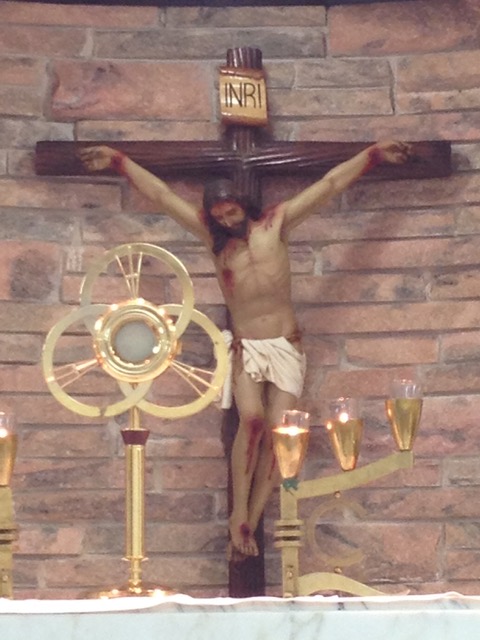
For my part, and for millions like me, it was never the “gold of the temple” nor the gifts on the altar that captured me. It was the Living God within that temple, in that altar, that made everything “sacred.” Within the tabernacle we have those humble little pieces of Bread that hold greater power than the Vatican and all the Cathedrals put together can ever have! Yes, these “temples” are holy and we “swear” by them, but they are empty buildings without the Life that dwells in them. In the same manner, out lives as Catholics are just as empty if we don’t just relax, take a deep breath, and let Jesus fill our hearts with the power of His Love. Jesus has always been the one that calls me to “Church.” I go to mass to be with Him. Only then, can I look around and feel the greatest reverence for His people within that building. In this Monday’s Gospel Jesus goes on to tell us: “One who swears by the altar swears by it and all that is upon it ; one who swears by the temple swears by it and by Him Who dwells in it ; one who swears by heaven swears by the throne of God and by Him Who is seated on it.”

I have this great faith that we will overcome all these problems in our Church. Too much bleeding and suffering has gone into it. What gives me the right to feel this way? The loving intimacy with which Jesus Christ, my Lord, has claimed me gives me the right. He is ready to give this to everyone. How dare we approach Him when we have so much in common with those Pharisees, unreliable servants, and careless virgins? Because He died for all of us. The answer to the whole puzzle somehow lies in His Passion, Death, and Resurrection.

“Therefore, brothers [and sisters], since through the blood of Jesus we have boldness to enter into the sanctuary by the new and living way He opened for us through the veil, that is His flesh, and since we have a great priest over the house of God, let us approach with a sincere heart and in absolute trust, with our herts sprinkled clean from an evil conscience and our bodies washed in pure water.” (Heb 19-22)

A few years ago someone said to me, “I don’t go to mass because I just don’t trust those priests.” I love and trust quite a lot of priests, but what I told the man was, “The priest I go to meet at mass is called Jesus Christ.” Jesus is the ultimate Power that can lead us to say : “I am a Catholic.”

“For we do not have a high priest who is unable to sympathize with our weaknesses, but one who has similarly been tested in every way, yet without sin. So let us confidently approach the throne of grace to receive mercy and to find grace for timely help.” (Heb 4:15-16)

Orlando Hernandez

21st Sunday of the Year b: First, Believe

For this week’s homily, please play the video below.

18th Sunday of the Year: Bread, Manna for the Journey

For this week’s homily, please play the video file below:

17th Sunday: Give Us This Bread

For this week’s homily, please play the video below.