Category Archives: spirituality

33rd Sunday C: Visiting Churches

Audio homily here: 

Whenever I can, I invite visitors to our monastery in Jamaica, Long Island, to take the subway to downtown Manhattan for a ride on the Staten Island Ferry and then visit Battery Park, the Museum of the American Indian, and some of the old churches and shrines among the city’s famous skyline. I try to tell the story of our country and the Catholic church in America by walking through those places. It’s a good opportunity to talk about the care we need to give creation as we look at the waters of the harbor, the question of immigration as we visit Castle Clinton in the Battery, and the church as we visit the area’s churches. Looking at the past helps you to understand the present.

Our walk usually ends at St. Peter’s church, the oldest Catholic church in New York City, on the corner of Church and Barclay Streets, a block away from the World Trade Center. The church was dedicated November 4, 1786, three years after British troops evacuated the city at the end of the Revolutionary War and it’s been there as an active parish every since.

Previously, New York City was under Dutch and British rule for almost 150 years. During that time the city was strongly anti-Catholic, with laws calling for any Catholic priest who came there to be jailed. Catholic worship was forbidden; there were no Catholic churches.

Even after the Revolutionary War, despite their support for the American cause, Catholics were looked down upon in New York City. There were only a few hundred in a population of almost 20,000. Being a Catholic didn’t get you far in New York in those days.

So how did that church get built? Well, there were some foreign diplomats from France and Spain and Portugal in the city then. New York was the nation’s capital at that time. (1785-1790)

There were a couple of well-to-do Catholic businessmen, but most of the Catholics that formed St. Peter’s were poor Irish and German immigrants and French refugees and slaves from the recent revolution in Haiti.

Not a good mix of people to form a parish, you might think. This new congregation, besides facing the anti-Catholic attitude of New Yorkers, was poor and getting poorer as new Catholic immigrants poured into New York from Europe. Its priests weren’t the best either. They seemed to be always squabbling among themselves. There were some scandals among them. The laypeople were also divided among themselves. There were factions that wanted to run the parish their way or no way. There wasn’t a bishop in the country at the time to straighten things out.

So what kept it going? The other day we celebrated the Feast for the Dedication of the Church of St. John Lateran in Rome. The liturgy for that feast offers some wonderful insights into what a church and a parish should be. “My house is a house of prayer,” Jesus says. This church is not a social hall; it’s a place where we meet God and God meets us. It’s a place where we are welcomed on our way through life by a living water that restores us and helps us grow. ( Ezekiel 47.1-12) It’s is a place where we remember our mission in this world: we’re builders of the City of God, living stones that together form the temple of God. ( 1 Corinthians 3, 9-17) It’s is a place of communion, where we commune with God and God with us.

The readings for the feast say a church is a place of welcome. It’s where the lost sheep find their way home. It’s where people like Zacchaeus, the tax collector mentioned in St. Luke’s gospel, find new hope for their lives. It’s is a place of sacraments, where infants are blessed, where marriages begin, where we put our dead in the hands of God who promises eternal life.

What keeps a church and a parish going is its spiritual life, its life of prayer, its life of ministry.

Whenever I go to St. Peter’s Church on Barley Street I point out two markers at its entrance. One says that St. Elizabeth Seton, the first native born American saint, was received into the Catholic Church here in 1806. She had been a member of a prominent Anglican church just down the street, Trinity Church, but came to St. Peter’s drawn by her faith in the Mass and the Blessed Sacrament. Socially, it was step down for her. Spiritually, she found a home here in this struggling, messy parish of poor immigrants.

The other marker recalls Pierre Toussaint, a Haitian slave who was also a member of this church in colonial times. He became a famous New York hair-dresser and was welcomed into the homes of elite members of New York society for over 50 years. For 50 years he came to Mass every morning at St. Peter’s. He’s buried in the crypt at St. Patrick’s Cathedral and in being proposed for canonization today.

The church is not a place of brick and stone. It’s a place for people, holy people, to meet God and one another.  They make the church.
Friday Thoughts: Acceptance Speech

.

Just start walking.

Leave the pew behind.

Everything else falls away.

All that was dead comes to life.

Pastures and valleys. Fields and streams.

Tiny violet flowers on the walls of quarries.

Wood and stone. Water and wine.

Teardrops and smiles.

A poor boy gets in line.

Just a taste. A nibble. A crumb from the table.

But he looks at his clothes.

But it’s all he’s got.

Just keep walking.

You’ve left the pew behind.

Everything else has fallen away.

All that was dead has come to life.

A thorny bush now a fruitful tree.

A man raises his hand:

“The Body of Christ.”

A child opens his mouth:

“Amen.”

A shepherd boy ascends to the throne.


.

—Howard Hain

.

Pope Leo the Great: Part 2

LEOATTILAa

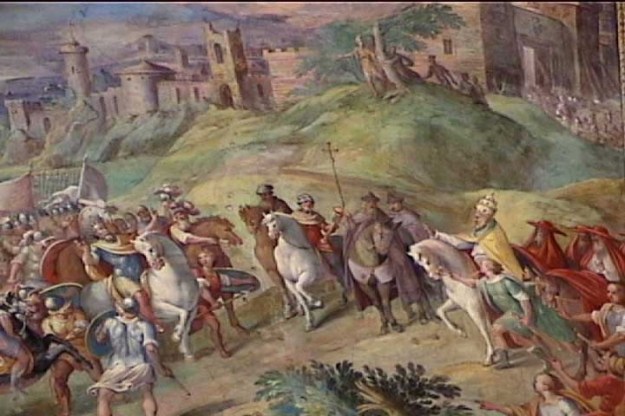
Pope Leo had to step in when Attila and his army were threatening to destroy Rome. The elite of Roman society had fled the city, the government was gone, the rest were busy securing their own homes in the city. I don’t think Leo, a churchman who was by nature a thinker deeply engaged in the study of spiritual things wanted to meet the dangerous invaders at the city gates, but he did. He rose to accept the responsibility.

When society is in danger because it refuses to face the issues that endanger it, the church can’t flee or look to its own security. It has to step in. That means not only church leaders but every believer has to meet the challenges at our gates today which government and society won’t acknowledge– Climate change and care for the earth, immigration and care of refugees, nuclear disarmament, universal healthcare, global peacekeeping, respect for the family and human rights.

“Remember your leaders who spoke the word of God for you. Consider how their lives ended and imitate their faith. “ (Hebrews 13, 7) (Common of Pastors} Remember Leo.

Tomorrow we have another leader, who fought for the poor when most were concerned for the rich: Martin of Tours. Remember Martin of Tours.

Morning Thoughts: Glory Be To The Father

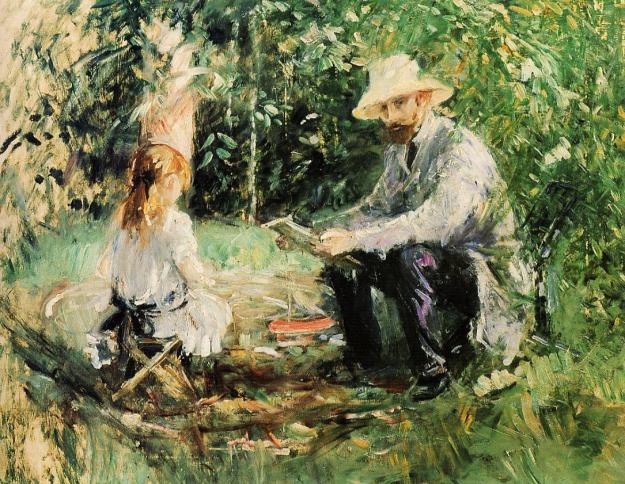
berthe-morisot-eugene-manet-and-his-daughter-in-the-garden-1883

Berthe Morisot, “Eugene Manet and His Daughter in the Garden”, 1883


.

“Let the little children come to me, and do not hinder them, for the kingdom of heaven belongs to such as these.”

Matthew 19:14


.

I spent most of the day with my two-year-old daughter. I intended to work on a piece concerning the Garden of Eden. Well, “most of the day” turned into most of the evening, my wife needing to attend a wake for the father of an old friend. So instead I share an innocent blessing.

I have had the privilege to spend a great amount of time the last two years witnessing my child’s growth. One beautiful result is a strong attachment that is quite reciprocal. One practical consequence is many long goodbyes. Francesca can get quite upset to see me leave. I do what I can at the door to be consoling. Ensuring her that I’ll be back, engaging in a series of hugs and kisses, allowing her to flick the light switch on and off a few dozen times—and then, before the hopefully peaceful handoff to my wife, I anoint her little forehead with the Sign of the Cross and quietly say a prayer.

One particular morning a few months back I was running late, and when it came time to leave, Francesca had a particularly tough time letting go. After the regular routine, she continued to cry and cling to my neck. I managed to pry her off and get her to stand on her own, but all the while she continued to point at my head. I confess I was losing composure. I was about to just close the door, though it kills me to leave without feeling that I have ensured her peace. I tried once more to explain that I’d be back. She continued to jump up and down and point toward my brow. I realized that she was identifying the large freckle on my forehead. You need to understand that to Francesca all freckles are “booboos.”

I pacified her by bending over so that her forefinger could touch the dark spot. That didn’t do it. Booboos need to be kissed. So now with little patience, I patronizingly knelt on the foyer side of the door. And Francesca pressed her lips to my forehead. I remained on my knees, feeling the awesome weight of humility.

Here I was concerned about blessing my child, about being the spiritual caretaker, the father in both body and spirit—and yet it is Francesca who blesses me, who anoints my forehead and consecrates my day.

I descended the stairs feeling incredibly foolish, walking out into the world with a renewed awareness of just how little I control.

My daughter and I have the same father.

.


.

“Forgive me Lord, for not being as good a father to her as You are to me. Thank You Lord, for trusting me with such a tremendous responsibility. Praise You Lord, for all the beauty that resides within this precious child. May I serve You Lord, by fulfilling Your will for her as made manifest through me.”

.


.

—Howard Hain

.

32nd Sunday C: Thinking About Death

Audio Homily here:

How do we want to die? I think we’ll be hearing that question more frequently after our current elections are over. “End of life” decisions are going to be part of the political agenda in the future. In our society we’ll be facing a range of questions about death and dying.. 

Let’s think about the term “end of life” first. If we listen to our first reading from the Book of Maccabees, the seven brothers who are put to death for defying their Greek conquerors and keeping their Jewish faith don’t see death as an end of life. “You are depriving us of this present life,” one of the brothers says, “but the King of the world will raise us up to live again forever.”

The seven brothers see this life as given to them by God, who is master of life and death. Life doesn’t end. We are in God’s hands from the beginning. It’s for God to decide when we die, but God promises life beyond death. It’s for us to remain faithful as long as we live.

We hear in today’s gospel people denying that there’s life after death and trying to bait Jesus with what they think are absurd circumstances. Jesus tells the Sadducees  that life beyond this life is not the same as here on earth. A heavenly life is beyond what we can imagine.

So denying life beyond death isn’t new. Today we can hear the same denial of eternal life, the life that Jesus promises and shows us in his resurrection. One of the signs of that denial may be, I think, the increasing number of suicides, even among young people. We can see this life as our only life, and when circumstances become seemingly intolerable and seemingly hopeless, some unfortunately end their earthly lives. But we leave them to God’s mercy.

Today death often goes unmentioned. We don’t want to talk about it. We just want to think about life. But death is an important part of life.

There was a passage in a popular book some years ago by Carlos Castenada about an old Indian, Don Juan, and a young sophisticated scientist from the northeast, walking together in the desert in the southwest. The two are world’s apart in the way they think. 

As I recall it, the old Indian says to the young man, “Did you see the White Eagle circling over your shoulder?”

“ Yes, I see it,” the young man replies.

“That’s your death, keep an eye on it.”

“That’s a morbid thought,” the young man says, “We don’t think about that any more.”

“You should,” Don Juan says, “Keep an eye on your death. It will keep you from being small-minded.”

The young man’s describing the way a lot of people look at life today. We don’t want to think about death. We’re thinking more about extending life here on earth, through better diet, better heath care, better exercise;  we don’t like to think of a life ending in death.

But we should keep death in mind. Death is the door to another life. By ignoring it we can limit ourselves to a life too small, too self-centered, too brief. We need to see life as God sees it.   Life is not ended in death, it’s changed.

So death  is not something to be ignored; it is one of the two most important moments in life. That’s why we say in the Hail Mary. “Pray for us sinners, now and at the hour of our death. Amen.”

Friday Thoughts: Clean Enough to Care

.

What if someone handed you a child?

A small child.

A tiny child.

An infant.

A few hours…a few minutes old.

What if you were the only one that the child could be handed to?

Only you.

No one else around to help.

Would you receive that child into your arms?

There’s no sterilized room, no sanitary precautions, no sink, not even a bar of soap—just plain old you, a bunch of imperfect circumstances, and a poor tiny child that needs to be embraced.

You know what you would do.

Even if your hands were filthy, completely covered in soot and mud, you know what you would do.

You’d quickly rub your hands against your pants or shirt and wipe away the obvious dirt.

Then you’d hold out your hands.

Wouldn’t you?

Yes. You would.

We all would.

That’s what makes us human.

That’s what makes us children of God.

We’d do what we could with what we have to help an innocent child.

We know that “cleanliness” in such cases really doesn’t matter. For even if the circumstances were “perfect” we’d still have that uneasy feeling. That feeling that we’re not worthy to hold such innocence, to be entrusted with such treasure.

It’s a holy hesitancy that only true humility can bear.

Yet, it’s the necessity to help, the clear need for our assistance—the abundantly clear reality that we’re the only “hands” on deck—that drives us to overcome such holy and righteous fear—a fear that reveals just how poor we really are, much poorer in fact than even the helpless child we are about to embrace.

It is preciously this beautiful fear of God that propels us to love boldly—to boldly reach out beyond ourselves, to boldly become part of God’s mystical body, to become His very arms and hands—to embody Divine Love Itself—that perfect love of the eternal Father for each and every child ever created.

For it is the Father’s love that creates us, and sustains us, and longs to flow through us.

We just sometimes need extreme circumstances—ridiculously obvious situations—in order to tap the needed courage to let it to flow beyond our own borders and into those around us.

You are in such a situation. Right now.

We all are.

This very moment.

No matter where you are or what you’re doing.

Such a situation is at hand.

A child, a new born—cold, hungry, and without a home—desperately needs to be held.

Quick then, wipe your dirty hands, make due with what you’ve got—believe the Word of God, it’s good enough—now hold out your hands.

You’re clean enough to care.


.

—Howard Hain

.

Remembering World Youth Day

img_3385

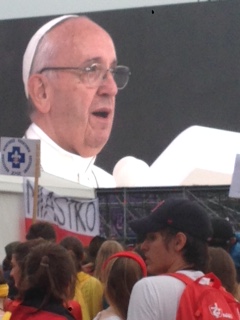
During the summer of 2016, I had the opportunity to travel to Krakow, Poland, to attend World Youth Day. I began my journey with five other people from my parish, Holy Family Church in Fresh Meadows. along with the 500 people from the Diocese of Brooklyn. I had no expectations for what was to come my way.

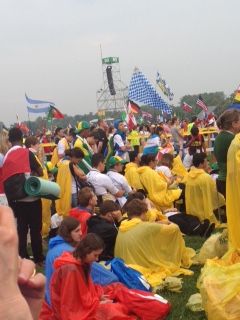
I had so many incredible experiences when I realized that there were approximately 3 million Catholics who came from across the world to be united in Poland because of their love and passion for Jesus. There were an overwhelming amount of opportunities to experience the year of mercy throughout the different activities in Poland. I attended the catechesis sessions in Krakow, walked through the concentration camp in Auschwitz, visited the chapel in the shrine of the Black Madonna in Czestochowa, and attended the festival in Blonia Park where Pope Francis visited the anxiously awaiting pilgrims.

img_3363

The incredible overnight experience in Krakow was so joyful as I walked along a five mile route with the rest of the young people from Brooklyn and Queens. We camped out in an open field and joined millions of youth in a peaceful environment. The year’s World Youth Day was focused upon the lives of Saint Pope John Paul II, Saint Faustina and Saint img_3367Maximilian Kolbe, especially during the catechesis sessions.

World Youth Day in Krakow changed my view of Catholicism because I was used to attending church on Sundays and occasionally a meeting with my youth group. I never would believe that there were so many young Catholics that are truly seeking Jesus and eager to spread his mission. I truly believe that my Catholic faith has been transformed spiritually and I am very grateful for that experience.

I hope to attend World Youth Day in Panama in 2019!


Raquel Goncalves

Morning Thoughts: The Bad Thief

rembrandt-self-portrait-c-1668

Rembrandt, “Self Portrait”, c. 1668 (detail)


.

The Bad Thief
.


.
.
good thief
bad thief
Savior in between
how is it
that you and i
can be all three?
.
we know of Jesus
as perfect
as perfect can be
speaking faith
breathing forgiveness
the Word
bound up
still
completely free
.
we know too
of the good thief
turning
turning toward Goodness
our Goodness
so gracious
hanging there
tortured
beside him
beside the good thief
Jesus nailed
one with the tree
.
we know too
what happened
what happened then
to the prodigal thief
humility
contriteness
a humble heart
spurned not
yes
true repentance
sorrow for sin
painful sorrow
paid forth
by a sinless man
and God
God the father
accepting the fee
the precious blood
of Jesus Christ
setting him
the good thief free
.
but what
what of the other one
what of the thief
named bad
what of him
unrepentant
deserving to hang
what of that poor man
that poor
prideful soul
just like you and me
that poor
nameless sinner
just like you and me
also hanging
hanging there
hanging above Mary
and the disciple
Jesus loved
hanging there
upon a third
a third
rarely talked about tree
.
who is he?
but you and me
.
i am the bad thief
.
and so are you
.
i have stolen
stolen so much
.
especially time
.
what have you
in your pocket
that isn’t thine?
.
Jesus makes it
perfectly clear
what happens
what happens to thieves
thieves like us
who simply say
i’m sorry
yet even His promise
His promise
full of mercy
His promise
of paradise
of paradise in fact
that very day
doesn’t stop
his good thieving legs
from being smashed
his repentant body
completely broken
head to toe
no
not even Christ’s promise
the promise
from the King Himself
removes the good thief
from the gift
from the gift that is his cross
.
but what of the other one
what of you and me
what of us
thieves who also lie
who reject justice
Justice hanging
right next-door
what of the bad thief
can be redeemed
what of the bad thief
in you and me
God only knows
.
mercy
mercy
mercy
Father
upon the dead
both the living
and the deceased
mercy
mercy
mercy
Father
upon us all
upon Your children
Your children turned thieves
whose faith
and sorrow
is known
by You
and You alone
.
good thief
bad thief
Savior in between
how is it
that you and i
and all the rest
of all humanity
can lack
to such a degree
true repentance
true humility
.
good thief
bad thief
Savior in between
how is it
that you and i
are all three?
.


.

.
—Howard Hain

.

31st Sunday C: Mercy Goes Everywhere

Audio homily here:

Luke’s gospel talks about God’s mercy, not in definitions but in stories. Today at Mass it’s the story of Zacchaeus, the chief tax collector in Jericho. He was a wealthy man who climbed a tree to see Jesus as he was passing by through his town, and Jesus called him and stayed with him in his house on his way to Jerusalem. In many ways, his story is an interesting lesson that shows how God’s mercy works. It works everywhere. (Luke 19, 1-10)

Zacchaeus was the chief tax collector in Jericho, which means he was an agent for Herod Antipas, who ruled Galilee and Perea in Jesus’ day. Archeologists have uncovered the ruins of many of Herod’s building projects in Galilee and elsewhere, and it’s evident he built on a grand scale and built lavishly, to impress his allies the Romans.

You needed money for this kind of building, of course, and that’s where tax-collectors came in. There was no dialogue or voting on government spending then. Herod told his army of tax-collectors, “Here’s how much I need; you go out and get it. Go to the fishermen along the Sea of Galilee and the farmers around Nazareth and the shepherds in the Jordan Valley and the merchants in Jericho and get what I need; I don’t care how you get it out of them.”

And so the tax collectors went out and got the money, keeping some for themselves too. That was the way the system worked. You needed to be tough and relentless for that job, and it had to leave you hard headed and hard hearted. An unsavory profession. People thoroughly resented them. They wanted nothing to do with them.

Zacchaeus, the chief tax collector in Jericho, was the one whom Jesus called and the one he stayed with on his way to Jerusalem. God wanted to do something for him.

The only thing Jesus says in the tax collector’s house, a place into which others wouldn’t go, is: “Today salvation has come to this house because this man too is a descendant of Abraham. For the Son of Man has come to seek and to save what was lost.” No thunderous warnings, no stern corrections. Salvation has come and they sit down for a feast. You can hear in the story echoes of the Parable of the Prodigal Son, also from Luke’s gospel.

It’s interesting to note, too, that Jesus doesn’t call Zacchaeus to follow him, as he told another tax-collector, Matthew. He doesn’t tell him to give up his job and get out of that dirty, complicated situation. No, as far as we can tell Zacchaeus was still chief tax-collector in Jericho after Jesus left, still taking orders from Herod Antipas, still part of a sinful world. But that’s where Zacchaeus will experience salvation, even there.

That might be one of the interesting lessons about God’s mercy. It works in the real world and in real life. God’s mercy works in the difficult, complicated situations that people experience in life. It’s not always easy to get away from life as it is. Yes, surely Zacchaeus was a changed man from his meeting with Jesus. God reached out to him, God came to his house, God called him to change, and he did. “Behold, I give half of my possessions to the poor, and if I have defrauded anyone, I’ll return it fourfold.” He was changed by his experience of the mercy of God.

We hope we are too.

Friday Thoughts: Innocence Itself

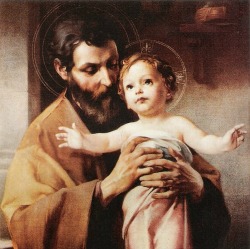
saint-joseph-and-child-jesus

.

A small, beautiful child.

What could be more innocent?

The tiny face of one born a few days before.

What could be more pure?

At what age does that stop?

When is it that we no longer see an innocent child, but instead, just one more man or woman walking the crowded streets?

If the child is our own, probably never.

Parenthood is a gift.

A gift beyond telling.

Yet every person we shall see this day was once a child.

Every person we shall see this day is still a child.

A small, beautiful child.

What could be more innocent?

The tiny face of one born a few days before.

———

Can you imagine what Saint Joseph felt?

What it was like to hold Jesus in the crook of his arm?

To present Innocence Itself to the world?

———

True humility has little to do with wanting to be humble.

It has nothing to do with wanting to look small, tiny, and somewhat sad.

True humility comes through grace.

The grace of knowing that no matter what you do, no matter how hard you try, you on your own cannot stop innocence from being slaughtered.

———

Somewhere, right now, the infant Jesus is being rejected.

Saint Joseph can hardly believe it:

Here He is. The Son of Man. Please don’t do anything, don’t say anything, don’t even think anything that offends His dignity.”

———

The next time we are tempted to judge anyone perhaps we should remember that.

Perhaps we should use our imagination, our faith, our hope, our love—all the gifts and talents that come from God, that return to God, but that God Himself lends us for the time being—to find a child.

For wasn’t that very person, the one who is about to be judged, once too only a few days old?

———

Think of Saint Joseph holding Innocence Itself.

Think of Saint Joseph humbly holding a tiny child, a tiny innocent child reaching out to all mankind with outstretched arms—so innocent that it’s hard to even imagine that all the world, that each and every one of us doesn’t immediately reach back with all our might to tenderly embrace this most precious gift—the most precious gift that a guilty world could receive.

Innocence Itself.


.

—Howard Hain

.