Category Archives: spirituality

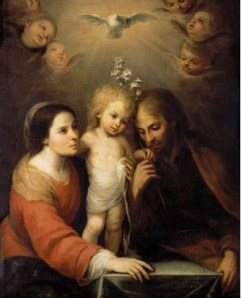
Friday Thoughts: Heroic Virtue, The Holy Face of Jesus


.

He had no majestic bearing to catch our eye,

no beauty to draw us to him.

.

—Isaiah 53:2


.

There is a great hero alive this very moment.

He’s running into a burning building to rescue a small child.

He’s chasing down a thief who nabbed a pocketbook from a helpless old lady.

He’s performing CPR on a middle-aged man in the midst of a heart attack.

He’s keeping diligent watch over the safety of a nation.

But there is no “burning building”, no “thief”, no “heart attack.” And the “nation” he watches over is his own home.

Oh, but there is crisis, there are certainly trials.

There are countless situations and scenarios that require heroic virtue.

For the child he rescues lives in a foreclosing home, the helpless old lady he aides is robbed by dementia, the middle-aged man he resuscitates is his own brother who desperately needs a sober ride home.

And “he”, our hero, is not just one man. He is several, and numerous, and he wears all kinds of different clothes.

And like that ultimate superhero, the one our childhood comic books ceaselessly proclaim, he spends most of his other waking hours in a job that appears rather mundane.

His “telephone booth”—where he quickly straps on his boots, belt, and cape—is often a tiny bathroom—into which he quietly enters and calmly closes the door, only to clasp his face and let out a silent cry. He sometimes even falls to his knees, begging God for strength. But he only has a minute.

He cant help but look in the mirror as he regains his composure and dries his face, preparing to head back into the arena. What he sees looks old and unfamiliar. That’s not the face of adolescent dreams.

And the door is opened and out walks our hero to save the scene.


.

Yet it was our pain that he bore,

our sufferings he endured.

We thought of him as stricken,

struck down by God and afflicted…

.

—Isaiah 53:4-5


.

—Howard Hain

.
Morning Thoughts: The Sovereignty of Good


The Lord be with you.

—And with your spirit.

Lift up your hearts.

—We lift them up to the Lord.

Let us give thanks to the Lord our God.

—It is right and just.

(The beginning of the Eucharistic Prayer, The Order of Mass)

.

The next right thing.

Sometimes it is just that simple.

In fact, it is always that simple.

But to silly people like us, simple is not good enough.

It’s not complex enough.

Not sophisticated enough.

Not civilized enough.

Not cultured enough.

Not smart enough.

“Simple” lacks “nuance” and “subtlety”.

“Simple” contains nothing of the triune god of highly-refined society: arrogance, ambition, and ambiguity.

“Simple” is simply not good enough for you and me.

But it is for God.

He is simply great.

He is “right and just.”

Let’s simply be like Him.

Believe the next right thing.

Hope the next right thing.

Love the next right thing.

For the next right “thing” is God Himself.

For God is Good.

And He is Love.

Let us love then.

One step at a time.

One breath at a time.

One charitable conception, thought, and decision at a time.

Let us be like God.

Let us be amazingly simple.

Let us be simply amazing.

— “It is right and just.”


.

It is truly right and just, our duty and our salvation, always and everywhere to give you thanks, Lord, holy Father, almighty and eternal God, through Christ our Lord.

(Common Preface I, Eucharistic Prayer, The Order of Mass)

.

—Howard Hain

.

The Epiphany

We’re into the New Year and automatically we wonder about the future. We can’t avoid it. We’re wondering what this year is going to bring. What’s coming?

Living in a secular age as we do, we see things mainly with eyes for the here and now, which often boils down to politics and economics. What’s the country going to be like under President Trump? What’s the economy going to be like? Unfortunately when we look at things only like that, we can end up being small minded. We can think that what we see and hear and touch now is all there is. We lose a larger vision of life.

We need the spark, the light, of revelation.

Can we see that light in the mystery of the Epiphany we celebrate today? It begins with a star, guiding some travelers on their way. Can this mystery lift up our secular minds and point out something more? Is our world being guided by a Star?

To start, let’s not see the story of the Magi as a cute story of some people riding on camels coming to see Jesus. More than that, it’s a revelation of God’ divine plan which carries news for us and our world, and it’s as important now as it was then.

The Magi story is only found in the Gospel of Matthew, who was writing for Jewish Christians in Galilee and the Syria about the end of the first century. The temple of Jerusalem was recently destroyed and Jewish Christians like other Jews were facing an unknown, disturbing future. When Jesus came to them, he began his mission saying to the Canaanite woman, who pleaded for a cure for her daughter, “I was sent only to the lost sheep of the house of Israel.” (Mt 15;24)  “Go nowhere among the Gentiles, and enter no town of the Samaritans, but go rather to the lost sheep of the house of Israel,” Jesus first told the twelve whom he sent out to preach. (Mt 10, 5) It looked as though the promises of God were for the Jews and them alone.

But that made the promises of God too small.

Matthew’s story of the Magi was a reminder that the gospel was meant for others besides. Jesus came for all, though his ministry was first to the Jews. God wants the world to be one family and he wishes his gifts and graces be given to many peoples and places. God doesn’t save a few.

The Magi may have come from present day Iran or Yemen; two places we hardly view positively today. We tend to see ourselves a privileged people and our own country a promised land. God is on our side. Better to leave the rest of the world to its wars, its earthquakes, its immigrants, its divisions, its problems. As the old song once said, let’s find “perfect peace, where joys never cease, and let the rest of the world go by.”

We can’t let the rest of the world go by. The story of the Magi reminds us we live in a big world that God means to be one. The story of the Magi is not a sweet story about people on camels who looked and dressed and spoke differently than us. They’re symbols of the world beyond ours that’s called by God to share in his promises.

And the newcomers come with gifts.

Friday Thoughts: Hide-n-Seek, Lost-n-Found, all within the Liturgy

.

A big fat book.

I’ll have to hollow it out.

I don’t see any other way to fit inside.

Of course I’ll have to leave the covers, the binding, and the outer edges of every inner page.

But what to do with the scraps?

Even the dogs are fed these.

Yes, I’ll eat them.

I’ll digest what’s been hallowed.

Then I’ll climb inside.

The cut-outs will be back in position.

Yes, all still right there, entirely inside, all in its proper place.

The complete volume.

The entire collected work.

The only difference is now I’m part of the story.

An essential part.

Without the pages in my belly the whole thing is essentially empty.

———

Here I am, tucked away, a perfect fit, fetal position within the bind of an ever-revolving nook.

The covers tightly closed, the pages all accounted for, the sanctity of the space preserved.

Now I can rest assured…

Not a bit of attention on little ole me.

———

But what if someone opens the cover?

Oh my, what if he turns the title page?

The jig is up!

I’m spotted for sure…seen as I am.

A stowaway. Hidden from the crowd. Holding out for the end of the storm. Eyes closed even within the dark pages of night.

But what’s he doing now?

He can’t possibly…

No, no…get away…this is my spot…there’s not enough space for two…

What do you mean there’s plenty of room?

What do you mean there are already a million others inside?

Where?

How?

Who?

I don’t see anybody but myself.


.

—Howard Hain

.

Morning Thoughts: New Year, New Love


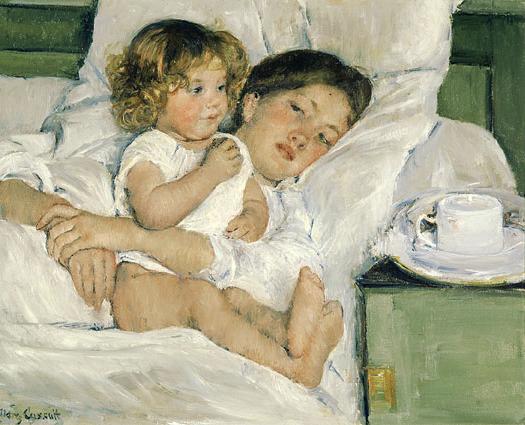
mary-cassatt-breakfast-in-bed-1897

Mary Cassatt, “Breakfast in Bed”, 1897

.

Lord, a new year is upon us.

Help us.

Help us to be grateful.

Gracious and grateful.

Gracious, grateful, and giving.

You give and you take away.

Nothing but Your love is truly ours.

For love You give and love You never take away.

Love only love.

Love just love.

What is it, Lord? What is Your love?

A million answers.

Each of us could probably come up with a thousand.

It’s times such as these that You are not silent, although You don’t seem to say a word.

You answer. You have and will always continue to do so.

You gave Your Only Begotten Son.

A tiny babe. A beautiful child. A strong young man. A fearless leader. A lamb to be slaughtered.

You gave the Tree of Life.

You threw it into the River.

You made all that is bitter sweet.

You gave the Sign of the Cross.

You wrote Your name upon our foreheads.

You gave us a mother, and common brothers and sisters, and holy angels and saints, all of whom we are free to call friends.

Yes, You gave us love.

But what is it, Lord?

We know love exits and we know it does not come from ourselves.

Even for those who say You don’t exist.

To them we could point at the ocean, or the sky—the sun, the moon, and the stars—or even a simple common everyday tree—a single leaf of grass.

“Who made them?”, we can ask.

“Who but God alone?”

Who but You, Lord God, Who willed not to be alone?

You willed love.

You willed Yourself.

Proof of Your existence is You don’t need it.

For nothing will prove You, for nothing can disprove You.

For the love You send is not only born, crucified, and risen, it also ascends.

Above all knowledge.

Into Heaven.

Pure and simple.

Knowledge.

Knowledge that You love us.

You truly love us.

Little old us.

That is what You love.

The object of Your love.

The product of Your love.

We are Your love.

Thank You, Lord.


.

—Howard Hain

.

The Most Holy Name

                                       The Most Holy Name

     On this Tuesday’s Gospel (Jn 1: 32-34) John the Baptist says : ” I saw the Spirit come down like a dove from the sky and remain upon Him. I did not know Him, but the One who sent me to baptize with water told me,  ‘On whomever you see the Spirit come down and remain, He is the One who will baptize with the Holy Spirit.’ Now I have seen and testified that He is the Son of God.”

     This past New Year’s Eve my wife and I could have spent the time in an anonymous bar, or in front of the TV, half-a-sleep, drinking. Instead we had the opportunity to go to a chapel in St Nicholas of Tolentine Parish in Queens, and wait for the new year in front of the Blessed Sacrament. We were singing songs with the people, praying, looking at Him in silence, realizing that here was Jesus, the Blessed, Living Name, the “Lamb of God who takes away the sin of the world.”(Jn 1:29b)

     This event could only have been possible through the efforts of two children of God, Grace and Maria. They arranged it with the parish priests. They invited whomever could make it. They prepared the sheets with songs and prayer. They hauled and provided all this food to be shared afterwards in the church hall. And they led us in song, with their guitar accompaniment, singing in such lovely harmony, like two angels.

     I could not help but feel the Spirit of God ” Come down and remain ” upon them, as I have often felt it in their presence before. I did not see a dove, or a halo over their heads. I saw their humanity, the precious humanity that we share with our Lord. Their presence leads me to whisper in my mind the Most Holy Name:  “Jesus”.

     I have experienced the same phenomenon countless times at the Immaculate Conception Monastery, and Passionist Retreat House in Jamaica, New York. Here, these holy men, priests, prophets, servants, have touched my life in so many ways. They guide me, inspire me, correct me, accept me. They have given me their friendship in God. Yes, what they say and how they say it has great power. What they do is so admirable. But it is their very selves, the invisible light that I feel emanating from their presence, that makes me think,

“Jesus, Son of God”.

     In Tuesday’s first reading, the first letter of St John, it says, ” Beloved, we are God’s children now; what we shall be has not yet been revealed. We do know  that when it is revealed we shall be like Him, for we shall see Him as He is. Everyone who has this hope based on Him makes himself pure, as He is pure.”

I know that these Passionists are only men, like me, but the hope that I see in their eyes is what gives me the strength to hope that purity is possible, because

“We are God’s children now”.

    A number of them, people I came to love, have left us in the past year. I miss them. But I just know that what they truly are has now been ” revealed to them”, that they ” have seen Him as He is”. And I just have to smile and think, ” Jesus, blessed be Your Name”.

     On New Year’s Day, my wife and I were walking through the woods in Alley Pond Park, Queens. We passed a couple with their big dog. I didn’t even look at them. I was afraid of the dog, and I didn’t like the man’s face. A friendly voice came from beside me wishing them, “Happy New Year”. With such lovely smiles on their faces the couple answered back in kind. Even the dog seemed friendly. This interchange was started by my beloved wife, Berta, who more and more each day seems to have the Spirit of Love ” come down and remain ‘” with her. I am so grateful to God because so many times she sets me straight and reminds me of Whose child I am, and of what I can become. And I just smile and say ” Jesus, Son of God, thank you. Blessed be Your Name!”.          

                      Orlando Hernández

The Holy Family


Luke 2,41-52

For most people, Christmas is over– the music’s stopped; Santa Claus is gone from the malls. The decorations are down and put away. It’s over.

But in church Christmas isn’t over. We’re still singing  carols and continue to celebrate as we think  about what it means when we say “our God was made visible.”

Today’s the feast of the Holy Family. The Word was made flesh, and as the child of Mary and Joseph Jesus was part of a family in the small town of Nazareth in  hills of  Galilee.

For one thing, families then were extended families or clans, living close together and working side by side. Archeological excavations in Nazareth and Capernaum (pictures below) make that clear. Families worked together in the fields or in  business, they ate together and moved together, as they still do in parts of the Middle East and elsewhere today.

holy familyCapernaumruinsDSC00062

It’s safe to say that nuclear families didn’t exist then. A nuclear family– mother, father and children– is a modern form of family life. Mary, Joseph and the Child Jesus were not all by themselves in a small house in Nazareth. Rather, Jesus was raised in an extended family where  grandfathers and grandmothers, uncles, aunts and cousins lived together and were involved in bringing him up.

That doesn’t take away the part Mary and Joseph played in his upbringing, of course. They weren’t props, standing by while angels brought him up. Some of the apocryphal gospels – early stories about Jesus which the church rejected  – seem to say that.  One  story describes the Child Jesus forming  the figure of a bird from clay, then breathing on it, and instantly it becomes a living bird and flies away. Stories like that presented him exercising  miraculous powers as a child.

The church rejected those stories because they gave a  false picture of Jesus growing up. He “was subject” to Mary and Joseph, the gospel of Luke says. He grew up in their care as an ordinary child would.

Like mothers and fathers everywhere, they saw to his needs, they held him in their arms,  fed him, clothed him,  stayed up at night when he was sick. They taught him his first words,  guided his first steps,  nudged him along this way and that.

They  brought him to church–the synagogue, the temple–as we see in today’s gospel from Luke. They instructed him in his tradition. They taught him to pray,  interpreted events for him,  listened to his questions,  encouraged him over and over. They had their misunderstandings, as today’s gospel  indicates. In fact, they  influenced his life.

Yes, angels were there, but at a distance.  Mary and Joseph and that larger family and village around him raised the Child.

Today’s  feast of the Holy Family takes in the years of Jesus’ childhood and early adult life called his “Hidden Life.” His  years in that nondescript town among those ordinary people were truly hidden, yet were they less important than his Public Life, the few years he taught and did great miracles,  suffered and died and rose from the dead? In those hidden years “he humbled himself.”  A hidden life is important; it’s what mostly characterizes life in a family.

We need to think about family life today, because it’s in trouble.  For one thing, the nuclear family– father, mother, children– is  in trouble. I read some disturbing statistics recently. In every state in our country, families where children have two parents have declined significantly in the last 10 years. One of three children live in a home without a father. Almost 5 million children live in a home without a mother. A single mother may have an income of $24,000. Two parents are likely to have an income significantly greater.

What can we do? How can we help? Feasts  like the Holy Family focus our attention on important things.  They remind us what’s important in God’s eyes. The feast of the Holy Family focuses on the family. It’s important, it says.  At the same time, it tells us God’s grace will be ours when we work to make families go and when we support them all we can.  God points to family life today. It’s vitally important in our world.

Friday Thoughts: Portrait of the Catholic as a Middle-Aged Man


george-seurat-aman-jean-portrait-of-edmond-francois-amna-jean-1882-83

Georges Seurat, “Aman-Jean (Portrait of Edmond Francois Aman-Jean)”, 1882-83, (The Met)

.

So much is not seen.

What is heard hardly tells the story.

The hairline leaves little to gaze upon.

A good sergeant, he worries little about appearances.

He often feels what he believes is slipping away beneath his feet.

The commands barked from above seem detached from the situation on the ground.

He follows orders anyway.

To many he is somewhat of a joke.

A puppet. A man who cant think for himself.

Some may even use the word ‘coward’.

But none of this is accurate of course.

No, he is a man of honor.

A noble-man.

He takes his vows and commitments seriously.

He will protect his wife. He will raise his children.

He will stand when others hide.

He will walk forward when others turn away.

Firm and steadfast.

He lives out daily the faith of his fathers.

Quietly and efficiently as possible.

No, he’s certainly not perfect.

And of this he is very conscious.

So much so he wonders often if God has chosen the wrong man.

And this is saving grace.

Humility is purgatorial.

It burns away the dross.

It polishes the trophy.

It propels him to love to heroic measures.

It keeps him around, in the game, engaged, alive, an active participant.

As much as it hurts, he knows it’s true, and he carries on, toward the goal.

Toward what he cannot see, toward what he certainly does not understand.

This man is a hero of faith.

And at the same time he is just another Joe.

Another Tom, Dick or Harry.

But in heaven, when all is said and done, he shall receive a crown.

His cross finally laid down, he shall finally see it as a walking stick.

A beautifully-crafted staff in the hand of a just and upright man.

A righteous upholder of God’s eternal law.

Then he shall take his place, very close to the King and Queen, right beside that other unknown man named Joe.

That common nobody led by angels and mocked by men.

The one chosen by God to raise the Messiah.

For where you find the anonymous man of whom I speak, you too shall discover the Holy Family.

Jesus, Mary, and Joseph

Joseph, Mary, and Jesus.

On earth as it is in heaven.

A little humble home in the middle of nowhere.

An eternal kingdom emanating all that is good.


.

—Howard Hain

.

http://www.metmuseum.org/art/collection/search/339751.

.

* Dedicated to my good friend, who I greatly admire.

.

Morning Thoughts: Wise as Doves

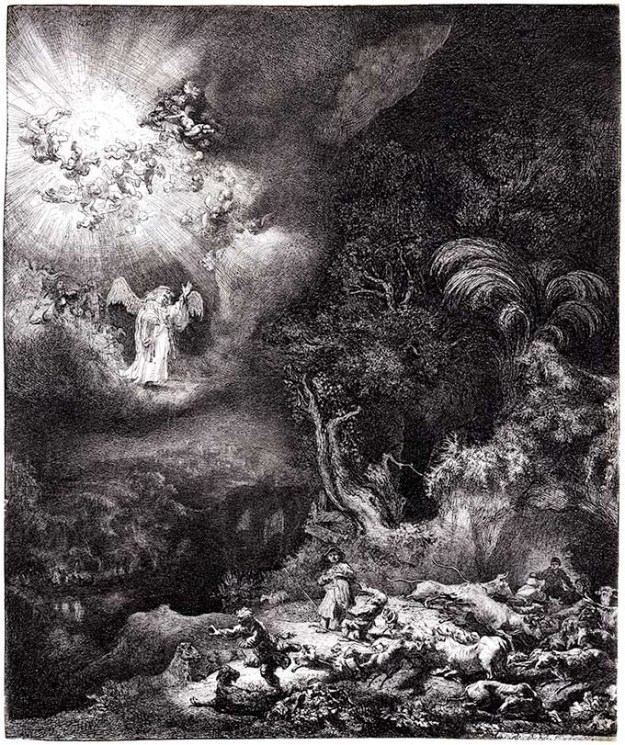
rembrandt-angel-appearing-to-the-shepherds-1634

Rembrandt, “The Angel Appearing to the Shepherds”, 1634

 .

Now there were shepherds in that region living in the fields and keeping the night watch over their flock. The angel of the Lord appeared to them and the glory of the Lord shone around them, and they were struck with great fear.

—Luke 2:8-9


.

Perhaps the scariest thing to those of us who cling tightly to the things of the world is to accept the job that the Lord assigns us.

Oh, how so many of us are so quick to long for greater adventure!

Yet, when it comes to those humble, little shepherds to whom the angel of the Lord appeared, we are perhaps even quicker to long to be one of them—sitting quietly upon a gentle hillside, effortlessly tending to a passive flock, while the always-full moon provides a soft, ever-so-appropriate illumination from above.

But we are liars. For there’s nothing less romantic in each one of our daily lives, or more mundane. We simply have to be honest, or at least consistent. It all depends on how we look at it. If we see the shepherds in such a delicate light then we also need to see ourselves in the same. For before the angel appears, the shepherds were hardly posing for picturesque landscapes. Perhaps it is for this very reason—their realness, their authenticity, their holy simplicity—that the Lord chose them to be present when He revealed His glory.

It is exciting. We have a wonderful choice, then. Either our “boring” lives make us just the kind of people to whom God prefers to reveal Himself, or our lives are a lot more “exciting” than we ever imagined. Either way, what is vital to making such a decision is true sincerity and genuine gratitude. We need to thank God for who He has made us, for where He has placed us, and for what type of task He has assigned us.

A faithful, humble heart dreams and believes and sees great things among the most ordinary circumstances. Just look at the young virgin and the upright carpenter to whom the shepherds “went in haste” to find in a stable, adoring a child born within the company of the “lowest” of men.

If we spend our time dreaming of being someone else, living somewhere else, and doing something else, we miss the opportunity of being exactly who God intends us to be—and when that happens—we are always in the wrong place, at the wrong time, and most tragically, doing that which matters very little.

For to be the first on the scene, the first to “lay hold”, the first to adore the New Born King, is as good as it gets—even for those whose “normal existence” isn’t standing around all alone—day after day in the scorching sun or biting cold, while picking fleas from matted-down fleece or scaring off hungry wolves.


.

The angel said to them, “Do not be afraid; for behold, I proclaim to you good news of great joy that will be for all the people…”

So they went in haste and found Mary and Joseph, and the infant lying in the manger. When they saw this, they made known the message that had been told them about this child. All who heard it were amazed by what had been told them by the shepherds.

Then the shepherds returned, glorifying and praising God for all they had heard and seen, just as it had been told to them.

—Luke, Chapter 2:10,16-18,20


.

—Howard Hain

.

Morning Thoughts: Home Sick

.

I wonder. Did God ever catch a cold?

Did Mary look at Him while He slept, watching carefully His chest rise and fall?

Did Joseph pace around their small home, looking upward, his right hand touching his brow?

I wonder. Did they wince in sync when Jesus coughed from the bottom of His soul?

Was there a day, a single hour, from the moment Jesus was conceived that Joseph and Mary weren’t concerned?

Concerning all this there’s not much to wonder.

Jesus is human.

Of course He experienced “cold” in all its forms.

Of course Joseph and Mary felt they’d rather die than see their child in pain.

And Jesus is divine.

Of course He was homesick.

Of course He longed to return.

Between Mary’s womb and heaven the desert is awfully dry.

He climbed up high, seeking out mountain views.

He returned to the sea, seeking out salt air.

He stopped to hang out with the little ones, seeking out angels.

Jesus is just like you and me.

Only He allows Himself to be loved.

And that led Him to love to the utter extreme.

All flowed from and toward a family reunion.

His pain, His grief, His hope, His love were perfectly ordered.

Even when He coughed or sneezed or tossed and turned, Jesus did so while in the company of a promise.

And He’s extremely contagious.

Joseph and Mary became homesick too.

There’s only one place they could want to be.

With their only child.

Clinging to Him, to their God with all their might.


.

—Howard Hain

.