Category Archives: spirituality

Change and Automation


17. Theological and philosophical reflections on the situation of humanity and the world can sound tiresome and abstract, unless they are grounded in a fresh analysis of our present situation, which is in many ways unprecedented in the history of humanity. So, before considering how faith brings new incentives and requirements with regard to the world of which we are a part, I will briefly turn to what is happening to our common home.

18. The continued acceleration of changes affecting humanity and the planet is coupled today with a more intensified pace of life and work which might be called “rapidification”. Although change is part of the working of complex systems, the speed with which human activity has developed contrasts with the naturally slow pace of biological evolution. Moreover, the goals of this rapid and constant change are not necessarily geared to the common good or to integral and sustainable human development. Change is something desirable, yet it becomes a source of anxiety when it causes harm to the world and to the quality of life of much of humanity.

19. Following a period of irrational confidence in progress and human abilities, some sectors of society are now adopting a more critical approach. We see increasing sensitivity to the environment and the need to protect nature, along with a growing concern, both genuine and distressing, for what is happening to our planet.
Pope Francis, Laudato SI, 17-19

Avoiding an “irrational confidence in progress and human abilities”, we need to make “a fresh analysis of our present situation,” the pope says. He speaks of the “rapidification” of life– a fast changing world that cares little for nature or sustainable human development.

Like automation, smart cars, or whatever else puts people out of work and removes them from involvement in society or having a hand in the progress of our created world?

Friday Thoughts: A Common Question

by Howard Hain

.

Does it make any sense to ask “why” but not want to know why?

It depends on how we see an answer. For there is one answer that applies to each and every question, that fully satisfies each and every query—one certainty that fully answers all wonderings.

All other answers—true although they may be—are subordinate to this one primary and exhaustive answer.

And this one answer has many expressions, but only one meaning. It has several names, but only one significance. It has billions of manifestations, but only one divine presence.

The answer is “I AM”…

The answer is “Truth”…

The answer is “Pure Existence”…

And on and on….

But let us express it one additional way: “The Perfect Will of God”.

If we believe this—if we believe in God we must believe this—then we have no questions to ask. Unless of course we ask for a different reason—a reason other than wanting an answer. And what may that reason be?

To experience God.

To “know” He is real.

To feel He cares.

———

For does an infant question his mother’s love?

Does he wonder if she will offer her breast?

Does he ask any questions at all?

No. He cries.

He prays with utter faith to a power beyond his capacity to wonder why.

For the newborn “knows” why.

The infant “knows” he is loved.

Yet he cries.

———

And we do too. We cry “why” to a God who knows our every need and has preordained our every righteous desire.

We pray like infants—like newborn children—when we ask our all-knowing and all-caring God a question we instinctively “know” is already forever answered.

We pray when we cry out loud in the direction of Him whom we believe exists—no matter the form of the cry.

For prayer is active believing. Asking is simply a common language.

Either way, the translation is the same.

———

“Why Lord?” (I believe in You)

“Why God?” (I trust in You)

“Why, Lord, why? (I love You)

———

And God always answers.

He always nurses.

More faith…more hope…more love.


.

.

Crimes Against the Natural World


“Patriarch Bartholomew has spoken in particular of the need for each of us to repent of the ways we have harmed the planet, for “inasmuch as we all generate small ecological damage”, we are called to acknowledge “our contribution, smaller or greater, to the disfigurement and destruction of creation” He has repeatedly stated this firmly and persuasively, challenging us to acknowledge our sins against creation:

“’For human beings… to destroy the biological diversity of God’s creation; for human beings to degrade the integrity of the earth by causing changes in its climate, by stripping the earth of its natural forests or destroying its wetlands; for human beings to contaminate the earth’s waters, its land, its air, and its life – these are sins” For “to commit a crime against the natural world is a sin against ourselves and a sin against God.’

“At the same time, Bartholomew has drawn attention to the ethical and spiritual roots of environmental problems, which require that we look for solutions not only in technology but in a change of humanity; otherwise we would be dealing merely with symptoms. He asks us to replace consumption with sacrifice, greed with generosity, wastefulness with a spirit of sharing, an asceticism which “entails learning to give, and not simply to give up. It is a way of loving, of moving gradually away from what I want to what God’s world needs. It is liberation from fear, greed and compulsion” As Christians, we are also called “to accept the world as a sacrament of communion, as a way of sharing with God and our neighbours on a global scale. It is our humble conviction that the divine and the human meet in the slightest detail in the seamless garment of God’s creation, in the last speck of dust of our planet”.

Pope Francis ,Laudato SI, 8-9

Morning Thoughts: Beyond

by Howard Hain


F. Hain Untitled ~2014

F. Hain, “Untitled”, ~2014


Beyond “Yes”

Beyond “Amen”

Beyond “I love You”

You are beyond

Beyond prayer

Beyond is my prayer

It looks a lot like sitting still

Like not thinking

Not remembering

Not planning

Not wanting

It looks a lot like pure existence

A lot like being free

Infinitely free


You, Lord, are the Lord of Freedom, if only we’d accept Your declaration—if only we’d love the person we most imprison with jealousy and petty dislikes.

Free us Lord from ourselves, from our most secret possession, from our deeply hidden pride.

Grant us, Lord of Infinite Freedom, the grace to fly upward, and inward, all toward You.

.


.


22nd Sunday A: Thinking Like Human Beings Do


For today’s homily, please play the video below:


Friday Thoughts: Can’t Be Afraid

by Howard Hain


No matter what it is. All good options are on the table. All goodness is on the table. For God sets a banquet before us, a great breakfast. Liberty first. We must be free. Drink deep of letting go of the past, repentance is not an aftertaste. Repentance sets the table. A table held in place by belief. Upon which God’s goodness gives life. It is always about life. More of it. More letting go, less picking up the scraps. Of course, if scraps are all we have, by all means let us be grateful. But I have a sneaky suspicion there’s a whole lot more—if only we’d tell “fear” to take a hike—and then take our proper place at the table.

So much goodness is in store.


Morning Thoughts: Remembrance of Things Past

by Howard Hain

.

“…forgetting the past and pushing on to what is ahead…”

—Philippians 3:13


.

What is the past? A remembrance of things past. Of what has been. Of what is not now. Of what is no longer today.

What is re-membering? A putting back together of what once was. Of what was once whole. Complete. United. Unified. A re-attachment of “bodily” members currently detached. A body made whole, brought back into health. It is healing. It is “being” fulfilled.

What is to forget? The act of properly re-membering. Beyond elimination. Beyond denial. It is re-valuation. It is re-deeming. Of value. A re-establishment of worth. An instance of humanity made universality worthy once more.

What is worthy? What has value? The future lived presently. Proper hope brought into active being. Knowing ‘now’ is a perpetual tomorrow, lived fully today.

It is tomorrow’s air breathed as we currently speak.

A human being living in heaven.

A human being “knowing” heaven was once, is now, and will be forever.

Worthy is a person “forgetting the past and pushing on to what is ahead…”


Praise be Incarnate Wisdom. Now and forever.

.


.

.

Friday Thoughts: The Laugh’s On Us

by Howard Hain

.

No matter what I’m going through I feel the urge to laugh when I speak to a brother in Christ—and now I know why—true fellowship reminds us that God laughs at our trifling fears.


Rembrandt Self Portrait

Rembrandt, “Self-Portrait”, (1668)


A Lot of Things We Don’t Know


Vacations take you away from home to somewhere else. My somewhere else for the last few days was Cape May, New Jersey, a small old town along the Jersey shore at the tip of the state.

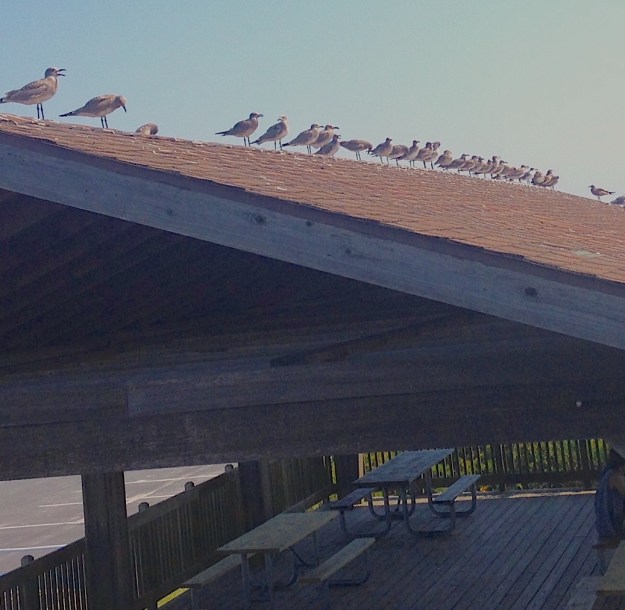
I went fishing but caught no fish. I went bird-watching at a good spot off the beach, but saw few local or migrating birds –except for the line of gulls perched on a shelter roof looking out to the sea. (Above)

Patient, they were. Why? I wondered. Were they expecting a feast from the nearby waters. Schools of baby blue fish had moved towards the shore, some fishermen said. Was that why no other fish were to be caught?

Were bigger fish on the way to feast on the baby blues? Who knows?

Something mysterious about the gulls perched patiently on the rooftop, though. Were they just taking a break, or did they know a feast was on the way and were gitting ready to swoop down on leftovers on the shore?

There are a lot of things we don’t know. You don’t have to go far from home to find that out.

Morning Thoughts: The Substance Of Prayer

by Howard Hain

.

How do we know if our prayer is answered?

When we no longer remember what we requested. When we discoverer inexplicable peace and experience inexplicable joy—even though we ride a hot, crowded, slow-moving subway car and have no idea if the specific circumstances surrounding our lives have changed in the least.

We know God is real, His will is perfect, and He never abandons us. We know we don’t need to understand. We know that somehow the peace and joy within us are actually related to our lack of understanding. We trust. We believe. We know “faith is the substance of things hoped for, the evidence of things not seen.” *

We know we’ve been blessed.

We know our faith has increased.

We know God has answered our prayer.


.

* Hebrews 11:1

.