Hold fast to the hope that lies before us. This we have as an anchor of the soul, sure and firm, which reaches into the interior behind the veil, where Jesus has entered on our behalf as forerunner, becoming high priest forever according to the order of Melchizedek. Hebrews 6:10-20
Travelers on the Mediterranean Sea from one port to another in early times were never sure on its unpredictable waters. An anchor became a symbol of their safe arrival . Large ancient seaports on the Mediterranean like Alexandria and Antioch adopted the anchor as a symbol for their city. Welcome home!
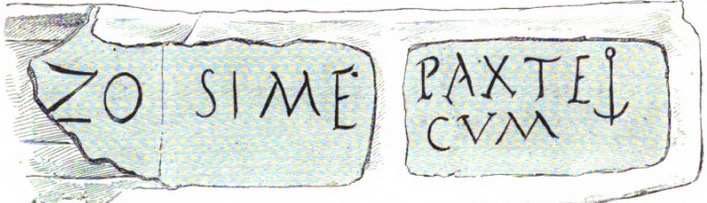
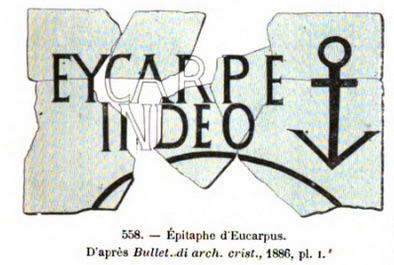
Hope is “an anchor of the soul”, the Letter to the Hebrews says. Early Christians adopted the sign as a symbol of their hope for reaching their heavenly port, the kingdom of God. Anchors are common inscriptions in the Christian catacombs expressing hope in Jesus Christ.
The anchor closely resembles a cross and surely that was what early Christians thought it to be. It’s the most common, and sometimes the only mark, found on the earliest Christian graves in the ancient Roman catacombs of Priscilla, Domitilla and Callistus.
“Pax tecum,” “Peace be with you” the inscription (above) next to an anchor on one of these gravesites reads. “Eucarpus is with God” is the inscription of the deceased on the grave (below) half destroyed by robbers looking for valuables long ago.
Agnes knew that sign, and I would expect it’s found among the number of inscriptions that marked her grave on the Via Nomentana where she is buried.
The Christmas Season closes after the Baptism of Jesus, which we celebrate this Sunday. The Christmas celebrations are over. Ordinary time begins. Does that mean there’s nothing to do till Lent and the Easter season?
Sure there is. Ordinary Time is a time for daily prayer, and daily prayer is never over. The Second Vatican Council’s Constitution on the Liturgy says that daily prayer is at the heart of the Christian life and created a daily lectionary of scripture readings so “ the treasures of the bible be opened more lavishly for the faithful at the table of God’s word.” (SC 51)
The daily lectionary is a treasure for praying with the scriptures, but don’t take it for granted. Treasures, Jesus said, are usually hidden and you have to dig for them. That’s what we do in daily prayer. The liturgy is always a “work”, our daily work, an important work, a daily prayer. It’s the “summit” of the Christian life. We’re always at the beginning, not at the end.
We begin Monday to read the Letter to the Hebrews and the Gospel of Mark from our lectionary. There are feasts of the Lord and his saints to celebrate in the days ahead. It’s a lifelong learning we’re into, a school God provides,and we learn day by day.
The land where Jesus lived spoke to him and inspired so many of his parables. The sea did too.
Jesus went out along the sea. All the crowd came to him and he taught them. As he passed by, he saw Levi, son of Alphaeus, sitting at the customs post. Jesus said to him, “Follow me.” And he got up and followed Jesus. (Mark 2:13)
From the Jordan where he heard his Father’s voice and the Spirit rested on him, Jesus went to Capernaum on the Sea of Galilee where he taught crowds and called disciples.
I remember looking quietly on the waters of the Sea of Galilee years ago on a visit.. At night a stillness centuries old takes over. The waters of the Jordan flow into it on their way to the Dead Sea. The river winds almost 200 miles from the Golan mountains in the north into the Sea of Galilee, then on to the Dead Sea in the south, a direct distance of about 60 miles. The river falls almost 3,000 feet on its way to the Dead Sea,.
.Jesus’ ministry began in the Jordan River. The waters spoke to him more strongly than they do to us today. The Jordan was sacred to the Jews from the time they miraculously crossed it on their way to the Promised Land. The great Jewish prophet Elijah came from a town near the river’s banks. Later he sought safety from his enemies there.
Elijah’s successor, the Prophet Elisha, also came from the Jordan. He told the Syrian general Namann to bathe in the river to be cured of his leprosy, and he was cured. Ancient hot springs near Tiberias on the Sea of Galilee still witness to the river’s curative powers.
At the time of Jesus, the river’s fresh flowing waters were the life-blood of the land, making the Sea of Galilee teem with fish and the plains along its banks fertile for agriculture. Pilgrims from Galilee followed the Jordan on their way to Jericho and then to Jerusalem and its temple. The river always spoke of life.
The Jordan Today
The river is still life to the region. It’s the primary source of its drinking water and crucial for its agriculture. Its water is a major point of controversy today between Israel and its Arab neighbors.
Nourishing Prophets
The Jordan nourished prophets. Somewhere near Jericho John the Baptist preached to and baptized pilgrims going to the Holy City. The place– hardly a desert as we may think of it– offered enough food for survival, like the “ grass-hoppers and wild honey” John ate. It was also an uncultivated place that taught you to depend on what God provided.
Jesus taught this too. “I tell you do not worry about your life, what you will eat, or drink, or about your body, what you will wear… Your heavenly Father knows that you need them all.” (Mt 6, 25 ff) The desert was a place for learning to put worry aside and trust in the goodness of God.
Water is a sign of life. When Jesus entered the waters of the Jordan, he acknowledged his heavenly Father as the ultimate Source of Life, the creator of all things. Like the prophets Elijah and John the Baptist, Jesus remained in this wilderness near the water for forty days before his divine mission. He also baptized and taught there with his first disciples. He readied himself there to depend on God for everything.
The Jordan after Jesus
Later, when the Roman empire accepted Christianity in the 4th century, Christians came to the Jordan River in great numbers on Easter and on the Feast of the Epiphany to remember the One baptized there. They bathed in the sacred waters, and many took some of it home in small containers.
Early Christian pilgrims like Egeria, a nun from Gaul who came to the Holy Land around the year 415 AD, left an account of her visit to the Jordan where Jesus was baptized. Monks who settled near the river knew a place called Salim, near Jericho. The town, associated with the priest Melchisedech, was surrounded by fertile land with a revered spring that flowed into the Jordan close by. Here’s Egeria’s description:
“We came to a very beautiful fruit orchard, in the center of which the priest showed us a spring of the very purest and best water, which gives rise to a real stream. In front of the spring there is a sort of pool where it seems that St. John the Baptist administered baptism. Then the saintly priest said to us: ‘To this day this garden is known as the garden of St. John.’ There are many other brothers, holy monks coming from various places, who come to wash in that spring.
“The saintly priest also told us that even today all those who are to be baptized in this village, that is in the church of Melchisedech, are always baptized in this very spring at Easter; they return very early by candlelight with the clergy and the monks, singing psalms and antiphons; and all who have been baptized are led back early from the spring to the church of Melchisedech.”
A 19th Century Pilgrim at the Jordan
Christians in great numbers visited the Jordan River. Towards the end of the 19th century, an English vicar, Cunningham Geikie, described Christian pilgrims following the venerable tradition of visiting its waters.
“Holy water is traditionally carried away by ship masters visiting the river as pilgrims to sprinkle their ships before a voyage; and we are told that all pilgrims alike went into the water wearing a linen garment, which they sacredly preserved as a winding sheet to be wrapped around them at their death.
“The scene of the yearly bathing of pilgrims now is near the ford, about two miles above the Dead Sea, each sect having its own particular spot, which it fondly believes to be exactly where our Savior was baptized…
“Each Easter Monday thousands of pilgrims start, in a great caravan, from Jerusalem, under the protection of the Turkish government; a white flag and loud music going before them, while Turkish soldiers, with the green standard of the prophet, close the long procession. On the Greek Easter Monday, the same spectacle is repeated, four or five thousand pilgrims joining in the second caravan. Formerly the numbers going to the Jordan each year was much greater, from fifteen to twenty thousand….”(Cunningham Geikie, The Holy Land and the Bible,Vol 2, New York, 1890 pp 404-405)
The Jordan and Christian Baptism
Today, every Catholic parish church has its baptistery where the mystery of the baptism of Jesus is celebrated for new believers. Some eastern Christian churches call their baptisteries simply “the Jordan.”
Today the site of Jesus’ Baptism, according to archeologists, is in Jordanian territory at el-Maghtas, where a large church and pilgrim center has been built following excavations begun in 1996 by Jordanian archeologists. It is probably the “Bethany beyond the Jordan” mentioned in the New Testament where Jesus was baptized and John the Baptist preached.
The Jordan River offers its own commentary on the mystery of death and resurrection of Jesus, expressed in his baptism. At one end of the river is the Sea of Galilee brimming with life, and at the other end is the Dead Sea a symbol of death. The river holds these two realities together, and if we reverse its course we can see the gift God gives us through Jesus Christ.
Like him, we pass through the waters of baptism from death to life.
Noah’s ark, the Magi, the Slaughter of the Innocents. “They’re just myths,” you hear it said. I don’t like those stories dismissed that way, because it easily leads to a further dismissal: ”Is any of it true? Probably not.”
We think straight reporting is the only thing true. “Just the facts, Mam.” Everything else is fake news. But are these stories fake?
“The Secrets of Noah’s Ark” a recent Nova program on PBS examining the biblical story makes good sense to me. In early times, floods were common in the “Fertile Crescent” the area in Mesopotamia {modern Iraq} where the Tigris and Euphrates Rivers and the ancient city of Babylon were located. So you had to keep boats handy– you never know.
You had to be ready for a great flood too, but people have short memories and people then, as now, tend to forget “the big ones.” “As it was in the days of Noah, so it will be at the coming of the Son of Man. In those days before the flood, they were eating and drinking, marrying and giving in marriage, up to the day that Noah entered the ark. They did not know until the flood came and carried them all away.” (Matthew 24, 37-38)
I suspect some Babylonian priests– meteorologists and story tellers of their time– came up with a flood story thousands of years before the Noah story to keep the people of their day on their toes – and maybe challenge some early climate change deniers too. It reinforced important advice: “ Keep your boats in good shape and make sure there’s also a big boat around for ‘the big one.’”
Exile of Jews to Babylon
In 587 BC, thousands of Jews were driven from Jerusalem, destroyed by Babylonian armies, and were forced to make the thousand mile journey in Babylon. It was their Exile. When they heard the story of the great flood they saw it as a symbol of their own tragic circumstances. “By the rivers of Babylon, we sat and wept, remembering Zion.” (Psalm137)
Returning from exile, the Jews incorporated their version of the flood story into the Torah. It became a reminder to keep the covenant God made with them and beware of living unfaithfully as “in the days of Noah.”
Does real history underlie the story of the Magi and the Slaughter of the Innocents? Begin with Herod the Great, ruler of Palestine then, whom secular sources and many archeological monuments from the time describe quite well. Herod was a micro-manager who built fortified palaces in Jerusalem, the Herodium outside Bethlehem and other places to keep watch over his kingdom.
Citadel, Herod’s Palace Fortress, Jerusalem
Herodium, Mountain Fortress of Herod the Great
He promoted trade with the outside world; he built the seaport of Caesarea Maritima on the Mediterranean Sea and cultivated the trade routes from Yemen and other eastern parts that led all the way to Rome. He would have kept tabs on those arriving with spices and luxury goods of all kinds. He knew who came and went.
Were the Magi wealthy eastern traders, quite knowledgeable about the religious world of the people with whom they traded? Did they hear of the Child in Bethlehem? Herod’s advisors and everyone else knew Bethlehem was associated with the legendary King David and there were prophecies about an heir to his throne coming from there. Did the foreigners visit the Child, bring their gifts, gold, frankincense and myrrh, the prizes of their trade, and then quickly leave, well aware of Herod’s paranoia, quick temper and brutality.
Given Herod’s jealous hold on power, the story of the slaughter of the Innocents in Matthew’s Gospel doesn’t seem unlikely, True, it’s not mentioned in any secular source, but neither are many other tragic stories of the time. Bethlehem, after all, was a small town, off the beaten track. The death of perhaps 20 or so infants might go unnoticed and be quickly forgotten.
Matthew’s story is hardly a myth. Rather, it sees things through God’s eyes. The star points to the real power guiding human history; the magi represent the rest of the world coming to adore the Child. Angelic powers are always at our side. The slaughtered infants are like so many tragic deaths that seem to question God’s promise of life, but God doesn’t forget, the story says, even if human history doesn’t remember. “The souls of the just are in the hands of God and no torment shall touch them.”
If you ever visit Bethlehem, go to see the Herodium, Herod’s massive fortified palace looking down on the nearby town. Joseph wouldn’t need much urging to take the Child and his mother from this place,would he? Go to the Citadel in Jerusalem built on the highest spot in the city. You can walk where Herod once walked and imagine him looking down on his kingdom. But it was not his kingdom, after all, it was God’s. Go to Caesaria Martima, the splendid port city created by Herod. Did the Magi’s caravans reach here?
Then ask yourself if the stories of Jesus’ birth and infancy are myths.
There’s always a temptation to make God distant and abstract. After all, God dwells “in light inaccessible,” the scriptures say. God is beyond the eyes of our mind and body.But God reveals himself in Jesus Christ, the “image of the invisible God.” The first followers of Jesus saw him with their own eyes and proclaimed that “the grace and kindness of our God has appeared” in him.
The First Letter of John, written as that first generation of eyewitnesses to the gospel was passing on, tells a new generation (certainly us too) to believe in Jesus Christ. As eyewitnesses pass on and years go by, we’re tempted to forget or minimize his place in our world and in our lives.
John’s letter warns about the dangers of docetism and gnosticism, two heresies supporting that temptation. A note in the New American Bible describes what these strange sounding heresies are all about:
“The specific heresy described in this letter cannot be identified exactly, but it is a form of docetism or gnosticism; the former doctrine denied the humanity of Christ to insure that his divinity was untainted, and the latter viewed the appearance of Christ as a mere stepping-stone to higher knowledge of God.”
He came “through water and Blood,” John writes. He urges us not to forget the humanity of Jesus Christ, the humble way he became flesh and shared our experience. God comes to us that way too. He was baptized in the waters of the Jordan uniting all nations journeying to God’s Kingdom. He died and shed his blood for us. Don’t forget the mystery of his death and resurrection.
“God gave us eternal life, and this life is in his Son.”
Love for one another is an essential part of loving God:
Beloved, we love God because he first loved us. If anyone says, “I love God,” but hates his brother, he is a liar; for whoever does not love a brother whom he has seen cannot love God whom he has not seen. This is the commandment we have from him: Whoever loves God must also love his brother.
Today, as we remember the mysterious visitors from afar who came seeking the new-born King of the Jews, I remember wandering years ago through the catacombs of Rome where early Roman Christians buried their dead. On the burial places of their loved ones they scratched the name of the deceased, little symbols and prayers, sometimes a picture from the bible.
In the catacombs of Priscilla is a 3rd century grave belongs to a Roman woman named Severa. Her simple profile appears with an inscription that reads, “Severa, may you live with God.” Severa points to the figures of the three Magi coming with their gifts to the little Child sitting on Mary’s lap. Over the Child is a star and the figure of a man, probably Balaam, the prophet who predicted a star would announce a new king in Judea. (Numbers 24,15-19)
What did this mean to Severa, you wonder? She lived in Rome, so many miles from where the Child was born, yet she believed in promise he made to those strangers who once brought him gifts. His gift to Severa was greater than gold, frankincense and myrrh. The Child promised her eternal life. She would live with God.
The theme of the three kings is common in early Christian art.
Severa’s faith, contained in the Apostles’ Creed, is the same as ours today. God made this world and guides it to its destiny. Jesus Christ is God’s Son, born of Mary, he suffered under Pontius Pilate, was crucified, died and was buried. On the third day he rose from the dead.
Severa believed in his promise: the resurrection of the body and life everlasting. She knew, too, the story of Herod, the powerful king, who threatened the life of the new born Child. Powerful emperors ruling then were like the ruthless king, but Severa knew the Child was more powerful than them all. He would bring her to another world, God’s world.
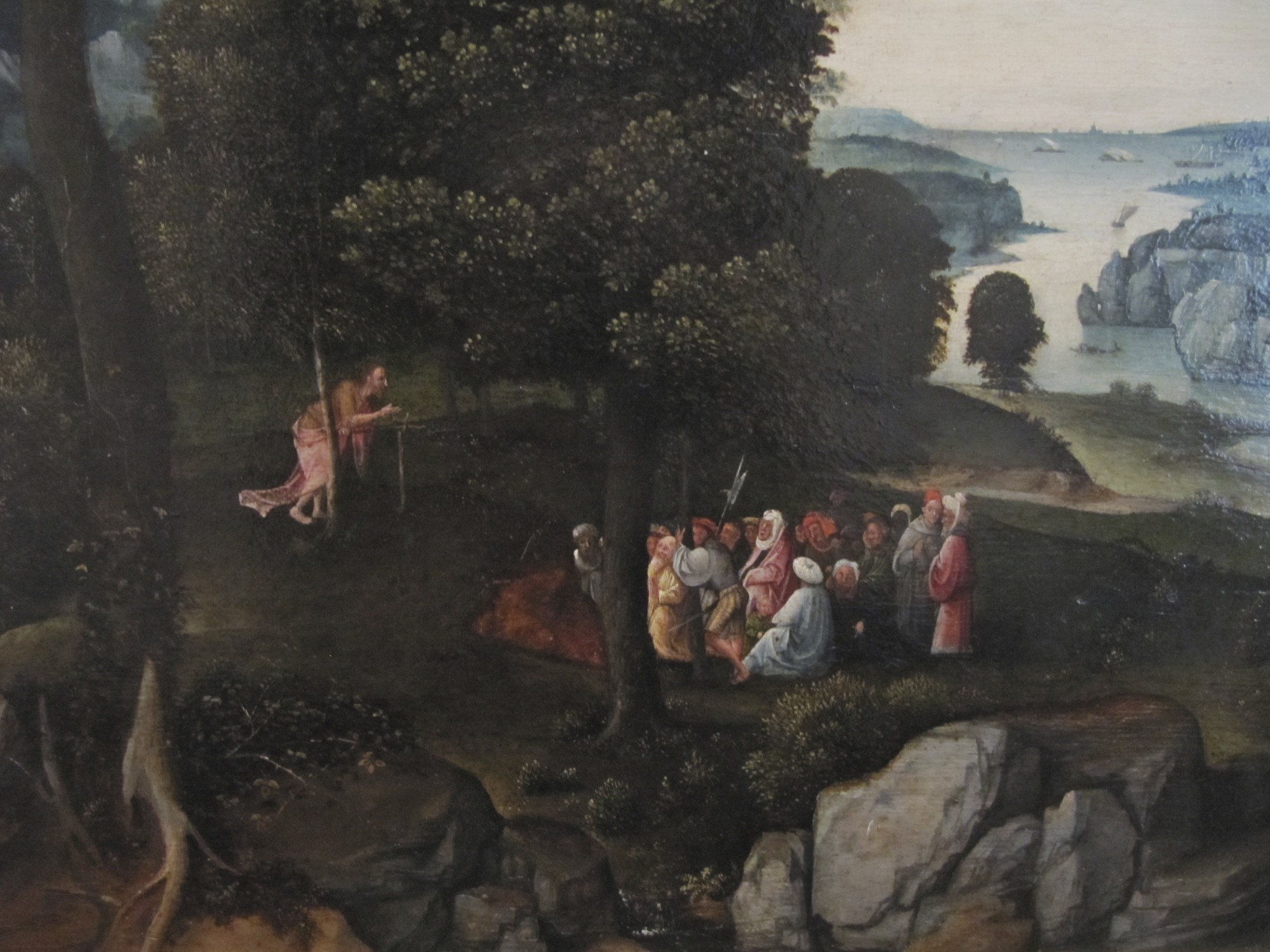
The artist who painted John the Baptist preaching near the Jordan river obviously had no idea what Palestine and the place of John’s ministry looked like, but he gets the story right anyway, I think.
The people listening to John are surrounded by an over-powering wilderness. They’re on their way to Jerusalem, but will they ever get there? There are no well marked trails in sight, no civilized world close by for food and lodging. Only a man preaching to them.
Our readings today from the Old and New Testament point out Elijah and John the Baptist as guides God sent to care for his people, the vine he planted. There were guides then and there will always be guides.
John sent those who listened to him in the wilderness on their way. He baptized them with water and pointed out the path. His words were food for their spirits and brought joy to their hearts. He gave them hope. They’ll find their way.
“No future without history.” Don’t omit faith in that history.
I remember a guide explaining the Black Forest in Germany to visitors years ago. The Romans called it “black”, he said, because it was such a forbidding, dark land. Now, of course, it’s one of the loveliest spots in Europe, where visitors enjoy nature and its farms provide some of the best produce on the continent. It’s become a model for environmental planning in northern Europe.
Monks fleeing from dangerous conditions in the towns along the Rhine River were the first settlers here, our guide said.
Were they just fearful escapees, I asked, or did a vision of faith bring them here? Were they inspired by the Book of Genesis to create a new garden here, where they would live close to the earth, their buildings and lifestyle taking on the rhythms of nature, in the Benedictine tradition. Or were they just refugees?
I wondered too if the many small chapels found in the Black Forest today (see above) suggest that the people coming after the monks absorbed that same ideal?
Europe and North America have become increasingly secularized. It’s not just that people aren’t going to church; it’s evident also in a way people today see and understand things– past, present and future– without reference to the spiritual. I notice it in the documentaries, like Ken Burns’ new documentary on Leonardo DaVinci. A spark of wonder with him started it all.
Our guides on our trip along the Rhine some years ago were polished, informed, personable presenters, but spiritual realities didn’t have much of a place in their explanations.
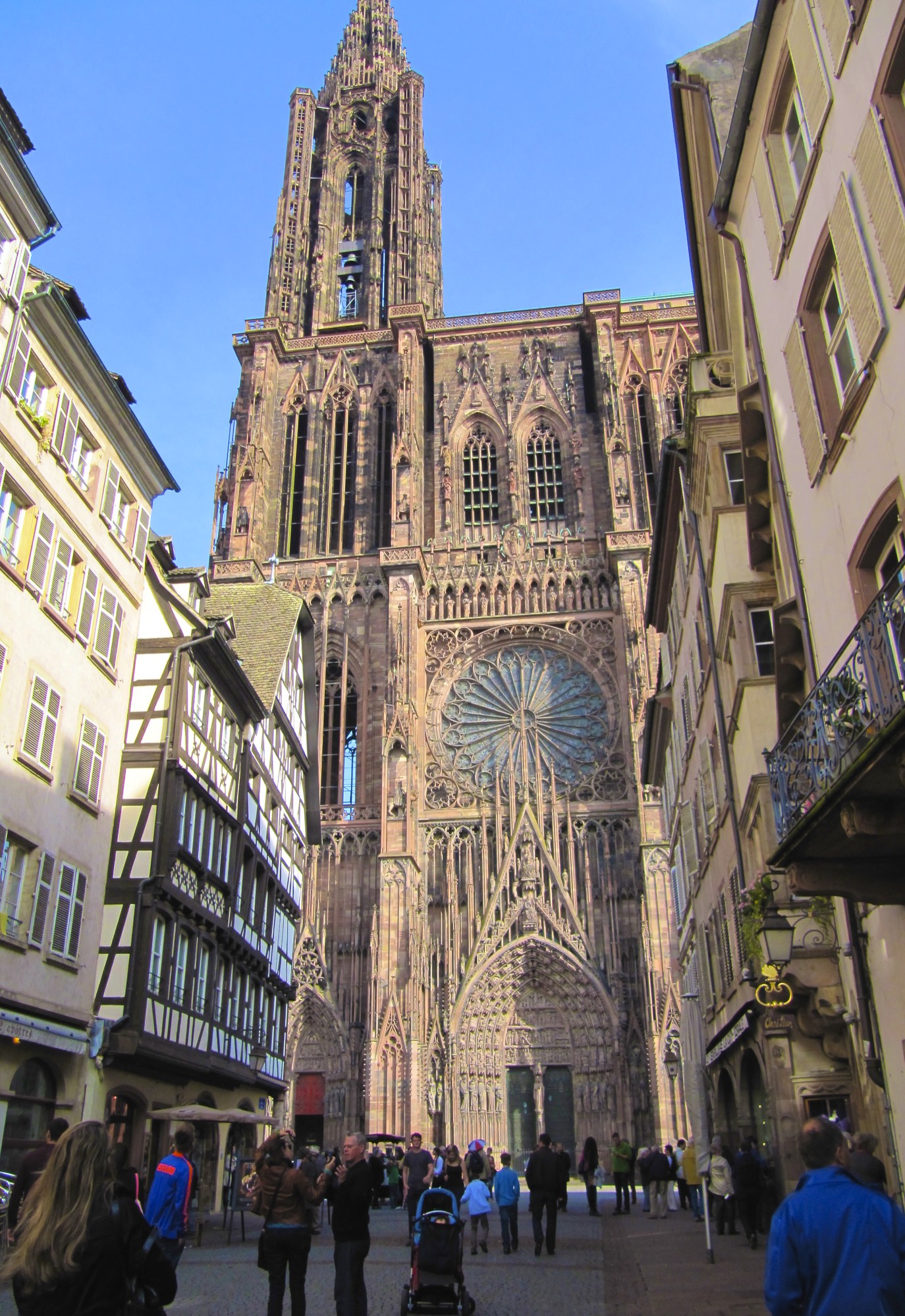
An example? Our guide in Strasbourg on the way to the cathedral through the maze of shops and colorful streets suggested that the great cathedral with its exquisite spire was a beacon drawing shoppers to the city’s abundant bazaars. A medieval version of MacDonald’s Golden Arches?
Medieval planners of the cathedral would be jolted by a suggestion like that. They built their great churches as places of splendor for relieving the monotony, squalor and hardships people experienced in their cities. Seeing them, people walking the streets saw beauty pointing to the heavens. Within them people knew themselves as the people of God.
A billboard for Donald’s? We have no future without history.
“Amen, I say to you, this poor widow put in more than all the other contributors to the treasury. For they have all contributed from their surplus wealth, but she, from her poverty, has contributed all she had, her whole livelihood.” Today’s gospel image of the generous widow emphasizes the attitude of biblical stewardship that is not based on surplus but on sacrifice. Most of us live this kind of stewardship. We call our offertory collection a “sacrificial offering.” Biblical stewardship goes far beyond the material because something behind that spirit of giving comes from having values, namely the values of sharing, support, and trust. Sharing is not a programmatic gift. It comes from seeing our parents and grandparents sharing a home, their love, shelter, food, and themselves with us so we could grow into generous human beings. Jesus is not advocating financial irresponsibility; he is asking for the freedom to give out of love, not out of calculation.
The early Church put a great emphasis on the care of widows and orphans. It wasn’t a safety net that gave the widow in today’s gospel the strength to give, it was the church that she knew as a family that cared with compassion for those who were in the greatest need.
I remember when I was in Jamaica, West Indies, we had a group from a parish in Pennsylvania visiting. We went to see a woman in a very rural area. She told us that some of her crops from her small plot of vegetables were stolen. We spent an hour with her and as we were leaving, she handed us a bag of beans from her garden. The visiting pastor was speechless and immediately protested knowing her garden was depleted because of a theft. But she smiled, “Father, you cannot come to my home and not receive a gift to take back to your home.” He took the beans and was shocked but said, “I just met the widow from the gospel.” He witnessed the living gospel.
May our eyes be open to those generous hearts who renew our hope in the way God provides and never tires of giving himself to us in his Son whose sacrifice is the ultimate act of generosity.
“The Vatican said recently he doesn’t exist,” our guide informed us as we looked up at the imposing statue in Cologne Cathedral in Germany a few years ago, Then, we passed quickly on.
Afterwards, I told him the Vatican didn’t say Christopher never existed, but as of now there is no historical evidence for the popular saint who carries the little child on his shoulders. For one reason or another, no historical evidence exists for a good number of our early saints.
It’s more than finding a Christopher in history, however. If you look at what he’s doing, there have been–and still are– many Christophers. (Bearers of the Christ Child) His holiness can be unrecognized, but very real. He’s there in the women and men who day after day carry children on their shoulders, getting them where they must go and keeping them from the dangers little children face.
Caregivers of all kinds do the same thing. I watch them here at our place, where we have a number of priests and brothers who can’t get around, getting them into wheelchairs and getting them to where they have to go. Not much glamor in that job, but a lot of people need carrying, especially today.
The media seems to thrive on violence today. Gangs taking on gangs, macho heroes blowing up cities, killing thousands. Non-stop violence.
Christopher was a sign to generations past that strength is more than swinging a sword. You’re strong when you serve the weak.
We need you today, St. Christopher. Pray for us. Inspire us.







 The Victor's Place