Category Archives: Religion

Jack Frost

Anyone who reaches 92 years, as Jack Frost did, leaves a trail of stories. Many at his funeral December 12, 2018 in Spring Lake, New Jersey, had their stories, some more than others. Jeannie, his wife of 67 years, had plenty to tell. They had 7 children, 20 grandchildren, 12 great grandchildren. St. Margaret’s church was filled with his family and friends.

The Irish poet W.B. Yeats tells a life story, surely his own, in a poem called “What then?” After each stage of life the question’s raised– ‘What then?’ What comes after this? The poem ends with the same question, “What then?”

What then? What comes after this? That the question we have, hoping for an answer, as we bring someone who has died to church. Is there an answer in this place of faith?

Faith is not seeing or science or reason. Faith is God’s way of speaking to us. As Christians we believe he spoke to us through Jesus Christ, and so we look for the signs we have here. Signs don’t say it all, of course, sometimes they’re not presented very well on our part, sometimes we’re not ready to see them. Even so, God speaks through them .

As we brought Jack’ body to the church the other day, the signs were there. The first thing we did was to bless him with holy water and place a white cloth on him as a sign of his baptism. What does that sign say?

Some days before he died, I visited Jack in hospice at Jersey Shore Hospital. HIs wife, five of their children and some of their children were all crowed into the room. A friend came in with a small bottle of holy water from a Marian shrine in Maryland. Jack was drifting in and out. “Jack, I’d like to bless you with this water,” I said, “ to remind you that God made you his child at your baptism and gave you gifts. You certainly used those gifts well over the years. Just look around this room. You did a good job.”

At that, everyone in the room started to clap “Good job, Dad. A good job.” Jack’s face lit up in a big smile. He was leaving this life to applause. I could still hear it as we brought his body into church. “Welcome, good and faithful servant,” the Lord must have said.

“Love makes one little room an everywhere” an English poet wrote. Jack had a great devotion to the Mass. It wasn’t something he had to do, a thing of duty; he wanted to be there. Instinctively, he understood what the poet said: “Love makes one little room an everywhere.” At his funeral Mass we brought him close to the altar in church.

“Love makes one little room an everywhere.” Every once in awhile when Jack wasn’t able to get to church and I was able, my sister and I would go over to the Frost’s to have Mass. Only the four of us, in a little room, but the world of everywhere was there. The world of the past, the world now, their kids’ world, even the world of politics somehow was in that one room. That’s what the Mass does: it brings the world of everywhere to God through Jesus Christ.

As we gathered in St. Margaret’s church for the Mass on Wednesday a wonderful grace seemed to settle on us all. A communion of saints was there, the saints now in glory, the saints struggling below. All together, we were drawn into that mystery.

When I left the dinner after the funeral Jeannie’s kids were all around their mother, their arms around each other, singing songs they sang as kids. “Good job, Jack.”

Pictures 2

Thoughts Upon The Cross: Doxa. Doxa. Doxa.

by Howard Hain

.

And we have seen his glory,

the glory of an only Son coming from the Father,

filled with enduring love.

—John 1:14


.

The power of God.

A tiny leaf caught between two worlds

Suspended by invisible threads

Dancing to the still small voice.

Deeper and deeper

Into the person

The Son of Man

Who is God.

Glory.

And Might.

Power.

And Majesty.

Fully Alive.

Beautifully Human.

Walking Wisdom.

The Lightness of Fullness.

The Heaviness of Simplicity.

Doxa. Doxa. Doxa.

Honor.

Adoration.

And Praise.

Doxa. Doxa. Doxa.

Beyond praise.

The Power of One.

He Is.

We’re not.

He stands.

We fall down.

He dies.

We live.

Doxa to the Father.

Doxa to the Son.

Doxa to the Holy Spirit.

Doxa. Doxa. Doxa.

Between two worlds.

Is a man.

Who says “I AM”.

A tiny leaf suspended.

He is Lord.

He is God.

Invisible threads.

He Is.

And so now are we.

Dancing.

Still.

Small.

Voice.

The Word.

The Depth.

Beyond the signs.

To the Person Himself.

The Person of Jesus.

Deeper.

And deeper.

Into His flesh.

Into His Glory.

Doxa is Thy Name.

Dwelling among us.

Abiding within us.

Still small leaves caught between two worlds.

Suspended by invisible threads.

Dancing to the breath of God.

From deep to deep.

Depth to depth.

It never ends.

Doxa. Doxa. Doxa.

Doxa in the highest.


.

(May 6, 2017)

I Love Advent


I love Advent.
I love the prayers of the Season,
the hymns of the Season,
the hope of the Season,
the hush of the Season.

Advent is a time of quiet waiting for me,
a time to focus on the Who of the Season
and the Why of the Season,
not the hustle-bustle of the season.

I’m grateful for the prayerful peace of Advent,
for the holly and evergreen branches
that brighten the short, cold, winter days of anticipation.
It’s the time to put candles in the windows
to shine in the long dark winter nights;
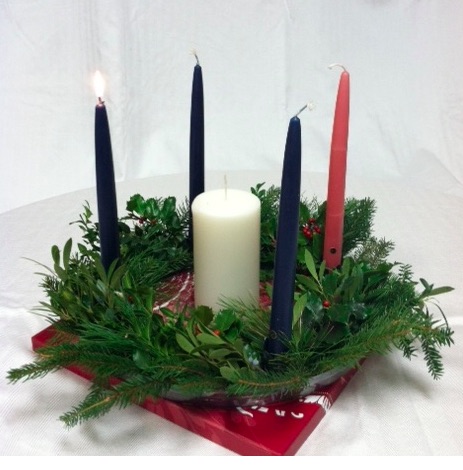
the time to place the Advent wreath on the table,
to light a candle each night,
and pray our Advent prayer together.

It’s time to set out the crèche and the tiny figures;
to set up the old-fashioned candle-lit altar from my childhood
with Jesus at the top and guardian angels on each corner.
A time to hang the wreath that reminds me of the
circle of God’s never-ending love.

Advent is now a time of freedom for me, a simpler time:
freedom from the hectic shopping, baking, cooking, decorating,
those things I once felt I must do to prepare for Christmas;
freedom to add Advent prayers to my daily prayers;
freedom to reflect, to ponder.

Our family gifts are the charities of each one’s choice,
given with our hope that others may also be blessed.
Our gift to one another is the love we share
as we come together to celebrate
the Birth of God’s Promised One,
Jesus, the Lord, the Light of the world,
Emmanuel, God with us.

Gloria Ziemienski, 2010

Festival of Lights


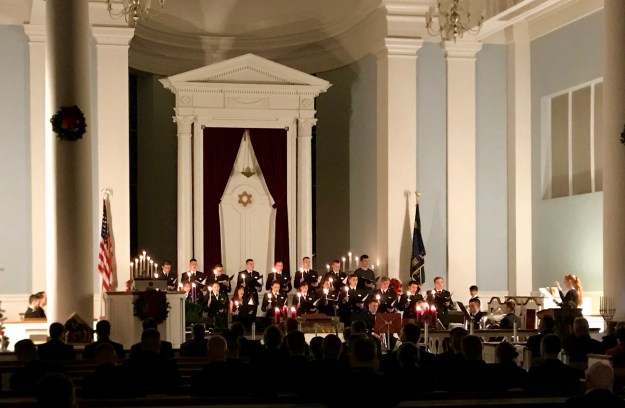
Tonight at the Merchant Marine Academy on Kings Point, New York, I heard the enduring and ever new music of Christmas. Just the thing to make your heart sing. I had the Benediction:

Loving God, your love formed the sun, the moon and the stars,
the seas and all that dwell in them.
Of all your creation, you made us in your image,
and told us to care for what comes from your hand.
Be with us this night as we sing songs of praise.

We praise you for all you have made and all you have done,
Our minds and words can scarcely take it in.
In wonder, we stand in your holy presence.

You have given us life and gifts without measure,
Help us to use well the gifts we have.

At this time of the year the earth grows darker
And the seas can rage with storms.
In the dark we can lose our way
And storms can make us afraid.

And so, loving God, who made the earth, the sky, the sea,
care for us all.
You are the light that guides us,
the strength that sustains us,
the love that never fails.

Bless us, as you promised.
Bless us as you always do.
Bless all your creation
and all of us. Amen.

Fr. Victor Hoagland, CP
December 9, 2018

Advent and Christmas Time

God works in time. The Jewish prophets knew that and however faithless their people, however dark and desolate their situation, they believed God was at work. God’s kingdom was coming.

Christianity knows this too. The seed the sower sows grows in time; the field has a treasure waiting to be found, servants get gifts to trade till their master’s return, storms threaten the sea, but God’s plan for peace unfolds in time. “In the fullness of time God sent his Son.” (Galatians 4,4)

Storms can be fierce, however, and make us “ready to die of fright”; we can also get tired waiting and, like the servants in the parable, fall asleep, a dangerous sleep.

Feasts and seasons are there to give us hope and wake us up. The four weeks of Advent and the feasts and days of Christmas and Epiphany waken us to God’s presence, the presence of God in the Incarnation of his Son. Advent begins a holy time; let’s welcome it. “Today if you hear God’s voice, harden not your hearts.”

Jesus Christ, God’s only Son, true God and true man, born of a woman, revealed to all people has come to save our world. He came once and he will come again “to judge the living and the dead and his kingdom will have no end.”

We know the mysteries of God slowly, however. ( Luke 24,25) Only little by little, as time goes by, do we grow in awareness, an awareness that can ” ransom the time being from insignificance.” ( W.H.Auden)

Advent culminates in two great feasts, Christmas and Epiphany.

What to look for in Advent and Christmas?

In the four weeks of Advent the Prophet Isaiah, John the Baptist and Mary of Nazareth are key messengers of God. Isaiah, the first voice we hear, brings a message of hope.

Isaiah was a priest in the temple of Jerusalem in the 8th century, a time of devastating wars and religious and political turmoil in Israel, when the powerful armies of Assyria were ravaging the kingdoms of Israel and Judah.

God came to him in a vision in the temple’s Holy of Holies (Isaiah 6) and Isaiah was overwhelmed by a Presence more powerful than any on earth. Human plans and schemes were not the answer, he realized; reliance on God was. No matter how bad the times, God is “Emmanuel,” “God with us.”

This was Isaiah’s message then, and it’s his message today.

“ I heard the voice of the Lord saying, ‘Whom shall I send? Who will go for us?’ ‘Here I am,’ I said; ‘send me!’” (Is 6,8)

Isaiah’s prophecies pervade Advent time, beginning with the first week. They may seem unreal to us, as they must have seemed unreal to those who first heard them when Assyrian armies were laying waste to Palestine.

Could anyone believe that all nations will stream toward the mountain of the Lord’s house, laying down the arms of war and seeking wisdom? Can all peoples, all nations, all races ever live in harmony and peace? Can families and neighbors live peaceably?

Today, in our splintered world, the prophet’s promise seems an impossible dream. But this holy time of Advent revives and expands our hope, not just a personal hope for ourselves and those dear to us, but hope for the whole world.

God loves the world and sent his Son to save it. Hard though it is to imagine, God’s coming kingdom will bring the world peace.

Sin is behind the fragmentation of our world. But sin is destroyed by God’s grace and ‘the grace of God has appeared,” the Child born to us is our Savior and Lord. “He will come to judge the living and the dead, and his kingdom will have no end.” The peaceable kingdom, seemingly impossible, is not impossible for God.

Advent and Christmas time ends with the Feast of the Epiphany and the Baptism of Jesus, who manifests himself to the gentiles and calls all nations into his kingdom.

” The season of Advent has a twofold character. It is a time of preparation for Christmas when the first coming of God’s Son to us is recalled. It is also a season when minds are directed by this memorial to Christ’s second coming at the end of time. It is thus a season of joyful and spiritual expectation.( General Norms for the Liturgical Year, 39)

Readings 2nd Week of Advent c


DECEMBER 9 SUNDAY SECOND SUNDAY OF ADVENT
Bar 5:1-9/Phil 1:4-6, 8-11/Lk 3:1-6 (6)

10 Monday Advent
Is 35:1-10/Lk 5:17-26 (181)

11 Tuesday Advent
[Saint Damasus I, Pope]
Is 40:1-11/Mt 18:12-14 (182)

12 Wednesday USA: Our Lady of Guadalupe
Feast
Zec 2:14-17 or Rv 11:19a; 12:1-6a, 10ab/Lk 1:26-38 or Lk 1:39-47 (690A), or any readings from the Lectionary for Mass (vol. IV), the Common of the Blessed Virgin Mary, nos. 707-712

13 Thursday Saint Lucy, Virgin and Martyr
Memorial
Is 41:13-20/Mt 11:11-15 (184)

14 Friday Saint John of the Cross, Priest and Doctor of the Church
Memorial
Is 48:17-19/Mt 11:16-19 (185)

15 Saturday Advent
Sir 48:1-4, 9-11/Mt 17:9a, 10-13 (186)

To reach God’s holy mountain there’s a journey to make, Isaiah says, but guides will show the way. “Behold, I send my messenger ahead of you, to prepare your way.” Mark 1, 1. John the Baptist appears in the desert promising forgiveness to those washing in the waters of the Jordan River. We have been baptized in the waters of baptism.

The Old Testament readings this Advent week, mostly from Isaiah, describe a desert journey, but the desert will bloom and a highway will be there, the prophet promises. (Monday) God will speak tender, comforting words to his people on the way. (Tuesday) Those who hope in him will renew their strength, soaring on eagle’s wings. (Wednesday) Though we are as insignificant as a worm, God holds us in his hands and says:“Fear not; I am with you.” (Thursday) God is our teacher and shows us the way to go. (Friday) On the way, prophets like Elijah accompany us. (Saturday)

Jesus is our way, the gospel readings say. He healed and forgave the paralyzed man– symbol of a paralyzed humanity– who was lowered through the roof into the house in Capernaum. (Monday) Like a good shepherd he searches for and finds the stray sheep. (Tuesday) “Come to me all who are weary, ” he says. (Wednesday) He sends us prophets and guides like John the Baptist and Elijah.( Thursday) Though rejected like John the Baptist, Jesus still teaches. (Friday)

He will save us, even though unrecognized like John and Elijah. (Saturday)

2nd Sunday of Advent c: Prepare the Way of the Lord

For this weeks homily please play the video below.

Advent Lesson


In “Wikipedia” it says that Advent is “a season observed in many Christian churches as a time of expectant waiting and preparation for both the celebration of the Nativity of Jesus at Christmas and the return of Jesus at the Second Coming.” The article also talks of another coming: “in our hearts daily.” I think this means in prayer. Prayer often can be experienced as “expectant waiting and preparation” for the felt presence of God. Sometimes it does not come so easily. Waiting can be difficult, and even cause frustration or anxiety. The Scripture readings during this season express this anxious waiting by the ancient Jewish people: “When is our Messiah coming?”
My wife and I love to light up the candles in the wreath and do a reading and prayer together everyday. We follow the Advent calendar and look at the daily Mass readings in the “Word Among Us”. This is all very wonderful, and I recommend it. But I have to confess that I have always had a hard time finding a particularly special or genuine feeling about Advent. It somehow eludes me, the purpose of honoring all this waiting, when our faith tells us that our Crucified and Risen Lord is always here with us.
Last Sunday my Lord gave me a beautiful image of what the “Advent feeling” is like. In one of the Advent Gospels (Tuesday of the First Week):

“Jesus rejoiced in the Holy Spirit and said, ‘I give you praise, Father, Lord of Heaven and Earth, for although You have hidden these things from the wise and the learned You have revealed them to the child-like.” (Lk 10: 21)

This reminded me of the joy and surprise that I felt during the homily that Fr. Chris Cleary CP gave on the First Sunday of Advent. So I have to share it with you. This wonderful priest told
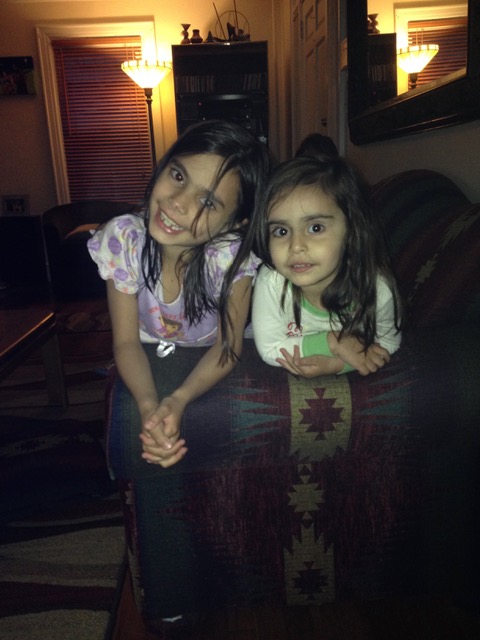
us a story. In this story two girls are sitting together in a very happy mood. The first girl proudly shows the other girl that she has 5 pennies in her hand. The other child smiles and responds, “Well, I have 10 pennies myself!” The first girl says, “Yeah? Let me see.,” And the second girl opens her hand to show the 5 pennies she also has. So the first one says, “You don’t have 10 pennies!” The second girl responds with a beaming smile, “I do, because my father said he is going to give me 5 more pennies tonight. AND HE PROMISED!”
Right then and there I had this wonderful insight into the meaning of this blessed season we are in. This second girl is still waiting for those 5 extra cents all the way until nighttime, but she has such confidence, trust, and faith in the promise of her beloved father that those coins can just as well be there in her hand!
Our Heavenly Father has promised Eternal Life for us with His very Son and Self. He promised! Why should we be anxious? Our Blessed Lord, thank You for the faith you give us every day. Beloved, You ARE the One “who was, and who is, and who is to come.” With peace in my heart and a smile on my face just like the little girl’s, I will wait and sing, “Marana tha, our Lord come!”

Orlando Hernández

Saints of Advent

In the revision of the church calendar after the Second Vatican Council an effort was made to reduce the celebration of saints feast days and emphasize the celebration of the mysteries of Christ during season like advent and Christmas. Why then, in this first week of advent are we still celebrating feasts of the saints, for example, St. Francis Xavier (Dec 3), St. John Damascene (Dec 4), St. Nicholas (Dec 6), St. Ambrose (Dec 7) and the Feast of the Immaculate Conception of Mary (Dec 8)?

The reason is that saints are a sign of the universality of holiness. Holiness is not found only in biblical times, but in every age. Holy people are not only in the bible; they’re found yesterday, today and tomorrow. Saints are signs that God’s plan, which we celebrate in feasts and seasons– unfolds in time. The saints, who express the mystery of Christ in their time and place, ask us to do the same in our time and place.

St. Francis Xavier (December 3) witnessed in his time the message powerfully proclaimed in Advent, especially by the Prophet Isaiah. God wills that the gospel be brought to all nations. He says to us “Portuguese merchants and officials brought me to the Indies. How are you bringing the gospel to all nations today?”

St. John Damascene (December 4) is an 8th century saint of the Eastern church, whom the Roman church included in its calendar and named a doctor of the church in 1890 during the pontificate of Leo XIII. By recognizing his teaching, the Roman church also recognized the teaching of the Orthodox churches. John Damascene is a sign that God works, not just through one church, but through other churches as well. He asks us now: “How do you recognize God’s teaching in churches other than your own?”

John Damascene also defended the use of images against those who saw them as impediments to the knowledge of a transcendent God. He validated the work of Michelangelo and Bach and generations of Christian artists. Can you imagine a faith or a church or Christmas without them?

Is there a saint more closely connected to the mystery of Christmas in the popular mind than St. Nicholas (December 6)? The delightful story of Nicholas throwing pieces of gold into a house where three poor girls are threatened with slavery is a story that mirrors the story of the Incarnation. And Nicholas doesn’t want to be recognized for what he does.

Jesus, the Word made flesh, is a gift of God’s mercy, who comes hidden as an infant into our poor world and quietly gives us eternal life, humbly asking nothing in return. Nicholas, Santa Claus, asks us to give quietly, humbly, in our time, as Jesus did.

St. Ambrose (December 7) was born in the 4th century into a Christian family and became a lawyer and high official of the Roman government in northern Italy. He was called by popular acclaim to be bishop, though not yet baptized! Eight days after his baptism he was ordained bishop and became one of the great Christian bishops of our church

He studied the scriptures and preached God’s world. He wrote once to another bishop: “Drink, then, from Christ, so that your voice may be heard…He who reads much and understands much, receives his fill. He who is full refreshes others.”

One of those Ambrose refreshed with his preaching was St. Augustine, whom he awakened to the beauty of God’s word. He baptized Augustine and his friends, who looked to him as an example. His voice was heard, the voice of Christ.

He tells us, “Study the scriptures; they speak of Christ, and your voice will be more and more the voice of Christ.”

Saints are signs of Christ, yesterday, today and forever. Be signs of Christ today, they say.