Category Archives: philosophy

Hummingbird and Passionflowers

by Howard Hain
1509123983639705942327.jpg

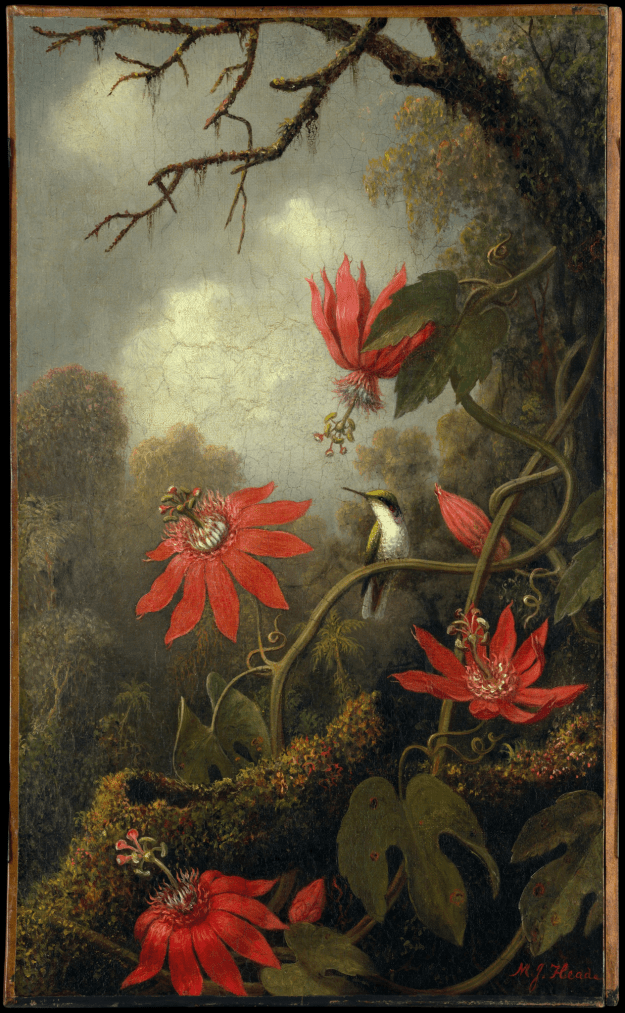
Martin Johnson Heade, “Hummingbird and Passionflowers” (ca. 1875-85) (The Met)

The delicate little bird that resides within each of us.

It hops to and fro. It stands startlingly still.

Very often we are the very ones who chase it away.

But it doesn’t fly far.

Just to the closest branch, that’s just beyond our reach.

And it looks back at us, as if to ask, “Why are you afraid?”

The tiny head of a tiny bird, slightly cocked to the side—a question mark floats from its beak.

It longs to return, to live within us, to build a nest, to raise its young.

But it doesn’t rush back.

No, it waits.

It waits for us to ask for it to return.

It’s a patient creature, that tiny bird.

One may be tempted to say it’s not very smart, but that’s not it at all.

It’s simple. It’s holy. It knows who it is. It’s not afraid of the fall.


Howard Hain is a contemplative layman, husband, and father.


Web Link: The Met Museum. Martin Johnson Heade, “Hummingbird and Passionflowers” (ca. 1875-85)

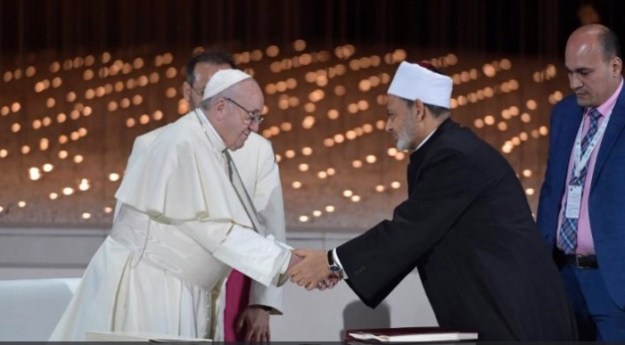
Document on Human Fraternity for World Peace and Living Together


Screen Shot 2019-02-06 at 8.49.53 AM

Pope Francis and the Grand Imama of Al-Azhar, Ahmad el-Tayeb,

“Something is happening.” That’s the way the great reading for our Holy Saturday liturgy, taken from an ancient homily, begins. We don’t see clearly yet, but something is happening.

And that’s the way I felt yesterday watching on YouTube a Mass at Abu Dhabi in the United Arab Emirates where more than one hundred thousand Christian migrant workers in the Middle East celebrated their faith with Pope Francis. Christianity is alive in the Middle East.

In the “Document on Human Fraternity for World Peace and Living Together” signed on Monday afternoon in Abu Dhabi by Pope Francis and the Grand Imama of Al-Azhar, Ahmad el-Tayeb, a path for the two religions and the world itself opened. Something is happening.

The document from leaders of these two great religious traditions, Christian and Muslim, is worth reflecting on.

It begins:
“In the name of God who has created all human beings equal in rights, duties and dignity, and who has called them to live together as brothers and sisters, to fill the earth and make known the values of goodness, love and peace,”

The document speaks for innocent human life, the poor, the destitute and the marginalized, the victims of destruction, calamities and war. It invokes the name of freedom, fraternity, peace and justice, the name of all people everywhere:

“In the name of God and of everything stated thus far; Al-Azhar al-Sharif and the Muslims of the East and West, together with the Catholic Church and the Catholics of the East and West, declare the adoption of a culture of dialogue as the path; mutual cooperation as the code of conduct; reciprocal understanding as the method and standard.”

“We, who believe in God and in the final meeting with Him and His judgment, on the basis of our religious and moral responsibility, and through this Document, call upon ourselves, upon the leaders of the world as well as the architects of international policy and world economy, to work strenuously to spread the culture of tolerance and of living together in peace; to intervene at the earliest opportunity to stop the shedding of innocent blood and bring an end to wars, conflicts, environmental decay and the moral and cultural decline that the world is presently experiencing.”

One commentator Tuesday said a meeting like this takes time for its meaning to be felt. “Something is happening.”

Facing “Unclean Spirits”

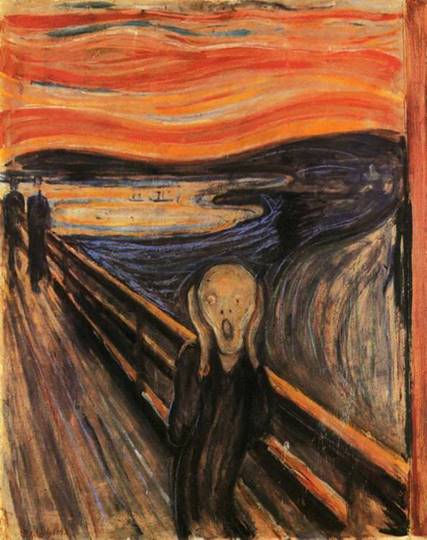
Edvard Munch: The Scream


When Jesus and his disciples cross the sea into pagan territory– an important new step in his ministry– they meet a man in the tombs and Jesus drives the unclean spirit out of him. (Today’s reading: Mark 5, 1-20) 

Throughout  his ministry “whenever unclean sprits saw him they would fall down before him and shout, ‘You are the Son of God.’ (Mark 3,11) Unclean spirits were favorite targets for Jesus in his ministry.

What’s an “unclean spirit”?

In their fine commentary on Mark’s gospel John R. Donahue, SJ, and Daniel Harrington, SJ, say “In this context ‘unclean’ (akatharton) primarily connotes not a moral (even less a sexual) fault), but something opposed to the “holy.” In the command of the Old Testament to be holy (Leviticus 11,44) it implies life, wholeness and completeness,( Leviticus 21, 17-21) whereas uncleanness implies something that should not be, something out of place ( e.g. soil in a farmer’s field is productive, while in a house it’s dirt). The opposite of the realm of the holy is the demonic, hence the spirits there are “unclean”. Physical defects or psychological aberrations can make a person “unclean”in a sense of incomplete, imperfect and out of order.”
(The Gospel of Mark, Sacra Pagina, Liturgical Press 2002 page 80.)

Jesus did not focus on the intellectual establishment or the religious establishment in his ministry. He engaged the chaotic world of the “unclean spirits.” He set up a “field hospital” to use a phrase dear to Pope Francis.

That can be a messy, scary world, as we see in Mark’s gospel. Just think of the poor man in the tombs, chained and hurting himself. Who wants to deal with him? But Jesus gives his disciples “authority” over unclean spirits. His followers have the power to take them on.

Jesus commissioned  his apostles for this ministry. He summons “the twelve and began to send them out two by two and gave them authority over unclean spirits.” (Mark 6, 7) We’re not out of place in our chaotic world today.

Feast of Corpus Christi

For this week’s homily, please play the video below:

Trinity Sunday


Ecumenism

I attended a beautiful Methodist funeral this week at a funeral home in Ocean Grove, New Jersey. I prayed and sang with the members of the family and their friends. Some years ago, before the Second Vatican Council, I would have been told “In no way is it permitted for the faithful to take part in any way in non-Catholic services.” (Canon 1258)

We have come a long way in our relations with other Christian churches and other religions. In the days of St. Francis de Sales in the 16th century, Christian churches were fighting each other over religion. Francis de Sales as the bishop of Geneva, Switzerland, chose to approach religious differences through dialogue and not arms. His approach anticipated the Vatican Council decrees on Ecumenism (Unitatis Redintegratia) and Non-Christian Religions (Nostra Aetate) which told Catholics to respect the religious beliefs of others and dialogue with them.

Dialogue means listening to the other and offering what you know in return. It’s an on-going process that ultimately, I think, has its roots in the created world we live in, which we know little by little. The word “respect”is a beautiful word, meaning “looking again,” Francis de Sales based his spirituality on respect for the variety of creation. We’re “living plants” in the garden of the world. We need to keep “looking again.”

And while we respect others, we need to “look again” at our own tradition to appreciate it and see it “ever ancient, ever new.”

We’re ending the Church Unity Octave on the Feast of the Conversion of St. Paul, the Apostle, January 25th. St Francis de Sales, St. Paul the Apostle, St. Paul of the Cross, pray for us.

The Most Common Occurrence

by Howard Hain


Christ lives in the Eucharistic Prayer.

He listens carefully.

The Father listens too.

We listen with Them.

The Holy Spirit speaks.

He speaks a great silence.

He listens to the listeners.

We collectively hear.

God.

Three Persons.

His Entire People.

All Creation.

The Sound of One Breathing.

The Sound of Life.

Communion.

Amen.


(Jan/4/18)

Wise as Doves

by Howard Hain

rembrandt-angel-appearing-to-the-shepherds-1634

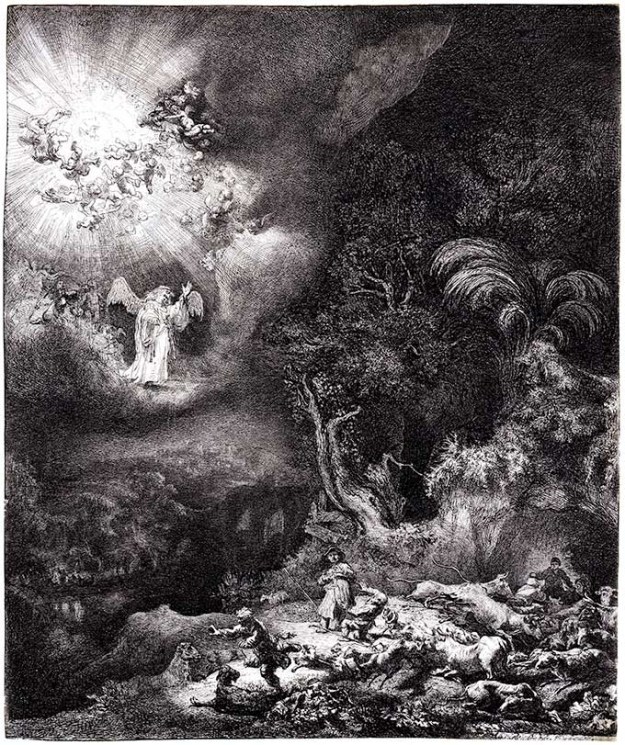
Rembrandt, “The Angel Appearing to the Shepherds”, 1634


Now there were shepherds in that region living in the fields and keeping the night watch over their flock. The angel of the Lord appeared to them and the glory of the Lord shone around them, and they were struck with great fear.

—Luke 2:8-9


Perhaps the scariest thing to those of us who cling tightly to the things of the world is to accept the job that the Lord assigns us.

Oh, how so many of us are so quick to long for greater adventure!

Yet, when it comes to those humble, little shepherds to whom the angel of the Lord appeared, we are perhaps even quicker to long to be one of them—sitting quietly upon a gentle hillside, effortlessly tending to a passive flock, while the always-full moon provides a soft, ever-so-appropriate illumination from above.

But we are liars. For there’s nothing less romantic in each one of our daily lives, or more mundane. We simply have to be honest, or at least consistent. It all depends on how we look at it. If we see the shepherds in such a delicate light then we also need to see ourselves in the same. For before the angel appears, the shepherds were hardly posing for picturesque landscapes. Perhaps it is for this very reason—their realness, their authenticity, their holy simplicity—that the Lord chose them to be present when He revealed His glory.

It is exciting. We have a wonderful choice, then. Either our “boring” lives make us just the kind of people to whom God prefers to reveal Himself, or our lives are a lot more “exciting” than we ever imagined. Either way, what is vital to making such a decision is true sincerity and genuine gratitude. We need to thank God for who He has made us, for where He has placed us, and for what type of task He has assigned us.

A faithful, humble heart dreams and believes and sees great things among the most ordinary circumstances. Just look at the young virgin and the upright carpenter to whom the shepherds “went in haste” to find in a stable, adoring a child born within the company of the “lowest” of men.

If we spend our time dreaming of being someone else, living somewhere else, and doing something else, we miss the opportunity of being exactly who God intends us to be—and when that happens—we are always in the wrong place, at the wrong time, and most tragically, doing that which matters very little.

For to be the first on the scene, the first to “lay hold”, the first to adore the New Born King, is as good as it gets—even for those whose “normal existence” isn’t standing around all alone—day after day in the scorching sun or biting cold, while picking fleas from matted-down fleece or scaring off hungry wolves.


The angel said to them, “Do not be afraid; for behold, I proclaim to you good news of great joy that will be for all the people…”

So they went in haste and found Mary and Joseph, and the infant lying in the manger. When they saw this, they made known the message that had been told them about this child. All who heard it were amazed by what had been told them by the shepherds.

Then the shepherds returned, glorifying and praising God for all they had heard and seen, just as it had been told to them.”

—Luke, Chapter 2:10,16-18,20


Communion with Saints

by Howard Hain


A man named Paul lives in my home.

He’s an excellent house guest.

He never imposes.

He’s never and always alone.

My daughter and I talk of him often.

He brings wisdom to our kitchen table.

I’m not exactly sure when he moved in.

But it wasn’t so long ago.

Before and with him there are others.

Theresa, Francis, Bruno, John…just to name a few.

But Paul for some reason never seems to leave.

The others, they kind of come and go.

Paul on the other hand always hangs around.

But then again, I could say the same about the rest.

Is it cliché to say it’s a mystery?


Little Drummer Boys and Girls

by Howard Hain

Yesterday I witnessed a “dress” rehearsal for a live nativity. The cast was made up of first and second graders, and the audience was mostly composed of residents of a retirement home for religious sisters, Franciscans. It was spectacular.

Last week I was at Radio City Music Hall to watch the Rockettes in their “Christmas Spectacular”. It was quite a production.

Sitting in the dark this morning I cannot help but contrast the two.

I also cannot help but relate to the seven-year old who played the part of The Little Drummer Boy.

As that child walked so slowly toward the foot of the altar, where the rehearsal was being staged, I saw my vocation in an entirely different light.

The children were all singing their hearts out, and many of the eighty and ninety year-old sisters were mouthing the words. The boy with the drum didn’t utter a sound. He just kept walking, slowly, extremely slowly toward the altar, every once in a while ever so slightly pretending to tap two tiny sticks upon a toy drum. He was beautifully awkward.

There was no greater spectacle on earth at that very moment. Shall I dare to say, no greater event that heaven or earth has ever known?

For a child was born. We were all being born.

———

Come they told me, pa rum pum pum pum
A new born King to see, pa rum pum pum pum
Our finest gifts we bring, pa rum pum pum pum
To lay before the King, pa rum pum pum pum,
rum pum pum pum, rum pum pum pum,

So to honor Him, pa rum pum pum pum,
When we come.

Little Baby, pa rum pum pum pum
I am a poor boy too, pa rum pum pum pum
I have no gift to bring, pa rum pum pum pum
That’s fit to give the King, pa rum pum pum pum,
rum pum pum pum, rum pum pum pum,

Shall I play for you, pa rum pum pum pum,
On my drum?

Mary nodded, pa rum pum pum pum
The ox and lamb kept time, pa rum pum pum pum
I played my drum for Him, pa rum pum pum pum
I played my best for Him, pa rum pum pum pum,
rum pum pum pum, rum pum pum pum,

Then He smiled at me, pa rum pum pum pum
Me and my drum.*


Little Drummer Boy was composed by Katherine K. Davis, Henry Onorati and Harry Simeone in 1958.


Howard Hain is a contemplative layman, husband, and father. He blogs at http://www.howardhain.com