Category Archives: Motivational

Posture of Prayer

by Howard Hain
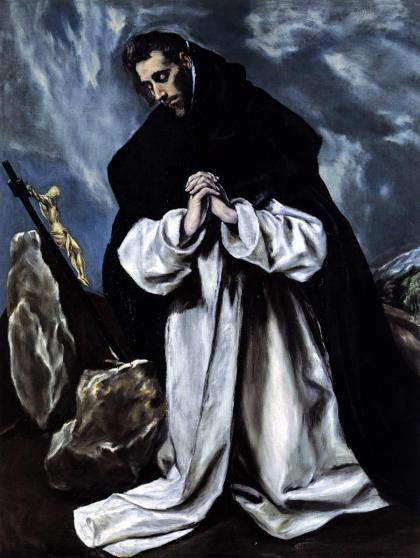
el_greco_st_dominic_in_prayer-1595

El Greco, “St. Dominic Praying”, c. 1588

Sometimes just showing up is all we can do.

To put ourselves in position to pray and worship—at least physically, even if we just cannot seem to get there spiritually—is an act of prayer and worship in itself. And quite often, it is the best we have to offer.

By confessing our aridity through physical obedience alone, we approach God’s altar with humility, for we come to God in our “nothingness”.

The bowing of head, the placement of knees, and the closing of eyes return us to the dark warmth of the womb. It is no coincidence that the posture of prayer and the fetal position bear great semblance.

It is in the womb that we are closest to God, furthest from the corruption of the world, and possess the least of what our “flesh” considers of value—our “brilliant” ideas, our “magnificent” plans, our “heroic” acts—our self-aggrandizement.

It is in the womb that we find ourselves in complete dependence. We receive all we need without knowing, without speaking, without cost.

In that sense, being in the womb is much the same as being in the world—for in the world we are still completely dependent—it is just that without the obvious reminder of the umbilical cord, we so easily forget our total and complete dependence on God, our Creator, our Sustainer, and our Ultimate End.

Hence we find ourselves “knowing,” “telling,” and “paying a price.” When in reality, the only thing that we can somewhat even come close to taking credit for is being physically present to receive His Word, His Wisdom, and His Will. All of which come free of charge, His Son having already paid the price.

———

“Lord, let me place my knees to the earth. Let me feel the foot of the cross against the caps of my knees. Let me close my eyes and bow my head. Let my brow lay upon your bloodied feet. Let me humbly raise my eyes to gaze upon your battered body. Oh my Lord and my God, let your blood and water rain down upon me.”

Amen.


Howard Hain is a contemplative layman, husband, and father. He blogs at http://www.howardhain.com

Follow Howard on Twitter @HowardDHain

twitter.com/HowardDHain

If you enjoyed this post, please consider “liking” it, adding a comment, becoming an email subscriber, or passing it along via the social-media links below. Your support is greatly appreciated. Step by step. All for God’s glory.

I’m Pro-Art

by Howard Hain
DT1554

Paul Cézanne, “Bathers”, 1874-75, (The Met)

I’m Pro Art

In other words:

I’m Pro Truth

In other words:

I’m Pro Beauty

In other words:

I’m Pro Love

In other words:

I’m Pro Creation

In other words:

I’m Pro Life

(Oops, how’d that happen…funny how logic can lead you to such “un-expecting” places.)

(Words do seem to matter—or at least carry some weight—maybe even 7 pounds 8 ounces worth.)

(Before you panic, give it a little, teeny-weeny, infant-sized bit of thought…)

Conclusion:

ProArt (pro-creates) ProLife

ProLife (pre-conceives) ProArt

ProArt (equ=als) ProLife


Howard Hain is a contemplative layman, husband, and father. He blogs at http://www.howardhain.com

Follow Howard on Twitter @HowardDHain

twitter.com/HowardDHain

If you enjoyed this post, please consider “liking” it, adding a comment, becoming an email subscriber, or passing it along via the social-media links below. Your support is greatly appreciated. Step by step. All for God’s glory.

Web Link: The Metropolitan Museum of Art. Paul Cézanne, “Bathers”, 1874–75

Mary Gardens

Andrea Oliva Florenda, a professor at St. John’s University in Queens, New York, offered a day of reflection on Mary Gardens, December 1 at Bishop Molloy Retreat Center, Jamaica, New York. Professor Florenda teaches in the department of theology and religious studies at St. John’s, specializing in Marian theology. She’s also the designer and curator of the Marian Garden at the university.

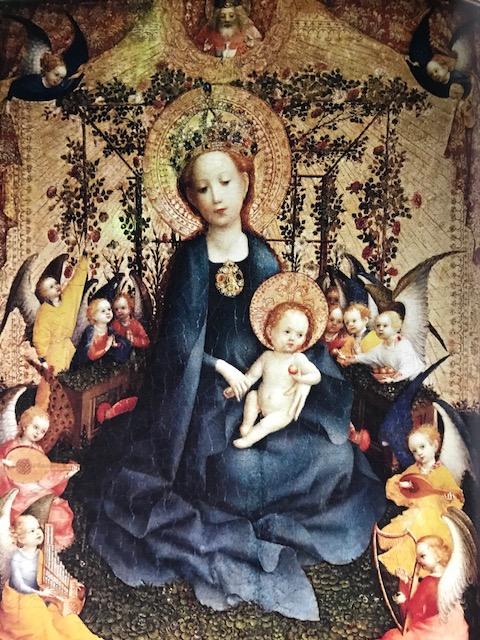
Mary Gardens, dedicated to Mary, the Mother of Jesus, appeared in Europe following the Black Death, a pandemic that caused millions of deaths in that part of the world in the 14th century. The gardens, usually found in monasteries and religious shrines, brought hope to people walking “in the shadow of death.”

God placed Adam and Eve in a garden, Christian tradition says. (Genesis 2, 8-28) Rising from the dead, Jesus proclaimed eternal life in a garden. (John 20,11-18) For early and medieval Christians, Mary appeared as a garden enclosed, flowers, plants and trees surrounded her, “our life, our sweetness and our hope.” The Mary Garden, which became a favorite inspiration for medieval and renaissance artists, brought the promise of life to the “poor banished children of Eve.”

Does the Mary Garden have a role today in a world facing climate change and environmental degradation? Professor Florenda thinks it does. Besides the mysteries of faith, it teaches reverence for creation, for the soil, for plants that feed us and bring healing, for flowers that nourish our sense of beauty.

Certainly science and technology have a large part to play in the current environmental movement, but Professor Florenda notes the number of young people, from various religious tradition drawn to her Mary Garden at St. John’s, where the mysteries of seed and soil unfold, where pharmacy students study medicinal herbs and seasonal vegetables feed the poor.

The day of reflection on Mary Gardens ended at the grotto honoring Mary in the garden of Immaculate Conception Monastery in Jamaica. There, Professor Florenda spoke about the meaning of the grotto, its structure and the plants and trees surrounding it.

“There is a language in each flower,
that opens to the eye,
A voiceless but a magic power.
A prayer in earth’s blossoms lie.” Anonymous

1st Sunday of Advent: Wake Up!

For this week’s homily, please play the video file below:

Walking Into Heaven

by Howard Hain
Rembrandt_-_The_Philosopher_in_Meditation

Rembrandt, “Philosopher in Meditation”, 1632, (Musée du Louvre)


Dream big.

Think small.

Step by step.

Real growth is incremental.

Reaching toward a glory beyond our reckoning.


Sure and Steady

by Howard Hain
jusepe-josc3a9-de-ribera-tightrope-walkers-1634

Jusepe (Jose) de Ribera, “Tightrope Walkers”, 1634


The brighter the light the more we squint.

The closer we get the less we see.

And if we stare we go blind.

Now what?

You have to trust.

In what?

Not in yourselves.

In total darkness the answer is clear.

All other ways disappear.

Close your eyes.

Shutter your ears.

Forget the past.

Ignore what is below.

Chin slightly elevated.

Now walk.

No need to go too slow.

Sure and steady.

Heart on the goal.

And if we slip?

Don’t worry.

I made the rope.

I hold it tight.

My Son is “the way and the truth and the life”.

In Him you never fall.

In Him you know.

In Him you live.

He walks before you.

You may not see Him but He is there.

Follow close behind.

It is a tight walk.

That’s why I gave Him a pole.

I gave you one too.

And because it can get very dark.

I made them easy to identify.

They are made of thick dead wood.

Your hands know their splinters and knots.

Hold tight.

Say thank You.

Kiss in the dark what you cannot see.

For that old piece of wood.

Will get you across the gorge.

Where on the other side.

It will be planted.

Grafted into the Tree of Life.


Howard Hain is a contemplative layman, husband, and father. He blogs at http://www.howardhain.com

Follow Howard on Twitter @HowardDHain

twitter.com/HowardDHain

If you enjoyed this post, please consider “liking” it, adding a comment, becoming an email subscriber, or passing it along via the social-media links below. Your support is greatly appreciated. Step by step. All for God’s glory.

Clean Enough To Care

by Howard Hain
DP801172.jpg

John Downman, “Child Holding a Doll”, 1780 (The Met)


What if someone handed you a child?

A small child.

A tiny child.

An infant.

A few hours…a few minutes old.

What if you were the only one that the child could be handed to?

Only you.

No one else around to help.

Would you receive that child into your arms?

There’s no sterilized room, no sanitary precautions, no sink, not even a bar of soap—just plain old you, a bunch of imperfect circumstances, and a poor tiny child that needs to be embraced.

You know what you would do.

Even if your hands were filthy, completely covered in soot and mud, you know what you would do.

You’d quickly rub your hands against your pants or shirt and wipe away the obvious dirt.

Then you’d hold out your hands.

Wouldn’t you?

Yes. You would.

We all would.

That’s what makes us human.

That’s what makes us children of God.

We’d do what we could with what we have to help an innocent child.

We know that “cleanliness” in such cases really doesn’t matter. For even if the circumstances were “perfect” we’d still have that uneasy feeling. That feeling that we’re not worthy to hold such innocence, to be entrusted with such treasure.

It’s a holy hesitancy that only true humility can bear.

Yet, it’s the necessity to help, the clear need for our assistance—the abundantly clear reality that we’re the only “hands” on deck—that drives us to overcome such holy and righteous fear—a fear that reveals just how poor we really are, much poorer in fact than even the helpless child we are about to embrace.

It is preciously this beautiful fear of God that propels us to love boldly—to boldly reach out beyond ourselves, to boldly become part of God’s mystical body, to become His very arms and hands—to embody Divine Love Itself—that perfect love of the eternal Father for each and every child ever created.

For it is the Father’s love that creates us, and sustains us, and longs to flow through us.

We just sometimes need extreme circumstances—ridiculously obvious situations—in order to tap the needed courage to let it to flow beyond our own borders and into those around us.

You are in such a situation. Right now.

We all are.

This very moment.

No matter where you are or what you’re doing.

Such a situation is at hand.

A child, a new born—cold, hungry, and without a home—desperately needs to be held.

Quick then, wipe your dirty hands, make due with what you’ve got—believe the Word of God, it’s good enough—now hold out your hands.

You’re clean enough to care.


Howard Hain is a contemplative layman, husband, and father. He blogs at http://www.howardhain.com

Follow Howard on Twitter @HowardDHain

twitter.com/HowardDHain

If you enjoyed this post, please consider “liking” it, adding a comment, becoming an email subscriber, or passing it along via the social-media links below. Your support is greatly appreciated. Step by step. All for God’s glory.


Web Link: The Metropolitan Museum of Art. John Downman, “Child Holding a Doll”, 1780

Golden Coins

By Orlando Hernandez

This Wednesday’s Gospel (Lk 19: 11-28) gives Luke’s version of last Sunday’s Gospel from Matthew (Mt 21:14-30).

“A nobleman went off to a distant country to obtain the kingship for himself and then to return. He called ten of his servants and gave them ten gold coins and told them, ‘Engage in trade with these until I return.’” (Lk 19: 12-13)

Luke introduces another parable within the main one. This nobleman is rejected and despised by his own people. Jesus was already “near Jerusalem”, so His Passion was certainly on His mind. Since this Gospel was probably written after the destruction of Jerusalem, we are given a reference to the “slaying” of so many of Jesus’ “fellow citizens”.
But let me return to the main message of this parable in both Luke and Matthew. The master entrusts ten servants with a gold coin each. The first two servants seem to obediently invest their coins and make a good profit. The master is very pleased and rewards them with even greater responsibility! One possible interpretation of this parable is the immeasurable value of God’s gift of faith in Him ( the gold coin). We are called to share this faith so that this treasure will also live in others’ hearts. The more we do, the more Jesus expects us to accomplish for His Kingdom.
In Matthew’s parable the good servants are also rewarded by the invitation to “come, share your master’s joy.” There is so much joy in the service of God, even when we are called to do difficult things. Perhaps we can also look at this gold coin as the gift of Jesus Himself.
Last Sunday as I meditated on these parables, I stood behind the altar with the other Ministers of the Eucharist as I received the precious,
coin-shaped Host. I hardly had any time to relish this gift as I had to go down to the aisle, being very careful not to trip off one of the steps and drop the golden patten, full of treasure, which I gingerly carried in my hands.
The Body of Christ, His beautiful people, came one after the other. The priceless treasure that I would give each one of them filled me with luminous ecstasy. To hold Him in my hands! To worship Him each time I looked at Him and said “Body of Christ!” I truly felt like the good servant. I shared in His Joy. Thank You, Beloved !
Do I sound just a little like the Pharisee at the temple? What about the tax collector who comes with nothing to offer, except his fear and hope? What about the “wicked, lazy servant,” who took this golden coin, this gift of faith, and wrapped it in a handkerchief and hid it underground, or put it in some forgotten drawer, then saying to God, “I was afraid of you, because you are a demanding man; you take up what you did not lay down and you harvest what you did not plant.”? He cringes before God, as the punitive, exploitative dictator of our lives.
I know so many good people who feel like this, even though they were once worshipers of Jesus. The many bad breaks in their lives have led them to believe that God has it in for them. Their sinfulness has made them feel unworthy of salvation . The harsh Bible readings (like this one!), sermons, admonitions, and unfortunate rejections by our Church have led them to let go of that precious coin that was given to them.
But, to borrow from another parable, I believe that each one of them is actually a Lost Coin. God is looking for them! I know that Jesus says in this Gospel, “I tell you, to every one who has, more will be given, but from the one who has not, more will be taken away.” Yet, this is the same Jesus who said, “Blessed are the poor in spirit, for theirs is the Kingdom of God.” Jesus has His eye on those who are wailing and grinding their teeth, who are mourning, hungry and thirsty to be made right in the middle of their Godless lives. Sooner or later our Lord will take away the little we really have, all of us, good Christians and the lost, so that we might humbly go before His altar and beg, “Have mercy on me, a poor sinner.”
Beloved, You are Mercy itself. I trust in Your infinite Love.
The Reverend Daniel Considine,S.J. once wrote :
“ If we don’t look upon God as a hard man we have every reason to congratulate ourselves. We say we think Him merciful, kind, loving, but in our hearts look upon Him as hard. Three-quarters of the troubles of good people come from this. He feels intensely our misconception of Him. We look upon Him as a hard grasping man, who wants to get all He can out of us and give nothing in return. And woe betide us if we fail to satisfy Him. This is utterly wrong.
If God has ever shown me any love He must love me still. God does not care for me one day and hate me the next. He is not capricious or inconstant like man. Above everything, God wants my love, and with love come happiness and enthusiasm in His service.”
The golden coin He gave is of course, His Love. This is a forever gift.

Happy Thanksgiving!
Orlando Hernández

Walled Garden

by Howard Hain
francis-and-clare-from-the-movie-brother-sun-sister-moon-franco-zeffirelli

Saint Francis and Saint Clare from the movie “Brother Sun, Sister Moon”, (Franco Zeffirelli) (1972)


A garden enclosed, my sister, my bride,
a garden enclosed, a fountain sealed!

—Song of Songs 4:12


From memory it is not easy to recall. I do have a clear image, but if it is accurate that remains to be seen. Here we go.

It was downhill. A sloping path. As I approached the stone church, a few people wandered around out front. There was somewhat of a courtyard, well not a courtyard, more like a little wall hugging into existence a welcoming space. This wall was about bench height, made also of stone, and extended outward from the building. It created what I would normally call an out-front patio space, but in Italian terms, perhaps it would be called a terrazza, or maybe even be considered a piazza, or perhaps most accurately, a piazzetta. Then again, maybe it is just a patio to Italians too.

Well, sitting on this low wall was a friar. And running around the open area was a small brown dog with a shaggy little beige beard.

I entered the church. It was small, almost cave like. A curved ceiling. Dark. Old. There was the cross, a crucifix. Not the actual one that spoke to Saint Francis—no, that one was moved up into the Basilica of Saint Clare located in the central part of the still small but no-longer medieval town of Assisi.

The reproduction spoke to me.

I’m an early companion of Francis.


I remained in the chapel for a while. I’m not sure if I was praying or not. I’m pretty sure I got on my knees. But from that day’s perspective, prayer was not known to me. So from that perspective, I wasn’t praying. But from today’s perspective, I most certainly was. For I was there. I was in Italy, in Assisi, in the Church of San Damiano. I was there intentionally. I was lost but I was found. I was looking, and I was obeying. Obeying what I didn’t know. I had no idea why, but I wanted to be there. And I felt something. It was heavy, literally. I remember feeling bent over. I remember thinking about all the prayer that must have taken place in that small space over the past thousand years. I remember thinking that all that collective belief must have an effect. It did. It does. It will. I was certain that I felt it. It bowed me down. It bent me over. And I remember liking it.

Faith is common.

I was a pilgrim and didn’t know it.


I don’t remember much about the convent itself. I do remember walking from room to room, the communal rooms where Saint Clare and her companions, her biological mother and two sisters among them, ate and prayed and cared for their sick. I remember the small warm inner garden, with it’s old well. And the spot marked as the place where Clare liked best to sit. I’ve always loved internal courtyards. The thought of being outdoors and yet enclosed. Architecturally, it best represents the beauty of true solitude. Open. Yet safe. Free. Yet sheltered. Alone. Yet surrounded by those who believe the same.

In that sense, solitude—when it’s truly interior, truly spiritual—is like love: you can never get enough of it, and once you have it, once you truly live within it, you’re never again alone.

Solitude is love. And love is never solitary.


Therefore the Lord himself shall give you a sign. Behold a virgin shall conceive, and bear a son, and his name shall be called Emmanuel.

—Isaiah 7:14


Howard Hain is a contemplative layman, husband, and father. He blogs at http://www.howardhain.com

Follow Howard on Twitter @HowardDHain

twitter.com/HowardDHain

If you enjoyed this post, please consider “liking” it, adding a comment, becoming an email subscriber (drop-down menu at top of page), or passing it along via the social-media links below. Your support is greatly appreciated. Step by step. All for God’s glory.

Gratitude

by Orlando Hernandez

Five years ago I attended my first Catholic Charismatic prayer meeting. I was very much excited by all that music, praising, and shouting. I felt as if the Holy Spirit was right there “in my face.” A very fiery lay preacher spoke to us. She asked people from the audience to come up and thank God in front of everybody. There was silence. Nobody was coming up. Suddenly, I was there on the floor (with my bad knees!) yelling thanks to God for so many things, my wife, my grandchildren, my health, my faith, His sacrifice on the cross, the beauty of the world…and I don’t remember what else. The place remained quiet, and the preacher turned to the audience (I guess trying to shame them a little), and said, “This man here is the tenth leper!” Me, a leper? Gee, thanks! I had only a faint memory of that passage in the Bible. It has haunted me ever since.

In this Wednesday’s Gospel (Lk 17:11-19), Jesus is approached by ten lepers outside a village (they are not allowed there, of course). From a distance they cried to Him for mercy. The Lord “saw them” and instructed them to go show themselves to the priest. They walked away.

We are left to ponder what was going through their minds. Were they disappointed, and discouraged (go all the way to Jerusalem to fulfill the taxing requirements of Leviticus Chapter 14:1-20)? Or were they touched by His words of power and left with faith and hope? After all, they must have heard of so many healing done by Jesus already. Perhaps, even as they took two or three steps the miracle was already beginning to take place:

“As they were going they were cleansed. And one of them, realizing he had been healed, returned, glorifying God in a loud voice; and he fell at the feet of Jesus and thanked Him. He was a Samaritan. Jesus said in reply, ‘Ten were cleansed, were they not? Where are the other nine? Has none but this foreigner returned to give thanks to God?’ Then He said to him, ‘ Stand up and go; your faith has saved you.’” (Lk 17: 14b-19)

It turns out that Charismatic preacher was giving me a very kind compliment. Ever since my conversion, I have always related to all those paralytic, bleeding, blind, foreign, and “unclean” characters in the Gospel. That was the condition of my soul before my Lord manifested Himself to me and I thank Him with all my heart just about every day.

But do I thank Him enough? Am I not also like the other nine lepers who never came back? Every day is filled with countless miracles from God. Just waking up every morning, to breathe in the life-giving air, to feel the light of the sun, to know that God loves me so much and will never let me go, to feel love in my heart…..I usually forget to thank Him for these gifts, along with so much that, for His own reasons, He has chosen to give me in my life. I just go about my day without any thanksgiving, and even begin to fuss and complain about all my petty problems, and trudge along the way, until He gently nudges me, and reminds me of His loving Presence.

Perhaps those nine healed lepers felt great gratitude towards Jesus and gave thanks to God in their own way, but they were thinking about going back to their families, even getting a job after all this time of isolation. Where would they get the money to buy the birds, the lambs, the yarn, the hyssop, the bran flour, the oil and other things for their rituals of purification by the priests, and so on? I truly believe that in spite of all this, the Lord was also with them. Last week, a reader of this blog (cenaclemary12) wrote :
“People have so many activities and responsibilities to fit in each day. Make the most of each moment as a gift of God.”
This is one of my goals as a Christian. This is my daily prayer:

Thank You, thank You, thank You, Beloved, King of Peace!

Orlando Hernández