Category Archives: Motivational

Ecumenism

I attended a beautiful Methodist funeral this week at a funeral home in Ocean Grove, New Jersey. I prayed and sang with the members of the family and their friends. Some years ago, before the Second Vatican Council, I would have been told “In no way is it permitted for the faithful to take part in any way in non-Catholic services.” (Canon 1258)

We have come a long way in our relations with other Christian churches and other religions. In the days of St. Francis de Sales in the 16th century, Christian churches were fighting each other over religion. Francis de Sales as the bishop of Geneva, Switzerland, chose to approach religious differences through dialogue and not arms. His approach anticipated the Vatican Council decrees on Ecumenism (Unitatis Redintegratia) and Non-Christian Religions (Nostra Aetate) which told Catholics to respect the religious beliefs of others and dialogue with them.

Dialogue means listening to the other and offering what you know in return. It’s an on-going process that ultimately, I think, has its roots in the created world we live in, which we know little by little. The word “respect”is a beautiful word, meaning “looking again,” Francis de Sales based his spirituality on respect for the variety of creation. We’re “living plants” in the garden of the world. We need to keep “looking again.”

And while we respect others, we need to “look again” at our own tradition to appreciate it and see it “ever ancient, ever new.”

We’re ending the Church Unity Octave on the Feast of the Conversion of St. Paul, the Apostle, January 25th. St Francis de Sales, St. Paul the Apostle, St. Paul of the Cross, pray for us.

The Touch of God

In Mark’s Gospel we encounter many examples of Jesus’s physical touch and its magnificent power. In Mark 1:29-30 we read :

“ On leaving the synagogue Jesus entered the house of Simon and Andrew with James and John. Simon’s mother-in-law lay sick with a fever. They immediately told Him about her. He approached, grasped her hand and helped her up. Then the fever left her and she waited on them.”

Jesus grasped the woman’s hand. The miracle of healing happened.
Later on, Jesus touches even the “untouchable” in order to heal him:

“ A leper came to Him and kneeling down begged Him and said, ‘ If You wish, You can make me clean.’ Moved with pity, He stretched out His hand, touched the leper, and said to him, ‘I do will it. Be made clean.’ The leprosy left him immediately, and he was made clean.” (Mk 1 :40-42)

Perhaps Jesus touched this leper not only to heal him but to show him the great love that had moved Him “ to pity”. Of course, just His will, His word, is enough to “touch” us in the most powerful way. Jesus tells the paralytic who was lowered through the roof:

“ ‘I say to you, rise, pick up your mat, and go home.’ He rose, picked up his mat at once and went away in the sight of everyone. They were all astounded and glorified God, saying, ‘ We have never seen anything like this.’” (Mk 2: 11b-12)

It seems there was no physical contact there, but even the people in the place were “touched” to the point of glorifying God.
Two thousand years later, our Lord still touches us physically through the Eucharist. He also touches us with His Voice through the Scriptures. That is (as I have said before) why going to Mass is the greatest thing that we can do.
I believe though, that the healing touch of Jesus also takes place through every one of us. We can be His hands and voice. Every one of us is acquainted with the urge we sometimes get in the company of a distressed, suffering human being– to embrace them, or touch their arm, or their hands. Sometimes this is inappropriate, or we are too far away. Then the voice of the Powerful One can actually speak through us. Just knowing that someone cares can do so much to alleviate our pain. I thank my Lord for this blessed mystery.
This weekend at Long Island Jewish Hospital, I was offering my love and my final goodbye to Marie De Angelis, a fellow parishioner and leader of our St. Vincent de Paul group. She was a true champion of God, a powerhouse of mercy and love. After twenty years of fighting ALS, and truly doing “great works” in spite of her disability, our Lord was finally ready to take her in His arms into Eternity.
I knelt before the Hospice bed, and told her how I felt about her, how grateful I was. In spite of her discomfort and fever she was lucid. She understood all I said. There was this smile on her face. But I also held her hand lightly. I felt her faint grasp. The healing touch of Jesus was there. I don’t know how much good I did, but her presence was a light for me, a salve for my aching heart, my sense of helplessness . She gave me strength and faith, even the joy of God’s love filling my eyes with tears. I left the hospital feeling blessed. We are the Body of Christ. We are here for each other.

Orlando Hernandez

The Most Common Occurrence

by Howard Hain


Christ lives in the Eucharistic Prayer.

He listens carefully.

The Father listens too.

We listen with Them.

The Holy Spirit speaks.

He speaks a great silence.

He listens to the listeners.

We collectively hear.

God.

Three Persons.

His Entire People.

All Creation.

The Sound of One Breathing.

The Sound of Life.

Communion.

Amen.


(Jan/4/18)

Still Life with Nativity

by Howard Hain


Can’t keep it neat

Bunched-up cloth

Shifting sand

An avalanche of gifts

Those toward the outside move the most

The trough is fixed in place

The world turns, the Cross stands still” *

Manger, manger, what happened to you?

Sprouted roots

Began life as a tree

…..A table

……….A sawhorse

……………A wagon wheel

Dusty bumpy road

Excitement of a coming feast

Not quite yet

To and fro

Which place is home?

Bethlehem, Nazareth, Jerusalem

The land of Cana

A wedding toast

Now a wooden throne

Plenty of wine to go around

The world turns, the Cross stands still” *

Manger, manger, what happened to you?

Sprouted roots

Began life as a tree


* this line is a loose paraphrase of the Carthusian motto: “Stat Crux Dum Volvitur Orbis” (The Cross Stands Firm, While The World Turns)

Beholding Him

This particular Gospel (Jn 1: 29-34) makes me think about the wonder and power of an encounter with the Living God, especially when it is so tangible or physical:

John the Baptist saw Jesus coming toward him and said, “Behold the Lamb of God, who takes away the sin of the world. He is the one of whom I said, ‘A man is coming after me who ranks ahead of me because He existed before me.’ I did not know Him, but the reason why I came baptizing with water was that He might be made known to Israel.” John testified further, saying, “I saw the Spirit come down like a dove from the sky and remain upon Him. I did not know Him, but the One who sent me to baptize with water told me, ‘On whomever you see the Spirit come down and remain, He is the One who will baptize with the Holy Spirit.’ Now I have seen and testified that He is the Son of God.”

The Baptist must have said these last words in such a state of joy. He certainly appreciated and needed a moment like this, after waiting and working for so long. All of us do. We who feel compelled to tell the world that God is real, loving, and present, need always to return to the source of this Light in order to find the strength to persist in what often seems like a hopeless task.

This passage makes me think of the blessed power of the Eucharist. Here we come as close as possible to the experience of the Baptist when he “saw Jesus coming up to him.” Through the light of God’s given faith we “see” the Holy Spirit of God hovering over our Beloved Jesus, when the priest prays: “ May this same Holy Spirit graciously sanctify these offerings that they may become the Body and Blood of our Lord Jesus Christ…”
This incredible infusion of grace can go a long way in enabling us to live the Christian example to the world, even as we endure so many challenges and sorrows that come our way.

One important lesson that we could learn is to approach all of this with humility. We will not save the world. It is too big a task. Perhaps a little contribution to Love is all we can give. I look at all the divine examples in this Gospel. Our Omnipotent Lord is compared to a lamb, a Suffering Servant coming as a sheep to the shearers. The Giver of Life, the Spirit of God, manifests Himself, not as a powerful Roman eagle, but as a gentle dove, like the doves that were the most that the poor could afford as sacrifices for the temple. This is the God of the impoverished and the powerless. In the Eucharist the Powerful One comes to us as a humble, little, thin wafer, tp give us the strength to do the little things that together add up to the salvation of the world.
Just in case anyone reading this has not been to Mass in a while, come join us at the humble feast, even if the church is half-empty. Rather than just seeing, you might get the chance to behold. You just might be surprised to find our Savior, Jesus, walking right up to you! That’s what happened to me.

Orlando Hernandez

Wise as Doves

by Howard Hain

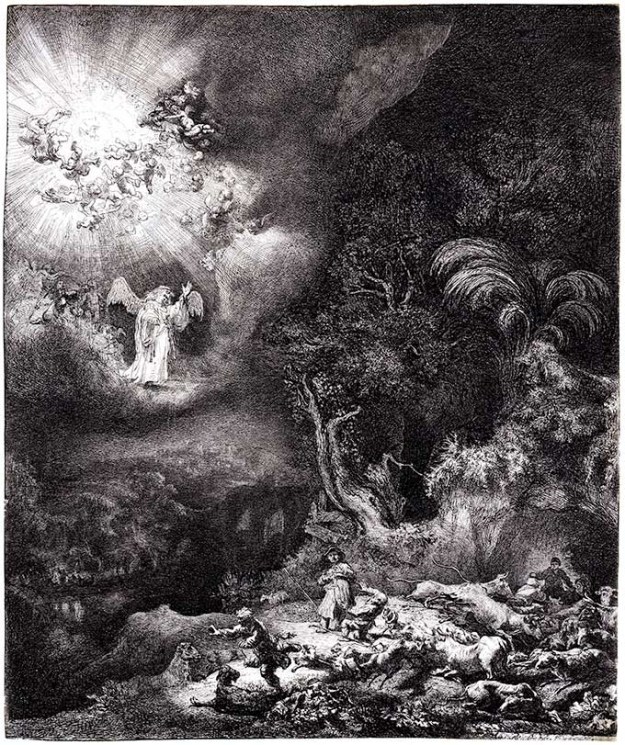
rembrandt-angel-appearing-to-the-shepherds-1634

Rembrandt, “The Angel Appearing to the Shepherds”, 1634


Now there were shepherds in that region living in the fields and keeping the night watch over their flock. The angel of the Lord appeared to them and the glory of the Lord shone around them, and they were struck with great fear.

—Luke 2:8-9


Perhaps the scariest thing to those of us who cling tightly to the things of the world is to accept the job that the Lord assigns us.

Oh, how so many of us are so quick to long for greater adventure!

Yet, when it comes to those humble, little shepherds to whom the angel of the Lord appeared, we are perhaps even quicker to long to be one of them—sitting quietly upon a gentle hillside, effortlessly tending to a passive flock, while the always-full moon provides a soft, ever-so-appropriate illumination from above.

But we are liars. For there’s nothing less romantic in each one of our daily lives, or more mundane. We simply have to be honest, or at least consistent. It all depends on how we look at it. If we see the shepherds in such a delicate light then we also need to see ourselves in the same. For before the angel appears, the shepherds were hardly posing for picturesque landscapes. Perhaps it is for this very reason—their realness, their authenticity, their holy simplicity—that the Lord chose them to be present when He revealed His glory.

It is exciting. We have a wonderful choice, then. Either our “boring” lives make us just the kind of people to whom God prefers to reveal Himself, or our lives are a lot more “exciting” than we ever imagined. Either way, what is vital to making such a decision is true sincerity and genuine gratitude. We need to thank God for who He has made us, for where He has placed us, and for what type of task He has assigned us.

A faithful, humble heart dreams and believes and sees great things among the most ordinary circumstances. Just look at the young virgin and the upright carpenter to whom the shepherds “went in haste” to find in a stable, adoring a child born within the company of the “lowest” of men.

If we spend our time dreaming of being someone else, living somewhere else, and doing something else, we miss the opportunity of being exactly who God intends us to be—and when that happens—we are always in the wrong place, at the wrong time, and most tragically, doing that which matters very little.

For to be the first on the scene, the first to “lay hold”, the first to adore the New Born King, is as good as it gets—even for those whose “normal existence” isn’t standing around all alone—day after day in the scorching sun or biting cold, while picking fleas from matted-down fleece or scaring off hungry wolves.


The angel said to them, “Do not be afraid; for behold, I proclaim to you good news of great joy that will be for all the people…”

So they went in haste and found Mary and Joseph, and the infant lying in the manger. When they saw this, they made known the message that had been told them about this child. All who heard it were amazed by what had been told them by the shepherds.

Then the shepherds returned, glorifying and praising God for all they had heard and seen, just as it had been told to them.”

—Luke, Chapter 2:10,16-18,20


Home Sick

by Howard Hain

I wonder. Did God ever catch a cold?

Did Mary look at Him while He slept, watching carefully His chest rise and fall?

Did Joseph pace around their small home, looking upward, his right hand touching his brow?

I wonder. Did they wince in sync when Jesus coughed from the bottom of His soul?

Was there a day, a single hour, from the moment Jesus was conceived that Joseph and Mary weren’t concerned?

Concerning all this there’s not much to wonder.

Jesus is human.

Of course He experienced “cold” in all its forms.

Of course Joseph and Mary felt they’d rather die than see their child in pain.

And Jesus is divine.

Of course He was homesick.

Of course He longed to return.

Between Mary’s womb and heaven the desert is awfully dry.

He climbed up high, seeking out mountain views.

He returned to the sea, seeking out salt air.

He stopped to hang out with the little ones, seeking out angels.

Jesus is just like you and me.

Only He allows Himself to be loved.

And that led Him to love to the utter extreme.

All flowed from and toward a family reunion.

His pain, His grief, His hope, His love were perfectly ordered.

Even when He coughed or sneezed or tossed and turned, Jesus did so while in the company of a promise.

And He’s extremely contagious.

Joseph and Mary became homesick too.

There’s only one place they could want to be.

With their only child.

Clinging to Him, to their God with all their might.


Little Drummer Boys and Girls

by Howard Hain

Yesterday I witnessed a “dress” rehearsal for a live nativity. The cast was made up of first and second graders, and the audience was mostly composed of residents of a retirement home for religious sisters, Franciscans. It was spectacular.

Last week I was at Radio City Music Hall to watch the Rockettes in their “Christmas Spectacular”. It was quite a production.

Sitting in the dark this morning I cannot help but contrast the two.

I also cannot help but relate to the seven-year old who played the part of The Little Drummer Boy.

As that child walked so slowly toward the foot of the altar, where the rehearsal was being staged, I saw my vocation in an entirely different light.

The children were all singing their hearts out, and many of the eighty and ninety year-old sisters were mouthing the words. The boy with the drum didn’t utter a sound. He just kept walking, slowly, extremely slowly toward the altar, every once in a while ever so slightly pretending to tap two tiny sticks upon a toy drum. He was beautifully awkward.

There was no greater spectacle on earth at that very moment. Shall I dare to say, no greater event that heaven or earth has ever known?

For a child was born. We were all being born.

———

Come they told me, pa rum pum pum pum
A new born King to see, pa rum pum pum pum
Our finest gifts we bring, pa rum pum pum pum
To lay before the King, pa rum pum pum pum,
rum pum pum pum, rum pum pum pum,

So to honor Him, pa rum pum pum pum,
When we come.

Little Baby, pa rum pum pum pum
I am a poor boy too, pa rum pum pum pum
I have no gift to bring, pa rum pum pum pum
That’s fit to give the King, pa rum pum pum pum,
rum pum pum pum, rum pum pum pum,

Shall I play for you, pa rum pum pum pum,
On my drum?

Mary nodded, pa rum pum pum pum
The ox and lamb kept time, pa rum pum pum pum
I played my drum for Him, pa rum pum pum pum
I played my best for Him, pa rum pum pum pum,
rum pum pum pum, rum pum pum pum,

Then He smiled at me, pa rum pum pum pum
Me and my drum.*


Little Drummer Boy was composed by Katherine K. Davis, Henry Onorati and Harry Simeone in 1958.


Howard Hain is a contemplative layman, husband, and father. He blogs at http://www.howardhain.com
 

An Honest Environment

by Howard Hain
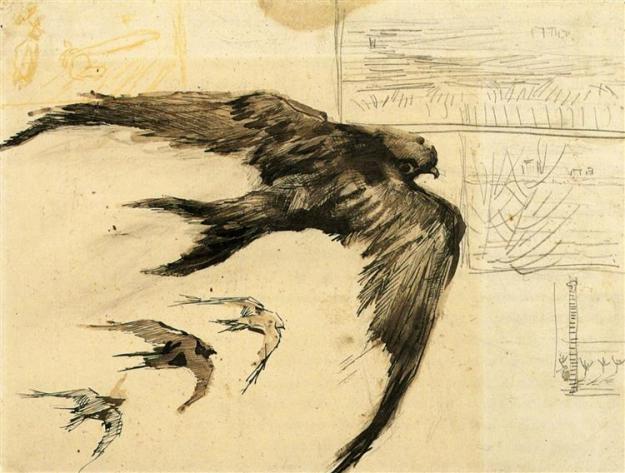
four-swifts-with-landscape-sketches-1887(1).jpg!Large

Vincent van Gogh, “Four Swifts With Landscape Sketches”, 1887


If a child is wasteful, what should the parents do?

Give them more?

More toys?

More snacks?

More disposable goodies?

Should they inflate the number and insignificance of what the child already has?

If the child’s room or backyard is full of waste, scattered remnants of “grown-bored-with” toys and doodads, what’s the answer?

Should the parents implement specific and tedious rules detailing what the child should do and not do in order to preserve the cleanliness and neatness of the home and outdoor space?

Should the parents provide the child with even greater means to continue to live so wastefully, with such little appreciation?

Or maybe, just maybe, the answer begins with the child possessing less, less toys, less privilege—especially when the family budget doesn’t allow for them in the first place—wouldn’t that be more beneficial to all involved?

Maybe if the child had only a few but well-loved toys, the child would be less wasteful, less likely to discard them and negatively affect the family environment?

Isn’t it the same with the overall environment? With the care of the earth and its resources?

If we are really serious about the environment, is the answer really man-made laws from “up high” limiting the freedom of individuals and localities? Or would it be better to begin with embracing a liberating reality that would help foster a more natural and organic conservancy?

Put it this way, if the government actually had to balance the budget, I mean really balance it on an annual basis—spending only what it brings in—and they didn’t continue to print more money (especially when the new “currency” is not based on any real asset, but instead out of “thin-air”) don’t you think that spending on the national level would change?

It would have to, period.

And don’t you think that the debate over what we do spend on would tighten up, become quite serious, efficient, and effective? And don’t you think that on the local level it would be the most freeing? For it would create an environment where individuals wouldn’t be handed false paper to purchase false products (designed to be disposable), and then maybe we’d have a commercial reality that is truly sustainable—where we have perhaps fewer items but items we cherish, are grateful to possess, and protect and care for—goods we wouldn’t just throw away.

Would that perhaps change the pollution problem?

Would it perhaps address our reckless use of natural resources?

In short, no “environmentalist” is serious about the environment (and values individual rights and freedom of local choice) if they do not deal with the biggest polluter of all: runaway debt, rising inflation (with concurrent deflation of valued consumer-driven product), and false and perpetually self-emptying currency.

Because without the false means of consumerism, consumerism would have to return whence it came: nonreality.

For imbalanced budgets, large deficit spending, and reckless printing of currency are the most non-organic, the least natural, and most non-locally-supporting factors concerning the health of our rivers, soil, trees, and, quite frankly, ourselves.

So let’s be real. Real as dirt. Let go of the hidden influences, agendas, and political prejudices, and be serious about what is truly causing waste and environmental destruction.

The truthful alternative is certainly refreshing: an unwavering allegiance to God’s most natural law of truth, beauty, and divine efficiency. For while God is certainly exuberant in His abundance and provision, He is never wasteful. He never lies. He never “cooks the books”.

The Creator of the Universe is honesty to the utmost degree. Pure harmony. Pure integrity. Pure accountability. Not a trace of fallacy or fiction.

If you doubt me, well then just ask the local bird. Ask him if he can borrow against bad credit, if he can feed his babes with worms that are printed merely on paper, and if he ever worries about his offspring buying and buying and throwing out and throwing out—or is it precisely his non-inflated natural resources that actually keep his local environment in harmonious check?

It is as long as some bureaucratic bird, puffed up with unrealistic good intentions (and other people’s money) doesn’t come along promising freebies and handing out nests that he and his other fine-feathered friends pay for with bad credit or currency based on a non-existent reality.

In their bird-brained world, thank goodness, that doesn’t happen. No, birds build their nests in reality. And continue to fly high because of it.

We on the other hand have many among us who try to sell us such false narratives and papier-mâché mansions. They also ironically tend to be the ones who “support” the “environment” the most.

For to discuss global warming, sustainability, and carbon credits without discussing the need for balanced budgets and disciplined currency policy is to be either a fool or a liar—both cases are unsustainable.


Howard Hain is a contemplative layman, husband, and father. He blogs at http://www.howardhain.com
Advent Readings: Week 2

Advent_heading copy 2To reach God’s holy mountain there’s a journey to make, Isaiah says, but guides will show the way. “Behold, I send my messenger ahead of you, to prepare your way.” Mark 1, 1. John the Baptist appears in the desert promising forgiveness  to those washing in the waters of the Jordan River. We have been baptized in the waters of baptism.

The Old Testament readings this Advent week, mostly from Isaiah, describe a desert journey,  but the desert will bloom and a highway will be there, the prophet promises. (Monday) God will speak tender, comforting words to his people on the way. (Tuesday) Those who hope in him will renew their strength, soaring on eagle’s wings. (Wednesday) Though we are as insignificant as a worm, God holds us in his hands and says:“Fear not; I am with you.” (Thursday) God is our teacher and shows us the way  to go. (Friday) On the way, prophets like Elijah accompany us. (Saturday)

Jesus is our way, the gospel readings say. He healed and forgave the paralyzed man– symbol of a paralyzed humanity– who was lowered through the roof into the house in Capernaum. (Monday) Like a good shepherd he searches for and finds the stray sheep. (Tuesday) “Come to me all who are weary, ” he says. (Wednesday) He sends us prophets and guides like John the Baptist and Elijah.( Thursday) Though rejected like John the Baptist, Jesus still teaches. (Friday)

He will save us, even though unrecognized like John and Elijah. (Saturday)

List of Readings

Monday: Isaiah 30, 1-10 The desert will bloom and a highway will be there, a holy way.Luke 5,17-26 The paralyzed man, lowered through the roof, is healed and forgiven.

Tuesday: Isaiah 40,1-11 The desert is a way to the Lord. Comfort my people. Mattthew 18, 12-14 The shepherd searches for the stray sheep.

Wednesday: Isaiah 30,25-31 God is the strength of his people. Matthew 11,28-30   “Come to me all who are weary…”

Thursday: Isaiah 41,13-20   God says, “I will grasp you by the hand. Fear not.”Matthew 11,11-15   John the Baptist is sent like Elijah.

Friday: Isaiah 48-17-19 I teach you what’s for your good and lead you on the way to go. Matthew 11,1-19   John and Jesus rejected as teachers.

Saturday: Sirach 48,1-4; 9-11 Elijah, precursor of John. Matthew 17, 9-13   Elijah and John not recognized.