Category Archives: Inspiration

The Hundred Guilder Print

Artists can be good interpreters of scripture. Rembrandt is one of the best. We’re in the second day of a Parish Mission–Revive, at St. Thomas of Canterbury Parish, Cornwall on Hudson, NY. I’ll be reflecting on some of the teachings of Jesus as he makes his way to Jerusalem from Galilee.

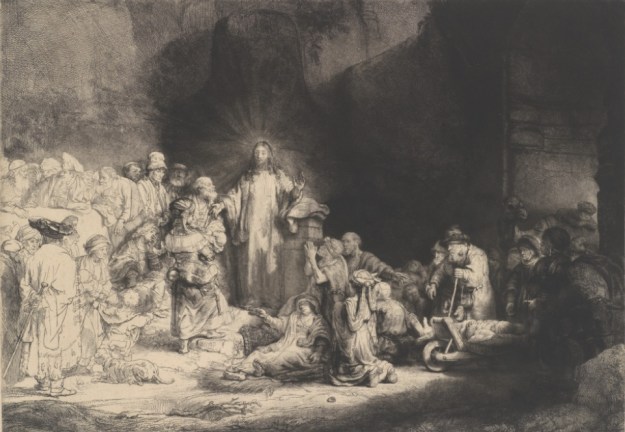
Rembrandt does that in his Hundred Guilder Print, a reflection on the 19th Chapter of Matthew’s Gospel. It’s an inspiring portrait of Jesus calling poor humanity to himself. He is our Savior.

The Guide Back

This Wednesday’s Gospel ( Jn 16: 12-15 ) our Lord continues to tell His disciples about the Holy Spirit.

“ I have much more to tell you, but you cannot bear it now. But when He comes, the Spirit of truth, He will guide you to all truth,. He will not speak on His own, but He will speak what He hears, and will declare to you the things that are coming. He will glorify me, because He will take from what is mine and declare it to you. Everything that the Father has is mine; for this reason I told you that He will take from what is mine and declare it to you.”

Lately I am suffering from a slight disconnect with my intimate friend, Jesus. It’s as if I “ cannot bear “ what He has to tell me. So many outside problems seem to stand in the way of my prayer. Yet I know that Jesus is with me all the time, even when I find myself pushing Him aside. Thank heavens for the word of God. When I read today’s short Gospel as if Jesus is personally talking to me, I am filled with hope and consolation.
Jesus seems to tell me that even though lately our dialogue seems lacking, He is sending His Spirit to help out. First of all the Spirit guides us back to the Truth of God’s love for us. Never mind all the illusory lures and complications of this life, The Spirit enables us to see that God is the ultimate truth, the rock upon which we truly stand.
The Spirit of God will speak, perhaps in a whisper, the advice of a friend, or the song of a sparrow. He will make me hear what is important. He declares what is important to look out for. In His own time the Spirit will even once again let me feel the Glory that is God. He will take this Glory of Jesus, and therefore, of our loving Heavenly Father,and His own,  and show it to me. He will declare it.
All I have to do is find that moment of quiet and simply listen, because, Jesus, no matter what is troubling me, I trust in You. Because You trust in me. You do not give up on me that easily! Your Holy Spirit tells me so.

Orlando Hernández

Thoughts Upon The Cross: Bold Humility

by Howard Hain

.

We should always strive to be fully united with The Body of Christ, in both thought and prayer. To think prayerfully, and to prayerfully think.

Let us then prayerfully embrace this particular moment:

Lord God, Father Almighty, let us use the talents, the gifts, and the abilities—that come from You, that will return to You, but that You have lent us for the time being—with maximum effectiveness, maximum efficiency, and bold humility—all for Your glory.

In the name of Jesus—in the person of Christ—as the Messiah Himself would offer.

Amen.

———

Now, let us think, prayerfully.

What is “bold humility”?

Let’s explore an answer, slow and steady.

First, like all manifestations of God’s glory, “bold humility” is a matter of transcendence.

Second, transcendence is not merely a type of balance. Balance is something else entirely. It is something less than divine. Balance is a man-made religious concept. It is practical human philosophy at work in the world, depending on and functioning within human limitation. Unlike transcendence, balance does not stem from the theological posture of divine providence, and more so, it does not rely on the acknowledged power and faithful acceptance of divine grace.

For example, with regard to the matter at hand, “bold humility” is not merely the balancing of boldness and humility—it is not a matter of being equally bold and equally humble—as if on a scale of 1-10, a score of 5 for boldness and a score 5 for humility is achieved simultaneously—adding up to 10 and at the same time keeping the “seesaw” of virtue straight and parallel to the earth lying below.

No, “bold humility”, like all Christian (and therefore preternatural) virtue is not a matter of equally limiting each natural characteristic in order to fit them all within the confines of human potential and logical limitations.

In plain language then, “bold humility” is not simply a healthy combination of two virtues, namely “boldness” and “humility”.

And most directly to the point: Christ didn’t balance. He transcended.

Then what does transcendence mean in this supernatural sense?

Well, let us rule out a few more false understandings before positing a possible positive understanding.

It will prove helpful to also establish this negation: To transcend is not merely to eliminate. Nor is it merely to deny. By transcending one does not destroy the categories it transcends. So in this particular case we can say that “bold humility” does not “eliminate” or “deny” the category of “boldness” or the category of “humility”.

Now let us begin to state positively what Jesus accomplished—for Jesus most certainly transcended.

To transcend is to rise above and beyond. It is to journey through. It is to transform.

Transcendence fulfills the “categories” it leaves below—it completely and utterly fulfills each and every virtue that man could ever conceive—and not only at the same time or simultaneously, but eternally and to a maximum degree. Transcendence is perpetual fulfillment of all “goodness” to an infinite “degree”.

Transcendence is then what we might call: Active Shalom.

It is living, breathing “Fullness”. It is “True Peace”. It is “Oneness” and the “Unity of God”—alive and constantly in motion. For to transcend is also to enter and live within the Internal Consistency of The Eternal Creator Himself.

Transcendence is the ultimate simplicity of “I AM.

It is Ipse Christus—Christ Himself—God made man, the Word made flesh, the magnificence of God brought into visible light.

And it is human redemption at work.

For the person of Jesus is just that: He is the glory of God woven into and through the very fabric of humanity—taking humanity above and beyond itself—transforming it on earth and simultaneously bringing it back with Him to the Father in heaven—as a new, glorified, and righteous form.

Jesus both lifts humanity into heaven and manifests fully God’s glory on earth.

Bold Humility” is Jesus Himself.

He alone fulfills completely both “boldness” and “humility” without ceasing.

And by doing so He straddles two worlds—making them one. But yet He is much more than a bridge, much more than a mere mystical ladder. Jesus, if you will, is Jacob’s Ladder but built of human flesh—upon Whom not only holy angels ascend and descend between heaven and earth—but through Whom the very helix of humanity is redeemed and glorified.

———

But enough words.

For they can never capture.

Jesus is profoundly free.

The best we can hope for is a glimpse—a fleeting image of the living, breathing manifestation of “Bold Humility” in ultimate action.

It takes silence.

It involves leaving the senses and faculties behind.

It requires “spirit and truth”:

We must stare at The Cross.

We must experience—firsthand—The Crucified Christ.


..

Let us then pray once more:

Lord God, Father Almighty, let us use the talents, the gifts, and the abilities—that come from You, that will return to You, but that You have lent us for the time being—with maximum effectiveness, maximum efficiency, and bold humility—all for Your glory.

In the name of Jesus—in the person of Christ—as the Messiah Himself would offer.

Amen.


.

.

Thoughts Upon The Cross: Act Like A Man

by Howard Hain

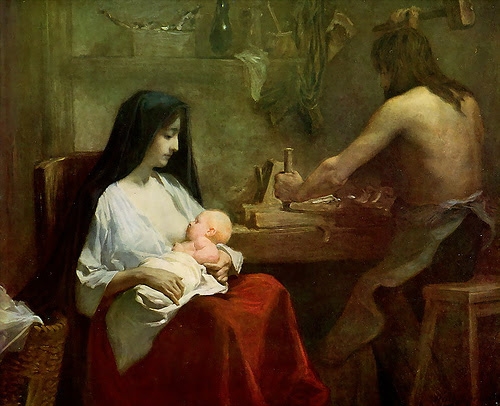
saint joseph, holy family.

To all men it may concern (definitely including me):

.

Complaining is not strength.

It is actually quite unbecoming, to say the least.

In fact, it can easily become extremely boring.

And when it spills forth from the mouths of men who are appointed to lead, it manages to take on a whole new level of tediousness.

It becomes outright pathetic.

Of course, I am not talking about having private conversations with friends or colleagues, the kind of back and forth that can often strengthen and give great consolation. No, that falls under fellowship, under spiritual friendship. In those situations, practicing vulnerability and allowing oneself to be seen as truly struggling is actually a sign of strength.

What I am referring to are those too-often times when “leaders” openly and repeatedly complain in front of the very people they are chosen to lead and inspire—in front of the very people they are chosen to protect, guide, and encourage. Or to put it in more spiritual and pastoral terms—in terms of the “Good Shepherd” if you will—instead of feeding their sheep a sense of hope, a sense of security, and a sense of peace, the shepherds themselves cultivate and offer their flocks an atmosphere of worldly concern, a stream of ongoing despair, and a diet of downright near hysteria.

It is so embarrassing.

And the scope is broad, for appointed “leadership” comes in many forms: public officials, all kinds of employers, managers, politicians, coaches, pastors, administrators, teachers, and most certainly, and perhaps most significantly, every married man and father in the world.

God have mercy on us.

Forgive us our many failures.

Especially for us Catholic Christians, called to imitate in a special manner the Crucified Christ.

And this isn’t simply a matter of ever-changing public opinion. No, it’s a matter of being inherent in the very idea of leadership itself.

Shepherds lead, sheep follow.

Think about it, when was the last time you saw an artwork depicting a small group of little lambs carrying a full-grown living breathing Jesus?

Needless to say, never.

And in terms of practical and applied philosophy, let us then keep this significant and relative reality in mind: When it comes to real and everyday concerns, chances are that the most grueling day for most of us modern men is only as difficult as the normal, run-of-the-mill, daily employment of a mother of three—not to mention if that mother is also working full-time, single, in an abusive relationship, and/or barely speaks English—then it’s no contest—and in our current “ever-progressive” society, these conditions unfortunately too often apply.

So, if this not-so-gentle “correction” applies to you (as it most certainly applies to me) know that many are praying for us, many feel for us, many love us, many even need us, but we need to do our part:

Act like a man.

For sake of Christ.


.

Let us pray:

Lord God, Father Almighty, Creator of heaven and earth, we give you praise. Help us Father, help all men, all those called by You to lead. Help us to follow the only True Man, Your Only Begotten Son, Christ Jesus—our Lord and our God, and living Innocence itself. May we follow Him and Him alone, so we may be properly equipped—emotionally, physically, and spiritually—to lead those You have entrusted to our care. Make us strong and patient, courageous and persevering. Let us learn through the example of Saint Joseph the true meaning of humility, obedience, and selfless sacrificial service. Teach us to cherish silence and value greatly the grace of a truly developed interior life. Inspire us to love our wives and children with sincerity and integrity and profound gratitude. And when need be, Heavenly Father, show us how to be truly decisive, how to act with boldness in defending Your truth, and how to be utterly fearless in helping rescue those crushed by injustice and hypocrisy.

In all matters may we always do Your will and act on Your behalf—with minds made spotless, hearts made pure, and bodies kept chaste.

We ask this in the name of Jesus, in the perfect unity of the Holy Spirit, for Your endless glory.

Amen.


.

.

Thoughts Upon The Cross: Speak Life

by Howard Hain

Sandro Botticelli, The Last Communion of Saint Jerome, early 1490s (detail)

Botticelli, “The Last Communion of Saint Jerome”, early 1490s, (detail), The Met


.

Heal us.

In the form of bread.

Our tongues like cribs.

You come to rest.

A sacred place.

A mother watches.

A father can hardly believe.

Greatness simply conceived.

Silent.

Yes let us be.

Help us not to speak.

No words can be.

No thoughts except those that flee.

Yes.

Hold our tongues.

Into quiet place.

Stillness.

Let us wait.

Till hear You cry.

A hungry child.

Tucked in for night.

A drop of milk.

In reality blood.

In the form of wine.

The angels sing.

Holiness explodes.

Heaven down to earth.

Saints to and fro.

Blessings forth.

Grace abounds.

The sick are healed.

The blind can see.

The lonely find friends.

Children unwanted?

They finally reach home.

We look.

We see.

We wonder.

How could it be?

It’s Him!

It’s Him.

Right there.

The One nailed to the tree.

Alive again.

Within my mouth.

And at my right hand.

And to the left.

And straight ahead.

And there!

Yes, there too!

In that hopeless situation.

We thought all was lost.

But, no, it’s Him.

He really does care.

And He calls us over.

To Himself.

And yes.

Silence changes forms.

It’s again time to speak.

What else can we do?

The Eternal One.

The Son of Man.

The Conqueror of Strife.

Let us smile at one another.

Let us speak life.


.

http://www.metmuseum.org/art/collection/search/435728

..

Thoughts Upon The Cross: The Imitation of Christ

by Howard Hain

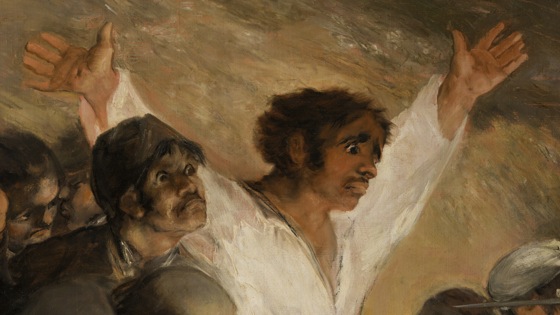
Francisco Goya, The Third of May, 1808 in Madrid, 1814-15 (detail), oil on canvas, (Museo del Prado, Madrid)

Francisco Goya, “The Third of May, 1808 in Madrid”, 1814-15 (detail)


.

I hear, ironically mostly among clergy, that the spiritual classic “The Imitation of Christ” is no longer really relevant—that it is too hard, too negative, too oppressive—written for a time when plagues and famines and wars were rampant, when men hardly lived to what we now call “middle age.” But most of all, perhaps, I am told through cute smirks and smug expressions that it is a book not for our “age”, that it no longer applies to our advanced “civilization”, that it no longer rings true in the triumphant “West”.

I ask: Are we free of plagues, free of war, free of famine?

Are not our priests and religious sisters dying off rapidly? Are not babies systematically massacred inside their mothers’ womb? Are not children starving for their fathers to marry their mothers, for there to be a man who actually lives in the same home?

Do we no longer thirst?

Or have we “moved passed” Christ’s inconvenient cry from the Cross?

It seems to me that Christ Himself put little value on living past “middle age”.

Perhaps imitating Him would not be such a barbaric idea.

Lord, have mercy on us.


.

Francisco Goya, The Third of May, 1808 in Madrid, 1814-15 , oil on canvas, (Museo del Prado, Madrid)

Francisco Goya, “The Third of May, 1808 in Madrid”, 1814-15, oil on canvas, (Museo del Prado, Madrid)


.

Thoughts Upon The Cross: A Child Named Marriage

by Howard Hain

.

“This is why a man leaves his father and mother and becomes attached to his wife, and they become one flesh.”

—Genesis 2:24


.

Shouldn’t we ask the Lord to purify our flesh?

And if we should, shouldn’t we ask Him to purify all our flesh?

The answer seems obvious. Yet, it has tremendous and exceedingly beautiful consequences—consequences that are too often divorced from day-to-day reality.

For just as we ask the Lord to purify our flesh, we should also ask Him to purify our marriages. Or do we not really believe that bridegroom & bride become “one flesh” once they become husband & wife?

The answer, between you and me, should be a resounding: “I do.”

———

Just as we ask for our bodily flesh to purified, those of us who are married need to ask for our “marital” flesh to be purified as well. By doing so we send the Lord a birth announcement—for before we were married the “one flesh” of marriage that now exists within a specific time and place of human history only existed in the mind of God. In earthly terms, what existed in potentiality did not yet exist in actuality, what was possible was not yet real, or to put it yet another way, the divine idea was not yet “incarnate”—the marriage was not yet “made flesh“.

But once the seal of the sacrament drifts down “like the dewfall” upon the divine idea, a new life, a new flesh, a new “being”—a living, breathing “child” named marriage—comes into existence—just as with an individual child, who exists only in the mind of God but then comes into physical reality at the moment of conception, at the permanent merger of sperm and egg.

Therefore, just as with a “real” child—especially an infant—shouldn’t we be boundlessly gentle, soft, kind, patient, tolerant, and self-sacrificing with a new marriage? And no matter how “old” the marriage becomes, shouldn’t we also remember that it is always a child, a new creation of God spawned from the union of two committed souls vowing unity and oneness, all for the greater glory of God?

More so, shouldn’t a child named marriage, as with any child, be treated as an offspring of God’s grace, and therefore as something we do not own or possess but instead as something we have been appointed to steward—to care for and nurture as God Himself wills and directs?

“Yes”, “Yes”, and “Yes”, to all of the above.

So next time you’re about to yell at each other, remember: Don’t wake the baby!

———

And that’s the crux of it, isn’t it? It’s not about you anymore.

No, there’s a new life in your hands—and just imagine what good parents we’d all become for our “actual” children if we first practiced parenting on the very marriage that begets those precious babes?

———

One more thought, if we can’t apply purification to the “one flesh” of earthly matrimony, what makes us believe we will ever be properly prepared for the ultimate wedding feast to come—that feast of all feasts—that day, that hour, when the Eternal Bridegroom, Christ Jesus, will come for His bride, The Universal Church?

For if we are truly within Christ’s Church shouldn’t we be preparing ourselves to be beautified mini-brides within the One, Holy, and Universal Bride?

Let us prepare.

Let us practice.

Let us not be left at the altar.

And let us start today: For God has birthed a mini-book of revelation, and its name is your marriage—a living, breathing, child of God.

———

And for those not married, the lesson still applies, for shouldn’t all close relationships, if not all relationships, be treated as precious infants, full of promise and hope, as clean slates, or better yet, as new, purified flesh?

Yes, they should, for it is no longer simply between the two of you—it is about “a new creation” floating among and above you.


.

“What came to be through him was life, and this life was the light of the human race…”

—John 1:3


.

.

Thoughts Upon The Cross: The Fiddlehead

by Howard Hain

.

“Oh Thou, before whom all words recoil…”

—Shankara, 8th century Hindu philosopher and theologian

.


.

Truth is Truth is Truth.

Find it where it’s planted. Find it where it grows. Find it where it bears fruit.

Find it in the soil. Find it in the stem. Find it in the apple.

Throw it in the air

Launch it toward the sky

Watch it turn back

See it return to earth

Up, up, and away…

When the cat’s away the mice can play…

It’s a bird…

It’s truth…

It’s not to be held by any man.

———

“Holy, Holy, Holy…”

“Heaven and Earth are Full of Your Glory…”

“Hosanna in the Highest!”

———

Try, try, and try again…

We adore

We praise

We acclaim

We toss up

We watch rain

Back upon us

Our own words fall

Down, down, down…

“Oh Thou, before whom all words recoil.”

———

The strongest heart

The loudest cry

The hardest throw

All fall short

Thus Beauty smiles

For even in failure

Praise and Grace

Go hand in hand

With growth and motion

And a music man

For what goes up

Must come down

To leave a wake

A delightful shape

No man may make

Nor no violin display.

———

A fiddlehead

A fern

A plant

A plan

A play

Upon which

All Truth

All Beauty

All Joy

On full display.


.

“Oh Thou, before Whom all words recoil…”

“…hallowed is Thy name…”

.


.

Thoughts Upon The Cross: Black Ashes, Red-Hot Coals

by Howard Hain


marc-chagall-the sacrifice-of-isaac-1966 detail

Marc Chagall, “The Sacrifice of Isaac”, (1966), detail

.

When it was already dawn, Jesus was standing on the shore; but the disciples did not realize that it was Jesus.

When they climbed out on shore, they saw a charcoal fire with fish on it and bread. Jesus said to them, “Bring some of the fish you just caught.”

Jesus said to them, “Come, have breakfast.” And none of the disciples dared to ask him, “Who are you?” because they realized it was the Lord.

—John 21:4,9-10,12

———

When is it that we break-fast?

Perhaps it is at morning Mass, when the long night of daily winter is slowly burned away by “the dawn from on high”.

Perhaps it is there, at the altar of our Lord, at the breakfast table of our one united body, that we come to see the Crucified Christ truly risen and waiting for us, “standing on the shore”.

We take so much for granted, so much we just assume is already prepared, without giving much thought to just how much goes into each meal. But we are in good company, Peter and the rest of the apostles, like us, come to a meal already in progress.

And just as Jesus called the apostles to a new morning meal, He calls each one of us each new day to a meal prepared ahead of time—in fact it was ordained a long, long time ago—for even upon those hot coals which the apostles approached two millennia ago, fish were already waiting.

It is to this ongoing meal that He asks all apostles to bring their fish, their most recent catch—to add to the fire—to the feast ever being prepared for those still yet to come.

The Fisher of Men, who calls others to become fishers as well, asks His disciples to contribute not only their earthly catch but the eternal offering of themselves.

But who is it that we find already lying upon the charcoal fire, upon the table of the Lord, waiting for us each morning as we approach the altar with our daily catch?

Is it not all those who have walked in faith before us? Is it not the communion of saints, the cloud of witnesses, the community of believers?  Is it not those who pray in silence this very day for the conversion of sinners, the salvation of souls, the release of those in purgatory, the return to a unified Church?

Is it not those who suffer each and every day for the sake of Christ?

We will never really know exactly who, at least not while we walk within these “earthen vessels” we call bodies—not while we continue our pilgrimage through this valley of tears and wage our military-like mission against the powers of darkness.

We will never know while here on earth just how many fish are laid upon the fiery altar each new day, just how many join Jesus in His one perfect offering, just how many “share in his glory” because they “share in his suffering”.

But God does know, and he orchestrates it all. He knows exactly how many, and who. He misses not a tear, not a moan, not the slightest prick of a pin. He knows each and every one of His silent, unknown martyrs—those whose suffering “completes” what is “lacking in Christ’s afflictions”.

The Mystery. The Love. The Wisdom of the Cross. The Grandeur of God’s Salvific Plan. Praise be to God. Praise be to Christ Crucified and Risen. Praise be to the Holy Spirit: “O font of life! O fire of love!”

Let us then join the breakfast feast.

And let us not only eat but add to the meal.

Let us offer up all our “prayers, works and sufferings of this day in union with the Holy sacrifice of the Mass throughout the world…”

And let us dare to wonder with true childlike joy and adoration. Let us wonder who it is that is already laid upon those ancient coals as the apostles approach that gloriously simple meal on the shining shore of a most placid sea.

Is the fish already in place Jesus Himself? Jesus who is priest and sacrifice and altar?

Yes. Of course it is Him.

But perhaps it is someone else too.

Perhaps among that first batch of fish is also the first follower of Christ: the first to surrender all “possessions”, the first to pick up the cross daily, the first to follow Jesus through the completion of His Passion.

Yes, perhaps it is Mary, His mother, His first disciple…our mother and the queen of all apostles. And perhaps it is also that “upright” man whom Jesus Himself saw as a father, the “righteous” Joseph who suffered so much in the name of Jesus. Perhaps that first batch contains all three: Jesus, Mary, and Joseph, that most blessed of families—The Holy Trinity “made flesh”—The One Triune God dwelling in a humble hut in a little town named Nazareth.

In that sense, perhaps that first batch of fish is also you and me, your family and mine—and perhaps then “our” little “sacrifice” is already being offered up, right here in each of our “humble” homes and within the boundary lines of our own “Nazareths”.

Perhaps that first batch is waiting to be joined to all other offerings, to be joined together with all the other individuals and families that are called to be a “living sacrifice”.

Perhaps that first batch is within each one of us and is longing to be united to the one true sacrifice—the sacrifice of God’s crucified love, eternally offered upon the white-hot coals of God’s infinite charity.

———

Another angel came and stood at the altar, holding a gold censer. He was given a great quantity of incense to offer, along with the prayers of all the holy ones, on the gold altar that was before the throne. The smoke of the incense along with the prayers of the holy ones went up before God from the hand of the angel. Then the angel took the censer, filled it with burning coals from the altar, and hurled it down to the earth…

—Revelation 8:3-5


.
Walking With The Lord

In Wednesday’s Gospel(Lk 24: 13-35) we experience the beautiful story of the Easter apparition of the resurrected Jesus to the two downcast disciples, probably fleeing Jerusalem, on the road to Emmaus. They share with the mysterious stranger ( our Lord ) their disappointment with the Passion and death of their Master. Jesus teaches them about the Scriptures in order to make them see why it was ” necessary that the Christ should suffer these things and enter into His glory.”
They urge Him to stay with them and have dinner with them. Here our Lord performs yet another Eucharistic celebration:

” And it happened that, while He was with them at table, He took bread, said the blessing, broke it, and gave it to them. With that their eyes were opened and they recognized Him, but He vanished from their side. Then they said to each other, ‘ Were not our hearts burning within us while He spoke to us on the way and opened the Scriptures to us? ‘ ”

The story of the Road to Emmaus has a powerful, special meaning to me. In the winter of 2012 I went to my first Emmaus retreat, a phenomenon  similar to Cursillo, but with a special focus on this Gospel of Luke.
In the previous year I had seen my wife Berta fall in love with God, during Fr. Vincent Youngberg’s mission in Florida. We finished our RCIA program in Bayside, N. Y. and were able to receive the Sacrament of the Eucharist with God’s whole blessing. That same summer we celebrated the Sacrament of Matrimony after being civilly married for 25 years. That fall we visited the Holy Land, and we were overwhelmed by the anointing experience. We also went to our first retreats at the Passionist Spiritual Center in Jamaica, NY.
I was so full of love for God that my heart felt like a furnace . When I went to Florida to spend the winter I thought there was nothing else left to bring me closer to Jesus.
Then, at St. Matthew’s Church in Hallandale, FL, a smiling man gave me a brochure advertising the ” Emmaus Retreat Experience” coming up in a week. I had no idea what it was about . I knew about the story of Emmaus in the Gospel of Luke, but I did not have a particularly strong feeling towards it. Nevertheless I got this crazy urge to go, and my wife actually said “Yes”.
It was during this weekend retreat that I became a disciple of the Lord, a servant of God.
We were only 20 retreatants, but there must have been about 70 lay people and some priests serving us as cooks, waiters, cleaners, organizers, table companions, musicians, prayer guides, and presenters. They called themselves “Emmaus Brothers”. I could not believe the joy and love that I was seeing all around . These were disciples of Christ, like the ones in the Bible! During the fantastic meals as many as three or four of them would eat with us and share their lives with us. Jesus was sitting there at the table as we would bless the bread and share it in fellowship. The presentations were Scripture-based, and courageous in their sincerity, as they shared their painful redemptive stories with us. There was so much more. The main them was how much God loves us, no matter what we have done in our pasts.
The last night, after a presentation on faith and confidence in God, they blindfolded us and turned out the lights. Carrying flashlights one Brother after another would pick up one of us from our seats and take us on a ” trust walk” to our next culminating experience.
I was freezing in that chair as I waited to be picked up. The air conditioning was just too high. They would take one retreatant after another except me. I felt as if I was being left behind. Perhaps I was not worthy. God had forgotten about me. I was perturbed and afraid.
Then suddenly I heard a young man’s voice saying, ” Have confidence in your Emmaus Brother. Don’t be afraid.” and he held me by the elbow and guided me through the darkness, turning corners, and going down hallways and steps until we were outside. I felt the warm night breeze. There were whispers all around and even fireworks somewhere in the city. Suddenly I felt this great peace. I was sure that Jesus Himself was holding me by the other arm. I felt His closeness. I felt His love. I just knew that He would never leave me.
Many more wonderful, holy things happened which I cannot talk about. All I know is that when the retreat ended our hearts were surely burning. We had all cried and laughed together that weekend. We had become like family, the family of Jesus. Like the two disciples in the Gospel we ran back into our lives to announce to the world that Christ lives ! I knew that I would always serve Him, even unto exhaustion. I joined the Brotherhood under the auspices of St. Joseph’s Parish in North Miami Beach, and served on ten retreats over the next four years in various capacities.
Back in NY, along with my wife Berta, I looked for every opportunity to serve the Kingdom of God. Some wonderful Passionist priests have advised me to slow down a little and ” take it easier “.  I’m not that young.
I keep in touch with my Emmaus Brothers in FL and surely miss them. By the way, when we meet each other somewhere, our greeting and our motto is

“JESUS CHRIST IS RISEN !”
” HE IS RISEN INDEED! ”

Orlando Hernandez