Category Archives: contemplation

The Journey to Jerusalem

Jesus begins to set out for Jerusalem in today’s reading at Mass from the 10th chapter of Mark’s gospel. Matthew offers a similar account in the 19th and 20th chapters of his gospel.

Jesus doesn’t go to Jerusalem alone, he invites others to go with him. It’s a journey to resurrection and life and more than a couple of days, but as they hear Jesus describe the way to Jerusalem, people react like people do,

You can’t miss human weakness in the journey stories of Mark’s and Matthew’s gospel, beginning with the Pharisees. I suppose they represent human doubt and questioning that’s always there. The disciples rebuked the women bringing their children forJesus’ blessing, and Jesus rebukes them. Be like children to make the journey, Jesus tells them.

The rich young man wants to hold on to what he has, so he goes away sad. Peter says proudly he’ s given up everything to follow Jesus, but we know how inconstant he is. The story of the brothers, James and John, is obviously a story of human ambition.
1 Hundred Guilder Print
Rembrandt Hundred Guilder Print

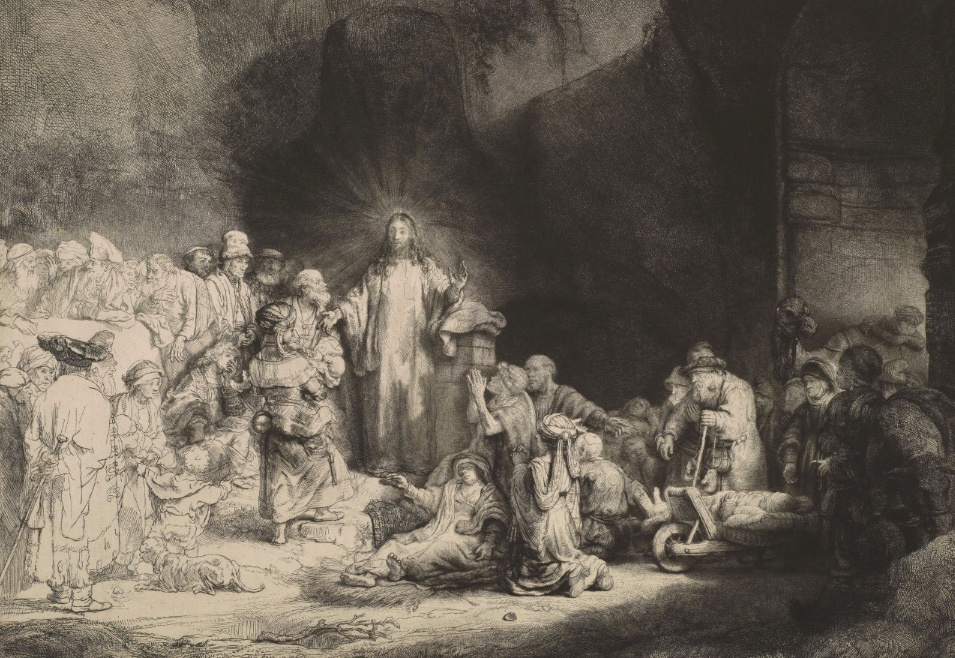
Matthew offers Mark’s stories in chapter 19 and 20 of his gospel. The artist Rembrandt drew a remarkable picture of the 19th and 20th chapter of Matthew called the Hundred Guilder Print.

Jesus stands at the center of Rembrandt’s work, bathed in light, his hands outstretched to the crowds before him.

Peter stands at Jesus right, close by. Other disciples, probably James and John, are next to him. Women and their children, whom the disciples told to go away, are next to them. The rich young man is also there in the crowd. Is he reconsidering?

Some of the enemies of Jesus who plotted against him and argued with him are also there, talking among themselves, but they’re still in the picture. Rembrandt even pictures the camel, back by the city gates.

Jesus sheds his light on them all. His arms are open to them all. Rembrandt has it right. Grace is more powerful than human weakness. It’s everywhere.

Facing “Unclean Spirits”

Edvard Munch: The Scream


When Jesus and his disciples cross the sea into pagan territory– an important new step in his ministry– they meet a man in the tombs and Jesus drives the unclean spirit out of him. (Today’s reading: Mark 5, 1-20) 

Throughout  his ministry “whenever unclean sprits saw him they would fall down before him and shout, ‘You are the Son of God.’ (Mark 3,11) Unclean spirits were favorite targets for Jesus in his ministry.

What’s an “unclean spirit”?

In their fine commentary on Mark’s gospel John R. Donahue, SJ, and Daniel Harrington, SJ, say “In this context ‘unclean’ (akatharton) primarily connotes not a moral (even less a sexual) fault), but something opposed to the “holy.” In the command of the Old Testament to be holy (Leviticus 11,44) it implies life, wholeness and completeness,( Leviticus 21, 17-21) whereas uncleanness implies something that should not be, something out of place ( e.g. soil in a farmer’s field is productive, while in a house it’s dirt). The opposite of the realm of the holy is the demonic, hence the spirits there are “unclean”. Physical defects or psychological aberrations can make a person “unclean”in a sense of incomplete, imperfect and out of order.”
(The Gospel of Mark, Sacra Pagina, Liturgical Press 2002 page 80.)

Jesus did not focus on the intellectual establishment or the religious establishment in his ministry. He engaged the chaotic world of the “unclean spirits.” He set up a “field hospital” to use a phrase dear to Pope Francis.

That can be a messy, scary world, as we see in Mark’s gospel. Just think of the poor man in the tombs, chained and hurting himself. Who wants to deal with him? But Jesus gives his disciples “authority” over unclean spirits. His followers have the power to take them on.

Jesus commissioned  his apostles for this ministry. He summons “the twelve and began to send them out two by two and gave them authority over unclean spirits.” (Mark 6, 7) We’re not out of place in our chaotic world today.

A Church with a Mission

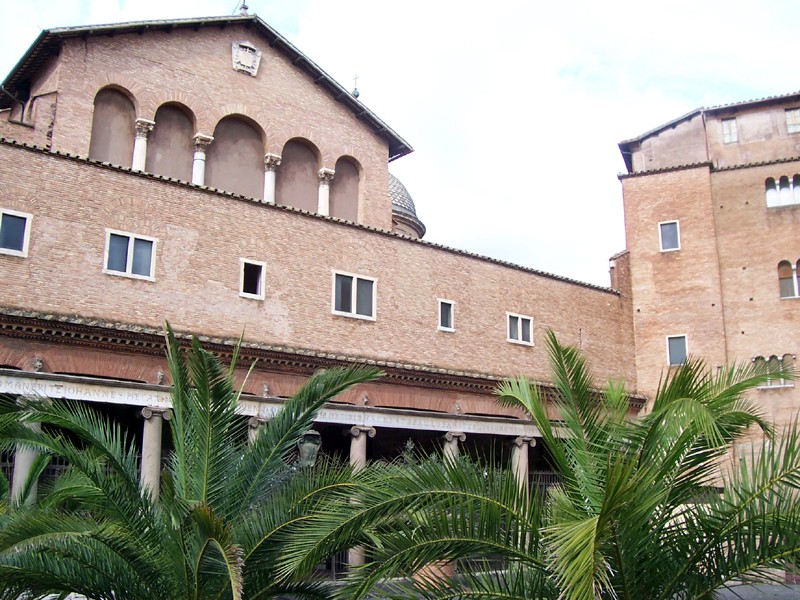
241SsGiovanniPaolo

Ss. Giovanni e Paolo 

A few days ago we celebrated the feast of St. Jerome, the great 4th century scripture scholar and controversialist. I’ll be staying through October in a place well known to him in Rome– the Caelian Hill and the church of Saints John and Paul.

In Jerome’s day Rome’s rich and powerful lived on the Caelian Hill, across from the Palatine Hill and the Roman forum. Jerome had prominent friends among them. Pammachius, the ex- Roman senator who built Saints John and Paul, the noblewoman Paula and her daughter Eutochium, who later joined Jerome in his venture in Bethlehem to study the scriptures, her other daughter Blaesilla and others.

Interest in the scriptures ran high among well-off Caelian Christians then, but they also were keen for gossip and religious controversies. Jerome loved the scriptures, but he also loved the fight. His relationship with Paula and her family was part of the gossip that  probably figured among the reasons he left Rome for the Holy Land. Following him there, Paula created a monastic community in Bethlehem and she and her daughter undoubtedly played  a bigger part in Jerome’s scriptural achievements than they’re credited for.

Jerome’s a saint, but I appreciate why so many artists picture him doing penance for his sins. He needed God’s mercy.

FullSizeRender

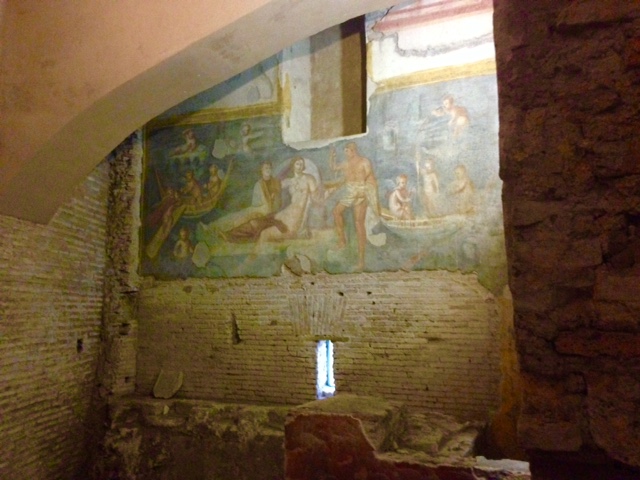
Excavations, Saints John and Paul

Underneath Pammachius’ Church of Saints John and Paul are remains of Roman apartments going back to the 2nd-4th centuries, probably the best preserved of their kind in the city and a favorite for tourists.

Years ago, when I studied here, one of the rooms in the excavations was pointed out as part of a house church with Christian inscriptions , now archeologists are not so sure.. That doesn’t mean Christians didn’t meet or worship in these buildings, only they didn’t create a special liturgical space for meeting or worship.  Christian evidence, however, says a “house church” was here early on.

Why then did Pammachius in the fourth century build the imposing basilica of Saints John and Paul here on the edge of the Coelian Hill facing the Palatine Hill and the Roman forum ? Many retired soldiers settled on the Caelian Hill then. Did he wish to win them to Christianity through the example of two soldier saints, John and Paul, who were honored in this church? Their remains are still found under the church’s main altar today.

Is there another reason? According to Richard Krautheimer, an expert on Rome’s early Christian churches, the emperor Constantine built St. John Lateran, St. Peter, St. Paul, St. Lawrence, the first Christian churches, on the edge of the city most likely in deference to the sensibilities of the followers of Rome’s traditional religions. He didn’t want any Christian church in the “show areas” of the city, near the Roman forum or the Palatine hill.

Saints John and Paul, Interior


By Pammachius’ time Christianity was more assertive. Was Pammachius’ church a statement to the city that Christianity had arrived and wished to speak its wisdom here at the heart of traditional Roman religion, near the Palatine Hill and the Roman forum? Jerome’s new translations and commentaries, along with the works of St. Augustine and others, gave them something to say.

So was this a church with a mission? A lesson for the church of today? Speak to the world of your time.

DSC01053

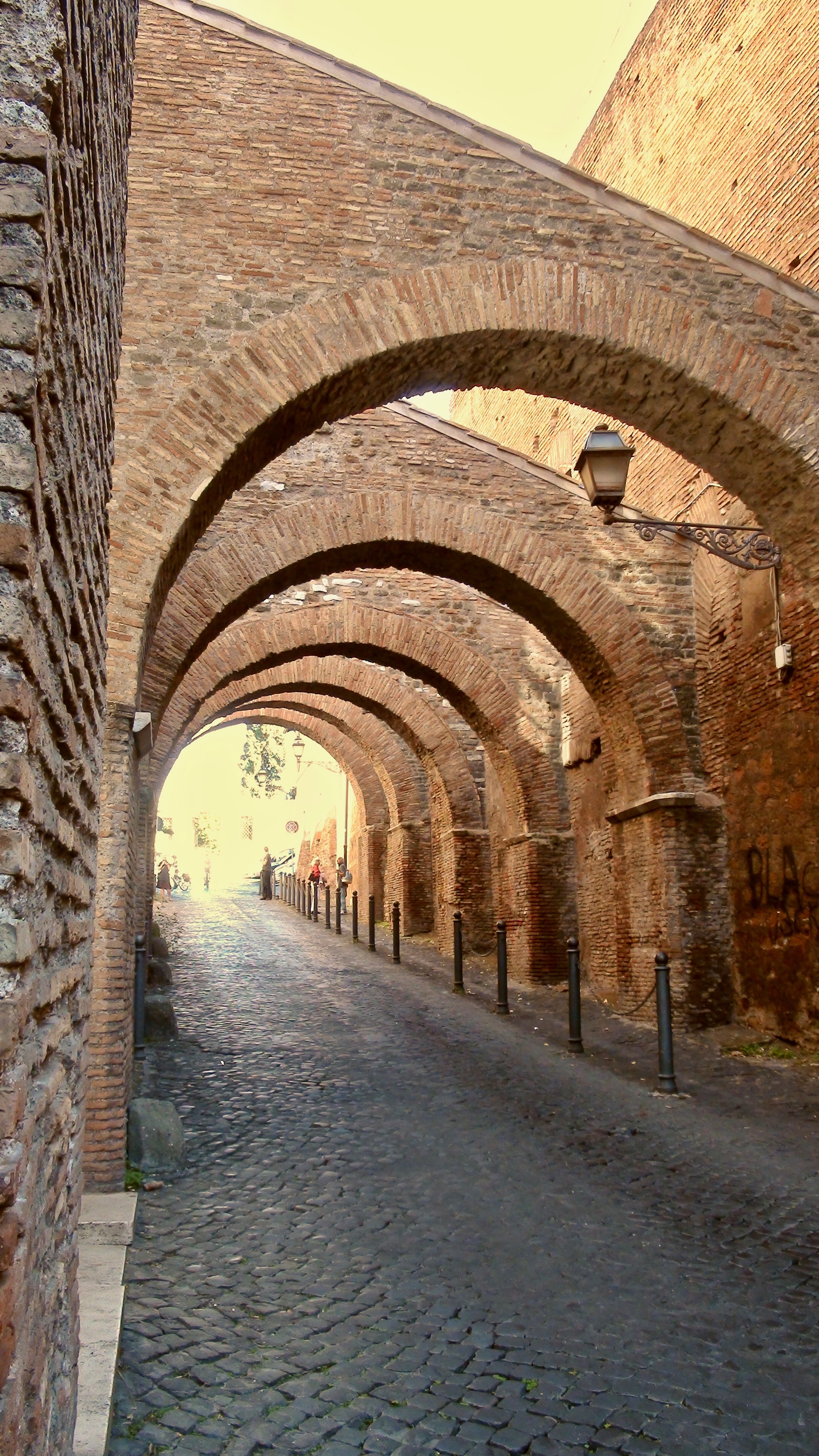
Clivo di Scauri

“Wait for One Another”

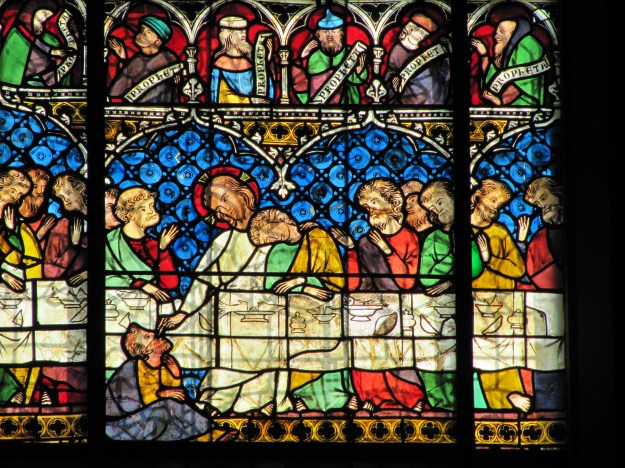
In today’s reading at Mass from 1 Corinthians ( 11, 17-26.33) we have the earliest written account of the institution of the Last Supper in the New Testament:
“For I received from the Lord what I also handed on to you,
that the Lord Jesus, on the night he was handed over,
took bread and, after he had given thanks,
broke it and said, “This is my Body that is for you.
Do this in remembrance of me.”
In the same way also the cup, after supper, saying,
“This cup is the new covenant in my Blood.
Do this, as often as you drink it, in remembrance of me.
For as often as you eat this bread and drink the cup,
you proclaim the death of the Lord until he comes.”

The simple account stresses that Jesus, taking bread and wine, gave himself, Body and Blood, “for you.” He gave himself for all. When we do this “in remembrance of me” we are called to be like him, to give ourselves for all.

Paul warns the Corinthians that by what he hears of their divisions and factions they’re failing to do what the Lord commands. Instead of imitating what Jesus d, they’re driving others away in their celebrations and thus bringing judgment on themselves.

Therefore, my brothers and sisters,
when you come together to eat, wait for one another.

A beautiful phrase Paul uses, “wait for one another.” A phrase that comes from the family meal in Paul’s time, when someone might miss the meal if the family did not wait for them. “We have to wait for them.”

So we wait for the grace Jesus offers at the Eucharist, to see all at the table of the Lord, loved by God who loves all.

Hurricane Florence is Coming

We not preparing for the disasters brought by climate change, an article in USAToday by Rick Hampson says. “Will repeated exposures to vivid scenes of natural disaster–Western wildfires, a global heat wave, Hawaiian volcano eruptions, the 2017’s hurricane’s anniversary and a suddenly active 2018 season” prepare us to do something? “Experience counsels skepticism. So does human nature.”

“Experts say people aren’t really motivated by disaster until it come to, or through, their door.” Hampson writes.

We forget that “America, the Beautiful” is vulnerable to climate change as other parts of the world are, and our political system doesn’t help us face the change either. The earth doesn’t get to vote.

“Democracies are creatures of the present, because the public focuses on the here and now, not some future hypothetical problem… Our political system makes us vulnerable to distant crises, because we don’t try to anticipate or diffuse them.” (Robert J. Samuelson)

In a previous blog Pope Francis asks us to hear in the changing climate cries of “Our  Sister, the earth” groaning from the abandonment and mistreatment received at our hands. Is Hurricane Florence a cry of creation?

“Save us, Lord, from becoming simply ‘creatures of the present.’ looking after ourselves. Let us hear our earth and sky and sea when they cry out from our abuse and lack of care. We ourselves are dust from the earth, we breathe her air and are refreshed by her waters. May we hear the cries of our Sister, the earth,  and care for her.”


Speak, Lord, Your Servants are Listening

In times like this we should listen to the voice of the mystics in our church. They speak in troubled times.

Among the mystics I count the writers of scripture, Luke and Paul, who speak in our readings at Mass these days and see things from a higher perspective than we do. Be careful of human wisdom, Paul says today to the Corinthians enmeshed in the politics and personalities of their church:

“So let no one boast about human beings, for everything belongs to you,
Paul or Apollos or Cephas,
or the world or life or death,
or the present or the future:
all belong to you, and you to Christ, and Christ to God.”

Luke’s gospel today (Luke 5, 1-11) describes the fishermen on the lake, Cephas among them, who have come from fishing all night and caught nothing. The One from Nazareth, no fisherman at all, tells them to cast their nets for a catch.

Wisely, they defer to him and their human wisdom is replaced by the power of God.

I think too of Bridget of Sweden and Catherine of Siena, mystics of their day, whose vivid perception of the powerful presence of God in their meditations and prayers reminded the leaders and people of their church to listen to their Lord.

Prayer and listening to God’s word are not small gestures today. We’re like the Corinthians and the fishermen by the lake. We need to listen to the Lord who speaks to us. We get so caught up in the wisdom of the day.

21st Sunday of the Year b: First, Believe

For this week’s homily, please play the video below.

18th Week of the Year

AUGUST 5 SUNDAY EIGHTEENTH SUNDAY IN ORDINARY TIME
Ex 16:2-4, 12-15/Eph 4:17, 20-24/Jn 6:24-35 (113)

6 Monday The Transfiguration of the Lord
Feast
Dn 7:9-10, 13-14/2 Pt 1:16-19/Mk 9:2-10 (614)

7 Tuesday
[Saint Sixtus II, Pope, and Companions, Martyrs; Saint Cajetan, Priest]
Jer 30:1-2, 12-15, 18-22/Mt 14:22-36 or 15:1-2, 10-14 (408)

8 Wednesday Saint Dominic, Priest
Memorial
Jer 31:1-7/Mt 15:21-28 (409)

9 Thursday
[Saint Teresa Benedicta of the Cross, Virgin and Martyr]
Jer 31:31-34/Mt 16:13-23 (410)

10 Friday Saint Lawrence, Deacon and Martyr
Feast
2 Cor 9:6-10/Jn 12:24-26 (618)

11 Saturday Saint Clare, Virgin
Memorial
Hb 1:12—2:4/Mt 17:14-20 (412)

18th Sunday of the Year: Bread, Manna for the Journey

For this week’s homily, please play the video file below:

16th Sunday of the Year. b: Rest Awhile

For this week’s homily, please play the video below: