Category Archives: contemplation

The Season of Creation, September 1st -October 5th

1 September 2022, Pope Francis writes:

Dear brothers and sisters!

“Listen to the voice of creation” is the theme and invitation of this year’s Season of Creation.  The ecumenical phase begins on 1 September with the World Day of Prayer for the Care of Creation, and concludes on 4 October with the feast of Saint Francis.  It is a special time for all Christians to pray and work together to care for our common home.  Originally inspired by the Ecumenical Patriarchate of Constantinople, this Season is an opportunity to cultivate our “ecological conversion”, a conversion encouraged by Saint John Paul II as a response to the “ecological catastrophe” predicted by Saint Paul VI back in 1970. 

If we learn how to listen, we can hear in the voice of creation a kind of dissonance.  On the one hand, we can hear a sweet song in praise of our beloved Creator; on the other, an anguished plea, lamenting our mistreatment of this our common home.

The sweet song of creation invites us to practise an “ecological spirituality” (Laudato Si’, 216), attentive to God’s presence in the natural world.  It is a summons to base our spirituality on the “loving awareness that we are not disconnected from the rest of creatures, but joined in a splendid universal communion” (ibid., 220).  For the followers of Christ in particular, this luminous experience reinforces our awareness that “all things came into being through him, and without him not one thing came into being” (Jn 1:3).  In this Season of Creation, we pray once more in the great cathedral of creation, and revel in the “grandiose cosmic choir” made up of countless creatures, all singing the praises of God.  Let us join Saint Francis of Assisi in singing: “Praise be to you, my Lord, for all your creatures” (cf. Canticle of Brother Sun).  Let us join the psalmist in singing, “Let everything that breathes praise the Lord!” (Ps 150:6).

Tragically, that sweet song is accompanied by a cry of anguish.  Or even better: a chorus of cries of anguish.  In the first place, it is our sister, mother earth, who cries out.  Prey to our consumerist excesses, she weeps and implores us to put an end to our abuses and to her destruction.  Then too, there are all those different creatures who cry out.  At the mercy of a “tyrannical anthropocentrism” (Laudato Si’, 68), completely at odds with Christ’s centrality in the work of creation, countless species are dying out and their hymns of praise silenced.  There are also the poorest among us who are crying out.  Exposed to the climate crisis, the poor feel even more gravely the impact of the drought, flooding, hurricanes and heat waves that are becoming ever more intense and frequent.  Likewise, our brothers and sisters of the native peoples are crying out.  As a result of predatory economic interests, their ancestral lands are being invaded and devastated on all sides, “provoking a cry that rises up to heaven” (Querida Amazonia, 9).  Finally, there is the plea of our children.  Feeling menaced by shortsighted and selfish actions, today’s young people are crying out, anxiously asking us adults to do everything possible to prevent, or at least limit, the collapse of our planet’s ecosystems.

Listening to these anguished cries, we must repent and modify our lifestyles and destructive systems.  From its very first pages, the Gospel calls us to “repent, because the kingdom of heaven has come near” (Mt 3:2); it summons us to a new relationship with God, and also entails a different relationship with others and with creation.  The present state of decay of our common home merits the same attention as other global challenges such as grave health crises and wars.  “Living our vocation to be protectors of God’s handiwork is essential to a life of virtue; it is not an optional or a secondary aspect of our Christian experience” (Laudato Si’, 217).

As persons of faith, we feel ourselves even more responsible for acting each day in accordance with the summons to conversion.  Nor is that summons simply individual: “the ecological conversion needed to bring about lasting change is also a community conversion” (ibid., 219).  In this regard, commitment and action, in a spirit of maximum cooperation, is likewise demanded of the community of nations, especially in the meetings of the United Nations devoted to the environmental question.  

The COP27 conference on climate change, to be held in Egypt in November 2022 represents the next opportunity for all to join in promoting the effective implementation of the Paris Agreement.  For this reason too, I recently authorized the Holy See, in the name of and on behalf of the Vatican City State, to accede to the UN Framework Convention on Climate Change and the Paris Agreement, in the hope that the humanity of the 21st century “will be remembered for having generously shouldered its grave responsibilities” (ibid., 65).  The effort to achieve the Paris goal of limiting temperature increase to 1.5°C is quite demanding; it calls for responsible cooperation between all nations in presenting climate plans or more ambitious nationally determined contributions in order to reduce to zero, as quickly as possible, net greenhouse gas emissions.  This means “converting” models of consumption and production, as well as lifestyles, in a way more respectful of creation and the integral human development of all peoples, present and future, a development grounded in responsibility, prudence/precaution, solidarity, concern for the poor and for future generations.  Underlying all this, there is need for a covenant between human beings and the environment, which, for us believers, is a mirror reflecting “the creative love of God, from whom we come and towards whom we are journeying”.  The transition brought about by this conversion cannot neglect the demands of justice, especially for those workers who are most affected by the impact of climate change.

For its part, the COP15 summit on biodiversity, to be held in Canada in December, will offer to the goodwill of governments a significant opportunity to adopt a new multilateral agreement to halt the destruction of ecosystems and the extinction of species.  According to the ancient wisdom of the Jubilee, we need to “remember, return, rest and restore”.  In order to halt the further collapse of biodiversity, our God-given “network of life”, let us pray and urge nations to reach agreement on four key principles: 1. to construct a clear ethical basis for the changes needed to save biodiversity; 2. to combat the loss of biodiversity, to support conservation and cooperation, and to satisfy people’s needs in a sustainable way; 3. to promote global solidarity in light of the fact that biodiversity is a global common good demanding a shared commitment; and 4. to give priority to people in situations of vulnerability, including those most affected by the loss of biodiversity, such as indigenous peoples, the elderly and the young.

Let me repeat: “In the name of God, I ask the great extractive industries – mining, oil, forestry, real estate, agribusiness – to stop destroying forests, wetlands, and mountains, to stop polluting rivers and seas, to stop poisoning food and people”.

How can we fail to acknowledge the existence of an “ecological debt” (Laudato Si’, 51) incurred by the economically richer countries, who have polluted most in the last two centuries; this demands that they take more ambitious steps at COP27 and at COP15.  In addition to determined action within their borders, this means keeping their promises of financial and technical support for the economically poorer nations, which are already experiencing most of the burden of the climate crisis.  It would also be fitting to give urgent consideration to further financial support for the conservation of biodiversity.  Even the economically less wealthy countries have significant albeit “diversified” responsibilities (cf. ibid., 52) in this regard; delay on the part of others can never justify our own failure to act.  It is necessary for all of us to act decisively.  For we are reaching “a breaking point” (cf. ibid., 61).

During this Season of Creation, let us pray that COP27 and COP15 can serve to unite the human family (cf. ibid., 13) in effectively confronting the double crisis of climate change and the reduction of biodiversity.  Mindful of the exhortation of Saint Paul to rejoice with those who rejoice and to weep with those who weep (cf. Rom 12:15), let us weep with the anguished plea of creation.  Let us hear that plea and respond to it with deeds, so that we and future generations can continue to rejoice in creation’s sweet song of life and hope.

Rome, Saint John Lateran, 16 July 2022,  Memorial of Our Lady of Mount Carmel

Parables: (Matthew 13:10-17)

by Orlando Hernandez

In this Thursday’s Gospel (Mt 13: 10-17) our Lord is asked by His disciples why He speaks to the crowds in parables. I used to think that in this passage Jesus sounds almost disdainful as He talks of those who “look, but do not see and hear but do not listen or understand.” They do not seem to deserve the healing that in Isaiah’s prophesy God refuses to give them. I think of the harsh sermons that I remember hearing fearfully when I was a child and went to church. We are so undeserving.

However, our Lord is all goodness and mercy. He cannot have bad feelings toward anyone. This is a vital “knowledge of the Kingdom of Heaven” that I feel He has granted me! I truly believe that He loved those “crowds” who mostly rejected what He taught. But, He could not help but point out that, for the most part, “Gross is the heart of this people” and they were unable to “understand within their hearts” that the Creator of the universe was giving them the very gift of Himself
.
My wife Berta always tells me that the Passion of our Lord was taking place within Him throughout all His ministry. Jesus must have felt great sorrow as He went about trying to reach the people. They seem to want the miracle and the spectacle, but the message of Salvation and eternal life was beyond them. The Sermon on the Mount was too much for them to understand or accept. Things have not changed. In our modern world what can we followers of Christ tell others that will open their eyes, their understanding, their hearts? Look at Jesus’ frustration in the Gospel. Can we do any better?

I used to think that in Thursday’s Gospel Jesus is saying that He talks to the unbelievers through parables in order to confuse, insult, and reject them. I can’t believe that anymore. In his book “Jesus, a Pilgrimage,” Fr. James Martin says that parables were ways to reach the people through the things they understood: farm life, fishing, home-building, the nature surrounding them, human relations. Jesus must have known that so much of His teaching was beyond their understanding. Perhaps the stories and similes were meant to catch their attention and stimulate their imaginations, like seeds planted hopefully in the soil of their hearts, whether rocky, compacted, weed-ridden, obstinate, or uninterested.

Were the chosen disciples so much better off than these crowds? Yes, Jesus gave them a good amount of healing and knowledge. For His own divine reasons He had also put into their hearts the supernatural gift of faith. But did they really comprehend the vast mystery of God’s Glory and Love? They certainly had a long painful road ahead in order to achieve enough joy and understanding of who Jesus really was in order to become truly committed to the demands of discipleship.

When I sit at Mass I feel like a member of both the undeserving crowd and the circle of disciples. When I hear the modern parables of the priests’ homilies, do I have ears to listen to what God is telling me? When I look around, do I have the eyes to see the presence of the living God in the people that surround me? When the broken, wounded Host is raised before me (“Behold the Lamb of God, Behold Him…”) is my heart pure enough that I might truly see Him, the Eternal God?

Lord, You are such a mystery to me. Sometimes my link to You seems so tenuous. And yet Your gift of faith has been planted in my heart. I do not want to let You go. Please don’t let me go. But, most importantly, I beg You, have mercy on those unbelieving “crowds.” Touch their hearts, show them who You are!

Orlando Hernández

A Little Boy, Five Barley Loaves and Two Fish

Andrew, brother of Peter, says to Jesus when he asked his disciples to provide food for a hungry crowd: “There is a boy here who has five barley loaves and two fish; but what good are these for so many?” (John 6:1-15)

Duk Soon Fwang, an artist friend of mine, has been thinking a good while about that little boy and what he brought to Jesus. “We don’t know the little boy’s name and he only has a few loaves and fish to give. He’s like me,” she said. “But Jesus sees what he brings and makes it more.” 

She’s almost completed a painting of the boy and Jesus, which you can see above. 

At Mass this morning, we read that gospel story before we brought small pieces of bread and a cup of wine to the altar. I remembered what she said. This is our story. We bring what we have and God makes it more.

More on Duk Soon and her work here and here.

Poor in Spirit

Christmas is a time of poverty. The Spirit of Bethlehem is one of smallness, of tiny new beginnings that open our minds to the infinite largeness of Incarnate Wisdom. The Christ Child heals us of our presumption. The New Born shows us that we simply don’t know what God has in store. His impoverished delivery stops us in our tracks. We stand like beasts in a stable, our knowledge, our understanding, our science, our facts, our truths stripped of eternal value. All that remains, whether we’re shepherds or kings or someone in between, is for us to nod along with the tiny beat of the drummer boy offering his seemingly meaningless gift. Let’s welcome Christ Jesus, Innocence itself, by being poor with Him. Let’s let go of preconceived notions of having control. To stand before the Lord in our nothingness is worth more to Him than any amount of gold, frankincense or myrrh. Our humility before the bright light is pure praise and prayer to the One Who offers us everything.

—Howard Hain

Mary’s Mother

by Howard Hain

durer

Albrecht Durer, “Virgin and Child with Saint Anne”, ca. 1519 (The Met)

Christmas is a time for grandmothers.

They bake and cook and decorate. Their homes become mini North Poles, diplomatic outposts of Santa’s Castle.

At its core, Christmas is of course all about Jesus. All about Jesus, Mary, and Joseph. All about the Holy Family.

The Holy Family is an extended family though. And it doesn’t stop at grandmothers and grandfathers, aunts and uncles, or even cousins and distant cousins.

Just ask Saints Joachim and Anne, Zechariah and Elizabeth, or John the Baptist—not to mention all the unknown relatives whom the child Jesus surely encountered throughout His Galilean days. Ask any one of them about the far-reaching ripple effects of family grace.

Those touched by Jesus have a tendency to appear bigger than life.

Look at Santa Claus.

Most of us are aware that he is really Saint Nick.

But do we stop to wonder who Mrs. Claus really is?

I think she’s Saint Anne.

After all, Mrs. Claus is seen as everyone’s grandmother, especially when it comes to holiday cheer. But when it comes to truly celebrating the birth of Jesus, it is through Saint Anne that we approach the gates of Christ’s Nativity.

Mary’s Mother holds a special key. She is first among grandmas, first among those who pinch chubby cheeks, who pass along one more extra sugary treat.

———

Saint Anne help us. Speak to us. Show us how to be grand parents to all those around us, especially the little ones. Stir up the spirit of Advent. Bake away the holiday blues. Cook up a dish of Christmas love that only your hearth can serve.

———

Come one, come all, to the home of Saint Anne. Come with me to Grandma’s house for a holiday visit. Taste and see. Enter her kitchen, where the hot chocolate can always fit a little more whipped cream, where you hear the constant refrain: “eat…eat…eat…”

At Grandma’s your plate is never empty.

Her table is continually set.

She always sees Jesus as having just been born.

She is always wrapping Him up tightly in swaddling clothes.

It is simply grand.

To Grandma, Jesus is always an innocent child.

And she can’t help but see Him deep within both you and me.


(Dec/21/2017)

Howard Hain is a contemplative layman, husband, and father. He blogs at http://www.howardhain.com


Web Link: Metropolitan Museum of Art. Albrecht Durer, “Virgin and Child with Saint Anne”, ca. 1519


Broken Baby Jesus

by Howard Hain

(Note: This post was originally published on December 24, 2011.)

broken-baby-christ-2-1


We have not put up a tree in years.

For nearly a decade we have been moving—no longer than two years in any one house and no less than ten different not-so-humble abodes. Between and during the moves we were very much engaged with the world. A seemingly endless movable beast.

This December marks one year in our current house. I am happy to say it is our home. The Lord has blessed us with great peace. And with that peace comes a tree. A simple, well-shaped tree. Fittingly, a dear friend offered it to us as a gift.

Francesca could not be more ready to be initiated into the act of trimming. Before the tree arrived, her two-year-old fingers pointed out every tree, artificial or real, that graced the pages of a holiday flyer or the commercial floor of a Rite Aid or Dollar Store.

Up the stairs came the evergreen, into the old stand that has been in storage since my father last used it several decades ago. I cut off the mesh and out popped the branches.

We hung the lights and old glass ornaments that my mother-in-law washed a few days before.

The main attraction for Francesca was the Nativity.

Not since St. Francis of Assisi assembled the first Nativity in Greccio in 1223, has there been such admiration for each and every witness who Our Lord assembled to adore His Son that first Christmas two millennia ago. Francesca kissed and hugged every shepherd, sheep, donkey, angel, and king. Most of all she adored the Holy family, calling Mary and Joseph, Ma-ma and Da-da, respectively. And Jesus, He was simply called: “ba-be.”

She carried them around the apartment. I did not want to ruin her fun, but they are ceramic. I explained a few times to be very careful.

“Gentle, Francesca…gentle…”, I harked a host of times.

Boom. To the wood floor went the shepherd. Amazing, grace held him intact. I took that as a great sign to put an end to her carrying the animals, angels and representatives of mankind.

I was fixing my coffee when I turned to see Francesca with Baby Jesus in her tiny hands. But He is so small, so tiny, what harm could come from holding Him? So I let her get away with carrying the Savior.

As I stirred my spoon Christ crashed to the floor, the tile floor. Francesca immediately looked at me, as if expecting all hell to break loose. I think I sighed but that was about all. It is Christmas, right? And it is, after all, only a ceramic figure purchased at Target.

After assuring Francesca not to worry and guiding her toward a few coloring books in the living room, I bent down to retrieve the broken Christ.

———

St. Francis was told by a Crucifix in an old abandoned chapel: “Restore my Church.”

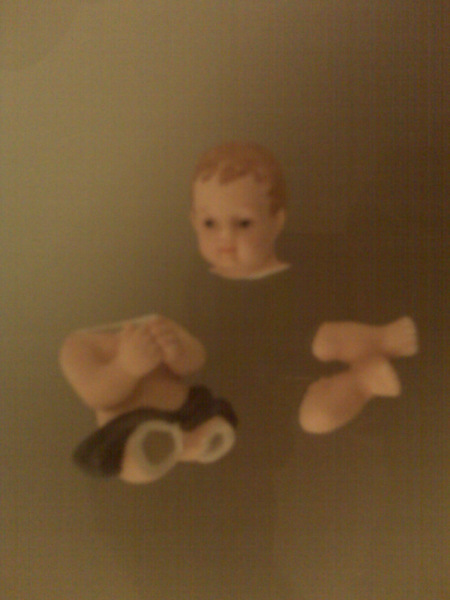
In my small one-bedroom apartment, I found Baby Christ, broken into exactly three: The Head, the Torso, and the Crossed Legs.

“Restore the Trinity,” was spoken to me.

———

For half of my forty years I can honestly say I have tried to pursue Truth, wherever it lie. In philosophy, in scripture, in literature, in art, in nature, in history…

Now, the entire Gospel of Christ lie naked on my kitchen floor.

We separate, we distinguish, we categorize, we breakdown. The Fall of Adam was a fall into denomination.

Christ’s body is One. His Church cannot be broken. Only mere men can get things so wrong.

I think of the great “Angelic Doctor” of the Church, St. Thomas Aquinas, who after spending a lifetime in unparalleled pursuit of human understanding, said after glimpsing a vision of what Our Lord has in store for those who love God:

“All that I have written seems like straw compared to what has now been revealed to me.”

Yes… “straw”…my brother Thomas…merely straw. Straw that lines the manger within which Our Savior is laid bare.

———

It is tradition to leave the crib empty until Christmas morning. Only then do we place the figurative baby Jesus into the scene, after all until that moment he was not yet brought forth from Mother Mary’s womb.

This Christmas morning I will glue together a Broken Baby Christ. The Head, the Torso, and the Crossed Legs will again be One.

Like the world after the birth of Christ, I will never be the same.

For what has now been revealed to me, no fall can break apart.


Howard Hain is a contemplative layman, husband, and father. He blogs at http://www.howardhain.com


The Yet Empty Stable

by Howard Hain

There’s a little stable not too far from here.

It sits in a church that has seen better days.

The parish is poor and the people seem to disappear.

But a few persistent peasants won’t stay away.

I love it there.

The priest is wonderfully uncertain.

He is afraid of God.

He instinctively bows his head at the mention of the name.

He knows how little he is in front of the great star.

I imagine he was involved in setting the stable.

It is a good size, on the relative little-stable scale.

It is surrounded by ever-green branches.

Probably snipped from the few Douglas Firs placed around the altar and yet to be trimmed.

The stable itself is composed of wood.

A little wooden railing crosses half the front.

A single string of clear lights threads through the branches laid upon the miniature roof.

They are yet to be lit.

I love it there.

I kneel before the empty scene.

For as of yet, not a creature or prop is present.

Not an ox or a goat, not a piece of hay or plank of fencing.

Not even a feeding trough that is to be turned into a crib.

No visible sign of Joseph and Mary, nor a distant “hee-haw” of a very tired donkey.

I wonder if I could get involved.

Perhaps I could slip into the scene.

There’s a darkened corner on the lower left.

In the back, against the wall.

I could hide myself within the stable.

Before anyone else arrives.

I don’t think they would mind.

I’d only be there to adore.

To pay homage to the new born king.

I might even help keep the animals in line.

Yes, a stagehand, that’s what I can be!

I know there’s no curtain to pull.

That’s to be torn in a much later scene.

But to watch the Incarnation unfold from within!

That’s what I dream.

To see each player take his and her place.

To see the great light locate the babe.

To watch the kings and shepherds stumble onto the scene.

Hark! To hear the herald angels sing!

O the joy of being a simple farmhand.

Of being in the right place at always the right time.

Of course though I wouldn’t be alone.

In that darkened corner, also awaiting the entire affair, there are many others.

Most I don’t know by name.

Too many in fact to even count.

But a few I know for sure.

For certain, present are those few persistent peasants who won’t stay away.

And of course there’s that wonderful anonymous parish priest.

The one who helped set into place this yet empty but very expectant stable.

The one whose fear of God is so clearly the beginning of wisdom.


(Dec/16/2016)

Howard Hain is a contemplative layman, husband, and father. He blogs at http://www.howardhain.com

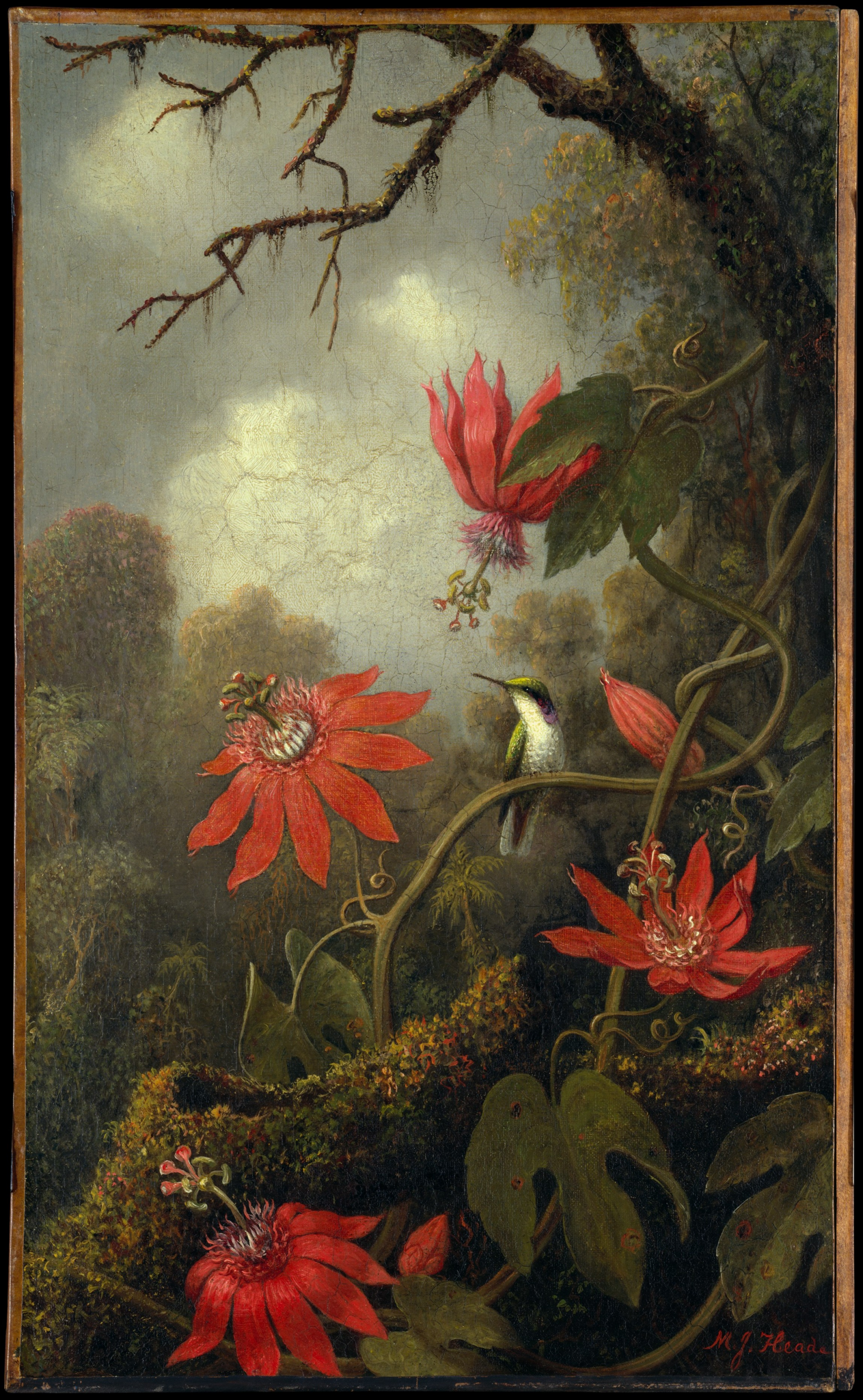
Hummingbird and Passionflowers

by Howard Hain

1509123983639705942327.jpg

Martin Johnson Heade, “Hummingbird and Passionflowers” (ca. 1875-85) (The Met)

The delicate little bird that resides within each of us.

It hops to and fro. It stands startlingly still.

Very often we are the very ones who chase it away.

But it doesn’t fly far.

Just to the closest branch, that’s just beyond our reach.

And it looks back at us, as if to ask, “Why are you afraid?”

The tiny head of a tiny bird, slightly cocked to the side—a question mark floats from its beak.

It longs to return, to live within us, to build a nest, to raise its young.

But it doesn’t rush back.

No, it waits.

It waits for us to ask for it to return.

It’s a patient creature, that tiny bird.

One may be tempted to say it’s not very smart, but that’s not it at all.

It’s simple. It’s holy. It knows who it is. It’s not afraid of the fall.


Howard Hain is a contemplative layman, husband, and father.


Web Link: The Met Museum. Martin Johnson Heade, “Hummingbird and Passionflowers” (ca. 1875-85)

First Snow in Our Mary Garden

The Elusive Prayer

by Orlando Hernandez

The Gospel readings for Tuesday, Wednesday, and Thursday of the 7th Week of Easter present to us the whole of Chapter 17 of the Gospel of John, Jesus’ beautiful prayer at the end of the Last Supper discourses. Cardinal Fulton Sheen, in his book Life of Christ, calls this chapter “Our Lord’s ‘My Father’”. Jesus must have said these words out loud in front of the Apostles, otherwise it could not have been recorded. I imagine Him, His eyes streaming with tears of joy and sorrow, arms open, facing heaven, saying these words like a nightingale in full-throated song.

Cardinal Sheen writes : “In the Our Father which He taught men to pray there were seven petitions. In His ‘My Father’ there were also seven petitions, and they had reference to His Apostles who are the foundation of His Kingdom on earth. First, their continual union with Him; second, their joy as a result of this union; third, their preservation from evil; fourth, their sanctification in the truth which is Himself; fifth, their unity with one another; sixth, that eventually they may be with Him; and seventh, that they may perceive His glory.”

I try to find the parts of Jesus’ prayer that illustrate these points. I almost seem to find them, and then I forget what they were; it’s so strange. This is the chapter of the Bible that I have read the most, and it always eludes me in some mysterious way. There is so much to it. I still cannot wrap my mind around it. It is like some of my deepest, most powerful prayer experiences. My heart is humming afterwards. My eyes might be full of tears, but I cannot find the words to express what I experience, almost as if I have forgotten most of it, like waking from a dream.

The part that remains with me the most is where Jesus, after praying for His Apostles, says, “I pray not only for these, but also for those who will believe in me through their word, so that they may all be one, as You Father are in Me and I in You, that they also may be in us, that the world may believe that You sent me.” (Jn 17: 20-21)

In his book The World’s Religions, Huston Smith comments on how perhaps the greatest psychological force that prompted so many thousands of people throughout the Roman Empire to consider Christianity, was the impressive unity, solidarity, and mutual sacrifice that the followers of The Way exhibited.

When our beloved leader and teacher, Fr. Owen Lally CP was alive, we would conclude our Charismatic prayer meetings by holding hands around the altar with the Monstrance containing the Living Blessed Sacrament, and would sing:
“Father, make us one.
Father, make us one,
that the world may know
That You sent Your Son.
Father make us one.”

I always felt it was the most powerful moment of our prayer meeting, when the presence of God was the most palpable to me. I felt as if our prayer group would never break up. I would realize that Jesus’ prayer in John 17 was being fulfilled right then and there. Years later, we still conclude with this song even in the absence of Fr. Owen, and of the Blessed Sacrament, the effect is still so unifying and holy.

Jesus, High Priest and Teacher, I thank You for this prayer that You say even for me. May it be always a “holy space” where I may be able to go and meet You. May it inspire us all not to lose hope in this “world” that refuses to accept Your words of love and peace. May we, as Your Church, be able to look into each others eyes, smile and say, without fear or embarrassment, “Father make us one.”

Orlando Hernández