Category Archives: contemplation

Saint Lawrence, the Deacon

August 10th is the Feast of St. Lawrence, the deacon, who ranks after Peter and Paul as a patron of the Church of Rome. The Emperor Constantine built a church honoring him on the Via Tiburtina, near one of the major gateways to the city in the 4th century. Lawrence was a Christian martyr, but he was something more.

Lawrence was a deacon of the Roman church in the middle of the 3rd century when Rome began experiencing wars and political instability. Gothic tribes breached the Roman lines along the Rhine River and the Persians invaded in the east.

The only thing to do was expand the army, and that’s what the Emperor Valerian did. He built walls and expanded armies. That cost money, of course, and in Rome the burden fell heavily on the poor. Famine and plague only worsened their situation.

The Christian church stepped in to help. Christians were still relatively few in numbers then, not wealthy, but they gave generously to the poor, and the Roman people admired what they saw.

Lawrence, the deacon, was behind this extraordinary Christian effort. After all, Jesus said: “I was hungry, and you gave me to eat; I was thirsty, you gave me to drink; I was sick and you visited me.”

Lawrence giving to the poor: Fra Angelico

Rome’s leaders became upset by the church’s growng popularity. They also wondered if the church’s money couldn’t be channeled towards their war effort. And so, in 257 an edict was published to imprison church leaders and confiscate church money. A second edict in 258 caused blood to flow. Pope Sixtus II and four deacons were seized in the catacombs of St. Callistus and executed on August 6th. Lawrence, the deacon, was seized and executed on August 10th. That’s why his feast day is today.

Popular stories later offered a colorful account of Lawrence’s martyrdom shaping his story and the way artists pictured him:

The Roman prefect, anxious for the church’s money, promised Lawrence freedom if he would transfer it over to him. Lawrence asked for three days to get the church’s treasures together for delivery to the prefect’s house. Then, after distributing the church’s monies to the poor, he gathered them and brought them to the prefect’s door. “Here are the church’s treasures,” he told the official, “ – the blind, the lame, the orphans and the old.”

The prefect ordered Lawrence burned alive on a gridiron. Those witnessing his execution said the saint went to his death cheerfully, even joking with his executioners. “Turn me over, I’m done on this side.”

After these events the Roman church gained a flood of converts. Respect for Christianity grew, not just because of its brave martyrs, but because of its outreach to the poor.

Constantine honored Lawrence, not just because he died for his faith, but because of his care of the poor. He would rely on the church, not just for its political support, but for its care of the poor.

Wherever you go in Rome, you are going to find Lawrence. There are other churches honoring him; he’s often pictured with Peter and Paul, the founders of the Roman church; Michelangelo has him among the blessed at the last judgment in the Sistine Chapel. Lawrence represents something important in the church.

A large fresco of the saint stands at the entrance to the Vatican Museum’s Chapel of Nicholas V with its priceless works of art. Lawrence seems blind to the riches all around him as he boldly proclaims the message inscribed beneath his feet: The Poor are the Treasures of the Church.

They should always be the treasures of the church.

Here’s a video on St. Lawrence

St. Bridget of Sweden: July 23

St. Bridget of Sweden, whose feast is July 23rd, was a 14th century mystic.She was a woman who challenged the powerful of her day, first the court of Sweden and later the papacy. She influenced Christian spirituality and art,

Born into a powerful Swedish family with ties to the royal court. Bridget married Ulf Gudmarrson when she was 14. They had 8 children, one of whom is also honored as a saint, Catherine of Sweden. Bridget was known for the care she took of the sick around her. She brought her children with her on her visits, to teach them this work of mercy.

As a child of 10 Bridget was attracted to the mystery of the Passion of Jesus and that mystery inspired her prayer and spirituality ever afterwards. Her deep understanding of his mystery made her fearless in challenging injustice when she saw it. Bridget protested the wanton living of Swedish royalty and its uncaring attitude towards the poor. After her husband’s death in 1334 she founded a religious community, continuing to speak out fearlessly against the lifestyle and privileges of the powerful.

In 1350 Bridget went to Rome to gain approval for her Order of the Most Holy Savior, the Brigittines. There she was inspired to confront the papacy. The pope , fearing the turmoil in the Papal States, had fled to in Avignon in France. Bridget strongly urged him to return to Rome. The pope was a shepherd, she said; he should be with his sheep, especially in times of turmoil.

Bridget’s prayers and revelations, widely circulated in her time, were reminders of what Jesus said and did, especially the example he gave in his Passion. She inspired people to meditate on the mysteries of Christ for their wisdom.

Artists were inspired in their portrayals of the mysteries of Christ. She saw in a vision Mary and Joseph adoring the Child lying on the ground. His Incarnation made the earth his home. Previously, Mary was portrayed at the crib, lying down after giving birth. In Bridget’s portrayal she joins Joseph, the shepherds (humanity) and the earth itself adoring the Word made flesh.

Jesus birth
Adoration of the Child, Giorgione, 1507, National Gallery, Washington

Bridget also inspired the portrayal of Mary holding the body of Jesus after his crucifixion and the devotion of the Pieta. Cradling him in her arms,, she recalls holding him at his birth in Bethlehem, Bridget said.

Rhine Valley, 14th century

In 1371, Bridget and some of her family went on pilgrimage to the Holy Land; her vivid accounts from there further stimulated the religious imagination of her contemporaries. On July 23, 1373 she died in Rome. Bridget is a patron of Sweden and of Europe.

The church always needs strong women like Bridget, firm in faith and unafraid to speak out. Society too needs women like her in politics and business to steer its course into the future.

Our church today seems to be alive with visionaries, people who claim God has revealed something to them. Bridget was always aware of the possibility that her visions could come from another source rather than God. She prayed to be saved from delusions and pride. This 15th century Swedish painting depicts Satan trying to influence her, but is hit over the head by an angel.

Prayer of St. Bridget

Jesus, true and fruitful Vine! Remember the abundant outpouring of blood shed from your sacred body as juice from grapes in a wine press.    From your side, pierced with a lance by a soldier, blood and water poured out until not a single drop was left in your body.

Through your bitter Passion and your precious blood poured out, receive my soul when I come to die. Amen.

O good Jesus! Pierce my heart so that my tears of penance and love will be my bread day and night; may I be converted entirely to you, may my heart be your home, may my conversation please you, may I merit heaven at the end of my life and be with you and your saints, to praise you forever. Amen

St. Cyril of Alexandria (d.444)

To be a saint doesn’t mean you’re perfect, Pope Francis says in his exhortation “Gaudete et exsultate“, on holiness in today’s world. That’s good to remember when we consider St.Cyril of Alexandria, the 4th century bishop of Alexandria and doctor of the church, whose feast is today, June 26th.

If you read his online biography in Wikipedia–where many today look for information about saints – you’ll find that he was deeply involved in the messy partisan politics of his time, when Christians, Jews and pagans fought and schemed to control over Alexandria, the city then probably the most important city in the Roman empire. Some called him a “proud Pharaoh;” “ a monster” out to destroy the church, an impulsive, scheming bishop in a riotous city. The Wikipedia biography mainly sees him that way.

He was a saint, other biographies say. Why a saint? Well, Cyril was absorbed in understanding and defending the Incarnation of the Word of God. How did the Word of God come among us? Who was Jesus Christ? Pursuing that mystery defined Cyril during life. It was at the heart of things for him, and the voluminous collection of sermons, letters, commentaries and controversial essays he left bears out that interest.

He thought and wrote extensively about this mystery. The way he came to express it was used at the Council of Ephesus (431) and became the way we also express it in our prayers. Mary was the Mother of God. The One born of her was not simply another human being. Her Son was true God, who would be truly human and eventually die on the Cross. God “so loved the world” that he came among us as Mary’s Son.

What we see as “the totality” of Cyril’s life, his “life’s jouney”, the “overall meaning of his person”, to use the pope’s words, is not his involvement in the violent politics of his day. Yes, that was there. But his abiding quest was to know Jesus Christ.

“‘The Word was made flesh’ [John 1:14], can mean nothing else but that he became flesh and blood like ours; he made our body his own and came forth man from a woman, not casting off his existence as God, or his generation of God the Father, but in taking to himself flesh remaining what he was. 

“This is the correct faith proclaimed everywhere. The holy teachers taught this and so they called the holy Virgin, the Mother of God, not as if the nature of the Word or his divinity began from the holy Virgin, but because that holy body with a rational soul, to which the Word, personally united, was born of her according to the flesh.”

— St. Cyril of Alexandria, First Letter to Nestorius

“When poisonous pride swells up in you, turn to the Eucharist; and that Bread, which is your God humbling and disguising himself, will teach you humility. When the fever of selfish greed rages in you, feed on this Bread; and you will learn generosity. When you feel the itch of intemperance, nourish yourself with the Flesh and Blood of Christ, who practiced heroic self-control during His earthly life, and you will become temperate. When you are lazy and sluggish about spiritual things, strengthen yourself with this heavenly Food; and you will grow fervent. Lastly, when you feel scorched by the fever of impurity, go to the banquet of the Angels; and the spotless Flesh of Christ will make you pure and chaste.”

Tenebrae: Holy Saturday

Today’s Tenebrae psalms (Psalms 15, 4, 24) speak of Jesus’ burial in the earth. He is the seed that falls to the ground, but he will rise and bring life:

“My heart rejoices, my soul is glad,                                                                                        Even my body shall rest in safety,                                                                                             For you will not leave my soul among the dead                                                                       Or let your beloved know decay.” Psalm 15

Jesus gives the gift of risen life, not only to humanity, but to the earth itself. “Cry out with joy to the Lord, all the earth. Serve the Lord with gladness.”“

It’s a gift we doubt is ours:

O men, how long will your hearts be closed
will you love what is futile and seek what is false"
It is the Lord who grants favors to those whom he loves.
Psalm 4

The gates of heaven open to Christ, risen from the dead, they are lifted high for all he loves:

O gates lift high your heads, grow higher ancient doors,
let him enter the King of Glory.
Who is the King of Glory, the Lord the mighty and valiant,
the Lord the valiant in war! Psalm 24

Tenebrae for Holy Saturday ends with an ancient homily: “Something strange is happening—there is a great silence on earth today, a great silence and stillness. The whole earth keeps silence because the King is asleep. The earth trembled and is still because God has fallen asleep in the flesh and he has raised up all who have slept ever since the world began. God has died in the flesh and hell trembles with fear.”

“The earth trembled and is still…” 

The Passion of Jesus is not only a human story; creation has part in it too. At his death “the earth quaked, rocks were split” Matthew’s gospel says. (Matthew 27,51) “From noon onwards darkness came over the whole land till three in the afternoon,” Matthew, Mark and Luke all say..

 The sun that rules the day, the moon that rules the night respond as Jesus cries out in a loud voice and gives up his spirit. Artists through the centuries place sun and moon at the cross of Jesus.

Remember too blood and water, those great elemental realities blood that John’s gospel says flowed from the side of Christ when a soldier pierced his side. Water refreshed with contact with the Word of God; blood source of life for living creatures come from the side of Jesus. They also share in the mystery of redemption.

The homily for today says that Jesus at his death goes “to search for our first parent…to free from sorrow the captives Adam and Eve…I am your God, who for your sake have become your son. Out of love for you and for your descendants I now by my own authority command all who are held in bondage to come forth, all who are in darkness to be enlightened, all who are sleeping to arise. Rise up, work of my hands, you who were created in my image. Rise, let us leave this place, for you are in me and I am in you; together we form only one person and we cannot be separated.”

Artists from the eastern Christian traditon see the Passion of Jesus leading to a great redemption. Jesus does not rise alone, but humanity and creation itself  will follow him.

The Days Since Genesis

It’ s a long way from the creation of the world to sitting on the porch in the morning. How many years before did God, the Creator of all things, bring light and water paving the way for a host of new things, non-living and living. Then, we humans enter the picture. A complex, changing world I belong to, sitting on the porch in the morning, looking eastward at the world before me.

.

Jessica Powers, a Carmelite nun and poet, wrote about our experience of that world– “Song At Daybreak”

This morning on the way,

that yawns with light across the eastern sky

and lifts its bright arms high –

It may bring hours disconsolate or gay,

I do not know, but this much I can say:

It will be unlike any other day.

God lives in his surprise and variation.

No leaf is matched, no star is shaped to star.

No soul is like my soul in all creation

though I may search afar.

There is something -anquish or elation-

that is peculiar to this day alone.

I rise from sleep and say: Hail to the morning!

Come down to me, my beautiful unknown.

“My Beautiful unknown”. Our world is beautiful, but unknown, surprising, with variations that bring “anguish or elation.” People of faith know this, since they believe in God who lives “in his surprise and variation”, but unfortunately we can make God too small. We “think like humans do.”

The Genesis account, which we just finished reading recently and the rest of the Bible, deserve a search for their wisdom. I know there’s a new story that science tells, but the scriptures were there first. We should listen to their special wisdom..

We’re Not Alone: Genesis 2: 18-25

genesis man alone copy 2
The LORD God said:
“It is not good for the man to be alone.
I will make a suitable partner for him.”
(Genesis 2,18)

We usually rush on when we hear these words to the creation of Eve, who becomes “bone of my bone, flesh of my flesh” for Adam, and the human story begins.

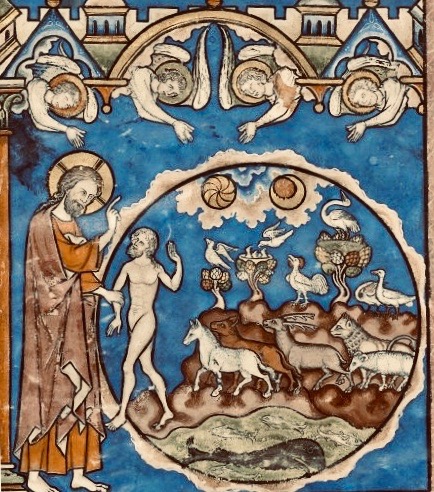
But the Genesis account  we read today and the medieval artist above remind us that God first “formed out the ground various wild animals and various birds of the air, and he brought them to the man… but none proved to be the suitable partner for the man.” (Genesis 2,19 ff)

Adam signals to God these new creatures are not enough, but does he dismiss them altogether for Eve?

Whether we realize it or not, we are not meant to be isolated individuals on this planet. We look for human companionship and friendship. But are human beings our only relationship. Besides caring for each other, we have destiny to care for all the creatures Adam names. They’re our partners too and we share this common home with them.

“A Vision Thing”


Here’s a favorite picture of mine from the Staten Island Ferry. You say it’s a picture of the New York skyline? I say it’s a picture of water that gave birth to the city. True, isn’t it? The water was here first. The city came to be because water brought the world here, making the city a capitol of world trade and drawing millions of human beings to this place

Now look at it. The man who built the new World Trade Center claims it’s the tallest building in the country, challenging the heavens–like Babel.

Be careful, though, about challenging the heavens and forgetting about the earth. Be careful about the waters that brought you where you are. No fish or oysters here to eat now. Little space for the waters to go when they rise. And they will.

Don’t forget– the water was here first. It’s a “vision thing.” That’s what Pope Francis says in “Laudato si”.

This week’s readings from Genesis are good readings for improving our vision. In the weeks before we read from the Letter to the Hebrews, so you might say that from the heavens we’re now reflecting on the earth.  

It’s good to reflect on creation, Genesis reminds us. God looks on what has been made and finds it good. Our account from Genesis today describes the creation of man (“man” here is a term for man and woman). Man is not immediately placed on the bare earth. No, he is placed in a garden where “various trees grow that were delightful to look at and good for food, with the tree of life in the middle of the garden and the tree of the knowledge of good and evil. “

Human beings, created by God, are called like God to find creation good. iThe Genesis account singles our the various trees that are delightful to look at and good for food, but all creation, from the sun and the stars to the simplest organisms, is to be looked at with delight.  

We’ll read for two weeks in our lectionary from the Book of Genesis and then we’ll be reading from the Book of Sirach which continues the Genesis message. Learn the Lord’s wisdom from the sands on the seashore, from heaven’s heights and earth’s depths, Sirach teaches.  Like the Book of Genesis, it tells us to learn from the world we live in. 

The scriptures in our lectionary are not assigned arbitrarily. The compilers of our lectionary after Vatican II carefully planned the way our lectionary unfolds.

Ordinary Time and Daily Prayer

The Christmas Season closes after the Baptism of Jesus, which we celebrate this Sunday. The Christmas celebrations are over. Ordinary time begins. Does that mean there’s nothing to do till Lent and the Easter season?

Sure there is. Ordinary Time is a time for daily prayer, and daily prayer is never over. The Second Vatican Council’s Constitution on the Liturgy says that daily prayer is at the heart of the Christian life and created a daily lectionary of scripture readings so “ the treasures of the bible be opened more lavishly for the faithful at the table of God’s word.” (SC 51)

The daily lectionary is a treasure for praying with the scriptures, but don’t take it for granted. Treasures, Jesus said, are usually hidden and you have to dig for them. That’s what we do in daily prayer. The liturgy is always a “work”, our daily work, an important work, a daily prayer. It’s the “summit” of the Christian life. We’re always at the beginning, not at the end.

We begin Monday to read the Letter to the Hebrews and the Gospel of Mark from our lectionary. There are feasts of the Lord and his saints to celebrate in the days ahead. It’s a lifelong learning we’re into, a school God provides,  and we learn day by day.

Solemnity of Christ the King

Statue of Christ the King at the Passionist Monastery in Jamaica, NY (Photo: Gloria M. Chang)

Christ the King Reigns Forever

“On the last Sunday of each liturgical year, the Church celebrates the Solemnity of Our Lord Jesus Christ, King of the Universe, or Christ the King. 

Pope Pius XI instituted this feast in 1925 with his encyclical Quas primas (“In the first”) to respond to growing secularism and atheism. He recognized that attempting to ‘thrust Jesus Christ and his holy law’ out of public life would result in continuing discord among people and nations. This solemnity reminds us that while governments come and go, Christ reigns as King forever.”

-The United States Conference of Catholic Bishops, About Christ the King

Happy Veterans Day

“To love both countries, that of earth below and that of heaven above, yet in such a mode that the love of our heavenly surpass the love of our earthly home, and that human laws be never set above the divine law, is the essential duty of Christians.”

Pope Leo XIII, Sapientiae Christianae (On Christians as Citizens)

Prayer for Veterans

Lord God, Almighty Father, creator of humankind and author of peace, as we are ever mindful of the cost paid for the liberty we possess, we ask you to bless the members of our armed forces. Give them courage, hope and strength. May they ever experience your firm support, gentle love and compassionate healing. Be their power and protector, leading them from darkness to light. To you be all glory, honor and praise, now and forever. Amen.