Category Archives: art

December 18: Joseph, Son of David

Nativity

In the gospel of Matthew  Joseph, the husband of Mary, has an important role in Jesus’ birth and early years. Mary points to him to tell the story of the birth of Jesus in the illustration above.

Matthew’s gospel calls Joseph  a just man, someone who listens to God rather than to himself. He does God’s will. He’s a carpenter, the gospels say, certainly not someone privileged – but he’s a “son of David” from the royal family who gives the world a Messiah.

During their betrothal, which in Jewish tradition was more than the modern engagement we know, Joseph finds that Mary is pregnant. A just man, he struggles to find a way to divorce her quietly when, in a dream, an angel of God tells him not to be afraid to take Mary as his wife.

Here is the key part of the angel’s message: “For it is through the Holy Spirit 
that this child has been conceived in her. She will bear a son and you are to name him Jesus, because he will save his people from their sins.”

Like Mary, Joseph believes God’s message. Like Mary, he sees more than human eyes and a human mind sees. “When Joseph awoke, he did as the angel of the Lord had commanded him and took his wife into his home.” He believed what we say in our creed: “(Jesus) was conceived by the Holy Spirit, born of the virgin Mary.” Jesus became one of us, God was with us.

Artists early on pictured Joseph with his head in his hands, listening in sleep to the angel’s message. In a dream later he heard the angel telling him to take the child and his mother to Egypt to escape Herod, the king. He was a man of great faith.

The medieval artist who painted the picture above has Mary pointing to Joseph as a witness to whose Child this is who’s’ born in a stable. They are the first to believe and they will care for Jesus with all the love and care they can give him.

Joseph has his hand on his head.. The angel spoke to him in dreams. Faith is like a dream where God speaks to us in another way.

O Leader of the House of Israel,
giver of the Law to Moses on Sinai:
come to rescue us with your mighty power!

The gospels for the remaining days until Christmas are from St. Luke, recalling the angel’s visit to Mary and her relative Zechariah. Matthew’s gospel will be read again after the birth of the Child, when Joseph will be warned of danger and takes the Child and Mary to Egypt and then to Nazareth..

Saving Santa Claus

Santa came to town for Macy’s annual Thanksgiving Parade. From the parade he went into the store for Black Friday and he will be there for the rest of the days till Christmas.

More than a salesman, Santa’s a saint– Saint Nicholas– and he reminds us Christmas is for giving rather than getting. His quiet giving mirrors God’s love shown in Jesus Christ.

Telling his story is one of the ways we can save Santa Claus from being captured by Macys and Walmart and all the rest. First, take a look at our version for little children, which has over 200,000 views on YouTube. How about telling that story to a real little kid you know? Wouldn’t you rather they know someone like him than the guy in the store in a red suit?

Then, you might want to go on to our  modest contribution for bigger children– like us:

St. Martin of Tours, November 11

martin_of_tours_204_detail_843x850

If saints are antidotes to the poison of their times, as Chesterton said, Martin of Tours is a saint worth reflecting upon.  So, what poison did Martin confront?

One was the poison of militarism. Martin was born into a military family in 316,  his father a Roman officer who arose through the ranks and  commanded the legions on the Roman frontier along the Rhine and Danube rivers. When his son was born his father saw him as a soldier like himself and named him Martin, after Mars, the god of war.

Rome was mobilizing then to stop invading barbarian tribes, and soldiers, like the emperors Constantine and Diocletian, were its heroes.  But Martin wanted nothing to do with war. As a young boy he heard a message of peace and non-violence from Christians he knew. Instead of a soldier, he became a Christian catechumen, over his father’s strong objections.

Martin was a lifelong peacemaker. He died on his way as a bishop to settle a dispute among his priests.

Another poison Martin confronted was the poison of careerism. Elected bishop of Tours by the people, Martin adopted a lifestyle unlike that of other bishops of Gaul, who were increasingly involved in imperial  administration and adopted the privileged style that came with an imperial administrator.

Bishops set themselves up in the cities;  Martin preferred to minister in the country, to the “pagani”, the uneducated poor. He established monasteries and the simple Christian life they promoted. The great monastic settlements that contributed to the evangelization of Gaul were largely his legacy.

Are the poisons of militarism and careerism around today? We remember our war veterans today.So many died in terrible wars these 100 years and many bear the scars of war. Militarism, the glamorizing of war, is still around.  So is careerism .

Finally, martyrdom was the great sign of holiness in Martin’s day, but Martin witnessed to another kind of martyrdom, the martyrdom of everyday. That could happen in embracing monasticism or religious life. It also could take place in embracing fully one’s own state in life. Martin was a martyr of another kind. For all these reasons, he is an important saint on our church calendar.

The story that epitomizes Martin, of course, is his meeting with a beggar in a cold winter as he was coming through the gate in the town of Amiens. Still a soldier but also a Christian catechumen, he stopped and cut his military cloak in two and gave one to the poor man. That night, the story goes, Christ appeared to him in a dream, wearing the beggar’s cloak. “Martin gave me this,” he said.

Pope Benedict XVI commented on this event.

“ Martin’s gesture flows from the same logic that drove Jesus to multiply the loaves for the hungry crowd, but most of all to leave himself to humanity as food in the Eucharist… It’s the logic of sharing.

May St Martin help us to understand that only by a common commitment to sharing is it possible to respond to the great challenge of our times: to build a world of peace and justice where each person can live with dignity. This can be achieved if an authentic solidarity prevails which assures to all inhabitants of the planet food, water, necessary medical treatment, and also work and energy resources as well as cultural benefits, scientific and technological knowledge.”

Well said.

In medieval Europe farmers, getting ready for winter at this time, put aside food and meat for the cold days ahead. Martin’s feast day was their reminder to put aside something for the poor. The poor are always with us; are we remembering them?

Today  Veterans’ Day in the USA honors those who fought in our country’s wars. It was originally called Armistice Day celebrating the end of fighting between the Allies and Germany on November 11, 1918. The United States lost 116,516 troops in the 1st World War; other countries lost millions more. The wars that followed added to that count.

Saints Simon and Jude: October 28

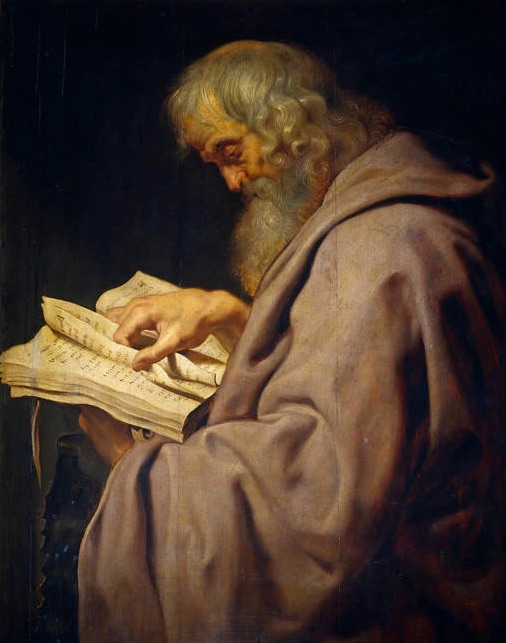
Simon Rubens
St. Jude LaTour

Saints Simon and Jude, whose feast we celebrate October 28, are mentioned only a few times in the New Testament list of apostles,  tenth and eleventh respectively. (Mark 3,13-19, Luke 6,12-16)

Simon is called  `the Zealot,’ either because he was zealous for the Jewish law or because he was a member of the Zealot party, which in the time of Jesus sought to overthrow Roman domination by force.

Some of Jesus’ followers,  the Gospels indicate, were hardly pacifists. Peter was ready to use his sword in the garden of Gethsemani when the temple guards came to seize Jesus;  James and John told Jesus to call down fire from heaven on the hostile Samaritans whom they met on their journey to Jerusalem. So did Simon have thoughts of revolution when he answered Jesus’ call ?

Jude, called “Thaddeus” to distinguish him from Judas Iscariot, may be the brother of James, the son of Alphaeus, some interpreters of the Gospel say. If that’s so, he’s also a relative of Jesus. He may be the author of the Epistle of Jude in the New Testament.

Early Christian traditions – all difficult to prove historically – locate the ministry of these apostles in places as far apart as Britain and Persia; one important legend from 3rd century Syria says they were apostles to Syria. If so, we ask their intercession for that troubled place today.

Knowing little about  Simon and Jude may be a good thing, because then we have to look to their mission to know them – they were apostles. Even if we don’t know exactly where each of them went, they were apostles. The mission of the apostles was to follow Jesus. “ As the Father has sent me, so I send you.” Jesus says in the Gospel of John. He also said, “I have come down from heaven, not to do my own will, but the will of him who sent me.”

God made his will known to the apostles in due time. They didn’t decide what to do or where to go by themselves. They knew God’s will day by day, as we do.  So often, it was unexpected and perhaps not what they planned. Simon had revolutionary thoughts. This was a revolution of another kind. Jude followed his cousin. He found himself in a family of another kind.

“Your will be done,” we say in the Lord’s Prayer. That’s an apostle’s prayer. We try to make it our prayer too.

Prayer to My Guardian Angel

“Prayer to My Guardian Angel” (abridged)
Matthew 18:1-5, 10
Memorial of the Holy Guardian Angels
©️2021 Gloria M. Chang

At that time the disciples approached Jesus and said, “Who is the greatest in the kingdom of heaven?” He called a child over, placed it in their midst, and said, “Amen, I say to you, unless you turn and become like children, you will not enter the kingdom of heaven. Whoever humbles himself like this child is the greatest in the kingdom of heaven. And whoever receives one child such as this in my name receives me.

See that you do not despise one of these little ones, for I say to you that their angels in heaven always look upon the face of my heavenly Father.”

Matthew 18:1-5, 10

Guardian Angels Guide Us to the Father

God, the Father Almighty, maker of heaven and earth, of all things visible and invisible, placed Christ at the center of the angelic world. Every child made in the image of the Incarnate Son of God receives a guardian angel at conception to guide them in their journey home to the Father. As “their angels in heaven always look upon the face of my heavenly Father,” they intercede and light the way through Christ in the Spirit to the heart of the Father.

From its beginning until death, human life is surrounded by their watchful care and intercession. “Beside each believer stands an angel as protector and shepherd leading him to life.” Already here on earth the Christian life shares by faith in the blessed company of angels and men united in God.

Catechism of the Catholic Church 336

Prayer to My Guardian Angel

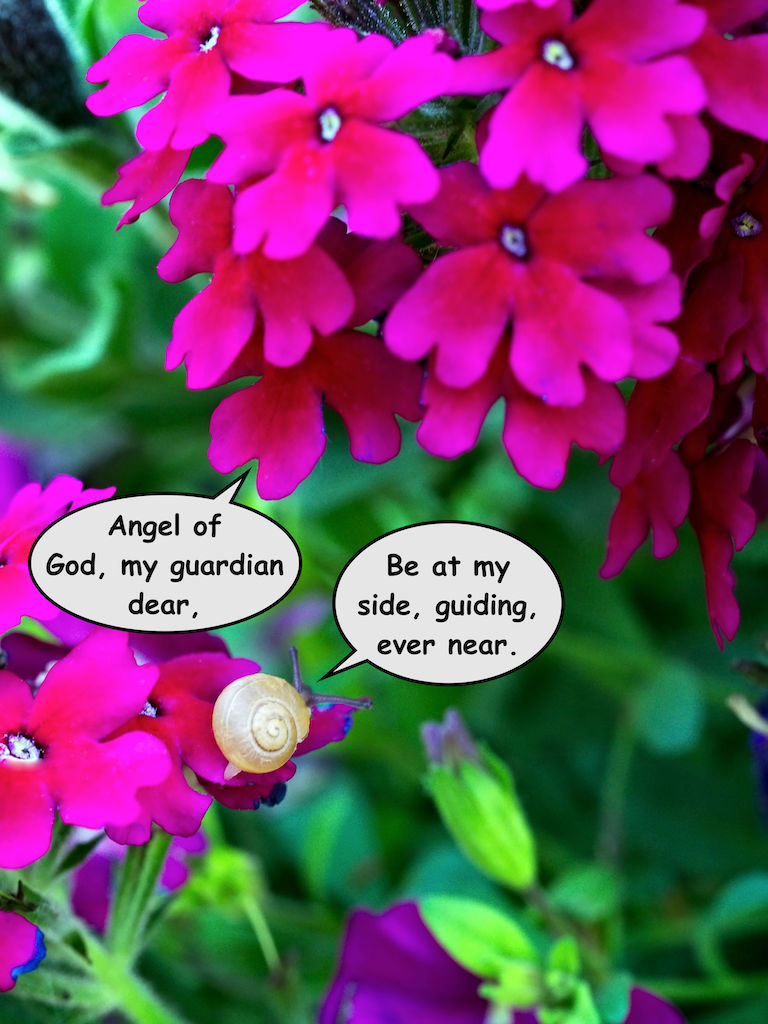
Angel of God, my guardian dear,
to whom God’s love commits me here,
ever this day be at my side,
to light and guard, to rule and guide. 
Amen.

Angel of God, my guardian dear,
Be at my side, guiding, ever near.


This content by Gloria M. Chang was originally published online at Shalom Snail: Journey to Wholeness.

St. Thèrése and the Passion of Jesus

therese-child-face-a

St. Thèrése put two titles to her name after she became a Carmelite nun. She holds those two titles in this photo. One was Thèrése of the Child Jesus, the other was Thèrése of the Holy Face of Jesus. She wished to be known by these two titles: Thèrése of the Child Jesus and the Holy Face.

The titles came from religious experiences she had. The first occurred on Christmas day, 1886, when she was 13 years old. Shorlty afterwards, she had an experience of the Passion of Jesus, which took place one Sunday of the next year, when she was 14. She describes the two experiences  in chapter 5 of her autobiography. Her experience of the Passion of Jesus involved a murderer.

“One Sunday, looking at a picture of Our Lord on the Cross, I was struck by the blood flowing from one of the divine hands. I felt great sorrow when thinking this blood was falling to the ground unnoticed. I was resolved to remain in spirit at the foot of the Cross and to receive the divine dew. I understood I was then to pour it out upon souls.

The cry of Jesus on the Cross sounded continually in my heart: “I thirst!” These words ignited within me an unknown and very living fire. I wanted to give my Beloved to drink and I felt myself consumed with a thirst for souls. As yet, it was not the souls of priests that attracted me, but those of great sinners; I burned with the desire to snatch them from the eternal flames.”

At the time a notorious murderer, Pranzini had been condemned to death and refused to see a priest. Thèrése was deeply affected by the sensational story and   asked Jesus, “feeling that I myself could do nothing,” to be merciful to him. She had Mass offered for him, she begged God’s mercy.

Afterwards the newspaper reported a priest offered Pranzini a crucifix as he went to his death and he kissed it fervently three times. Thèrése believed her prayers were answered “Then his soul went to receive the merciful sentence of him who declares that in heaven there will be more joy over one sinner who does penance than over ninety-nine just who have no need of repentance!”

For Thèrése the Passion of Jesus was a sign of God’s mercy. His words “I thirst,” were more than an expression of physical thirst, they expressed his desire to show a merciful love to the world.

The teen age girl’s experience reminds us that God’s graces can come to anyone, at any time. The experience left her with a lasting conviction, “I myself can do nothing.” One of her prayerbooks carries a remembrance of her experience.

therese-holy-card

Our Lady of Sorrows: September 15

DSCN0299

The Memorial of Our Lady of Sorrows is celebrated the day after the Feast of the Exaltation of the Cross (September 14). Eight days after Mary’s birth (September 7) her sorrows are recalled, her lifelong sorrows. 

The old man Simeon spoke of her lifelong sorrows when he  told Mary a sword would pierce her heart when Jesus was born. Her greatest sorrow, of course, came when she stood beneath the Cross of her Son.

What, then, were her lifelong sorrows? The gospels indicate some of them, but perhaps more important was Mary’s experience of the sorrow every human being experiences. An infant cries as it enters this world. “Our life is over like a sigh. Our span is seventy years, or eighty for those who are strong. And most of these are emptiness and pain.” (Psalm 90) Everyone experiences the human sorrow the psalms describes. Mary experienced that human sorrow.

The sword of sorrow struck Mary most deeply at the death of her Son. Some of Jesus followers stood at a distance when he was crucified. But John’s gospel describes Mary as the first of those standing close by, beneath the cross itself. “Standing by the cross of Jesus were his mother and his mother’s sister, Mary the wife of Clopas, and Mary Magdalene.”

Mary stands by the Cross of Jesus, close by, not at a distance. She’s not absorbed in her own suffering, not afraid to see. Her closeness to the Cross is significant. She enters the mystery of her Son’s suffering through compassion. 

She stood by him. Compassion doesn’t experience another’s suffering exactly, and it may not take another’s suffering away. Compassion enters suffering to break the isolation suffering causes. It helps someone bear their burden.  The sword, the spear, the sorrow, pierces both hearts, in different ways.

Our prayer for today’s feast says that when her Son “was lifted high on the Cross” his mother stood by and shared his suffering. “Grant that your Church, participating with the Virgin Mary in the Passion of Christ, may merit a share in his Resurrection.

For a commentary on John’s Gospel see here.

For a study on Mary on Calvary see here.

For readings for the feast and the Stabat Mater see here.

The Exaltation of the Cross: September 14

Holy sepul

Pilgims enteing the Church of the Holy Sepulcher, Jerusalem

This ancient ecumenical feast,  celebrated by Christian churches throughout the world, commemorates the dedication of a great church in Jerusalem at the place where Jesus died and rose again. Called the Anastasis ( Resurrection) or the Church of the Holy Sepulcher, it was built by the Emperor Constantine and dedicated on September 13, 325. It’s  one of Christianity’s holiest places.

Liturgies celebrated in this church, especially its Holy Week liturgy, influenced churches throughout the world. Devotional practices like the Stations of the Cross grew up around this church. Christian pilgrims brought relics and memories from here to every part of the world. Christian mystics were drawn to this church and this feast.

Holy Sepulcher - 28

Tomb of Jesus

Calvary

Calvary

Pilgrims still visit the church and the tomb of Jesus, recently renovated  after sixteen centuries of wars, earthquakes, fires and natural disasters. They venerate the rock of Calvary where Jesus died on a cross. The building today is smaller and shabbier than the resplendent church Constantine built, because the original structure was largely destroyed in the 1009 by the mad Moslem caliph al-Hakim. Half of the church was hastily rebuilt by the Crusaders; the present building still bears the scars of time.

Scars of a divided Christendom can also be seen here. Various Christian groups, representing churches of the east and the west, claim age-old rights and warily guard their separate domains. One understands here why Jesus prayed that ” All may be one.”

Holy Sepulcher - 04

Egyptian Coptic Christians

Seventeenth century Enlightenment scholars  expressed doubts about the authenticity of Jesus’ tomb and the place where he died, Calvary. Is this really it? Alternative spots were proposed, but scientific opinion today favors this site as the place where Jesus suffered, died and was buried.

For more on its history, see here.

And a video here.

Readings for the Triumph of the Cross

DSC00234
Via Dolorosa - 17

“Do not forget the works of the Lord!” (Psalm 78, Responsorial Psalm) We remember his great works here. How can we forget them.

Saint Lawrence, the Deacon

August 10th is the Feast of St. Lawrence, the deacon, who ranks after Peter and Paul as a patron of the Church of Rome. The Emperor Constantine built a church honoring him on the Via Tiburtina, near one of the major gateways to the city in the 4th century. Lawrence was a Christian martyr, but he was something more.

Lawrence was a deacon of the Roman church in the middle of the 3rd century when Rome began experiencing wars and political instability. Gothic tribes breached the Roman lines along the Rhine River and the Persians invaded in the east.

The only thing to do was expand the army, and that’s what the Emperor Valerian did. He built walls and expanded armies. That cost money, of course, and in Rome the burden fell heavily on the poor. Famine and plague only worsened their situation.

The Christian church stepped in to help. Christians were still relatively few in numbers then, not wealthy, but they gave generously to the poor, and the Roman people admired what they saw.

Lawrence, the deacon, was behind this extraordinary Christian effort. After all, Jesus said: “I was hungry, and you gave me to eat; I was thirsty, you gave me to drink; I was sick and you visited me.”

Lawrence giving to the poor: Fra Angelico

Rome’s leaders became upset by the church’s growng popularity. They also wondered if the church’s money couldn’t be channeled towards their war effort. And so, in 257 an edict was published to imprison church leaders and confiscate church money. A second edict in 258 caused blood to flow. Pope Sixtus II and four deacons were seized in the catacombs of St. Callistus and executed on August 6th. Lawrence, the deacon, was seized and executed on August 10th. That’s why his feast day is today.

Popular stories later offered a colorful account of Lawrence’s martyrdom shaping his story and the way artists pictured him:

The Roman prefect, anxious for the church’s money, promised Lawrence freedom if he would transfer it over to him. Lawrence asked for three days to get the church’s treasures together for delivery to the prefect’s house. Then, after distributing the church’s monies to the poor, he gathered them and brought them to the prefect’s door. “Here are the church’s treasures,” he told the official, “ – the blind, the lame, the orphans and the old.”

The prefect ordered Lawrence burned alive on a gridiron. Those witnessing his execution said the saint went to his death cheerfully, even joking with his executioners. “Turn me over, I’m done on this side.”

After these events the Roman church gained a flood of converts. Respect for Christianity grew, not just because of its brave martyrs, but because of its outreach to the poor.

Constantine honored Lawrence, not just because he died for his faith, but because of his care of the poor. He would rely on the church, not just for its political support, but for its care of the poor.

Wherever you go in Rome, you are going to find Lawrence. There are other churches honoring him; he’s often pictured with Peter and Paul, the founders of the Roman church; Michelangelo has him among the blessed at the last judgment in the Sistine Chapel. Lawrence represents something important in the church.

A large fresco of the saint stands at the entrance to the Vatican Museum’s Chapel of Nicholas V with its priceless works of art. Lawrence seems blind to the riches all around him as he boldly proclaims the message inscribed beneath his feet: The Poor are the Treasures of the Church.

They should always be the treasures of the church.

Here’s a video on St. Lawrence

St. Bridget of Sweden: July 23

St. Bridget of Sweden, whose feast is July 23rd, was a 14th century mystic.She was a woman who challenged the powerful of her day, first the court of Sweden and later the papacy. She influenced Christian spirituality and art,

Born into a powerful Swedish family with ties to the royal court. Bridget married Ulf Gudmarrson when she was 14. They had 8 children, one of whom is also honored as a saint, Catherine of Sweden. Bridget was known for the care she took of the sick around her. She brought her children with her on her visits, to teach them this work of mercy.

As a child of 10 Bridget was attracted to the mystery of the Passion of Jesus and that mystery inspired her prayer and spirituality ever afterwards. Her deep understanding of his mystery made her fearless in challenging injustice when she saw it. Bridget protested the wanton living of Swedish royalty and its uncaring attitude towards the poor. After her husband’s death in 1334 she founded a religious community, continuing to speak out fearlessly against the lifestyle and privileges of the powerful.

In 1350 Bridget went to Rome to gain approval for her Order of the Most Holy Savior, the Brigittines. There she was inspired to confront the papacy. The pope , fearing the turmoil in the Papal States, had fled to in Avignon in France. Bridget strongly urged him to return to Rome. The pope was a shepherd, she said; he should be with his sheep, especially in times of turmoil.

Bridget’s prayers and revelations, widely circulated in her time, were reminders of what Jesus said and did, especially the example he gave in his Passion. She inspired people to meditate on the mysteries of Christ for their wisdom.

Artists were inspired in their portrayals of the mysteries of Christ. She saw in a vision Mary and Joseph adoring the Child lying on the ground. His Incarnation made the earth his home. Previously, Mary was portrayed at the crib, lying down after giving birth. In Bridget’s portrayal she joins Joseph, the shepherds (humanity) and the earth itself adoring the Word made flesh.

Jesus birth
Adoration of the Child, Giorgione, 1507, National Gallery, Washington

Bridget also inspired the portrayal of Mary holding the body of Jesus after his crucifixion and the devotion of the Pieta. Cradling him in her arms,, she recalls holding him at his birth in Bethlehem, Bridget said.

Rhine Valley, 14th century

In 1371, Bridget and some of her family went on pilgrimage to the Holy Land; her vivid accounts from there further stimulated the religious imagination of her contemporaries. On July 23, 1373 she died in Rome. Bridget is a patron of Sweden and of Europe.

The church always needs strong women like Bridget, firm in faith and unafraid to speak out. Society too needs women like her in politics and business to steer its course into the future.

Our church today seems to be alive with visionaries, people who claim God has revealed something to them. Bridget was always aware of the possibility that her visions could come from another source rather than God. She prayed to be saved from delusions and pride. This 15th century Swedish painting depicts Satan trying to influence her, but is hit over the head by an angel.

Prayer of St. Bridget

Jesus, true and fruitful Vine! Remember the abundant outpouring of blood shed from your sacred body as juice from grapes in a wine press.    From your side, pierced with a lance by a soldier, blood and water poured out until not a single drop was left in your body.

Through your bitter Passion and your precious blood poured out, receive my soul when I come to die. Amen.

O good Jesus! Pierce my heart so that my tears of penance and love will be my bread day and night; may I be converted entirely to you, may my heart be your home, may my conversation please you, may I merit heaven at the end of my life and be with you and your saints, to praise you forever. Amen